Within Open Weights
What Happens When Safety Fixes Cannot Reach Every Copy?
Once model weights spread, later safety fixes depend on thousands of independent users choosing to install them.
On this page
- Why downloaded models escape universal updates
- How old and modified versions keep circulating
- What irreversibility means for emergency response
Page outline Jump by section
Introduction
One argument in AI doom debates is that some safety problems become much harder to manage once a powerful model’s weights have been released for anyone to download. Unlike a cloud-hosted AI service, an open-weight model is not controlled from a single location. Every downloaded copy becomes an independent instance that can continue operating even if the original developer later discovers a serious flaw or dangerous capability.
This does not mean every open-weight release is inherently unsafe. Rather, it highlights a specific mechanism that concerns many AI safety researchers: if an important safety improvement is discovered after release, there is no technical way to guarantee that every copy receives the update. Within broader discussions about existential risk, this matters because some proposed emergency responses depend on being able to modify or disable dangerous systems quickly. Open-weight models weaken that option by turning one model into thousands or millions of independently managed copies.[International AI Safety Report]internationalaisafetyreport.orginternational ai safety report 2026International AI Safety ReportInternational AI Safety Report 2026 | International AI Safety ReportFebruary 3, 2026…
Why downloaded models escape universal updates
Software developers regularly fix security vulnerabilities through automatic updates. Modern web browsers, operating systems and cloud services can often deploy patches to nearly all users within days because the software remains connected to the organisation that maintains it.
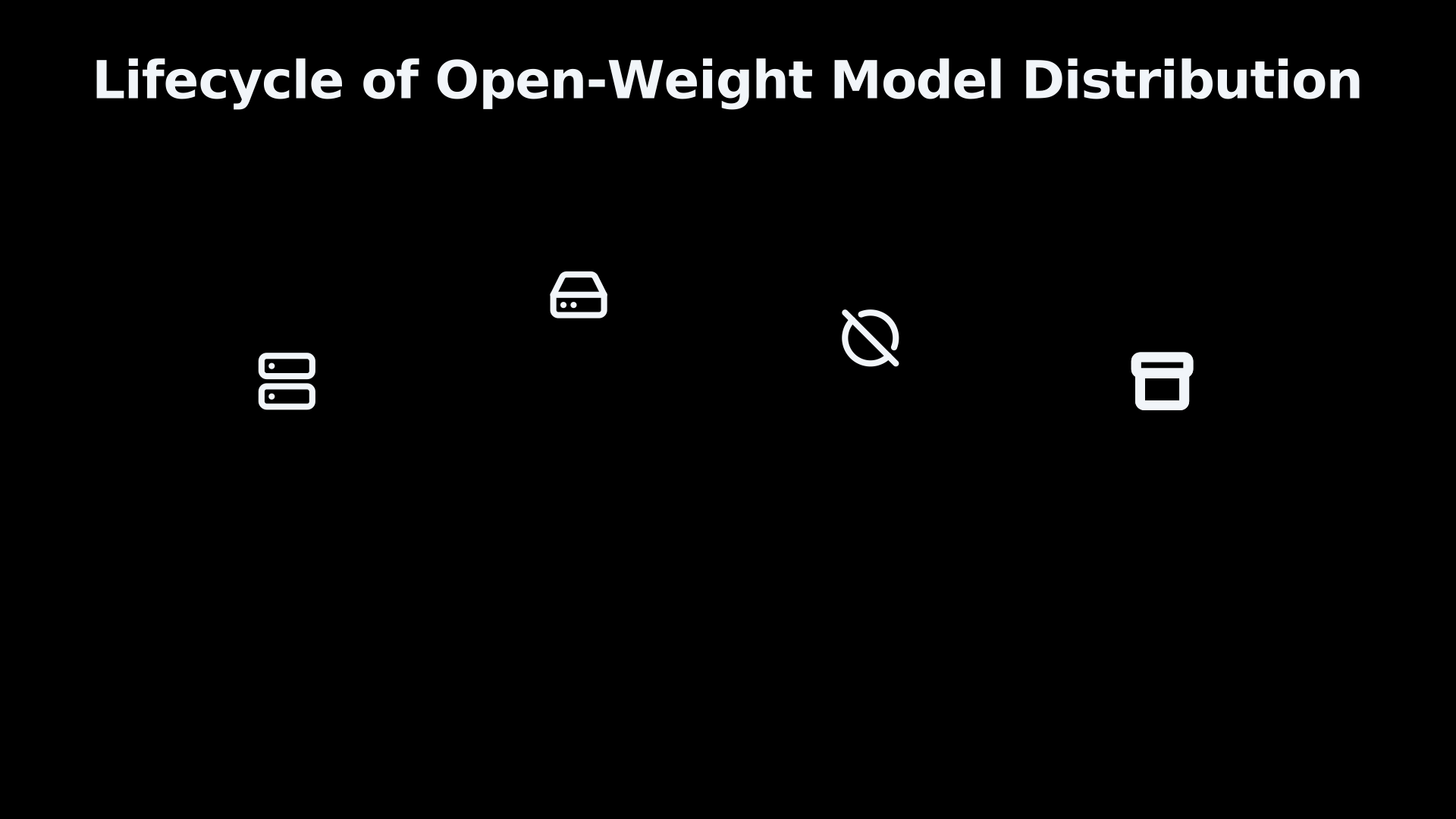
Open-weight AI models work differently. Once someone downloads the model weights, they can run the model entirely on their own hardware. The original developer has no reliable way to determine where every copy exists, whether it is still being used, or whether its owner will ever install a newer version.
This creates a simple but important distinction:
- Hosted AI services allow providers to deploy updated safety measures immediately across all users.
- Downloaded models rely on each individual owner deciding to replace their existing copy.
- Offline deployments may never reconnect to obtain updates at all.
- Archived copies can remain stored indefinitely and be reactivated years later.
The International AI Safety Report identifies this as a structural difference between hosted and open-weight releases rather than merely a policy choice. Once weights have spread, developers cannot perform a universal rollback or guarantee that later safety improvements reach every deployment.[International AI Safety Report]internationalaisafetyreport.orginternational ai safety report 2026International AI Safety ReportInternational AI Safety Report 2026 | International AI Safety ReportFebruary 3, 2026…
How old and modified versions keep circulating
Even if the original developer publishes an improved version, older models rarely disappear.
Several mechanisms keep outdated versions available:
- Users often retain older releases because they have integrated them into existing software.
- Research groups may reproduce experiments using earlier versions.
- Modified or fine-tuned variants frequently circulate independently of the original release.
- Mirrors, backups and private archives preserve copies long after official downloads are removed.
This is familiar from ordinary software, but model weights introduce an additional complication. Developers cannot simply distribute a small security patch. The weights themselves are usually the complete model, so updating often means downloading and replacing tens or hundreds of gigabytes of parameters. Organisations that have heavily customised a model may decide not to migrate because doing so would require repeating substantial engineering work.
As more organisations independently adapt a model, the ecosystem begins to branch. One laboratory’s updated version becomes only one descendant among many, rather than a replacement for all previous copies.[International AI Safety Report]internationalaisafetyreport.orginternational ai safety report 2026International AI Safety ReportInternational AI Safety Report 2026 | International AI Safety ReportFebruary 3, 2026…
Why modification makes coordinated fixes harder
Fine-tuning changes model behaviour to suit particular tasks. While this is one of the strengths of open-weight AI, it also complicates safety updates.
Suppose researchers discover that a model unexpectedly demonstrates a hazardous capability or an exploitable behavioural flaw. A new version may include improved safeguards, but users who have already customised the earlier release face trade-offs:
- adopting the update may require rebuilding months of fine-tuning work;
- compatibility with existing software may change;
- local performance could worsen for their application;
- some users may simply prefer the previous behaviour.
As a result, safety improvements compete against practical incentives to keep existing deployments unchanged.
This is one reason why AI safety researchers increasingly distinguish between creating a safer model and successfully deploying that safer model everywhere it is needed.[International AI Safety Report]internationalaisafetyreport.orginternational ai safety report 2026International AI Safety ReportInternational AI Safety Report 2026 | International AI Safety ReportFebruary 3, 2026…
What irreversibility means during an emergency
The inability to reach every copy becomes most significant in scenarios involving newly discovered high-consequence risks.
Imagine that a frontier model is released and months later researchers identify behaviour that substantially changes their assessment of its potential for misuse or loss of control. For a hosted service, operators could potentially:
- suspend access,
- deploy improved safeguards,
- increase monitoring,
- restrict high-risk users, or
- withdraw the service entirely.
Those options become much weaker once independent copies exist.
Even if download sites remove the official files, users who already possess the weights can continue operating them. Others may redistribute archived copies through different channels. The International AI Safety Report therefore describes open-weight releases as effectively irreversible after widespread distribution, even though platforms can make models harder to find by removing official hosting.[International AI Safety Report]internationalaisafetyreport.orginternational ai safety report 2026International AI Safety ReportInternational AI Safety Report 2026 | International AI Safety ReportFebruary 3, 2026…
This does not mean every dangerous model would necessarily remain widely used. Many users voluntarily update software, and removing official distribution can significantly reduce casual adoption. The concern is narrower: emergency mitigation becomes incomplete because developers cannot ensure every existing copy receives the fix.
Why this matters specifically for AI doom arguments
Within existential risk discussions, this mechanism is important because many proposed governance strategies assume that dangerous capabilities can be corrected after deployment.
If future frontier systems proved unexpectedly capable of enabling catastrophic misuse or displaying dangerous autonomous behaviour, rapid coordinated updates might become one layer of defence. Open-weight releases weaken that layer by making deployment decisions highly decentralised.
The concern is therefore less about ordinary software maintenance than about losing the ability to respond collectively to rare but high-impact discoveries. Once many independent actors possess the weights, the original developer no longer controls the system’s evolution.
Advocates of stronger caution argue that this increases the importance of pre-release evaluation, because some mistakes may be difficult or impossible to reverse afterwards. Critics respond that open-weight development also enables broader safety research, independent auditing and faster identification of flaws, potentially leading to stronger defences overall. They argue that openness should not automatically be equated with greater existential risk and that the balance of benefits and risks depends heavily on the capability level of the model being released.
The disagreement is therefore not over whether safety updates are harder to distribute—they clearly are—but over how much that limitation should influence decisions about releasing increasingly capable open-weight AI systems in the first place.[internationalaisafetyreport.org]internationalaisafetyreport.orginternational ai safety report 2026International AI Safety ReportInternational AI Safety Report 2026 | International AI Safety ReportFebruary 3, 2026…
Amazon book picks
Further Reading
Books and field guides related to What Happens When Safety Fixes Cannot Reach Every Copy?. Use these as the next step if you want deeper reading beyond the article.
Human Compatible
A leading artificial intelligence researcher lays out a new approach to AI that will enable us to coexist successfully with increasingly...
The Alignment Problem
Finalist for the Los Angeles Times Book Prize A jaw-dropping exploration of everything that goes wrong when we build AI systems and the m...
The Coming Wave
"We are approaching a critical threshold in the history of our species. Everything is about to change. Soon you will live surrounded by A...
Superintelligence
This profoundly ambitious and original book picks its way carefully through a vast tract of forbiddingly difficult intellectual terrain.
eBay marketplace picks
Marketplace Samples
Live-tested eBay searches with available results related to this page.
Selected fromAI model poster oneBay.co.uk.



Endnotes
1.
Source: GOV.UK
Title: international ai safety report 2025
Link:https://www.gov.uk/government/publications/international-ai-safety-report-2025/international-ai-safety-report-2025
Source snippet
[Withdrawn] International AI Safety Report 2025 - GOV.UK...
2.
Source: GOV.UK
Link:https://www.gov.uk/government/publications/international-scientific-report-on-the-safety-of-advanced-ai
3.
Source: aisi.gov.uk
Link:https://www.aisi.gov.uk/research/open-technical-problems-in-open-weight-ai-model-risk-management
4.
Source: internationalaisafetyreport.org
Title: international ai safety report 2026
Link:https://internationalaisafetyreport.org/publication/international-ai-safety-report-2026
Source snippet
International AI Safety ReportInternational AI Safety Report 2026 | International AI Safety ReportFebruary 3, 2026...
Published: February 3, 2026
5.
Source: internationalaisafetyreport.org
Link:https://internationalaisafetyreport.org/publication/2026-report-extended-summary-policymakers
Source snippet
International AI Safety Report2026 Report: Extended Summary for Policymakers | International AI Safety Report...
6.
Source: internationalaisafetyreport.org
Link:https://internationalaisafetyreport.org/publication/2026-report-executive-summary
7.
Source: internationalaisafetyreport.org
Title: International AI Safety Report
Link:https://internationalaisafetyreport.org/
8.
Source: internationalaisafetyreport.org
Title: Publications | International AI Safety Report
Link:https://internationalaisafetyreport.org/publications
9.
Source: internationalaisafetyreport.org
Link:https://internationalaisafetyreport.org/publication/second-key-update-technical-safeguards-and-risk-management
10.
Source: internationalaisafetyreport.org
Title: international ai safety report 2025
Link:https://internationalaisafetyreport.org/publication/international-ai-safety-report-2025
11.
Source: internationalaisafetyreport.org
Link:https://internationalaisafetyreport.org/about
Additional References
12.
Source: businessinsider.com
Link:https://www.businessinsider.com/dario-amodei-blog-post-anthropic-banning-open-weight-ai-models
Source snippet
In a blog post, Amodei clarified that Anthropic has never supported such bans and that open-weight models without dangerous capabilities...
13.
Source: youcongress.org
Title: Open-source AI is more dangerous than closed-source AI / You Congress
Link:https://youcongress.org/p/is-open-source-ai-potentially-more-dangerous-than-closed-source-ai
Source snippet
Open-source AI is more dangerous than closed-source AI / YouCongressJuly 20, 2026 — OPEN-SOURCE AI IS MORE DANGEROUS THAN CLOSED-SOURCE A...
Published: July 20, 2026
14.
Source: agenaxy.ai
Title: What Does Open-Source AI Actually Open?
Link:https://agenaxy.ai/learn/what-does-open-source-ai-actually-open/
Source snippet
July 24, 2026 — WHAT DOES OPEN-SOURCE AI ACTUALLY OPEN? Published July 24, 2026 Image: An opened modular AI package revealing sepa...
Published: July 24, 2026
15.
Source: brokengpt.com
Title: open weight vs open source
Link:https://brokengpt.com/guides/open-weight-vs-open-source
Source snippet
Open-weight vs open-source AI: what you actually receive · BrokenGPTJuly 15, 2026 — OPEN-WEIGHT VS OPEN-SOURCE AI: WHAT YOU ACTUALLY RECE...
Published: July 15, 2026
16.
Source: youtube.com
Link:https://www.youtube.com/watch?v=qTQmKl16BGE
Source snippet
Remove AI Censorship From Open Source LLMs Using Abliteration...
17.
Source: youtube.com
Title: Open-Source AI: A Dangerous Revolution?
Link:https://www.youtube.com/watch?v=EITabdq5bsw
Source snippet
Open weight AI model security fine tuning safety guardrails Remove AI Censorship From Open Source LLMs Using Abliteration Vectro AI...
18.
Source: youtube.com
Title: Open Source vs Closed AI: LLMs, Agents & the AI Stack Explained
Link:https://www.youtube.com/watch?v=_QfxGZGITGw
Source snippet
The Catastrophic Risks of AI — and a Safer Path | Yoshua Bengio | TED...
19.
Source: youtube.com
Title: Remove AI Censorship From Open Source LLMs Using Abliteration
Link:https://www.youtube.com/watch?v=zMJDjWWjjsg
Source snippet
Open Source vs Closed AI: LLMs, Agents & the AI Stack Explained...
20.
Source: cisa.gov
Link:https://www.cisa.gov/stopransomware/ransomware-guide
21.
Source: ntia.gov
Link:https://www.ntia.gov/programs-and-initiatives/artificial-[intelligence