Within Survey Limits
Are AI Doom Surveys Biased Toward Worried Experts?
Selection and non-response biases matter, yet available checks suggest they do not explain away the substantial concern found in major surveys.
On this page
- Who counts as an AI expert
- What non response checks can and cannot rule out
- Why expertise still does not guarantee good forecasting
Page outline Jump by section
Introduction
Expert surveys are often cited in debates about AI doom because they show what qualified researchers currently believe about the chances of existential catastrophe from advanced AI. A common objection is that these surveys may be distorted by response bias: perhaps only researchers already worried about AI risk bother to answer questions about it. This is a legitimate concern, because voluntary surveys can misrepresent a population if respondents differ systematically from non-respondents.

However, the available evidence does not support the stronger claim that response bias explains away the substantial concern seen in major AI expert surveys. The best-designed studies acknowledge this limitation, compare respondents with the wider target population where possible, and find no clear evidence that non-response alone could transform a survey showing widespread existential concern into one showing near-universal confidence. That does not mean the reported probabilities are correct, only that the observed pattern is unlikely to be entirely an artefact of who replied.[AI Impacts]wiki.aiimpacts.orgAI Impacts Surveys of experts on levels of AI Risk [AI Impacts WikiAI ImpactsSurveys of experts on levels of AI Risk [AI Impacts Wiki]May 9, 2023…
Why response bias matters in AI doom surveys
Response bias occurs when people who choose to answer a survey differ in important ways from those who ignore it. In the context of AI existential risk, critics usually suggest one of three possibilities:
- Researchers concerned about AI doom may be more motivated to complete surveys mentioning catastrophic risk.
- Researchers who view existential risk as speculative may be less interested in participating.
- Researchers who work directly on AI safety may be disproportionately represented compared with the wider machine learning community.
If any of these effects were large enough, survey results could overstate the prevalence of concern. This is a standard problem in survey research and is not unique to AI. Low response rates by themselves do not prove serious bias, but they do increase uncertainty about whether respondents perfectly represent the intended population. General survey methodology has long recognised that response rates and response bias are related only imperfectly; even surveys with modest participation can sometimes produce accurate estimates if respondents remain broadly representative.[PLOS]journals.plos.orgSurvey mode and nonresponse bias: A meta-analysis based on the data from the international social survey programme waves 1996–2018 an…
Who counts as an AI expert?
The first question is not who answered, but who was invited.
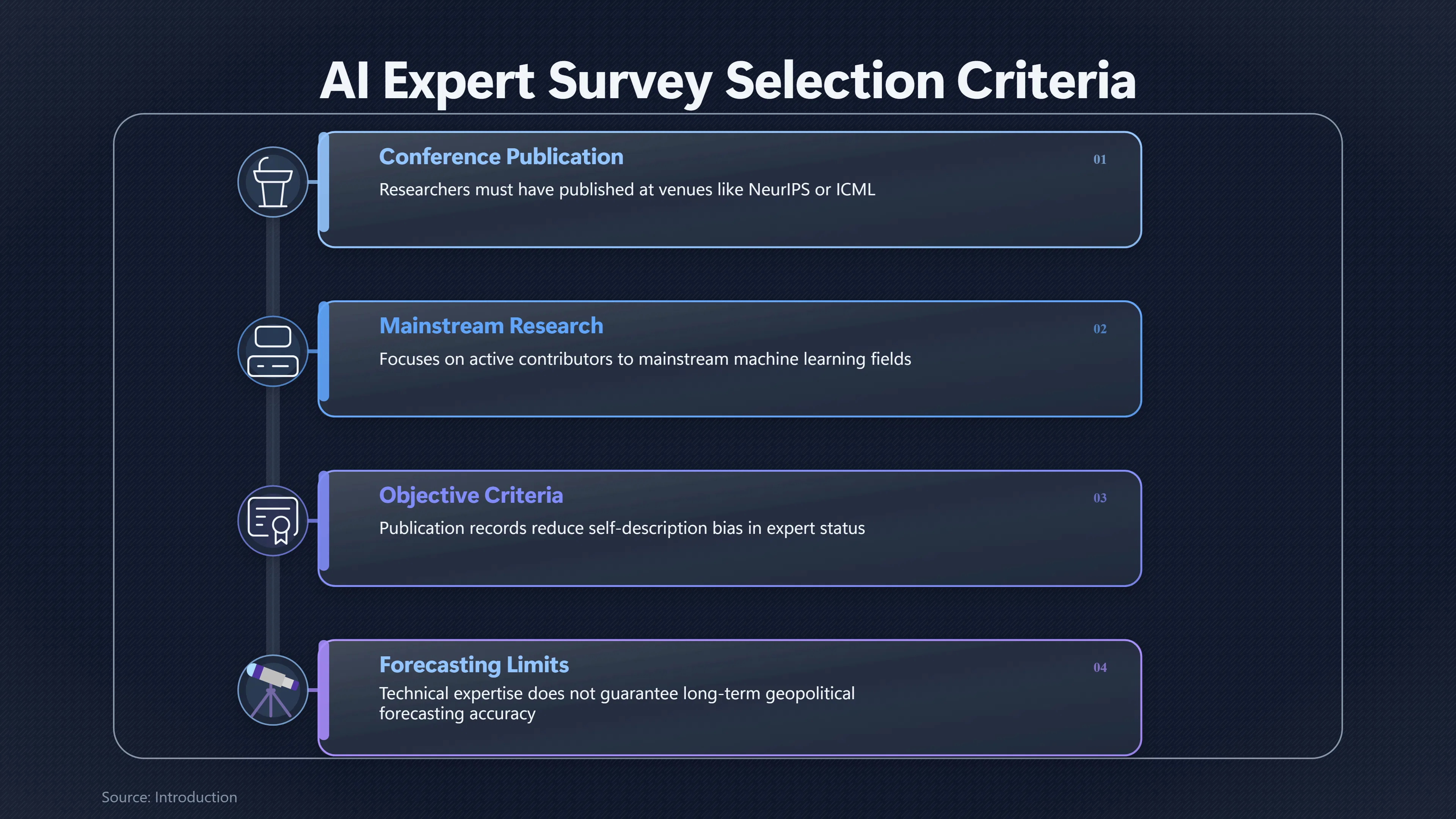
Large AI forecasting surveys generally do not recruit random internet users or members of advocacy organisations. Instead, they typically sample researchers who have recently published at leading machine learning conferences such as NeurIPS and ICML, or comparable venues. The goal is to capture active contributors to mainstream AI research rather than people already engaged in AI safety campaigning.[AI Impacts]wiki.aiimpacts.orgAI Impacts Surveys of experts on levels of AI Risk [AI Impacts WikiAI ImpactsSurveys of experts on levels of AI Risk [AI Impacts Wiki]May 9, 2023…
This sampling approach has strengths and weaknesses.
On the positive side, publication records provide an objective criterion that reduces the chance of recruiting people who merely describe themselves as AI experts.
On the negative side, publishing at a top machine learning conference does not automatically make someone an expert in long-term forecasting, geopolitics, philosophy of risk or AI alignment. A researcher may understand today’s models extremely well while having limited expertise in estimating civilisation-scale outcomes decades ahead.
This distinction matters because surveys measure informed opinion, not established scientific fact.

What non-response checks can and cannot rule out
The strongest published AI expert surveys do not simply ignore response bias. Researchers have attempted several checks to see whether respondents appear systematically unusual.
For example, the 2023 Expert Survey on Progress in AI compared characteristics of respondents with the broader publication pool used for sampling and analysed responses across different demographic and professional groups. While differences existed, they did not suggest that existential-risk concern was confined to a tiny ideological subgroup accidentally captured by the survey. The survey also found substantial diversity of opinion rather than a uniform “doomer” consensus, including many respondents assigning very low probabilities alongside others assigning much higher ones.[AI Impacts]wiki.aiimpacts.orgAI Impacts Surveys of experts on levels of AI Risk [AI Impacts WikiAI ImpactsSurveys of experts on levels of AI Risk [AI Impacts Wiki]May 9, 2023…
Equally important, similar patterns have appeared across multiple independently organised expert surveys using different recruitment strategies. Median estimates differ, question wording changes outcomes, and uncertainty remains enormous, but meaningful existential concern repeatedly appears instead of disappearing entirely when different populations are sampled.[AI Impacts]wiki.aiimpacts.orgAI Impacts Surveys of experts on levels of AI Risk [AI Impacts WikiAI ImpactsSurveys of experts on levels of AI Risk [AI Impacts Wiki]May 9, 2023…
These checks have limits.
They cannot observe the opinions of researchers who never responded. Nor can they prove that non-respondents would have answered similarly. If non-respondents systematically held much lower estimates of existential risk, published medians could be overstated.
What the evidence can say is narrower: available comparisons have not uncovered signs of a hidden, overwhelmingly sceptical majority large enough to erase the broad pattern reported by current surveys.
Why response bias is unlikely to explain everything
Several features of the data argue against the idea that only worried researchers responded.
First, responses span the entire probability range. Many experts report extremely low probabilities of existential catastrophe, while others report probabilities exceeding 50%. Such wide variation is more consistent with a heterogeneous research community than with a narrowly self-selected activist sample.[AI Impacts]wiki.aiimpacts.orgAI Impacts Surveys of experts on levels of AI Risk [AI Impacts WikiAI ImpactsSurveys of experts on levels of AI Risk [AI Impacts Wiki]May 9, 2023…
Second, most respondents simultaneously express optimism about AI’s overall benefits. Many assign a meaningful probability to existential catastrophe while still expecting AI to produce large net gains for humanity. That combination is difficult to reconcile with the stereotype that only committed “AI doomers” completed the survey.[AI Impacts]wiki.aiimpacts.orgAI Impacts Surveys of experts on levels of AI Risk [AI Impacts WikiAI ImpactsSurveys of experts on levels of AI Risk [AI Impacts Wiki]May 9, 2023…
Third, concern appears among researchers whose primary professional identity is mainstream machine learning rather than technical AI safety. If surveys merely captured specialist safety researchers, this broader distribution would be less likely.
None of these observations eliminates response bias, but together they weaken the claim that it is the dominant explanation for the findings.
Expertise helps, but it does not guarantee accurate forecasting
Even if response bias were negligible, expert opinion would still have important limitations.
Forecasting transformative AI involves predicting technological progress, social responses, political coordination, economic incentives and the behaviour of systems that do not yet exist. Expertise in machine learning provides valuable information about capabilities, but it does not automatically translate into calibrated long-term forecasting.
Research examining disagreement among AI experts illustrates this point. Experts differ not only in their numerical estimates of p(doom), but also in their underlying mental models of future AI. Some primarily view advanced systems as increasingly capable tools under human control, while others expect increasingly autonomous agents capable of pursuing objectives in unexpected ways. These conceptual differences often explain disagreement better than differences in technical competence alone.[arXiv]arxiv.orgOpen source on arxiv.org.
This means expert surveys should not be interpreted as measuring an objective probability. They measure the distribution of informed judgement under profound uncertainty.
What readers should conclude
Response bias is a genuine limitation of every voluntary expert survey, including those used in discussions of AI doom. It is entirely reasonable to ask whether researchers who choose to participate differ from those who do not.
The stronger claim—that major AI doom surveys mainly reflect a self-selected group of unusually worried researchers—is much harder to support. Current evidence suggests that selection effects and non-response introduce uncertainty, but they do not obviously explain away the consistent finding that a substantial minority of active AI researchers assign meaningful probabilities to existential catastrophe.[AI Impacts]wiki.aiimpacts.orgAI Impacts Surveys of experts on levels of AI Risk [AI Impacts WikiAI ImpactsSurveys of experts on levels of AI Risk [AI Impacts Wiki]May 9, 2023…
The more cautious interpretation is therefore the most defensible. Expert surveys provide evidence about the distribution of opinion within parts of the AI research community. They neither prove that AI doom is likely nor show that concern is confined to a fringe. Their greatest value lies in demonstrating that informed researchers remain deeply divided, and that this disagreement persists even after taking the usual concerns about survey response bias seriously.
Amazon book picks
Further Reading
Books and field guides related to Are AI Doom Surveys Biased Toward Worried Experts?. Use these as the next step if you want deeper reading beyond the article.
Human Compatible
A leading artificial intelligence researcher lays out a new approach to AI that will enable us to coexist successfully with increasingly...
The Alignment Problem
Finalist for the Los Angeles Times Book Prize A jaw-dropping exploration of everything that goes wrong when we build AI systems and the m...
Superforecasting
The international bestseller 'A manual for thinking clearly in an uncertain world. Read it.' Daniel Kahneman, author of Thinking, Fast an...
Thinking, Fast and Slow
Why is there more chance we'll believe something if it's in a bold type face? Why are judges more likely to deny parole before lunch? Why...
eBay marketplace picks
Marketplace Samples
Live-tested eBay searches with available results related to this page.
Selected fromdata science poster oneBay.co.uk.

Endnotes
1.
Source: arxiv.org
Link:https://arxiv.org/abs/2502.14870
2.
Source: journals.plos.org
Link:https://journals.plos.org/plosone/article?id=10.1371%2Fjournal.pone.0283092
Source snippet
Survey mode and nonresponse bias: A meta-analysis based on the data from the [international]({{ 'shared-testing/' | relative_url }}) social survey programme waves 1996–2018 an...
3.
Source: journals.plos.org
Link:https://journals.plos.org/plosone/doi?id=10.1371%2Fjournal.pone.0283092
4.
Source: youtube.com
Title: AI Impacts Survey
Link:https://www.youtube.com/watch?v=xwJx_xqZI3Q
Source snippet
Ep 13 - AI researchers expect AGI sooner w/ Katja Grace (Co-founder & Lead Researcher, AI Impacts)...
5.
Source: wiki.aiimpacts.org
Title: AI Impacts Surveys of experts on levels of AI Risk [AI Impacts Wiki]
Link:https://wiki.aiimpacts.org/uncategorized/ai_risk_surveys
Source snippet
AI ImpactsSurveys of experts on levels of AI Risk [AI Impacts Wiki]May 9, 2023...
Published: May 9, 2023
6.
Source: blog.aiimpacts.org
Link:https://blog.aiimpacts.org/p/faq-expert-survey-on-progress-in
Source snippet
No. We published the near-identical 2016 survey in the Journal of AI Research, so the methodology had essentially...
7.
Source: wiki.aiimpacts.org
Title: 2023 expert survey on progress in ai
Link:https://wiki.aiimpacts.org/ai_timelines/predictions_of_human-level_ai_timelines/ai_timeline_surveys/2023_expert_survey_on_progress_in_ai
Additional References
8.
Source: researchgate.net
Link:https://www.researchgate.net/publication/403307234_Views_on_AI_Existential_Risk_Before_and_After_a_Public_Event_at_Harvard_University
Source snippet
There is likely self-selection bias in our sample given that attendees chose to attend an event with a provocative title about AI existen...
9.
Source: forecastingresearch.org
Title: We initially invited approximately 2,600 individuals
Link:https://forecastingresearch.org/research/longitudinal-expert-ai-panel-leap-working-paper
Source snippet
The Longitudinal Expert AI Panel: Understanding Expert Views on AI Capabilities, Adoption, and Impact – Forecasting Research InstituteNov...
10.
Source: youtube.com
Link:https://www.youtube.com/watch?v=Nbpw90WQmgU
Source snippet
What is Response Bias? Types, Examples & How to Avoid It...
11.
Source: nature.com
Link:https://www.nature.com/articles/s41562-023-01632-7
12.
Source: doi.org
Link:https://doi.org/10.1073/pnas.2518075122
Source snippet
The potential existential threat of large language models to online survey research | PNASNovember 20, 2025 — THE POTENTIAL EXISTENTIAL T...
Published: November 20, 2025
13.
Source: youtube.com
Title: What is Response Bias? Types, Examples & How to Avoid It
Link:https://www.youtube.com/watch?v=W0oStHOcXew
Source snippet
What We Get Wrong About AI (feat. former Google CEO)...
14.
Source: rai.ac.uk
Link:https://rai.ac.uk/hed-are-ai-researchers-concerned-about-the-existential-threat-of-ai/
15.
Source: surveypractice.org
Link:https://www.surveypractice.org/article/89373-survey-mode-and-item-non-substantive-response-insights-from-a-replication-study-and-other-recent-trials
16.
Source: repository.cam.ac.uk
Link:https://www.repository.cam.ac.uk/handle/1810/283323
17.
Source: researchgate.net
Link:https://www.researchgate.net/publication/389274220_Why_do_Experts_Disagree_on_Existential_Risk_and_Pdoom_A_Survey_of_AI_Experts