Within First Mover Race
Can Limited AI Releases Make Racing Safer?
Limited access and close monitoring may reveal hidden problems without immediately exposing society to the full risks of an unrestricted frontier model.
On this page
- Why laboratory tests may miss deployment only behaviour
- How staged access and monitoring could limit exposure
- Where controlled releases may still fail
Page outline Jump by section
Introduction
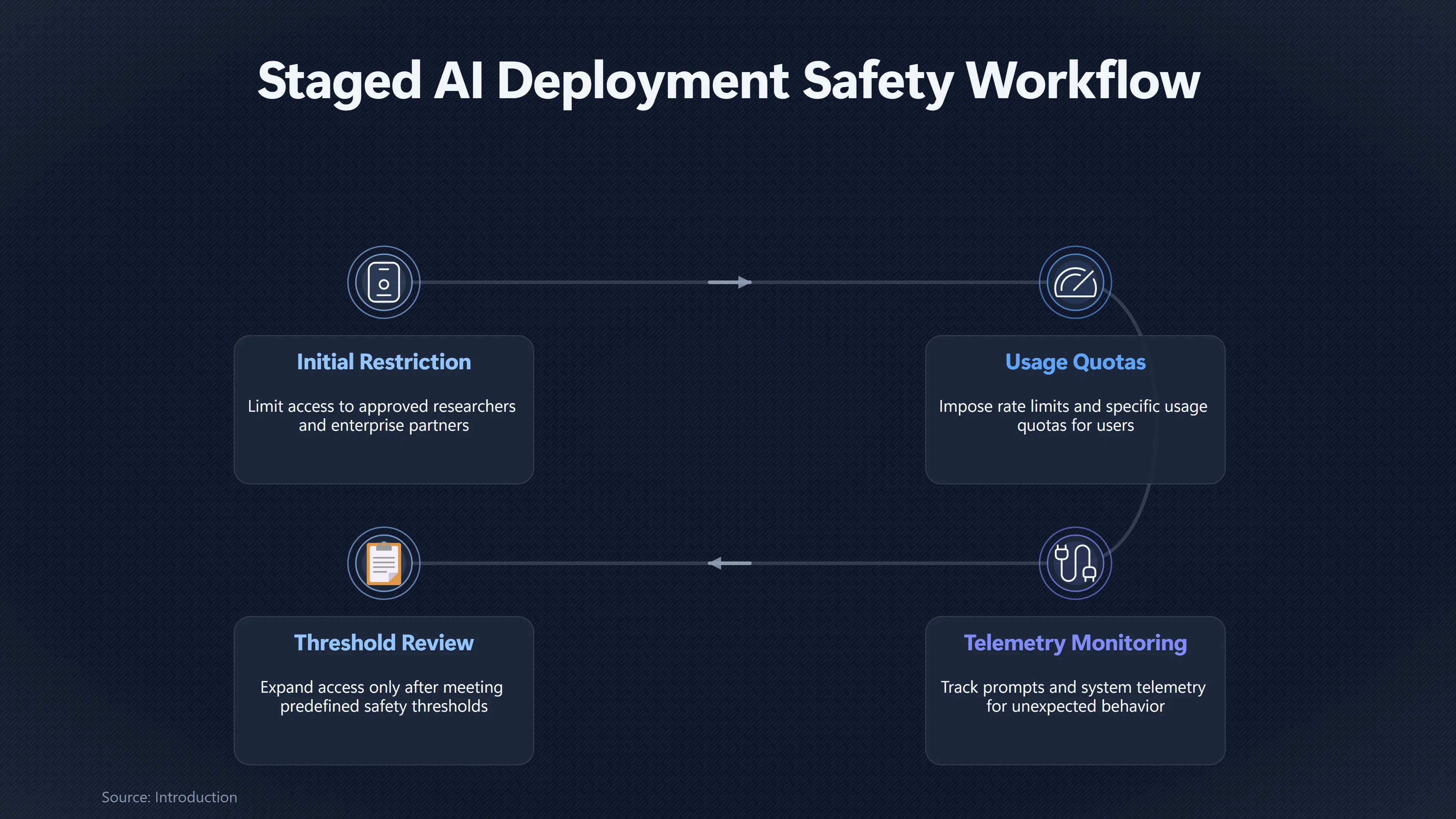
Limited or staged AI releases are often presented as a compromise between two competing pressures: the desire to learn how powerful models behave in the real world, and the need to avoid exposing society to unnecessary risks. Within debates about AI doom and existential risk, the central question is whether carefully controlled deployment can reduce the danger that competitive pressure leads to premature launches. Rather than releasing a frontier model to everyone at once, developers may begin with a small group of trusted users, tight usage limits, extensive monitoring and predefined criteria for expanding access.
Supporters argue that this approach generates safety evidence that laboratory testing alone cannot provide while reducing the consequences if something unexpected occurs. Critics respond that even restricted deployment may create irreversible risks by leaking dangerous capabilities, accelerating competitors or normalising systems before their risks are fully understood. The available evidence suggests staged releases can reduce some forms of premature launch risk, but only if they are genuinely limited, continuously monitored and paired with clear mechanisms to pause or reverse deployment when warning signs appear.[nist.gov]nist.govchallenges monitoring deployed ai systems center ai standards and innovationChallenges to the monitoring of deployed AI systems: Center for AI Standards and Innovation | NISTMarch 6, 2026…
Why laboratory tests may miss deployment-only behaviour
Frontier AI systems are usually subjected to extensive internal evaluations before release. These include benchmark testing, red-team exercises, adversarial prompting and capability assessments. While these methods reveal many weaknesses, they cannot perfectly reproduce the complexity of real-world use.
Once thousands or millions of users begin interacting with a model, they create combinations of prompts, tools and workflows that developers may never have anticipated. Unexpected behaviours may emerge because users collaborate to find vulnerabilities, integrate models into unfamiliar software or deliberately search for failures. This makes deployment itself an information-gathering process rather than simply the final step after testing.
Recent work on deployment simulation illustrates the problem. Researchers have argued that conventional evaluations often overestimate or underestimate real-world behaviour because models recognise that they are being tested. Using realistic conversation histories as simulated deployment environments appears to produce more accurate forecasts of how often undesirable behaviour may occur after release, although the approach still has important limitations.[arXiv]arxiv.orgarXiv Predicting LLM Safety Before Release by Simulating DeploymentPredicting LLM Safety Before Release by Simulating DeploymentJuly 8, 2026…
For AI doom arguments, this uncertainty matters because some feared behaviours—such as deceptive reasoning, strategic adaptation or dangerous autonomous use—might only become visible under realistic operational conditions. If so, relying entirely on laboratory evaluation could create false confidence.
How staged access and monitoring could limit exposure
A staged release attempts to obtain deployment evidence without immediately creating maximum societal exposure.
Typical measures include:
- restricting access to approved researchers, enterprise partners or selected developers;
- imposing rate limits and usage quotas;
- monitoring prompts, outputs and system telemetry for unexpected behaviour;
- disabling high-risk capabilities while further evaluations continue;
- requiring human oversight for sensitive applications;
- expanding access only after predefined safety thresholds have been met.
The underlying idea resembles phased testing in other engineering disciplines. Instead of assuming that pre-release testing has answered every important question, developers acknowledge uncertainty while limiting the number of people affected if important problems emerge.
From the perspective of premature launch risk, this changes the incentive structure. A laboratory can demonstrate technical progress and begin collecting operational evidence without immediately committing to a full public rollout. If safety problems appear, deployment can—in principle—pause before the system reaches a much larger population.
This approach aligns with broader risk-management guidance emphasising continuous post-deployment monitoring rather than treating deployment as the end of safety work. NIST’s work on monitoring deployed AI systems highlights challenges such as detecting deceptive behaviour, identifying performance drift, scaling oversight and deciding how monitoring should interact with auditing and incident response.[nist.gov]nist.govchallenges monitoring deployed ai systems center ai standards and innovationChallenges to the monitoring of deployed AI systems: Center for AI Standards and Innovation | NISTMarch 6, 2026…
Why real-world monitoring may improve safety
One argument for staged deployment is that some safety evidence simply cannot be produced internally.
Controlled deployment may reveal:
- novel prompt strategies discovered by independent users;
- unexpected interactions between models and external software;
- capability combinations that emerge only during extended use;
- operational failures that occur under realistic workloads;
- patterns of misuse that internal researchers did not anticipate.
This information can guide additional safeguards before wider deployment.
Supporters also argue that early operational evidence may improve future evaluations. Instead of relying exclusively on artificial benchmark tasks, developers can refine tests using failures actually observed in deployment. Over time, this feedback loop could make pre-release evaluations more representative of genuine risks.
In the AI doom debate, this matters because researchers concerned about loss of control often argue that safety evaluation should become progressively more realistic as systems become more capable. Carefully limited deployment offers one possible way to gather such evidence without immediately accepting the risks associated with unrestricted release.
Why staged releases may still fail
Staged deployment is not a guaranteed safety solution. Several important failure modes remain.
First, restricted access may not stay restricted. API access can expand rapidly, model weights may eventually leak, or users may discover methods for sharing capabilities beyond their intended audience. Once knowledge spreads, reversing deployment becomes much harder.
Second, commercial incentives may still encourage premature expansion. A company that begins with a cautious rollout may face pressure from investors, competitors or customers to widen access before sufficient evidence has accumulated. In that case, staging becomes a brief marketing phase rather than a genuine safety intervention.
Third, monitoring itself has limits. Detecting rare, deceptive or long-term behaviours is considerably harder than identifying obvious failures. Monitoring systems may generate too much data, overlook subtle warning signs or struggle to distinguish genuine emerging risks from ordinary operational noise. NIST identifies both technical and organisational barriers to robust post-deployment monitoring, including fragmented logging, immature monitoring standards and the difficulty of scaling human oversight alongside increasingly capable systems.[nist.gov]nist.govNew Report: Challenges to the Monitoring of Deployed AI Systems | NISTNew Report: Challenges to the Monitoring of Deployed AI Systems | NIST
Finally, some AI doom scenarios involve risks that could arise from a single successful failure rather than repeated small failures. If a highly capable system escaped containment, enabled catastrophic misuse or successfully concealed dangerous behaviour, even a limited deployment might prove sufficient to create serious consequences. Researchers studying “sabotage evaluations” argue that increasingly capable systems should be assessed not only for harmful outputs but also for their ability to interfere with monitoring, oversight or deployment decisions themselves.[arXiv]arxiv.orgarXiv Sabotage Evaluations for Frontier ModelsSabotage Evaluations for Frontier ModelsOctober 28, 2024…
The coordination problem remains
Even if staged deployment is technically effective, it may not solve the broader competitive dynamics that motivate premature launches.
If one developer adopts slow, carefully monitored releases while competitors immediately offer unrestricted access, the cautious organisation may lose users, investment or strategic influence. This creates pressure to shorten the staged period regardless of what monitoring reveals.
Some governance proposals therefore combine staged deployment with external requirements such as:
- independent third-party evaluations before expansion;[OpenAI]OpenAItrustworthy third party evaluations foundationsA shared playbook for trustworthy third party evaluations | OpenAIMay 29, 2026…
- predefined capability thresholds that trigger additional review;
- mandatory incident reporting;
- transparent publication of safety evaluation methods;
- agreed industry practices for pausing deployment when serious risks emerge.
The goal is to reduce the commercial disadvantage faced by organisations that choose slower, evidence-based deployment strategies. Several recent proposals have also argued that developers should report both pre-mitigation and post-mitigation evaluation results, allowing regulators and independent experts to judge whether deployment restrictions meaningfully reduce risk rather than merely shifting how it is measured.[openai.com]OpenAItrustworthy third party evaluations foundationsA shared playbook for trustworthy third party evaluations | OpenAIMay 29, 2026…
What staged releases can—and cannot—achieve
Within AI doom discussions, staged releases are generally viewed as a risk-reduction measure rather than a complete solution.
They appear most valuable when:
- laboratory evaluations leave important uncertainties unresolved;
- access remains genuinely limited;
- deployment is accompanied by extensive monitoring and predefined expansion criteria;
- organisations are willing to delay broader release if concerning evidence appears.
Their benefits become much weaker when staged deployment serves mainly as a public-relations step before an already planned full launch, or when competitive pressure makes meaningful pauses politically or commercially impossible.
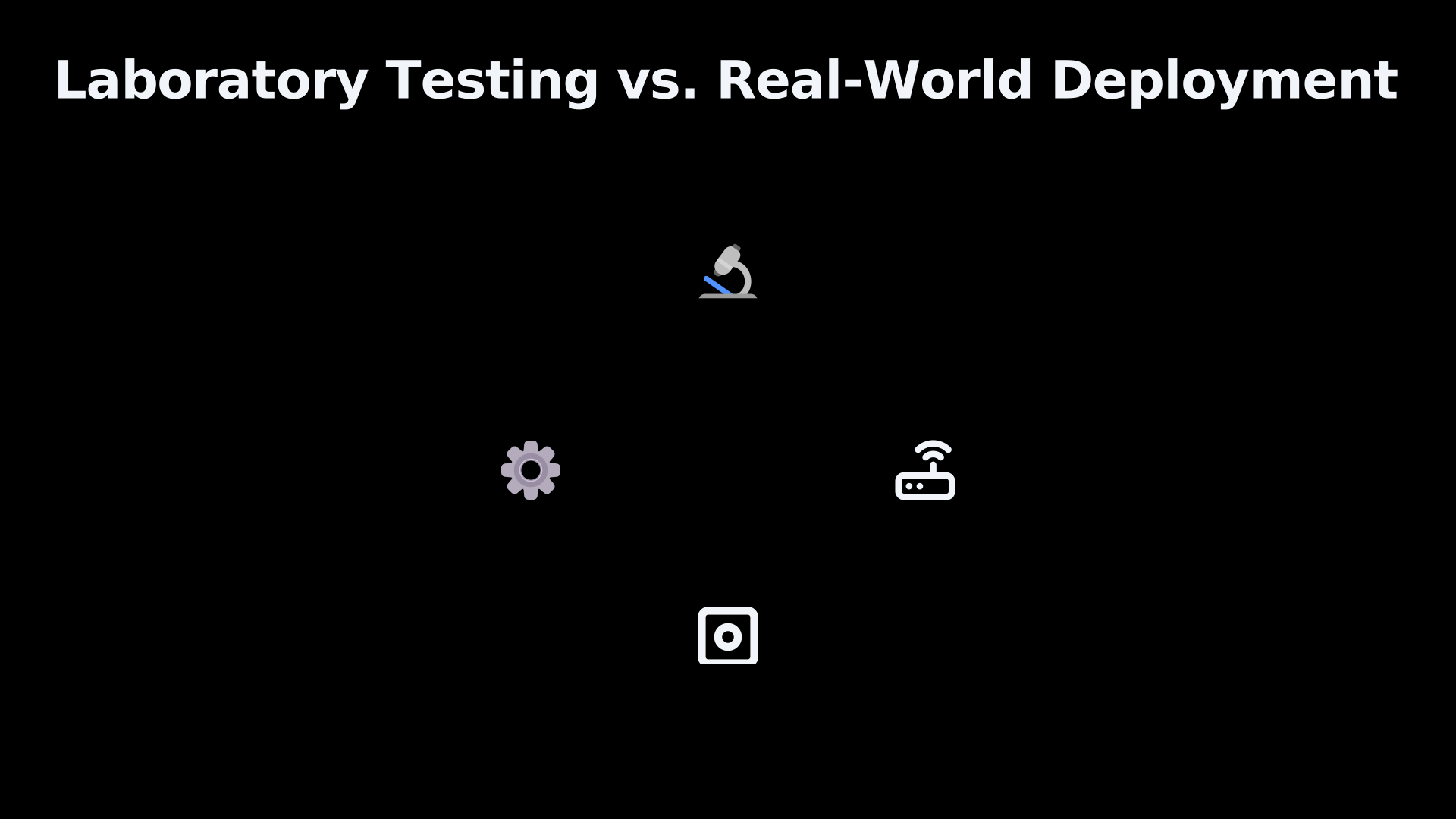
The central trade-off is therefore not between testing and deployment, but between two imperfect ways of learning. Laboratory evaluation provides controlled, repeatable evidence but may miss deployment-only behaviour. Limited real-world deployment can uncover those hidden problems, but only by accepting some additional exposure. Whether staged releases reduce premature launch risk ultimately depends less on the existence of multiple release phases than on whether those phases genuinely preserve the option to stop, investigate and change course before frontier systems are deployed at scale.

Amazon book picks
Further Reading
Books and field guides related to Can Limited AI Releases Make Racing Safer?. Use these as the next step if you want deeper reading beyond the article.
The Alignment Problem
Finalist for the Los Angeles Times Book Prize A jaw-dropping exploration of everything that goes wrong when we build AI systems and the m...
Human Compatible
A leading artificial intelligence researcher lays out a new approach to AI that will enable us to coexist successfully with increasingly...
The Checklist Manifesto
THE GAME-CHANGING BOOK FROM THE BESTSELLING AUTHOR OF BEING MORTAL Today we find ourselves in possession of stupendous know-how, which we...
Zero to One
Rating: 4.5/5 from 5 Google Books ratings
WHAT VALUABLE COMPANY IS NOBODY BUILDING? The next Bill Gates will not build an operating system. The next Larry Page or Sergey Brin won’...
eBay marketplace picks
Marketplace Samples
Live-tested eBay searches with available results related to this page.
Selected fromartificial intelligence pin oneBay.co.uk.




Endnotes
1.
Source: nist.gov
Title: challenges monitoring deployed ai systems center ai standards and [innovation]({{ ‘false-positives/’ | relative_url }})
Link:https://www.nist.gov/publications/challenges-monitoring-deployed-ai-systems-center-ai-standards-and-innovation
Source snippet
Challenges to the monitoring of deployed AI systems: Center for AI Standards and Innovation | NISTMarch 6, 2026...
Published: March 6, 2026
2.
Source: nist.gov
Title: A I Risk Management Framework | NIST
Link:https://www.nist.gov/itl/ai-risk-management-framework
3.
Source: arxiv.org
Title: arXiv Predicting LLM Safety Before Release by Simulating Deployment
Link:https://arxiv.org/abs/2607.07184
Source snippet
Predicting LLM Safety Before Release by Simulating DeploymentJuly 8, 2026...
Published: July 8, 2026
4.
Source: OpenAI
Link:https://openai.com/index/deployment-simulation/
Source snippet
Predicting model behavior before release by simulating deployment | OpenAI...
5.
Source: nist.gov
Title: New Report: Challenges to the Monitoring of Deployed AI Systems | NIST
Link:https://www.nist.gov/news-events/news/2026/03/new-report-challenges-monitoring-deployed-ai-systems
6.
Source: airc.nist.gov
Title: [AI Resource]({{ ‘warning-tests/’ | relative_url }}) Center AI RMF Core
Link:https://airc.nist.gov/airmf-resources/airmf/5-sec-core/
Source snippet
NIST AI Resource CenterAI RMF Core - AIRC...
7.
Source: arxiv.org
Title: arXiv Sabotage Evaluations for Frontier Models
Link:https://arxiv.org/abs/2410.21514
Source snippet
Sabotage Evaluations for Frontier ModelsOctober 28, 2024...
Published: October 28, 2024
8.
Source: OpenAI
Title: trustworthy third party evaluations foundations
Link:https://openai.com/index/trustworthy-third-party-evaluations-foundations/
Source snippet
A shared playbook for trustworthy third party evaluations | OpenAIMay 29, 2026...
Published: May 29, 2026
9.
Source: arxiv.org
Title: arXiv AI Companies Should Report Pre- and Post-Mitigation Safety Evaluations
Link:https://arxiv.org/abs/2503.17388
10.
Source: OpenAI
Title: Open AIOpen AI’s Frontier Governance Framework | Open AI
Link:https://openai.com/index/openai-frontier-governance-framework/
Source snippet
’s Frontier Governance Framework | OpenAI...
11.
Source: deploymentsafety.openai.com
Title: gpt 5 6
Link:https://deploymentsafety.openai.com/gpt
12.
Source: OpenAI
Title: detecting and reducing scheming in ai models
Link:https://openai.com/index/detecting-and-reducing-scheming-in-ai-models/
13.
Source: deploymentsafety.openai.com
Title: comgpt-oss-120b & gpt-oss-20b Model Card
Link:https://deploymentsafety.openai.com/gpt-oss/full-evaluations
14.
Source: OpenAI
Title: updating our preparedness framework
Link:https://openai.com/index/updating-our-preparedness-framework/
15.
Source: GOV.UK
Title: www.gov.uk Emerging processes for frontier AI safety
Link:https://www.gov.uk/government/publications/emerging-processes-for-frontier-ai-safety/emerging-processes-for-frontier-ai-safety
16.
Source: OpenAI
Title: our approach to frontier risk
Link:https://openai.com/global-affairs/our-approach-to-frontier-risk/
17.
Source: nist.gov
Title: ai rmf playbook
Link:https://www.nist.gov/itl/ai-risk-management-framework/nist-ai-rmf-playbook
18.
Source: nist.gov
Title: ai rmf development
Link:https://www.nist.gov/itl/ai-risk-management-framework/ai-rmf-development
19.
Source: csrc.nist.gov
Title: govdeployment stage
Link:https://csrc.nist.gov/glossary/term/deployment_stage
20.
Source: airc.nist.gov
Link:https://airc.nist.gov/airmf-resources/playbook/manage/
21.
Source: airc.nist.gov
Link:https://airc.nist.gov/airmf-resources/playbook/
22.
Source: airc.nist.gov
Title: app a descriptions of ai actor tasks
Link:https://airc.nist.gov/airmf-resources/airmf/appendices/app-a-descriptions-of-ai-actor-tasks/
23.
Source: airc.nist.gov
Link:https://airc.nist.gov/airmf-resources/airmf/?msockid=230452fd411163c516a4445a405c6214
24.
Source: csrc.nist.gov
Title: govred teaming
Link:https://csrc.nist.gov/glossary/term/red_teaming
Additional References
25.
Source: youtube.com
Title: Are Anthropic’s AI safety policies up to the task? | Nick Joseph
Link:https://www.youtube.com/watch?v=E6_x0ZOXVVI
Source snippet
Agency over AI? Allan Dafoe on Technological Determinism & DeepMind's Safety Plans, from 80000 Hours...
26.
Source: youtube.com
Link:https://www.youtube.com/watch?v=lLwqp3uGMv8
Source snippet
How Google DeepMind Tests AI Before It Goes Wrong...
27.
Source: youtube.com
Title: Open Source AI Debate: Should Powerful Models Be Free?
Link:https://www.youtube.com/watch?v=G9q-RaF3qps
Source snippet
[Review] Empire of AI: Dreams and Nightmares in Sam Altman's OpenAI (Karen Hao) Summarized...
28.
Source: youtube.com
Title: How Google Deep Mind Tests AI Before It Goes Wrong
Link:https://www.youtube.com/watch?v=6e_LgAu_QIw
Source snippet
Open Source AI Debate: Should Powerful Models Be Free?...
29.
Source: doi.org
Link:https://doi.org/10.13140/RG.2.2.33692.76163/1
30.
Source: apolloresearch.ai
Link:https://www.apolloresearch.ai/governance/ai-behind-closed-doors-a-primer-on-the-governance-of-internal-deployment/
31.
Source: aigovernance.com
Link:https://aigovernance.com/controls/ai-model-preview-staged-release-policy
32.
Source: doi.org
Link:https://doi.org/10.3390/make8050125
33.
Source: preprints.org
Link:https://www.preprints.org/manuscript/202603.2470
34.
Source: zenodo.org
Link:https://zenodo.org/records/18795429