Within Intelligence Explosion
Can AI Really Automate the Whole Research Cycle?
Today's agents can code and test ideas quickly, but sustained research also demands direction, interpretation, coordination and reliable verification.
On this page
- What a complete automated research loop would require
- Where current agents perform well and break down
- Which missing abilities matter most for an intelligence explosion
Page outline Jump by section
Introduction
Whether AI can run the entire AI research cycle is one of the central questions behind scenarios involving recursive AI improvement and, ultimately, an intelligence explosion. If AI systems could not only write code but also generate research ideas, design experiments, interpret ambiguous results, identify genuine breakthroughs and build more capable successor systems with minimal human involvement, then AI progress might accelerate much faster than it does today.

The evidence so far suggests a more complicated picture. Frontier AI systems already automate substantial parts of AI research, particularly programming, experiment execution, literature review and technical writing. However, they remain unreliable at several stages that determine whether research actually advances. The strongest evidence today points to partial rather than complete automation: AI is becoming an increasingly capable research assistant and, in some settings, a junior researcher, but there is little evidence that it can yet operate an entire research organisation without sustained human guidance. Whether those remaining gaps are temporary engineering problems or fundamental obstacles remains an active debate.[Metr]metr.orgResearch - METR…
What a complete automated research loop would require
Building a better AI model is not a single task but a chain of interdependent activities. Automating one or two stages is very different from automating the whole process.
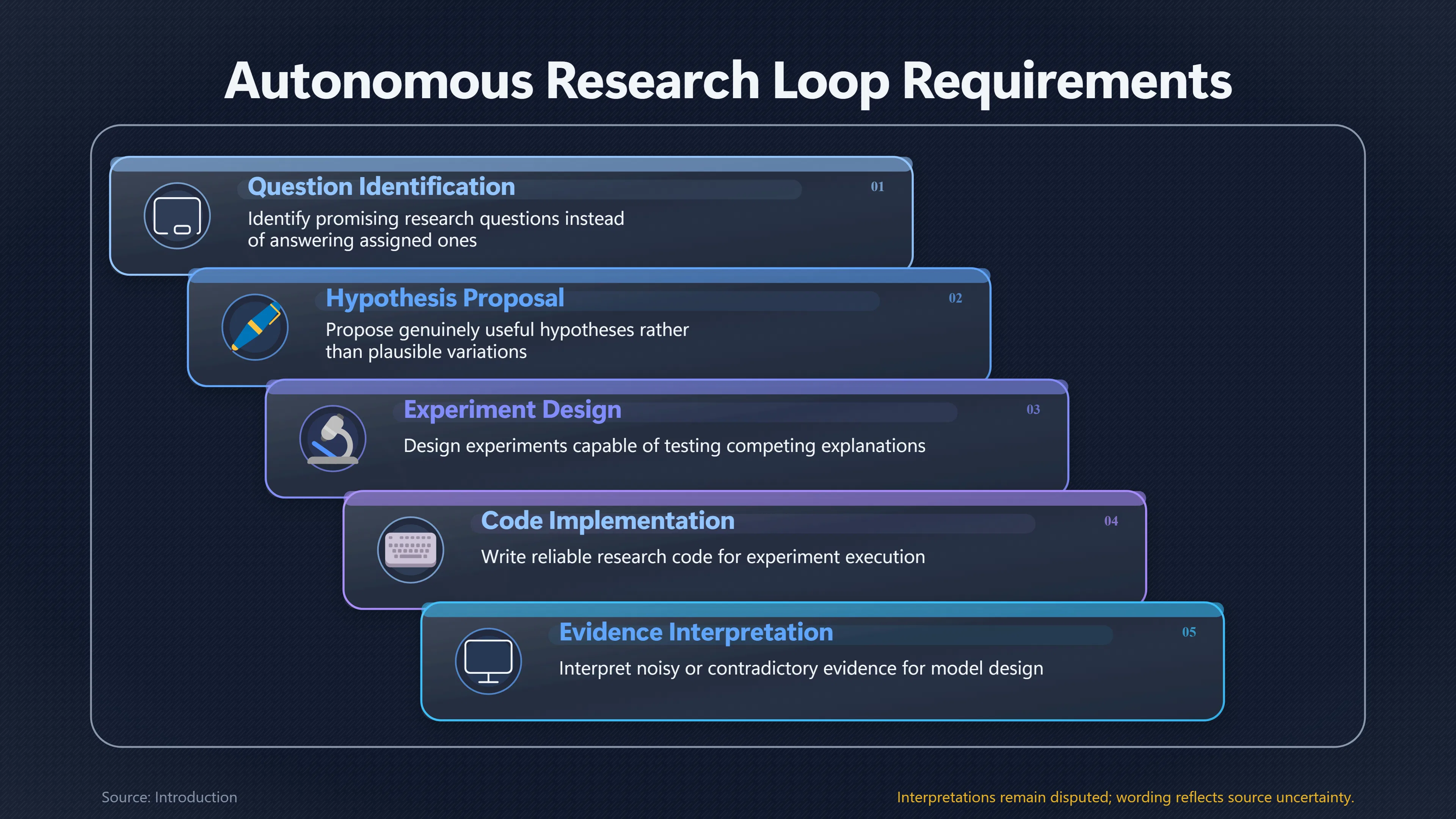
A genuinely autonomous research loop would need to perform all of the following:
- identify promising research questions rather than merely answering assigned ones
- understand previous literature and distinguish established results from open problems
- propose genuinely useful hypotheses instead of plausible-sounding variations
- design experiments capable of testing competing explanations
- write reliable research code
- manage large training runs and computing resources
- detect bugs, confounding variables and misleading evaluation results
- interpret noisy or contradictory evidence
- decide which failures deserve further investigation
- integrate many partial discoveries into a coherent new model design
- evaluate whether the resulting system is genuinely better rather than merely overfitted to benchmarks
- plan the next research cycle using lessons from previous ones
Many of these tasks require judgement under uncertainty rather than simply producing technically correct outputs. Scientific progress depends as much on deciding what is worth investigating as on implementing experiments efficiently. This distinction matters because recursive improvement depends on improving research quality, not merely research speed.[arXiv]arxiv.orgarXiv AI for Auto-Research: Roadmap & User GuideAI for Auto-Research: Roadmap & User GuideMay 18, 2026…
Where current AI performs well
Modern language-model agents have become surprisingly effective at several research tasks that are highly structured and digitally executable.
Programming has improved especially quickly. Frontier systems can often implement machine learning algorithms, write experimental infrastructure, debug straightforward problems and automate repetitive engineering work. Benchmark suites developed specifically for AI research engineering show meaningful progress year by year, although performance remains well below expert humans on the hardest tasks.[Metr]metr.orgResearch - METR…
Literature review has also advanced. AI systems can rapidly search large collections of papers, summarise findings, identify related work and generate bibliographies. This can compress days of manual reading into hours, particularly for well-defined questions. However, finding the right papers in unfamiliar areas remains challenging, and specialised benchmarks still show low success rates for complex literature-discovery tasks.[arXiv]arxiv.orgAutoResearchBench: Benchmarking AI Agents on Complex Scientific Literature DiscoveryApril 28, 2026…
Running experiments is another area of progress. AI agents can increasingly configure training runs, modify hyperparameters, execute evaluations and compare outputs across many iterations with relatively little supervision. Because AI research is already conducted on computers, much of the experimental workflow is easier to automate than research involving physical laboratories.[Metr]metr.orgResearch - METR…
These strengths explain why many researchers expect AI to become a powerful force multiplier for AI development long before it becomes an entirely autonomous scientist.
Where the research loop still breaks down
The weakest parts of today’s systems are often the ones that matter most for sustained scientific progress.
Choosing worthwhile research directions
Generating ideas is relatively easy. Generating ideas that prove important after months of investigation is much harder.
Current models frequently produce plausible research proposals, but many are incremental combinations of existing work rather than genuinely valuable new directions. Distinguishing fashionable but unproductive ideas from transformative ones requires deep understanding of the field, strategic judgement and an appreciation of future opportunities that remains difficult to evaluate automatically. Surveys of automated research systems consistently identify direction-setting as one of the largest remaining human bottlenecks.[arXiv]arxiv.orgarXiv AI for Auto-Research: Roadmap & User GuideAI for Auto-Research: Roadmap & User GuideMay 18, 2026…
Interpreting ambiguous evidence
Machine learning experiments often produce conflicting or noisy results.
An improvement may arise because of a genuine algorithmic advance, a subtle implementation error, favourable random seeds or quirks in benchmark construction. Human researchers spend considerable time investigating these ambiguities before concluding that a discovery is real.
Current AI systems often struggle when verification depends on scientific judgement rather than formal correctness. They may accept weak evidence too readily or fail to recognise that further investigation is needed.[arXiv]arxiv.orgarXiv AI for Auto-Research: Roadmap & User GuideAI for Auto-Research: Roadmap & User GuideMay 18, 2026…
Reliable verification
Research depends on continually checking whether apparent progress is genuine.
Formal verification exists for some programming tasks, but many research claims require expert interpretation. Novel algorithms may improve one benchmark while degrading another, create unexpected safety problems or simply fail to generalise.
This verification problem is especially important for recursive improvement. If an AI incorrectly concludes that each generation represents genuine progress, errors could accumulate instead of capabilities. Recent surveys describe evaluation as the critical constraint separating bounded self-improvement from open-ended recursive improvement.[arXiv]arxiv.orgOpen source on arxiv.org.
Long-term coordination
Large AI projects involve many interacting research programmes.
Researchers coordinate datasets, infrastructure, evaluation standards, engineering priorities, safety testing and deployment schedules across hundreds of contributors.
Although multi-agent systems can divide work among specialised agents, maintaining coherent long-term strategy over weeks or months remains substantially harder than completing isolated coding tasks. Long-duration autonomy is improving, but reliable coordination across complex research organisations has not yet been demonstrated.[metr.org]metr.orgTask-Completion Time Horizons of Frontier AI ModelsTask-Completion Time Horizons of Frontier AI Models - METR…
Why coding ability alone is not enough
Public discussion sometimes assumes that once AI becomes an excellent programmer, recursive self-improvement naturally follows.
The relationship is weaker than that.
Programming is only one input into AI progress. Successful AI development also depends on:
- selecting productive research agendas
- recognising when experiments invalidate assumptions
- designing new evaluation methods
- balancing competing objectives such as capability, efficiency and safety
- coordinating large engineering organisations
- deciding which apparent improvements deserve further investment
In practice, much research time is spent deciding what not to do. Eliminating unproductive ideas early is often more valuable than implementing them efficiently.
An AI that doubles coding productivity but repeatedly pursues weak research directions may contribute less to overall progress than a slower researcher making better strategic choices.

Evidence from autonomous research systems
Several research groups have begun constructing systems intended to automate larger portions of scientific research rather than isolated tasks.
Some experimental systems can generate hypotheses, implement experiments, analyse results and draft research papers with relatively little human intervention. These demonstrations are impressive because they show that multiple research stages can be connected into a single workflow rather than executed independently.
However, the strongest surveys of this emerging field reach similar conclusions. Automation is most reliable when tasks are highly structured, externally verifiable and supported by retrieval or specialised tools. Performance drops substantially when systems must assess novelty, reject misleading evidence or exercise scientific judgement without clear external feedback. Fully autonomous systems have not consistently demonstrated research quality comparable to leading human teams across the complete research lifecycle.[arXiv]arxiv.orgarXiv AI for Auto-Research: Roadmap & User GuideAI for Auto-Research: Roadmap & User GuideMay 18, 2026…
What current capability evaluations suggest
Researchers increasingly measure AI research ability directly instead of relying only on general intelligence benchmarks.
METR’s RE-Bench evaluates frontier models on realistic machine learning research engineering tasks performed by human experts. Results show substantial progress in AI-assisted research work while also highlighting persistent limitations on difficult, open-ended tasks. METR’s broader “task horizon” measurements similarly suggest that AI agents can successfully complete increasingly long software tasks, with estimated capability roughly doubling over time, but they remain far from automating every activity performed by experienced research teams.[Metr]metr.orgResearch - METR…
These evaluations are significant because recursive improvement depends on real research productivity rather than benchmark performance alone.
What this means for intelligence explosion arguments
For advocates of rapid intelligence explosion scenarios, the crucial question is not whether AI becomes a good programmer but whether it becomes a good researcher.
If the remaining bottlenecks—especially strategic judgement, experimental interpretation and reliable verification—prove relatively easy to automate, then AI research could become increasingly self-sustaining. Each generation might reduce the human effort required for the next, potentially producing accelerating capability growth.
If those bottlenecks instead require qualities that scale much more slowly than coding or reasoning benchmarks, recursive improvement may remain limited. AI could dramatically increase research productivity without producing the runaway feedback loop envisioned in faster intelligence explosion scenarios.
At present, the evidence supports neither extreme. AI already accelerates meaningful portions of AI research, and the frontier continues to advance quickly. At the same time, there is no convincing demonstration that an AI system can independently conceive, execute, verify and strategically direct an entire research programme over multiple generations without substantial human oversight. Whether that gap represents a temporary engineering challenge or a more persistent limitation remains one of the most important uncertainties in debates about AI doom, loss of control and the plausibility of recursive AI improvement.[metr.org]metr.orgResearch - METR…
Amazon book picks
Further Reading
Books and field guides related to Can AI Really Automate the Whole Research Cycle?. Use these as the next step if you want deeper reading beyond the article.
Human Compatible
A leading artificial intelligence researcher lays out a new approach to AI that will enable us to coexist successfully with increasingly...
The Alignment Problem
Finalist for the Los Angeles Times Book Prize A jaw-dropping exploration of everything that goes wrong when we build AI systems and the m...
Artificial Intelligence: A Modern Approach
Rating: 4.5/5 from 10 Google Books ratings
Artificial intelligence: A Modern Approach, 3e,is ideal for one or two-semester, undergraduate or graduate-level courses in Artificial In...
Superintelligence
This profoundly ambitious and original book picks its way carefully through a vast tract of forbiddingly difficult intellectual terrain.
eBay marketplace picks
Marketplace Samples
Live-tested eBay searches with available results related to this page.
Selected fromrobot scientist figure oneBay.co.uk.

Current eBay listing
LEGO SERIES 14 MONSTERS MINIFIGURE MONSTER SCIENTIST 71010

Current eBay listing
Playmobil 6844 Scientist with Robot Duo Pack figure figures - NEW


Endnotes
1.
Source: metr.org
Link:https://metr.org/research/
Source snippet
Research - METR...
2.
Source: metr.org
Title: Task-Completion [Time Horizons]({{ ‘time-horizons/’ | relative_url }}) of Frontier AI Models
Link:https://metr.org/time-horizons/
Source snippet
Task-Completion Time Horizons of Frontier AI Models - METR...
3.
Source: businessinsider.com
Title: A key progress metric is the duration an AI system can work mostly unsupervised
Link:https://www.businessinsider.com/openai-exec-ai-is-getting-closer-to-research-intern-capabilities
Source snippet
Pachocki noted that coding tools like Codex already manage significant programming duties at OpenAI, reflecting broader transformative ch...
4.
Source: arxiv.org
Title: arXiv AI for Auto-Research: Roadmap & User Guide
Link:https://arxiv.org/abs/2605.18661
Source snippet
AI for Auto-Research: Roadmap & User GuideMay 18, 2026...
Published: May 18, 2026
5.
Source: arxiv.org
Link:https://arxiv.org/abs/2605.23204
6.
Source: arxiv.org
Link:https://arxiv.org/abs/2607.07663
7.
Source: arxiv.org
Link:https://arxiv.org/abs/2604.25256
Source snippet
AutoResearchBench: Benchmarking AI Agents on Complex Scientific Literature DiscoveryApril 28, 2026...
Published: April 28, 2026
8.
Source: microsoft.com
Title: Sentinel Bench, a Benchmark for Long-Running Monitoring Agents
Link:https://www.microsoft.com/en-us/research/articles/sentinelbench-a-benchmark-for-long-running-monitoring-agents/
Source snippet
SentinelBench, a Benchmark for Long-Running Monitoring Agents - Microsoft Research...
9.
Source: metr.org
Link:https://metr.org/blog/2026-07-21-expenditure-horizon/
10.
Source: evaluations.metr.org
Title: claude 3 7 report
Link:https://evaluations.metr.org/claude-3-7-report/
11.
Source: metr.org
Link:https://metr.org/index.html
12.
Source: metr.org
Link:https://metr.org/es/research/
Additional References
13.
Source: evals.alignment.org
Title: 2026 07 21 expenditure horizon
Link:https://evals.alignment.org/blog/2026-07-21-expenditure-horizon/
Source snippet
Horizon: Measuring Optimization Ability, with an Application to NanoGPT - METRJuly 21, 2026 — Expenditure Horizon: Measuring Optimization...
Published: July 21, 2026
14.
Source: youtube.com
Title: How Far Can AI Go in Research? Results from Claude 3.5 and Open AI o1
Link:https://www.youtube.com/watch?v=SPkTPuSWGLQ
Source snippet
"The AI Scientist" Sakana AI automated research The AI Scientist: Can Research Be Fully Automated?...
15.
Source: youtube.com
Title: The AI Scientist: Towards Fully Automated Open-Ended Scientific Discovery
Link:https://www.youtube.com/watch?v=CFewReJ1Eyo
Source snippet
The AI Scientist-v2: Workshop-Level Automated Scientific Discovery via Agentic Systems...
16.
Source: youtube.com
Link:https://www.youtube.com/watch?v=1DcZGAAF1CA
Source snippet
Why Agent Hype can fall short of reality – Joel Becker, METR...
17.
Source: youtube.com
Title: The Rise of the AI Co-Scientist and the Future of Discovery
Link:https://www.youtube.com/watch?v=LL_aCXvVFt4
Source snippet
How Far Can AI Go in Research? Results from Claude 3.5 and OpenAI o1...
18.
Source: youtube.com
Title: Measuring Exponential Trends Rising (in AI) — Joel Becker, METR
Link:https://www.youtube.com/watch?v=9QSm_mRGpN8
Source snippet
The Rise of the AI Co-Scientist and the Future of Discovery...
19.
Source: youtube.com
Title: Why Agent Hype can fall short of reality – Joel Becker, METR
Link:https://www.youtube.com/watch?v=RhfqQKe22ZA
Source snippet
Measuring Exponential Trends Rising (in AI) — Joel Becker, METR...
20.
Source: nist.gov
Link:https://www.nist.gov/publications/can-ai-fix-buggy-code-exploring-use-large-language-models-automated-program-repair
21.
Source: researchgate.net
Link:https://www.researchgate.net/publication/406470523_Large_Language_Model_Agents_for_Autonomous_Scientific_Research_A_Lifecycle_Survey_of_Methods_Systems_Benchmarks_and_Risks
22.
Source: nber.org
Link:https://www.nber.org/papers/w34240