Within Intelligence Explosion
Could Real World Bottlenecks Halt an Intelligence Explosion?
Scarce chips, long training runs, physical infrastructure and harder scientific problems could prevent recursive improvement from accelerating without limit.
On this page
- Compute, energy and chip supply constraints
- Why long experiments resist rapid iteration
- Diminishing returns and the rising difficulty of useful discoveries
Page outline Jump by section
Introduction
One of the strongest objections to an intelligence explosion is surprisingly mundane: even if AI becomes extremely good at AI research, it may still be constrained by the physical world. Every new generation of models must be trained on hardware, powered by electricity, supplied with chips, and validated through experiments that take real time. Those steps cannot necessarily be compressed indefinitely.

For debates about AI doom, this matters because many fast-takeoff scenarios assume that recursive AI improvement could greatly outpace human oversight. If real-world bottlenecks impose hard speed limits, then an intelligence explosion could be slower, more gradual, or fail to occur altogether. On the other hand, supporters of rapid-progress scenarios argue that software improvements can sometimes substitute for additional hardware, that AI itself may accelerate research efficiency, and that existing computing infrastructure may already be sufficient for several rounds of rapid improvement. The evidence does not clearly settle the question. Instead, it highlights an important uncertainty at the heart of forecasts about AI takeover and loss of control.
Compute, energy and chip supply could become binding constraints
Modern frontier AI is an industrial process rather than a purely intellectual one. Training leading models requires enormous clusters of specialised graphics processing units (GPUs) or AI accelerators, high-bandwidth networking, vast quantities of electricity, cooling systems, storage infrastructure and engineering support.
This means recursive improvement cannot simply occur inside software. Each significant advance normally requires expensive experiments running on physical hardware. If AI researchers—or AI systems themselves—discover many promising ideas faster than experiments can be executed, computing infrastructure rather than intelligence may become the limiting resource.
Several mechanisms could slow progress.
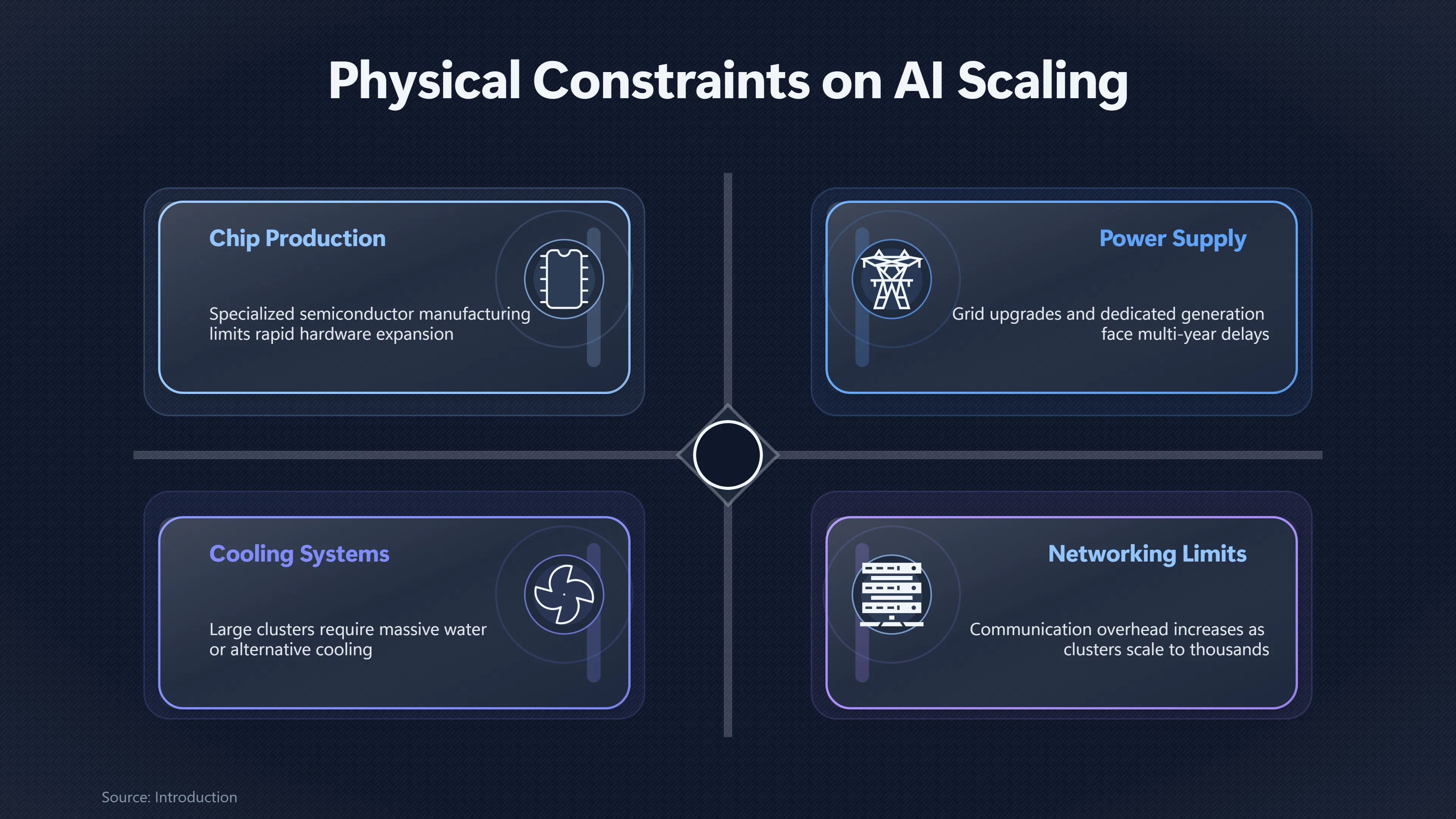
- Limited chip production. Advanced AI chips depend on highly specialised semiconductor manufacturing, advanced packaging technologies and high-bandwidth memory. These supply chains cannot expand overnight.
- Electricity and cooling. Large AI clusters increasingly require dedicated power generation, grid upgrades and water or alternative cooling systems, creating infrastructure delays measured in years rather than weeks.
- Networking limits. Very large training runs require fast communication between thousands of processors. Scaling clusters becomes progressively more difficult because communication overhead increases.
- Capital investment. Building new frontier data centres costs billions of pounds and involves long planning and construction cycles.
These constraints mean that even if an AI system became dramatically better at designing algorithms, it might still have to wait for physical infrastructure before testing them at scale. This is one reason why critics argue that software intelligence alone cannot necessarily trigger an unconstrained intelligence explosion.[forethought.org]forethought.orgWill Compute Bottlenecks Prevent a Software Intelligence Explosion?Will Compute Bottlenecks Prevent a Software Intelligence Explosion?April 4, 2025…
Why experiments resist unlimited acceleration
Research is not simply generating ideas. Most ideas fail.
AI development depends heavily on empirical testing. Researchers propose architectural changes, optimisation methods, data mixtures or training objectives, then run lengthy experiments to discover whether those ideas actually work. Many plausible improvements produce negligible gains or unexpected failures.
This creates an important distinction between thinking faster and learning faster.
An extremely capable AI researcher might generate thousands of promising hypotheses in minutes. Yet those hypotheses still require experimental validation. If every experiment takes days or weeks of computing time, increasing the rate of idea generation eventually provides diminishing returns because experimentation becomes the bottleneck.
Some experiments also depend on previous results. Researchers often cannot parallelise the entire discovery process because later decisions require information produced by earlier training runs. If each iteration depends on the previous one, progress retains an irreducible time component.
The analogy is scientific research in a laboratory. A brilliant scientist may devise hundreds of experiments rapidly, but chemical reactions, biological growth or telescope observations still take physical time. AI research is more digital than biology, yet large-scale model training has similar characteristics: computation itself becomes the experiment.
Economic modelling of frontier AI research has therefore explored whether compute and researcher effort behave as substitutes or complements. Initial results remain uncertain, with different modelling assumptions producing different conclusions, illustrating how unresolved this question remains.[arXiv]arxiv.orgarXiv Will Compute Bottlenecks Prevent an Intelligence Explosion?Will Compute Bottlenecks Prevent an Intelligence Explosion?July 31, 2025…
More compute does not eliminate diminishing returns
Another reason bottlenecks may matter is that scaling laws generally exhibit diminishing returns.
Empirical scaling laws show that increasing compute, model size and training data often produces predictable improvements. However, each additional unit of compute usually delivers a smaller improvement than the previous one. Maintaining the same rate of capability growth therefore requires disproportionately larger investments.
This creates two related possibilities.
First, AI progress could slow because additional compute becomes increasingly expensive relative to the gains achieved.
Second, recursive improvement itself may become harder. Early algorithmic advances may identify “low-hanging fruit”, while later improvements require increasingly subtle scientific discoveries.
This does not imply that progress stops. Rather, it suggests that sustaining exponential capability growth demands continual improvements in hardware, algorithms, software engineering and experimental efficiency simultaneously.
Recent work argues that scaling remains productive partly because engineers continually improve efficiency rather than relying solely on larger training runs. Better algorithms, improved hardware utilisation, model architectures and optimisation techniques can offset diminishing returns for considerable periods. However, this means recursive improvement depends on multiple complementary advances rather than intelligence alone.[arXiv]arxiv.orgThe Unreasonable Effectiveness of Scaling Laws in AIMarch 30, 2026…

Could AI remove these bottlenecks instead?
Supporters of rapid recursive improvement argue that today’s bottlenecks may themselves become research targets.
Rather than merely requesting larger computing budgets, advanced AI systems could discover:
- substantially more efficient training algorithms;
- better model architectures requiring less compute;
- improved data selection and synthetic data generation;
- faster optimisation methods;
- better scheduling of experiments across computing clusters;
- hardware-software co-design improvements.
History provides some support for this argument. Progress in AI has not come only from larger computers. Algorithmic improvements have often reduced the amount of computation needed to achieve a given capability by orders of magnitude.
From this perspective, compute shortages do not necessarily stop recursive improvement. They simply redirect it toward efficiency improvements.
This is why some researchers distinguish between physical compute and effective compute. A fixed collection of hardware can become much more productive if algorithms improve sufficiently. Whether those efficiency gains can continue indefinitely remains unknown.[jmlr.org]jmlr.orgOpen source on jmlr.org.
Physical limits still matter even with superhuman AI
Even optimistic scenarios for AI-assisted research encounter constraints that software cannot instantly eliminate.
Semiconductor fabrication plants require years to construct. Power stations and transmission networks require regulatory approval and physical construction. High-bandwidth memory production depends on specialised manufacturing capacity. New chip designs must themselves be manufactured and validated.
These constraints matter because an intelligence explosion is often imagined as proceeding almost entirely inside cyberspace.
In reality, frontier AI increasingly resembles a heavy industrial sector. Improvements in software can certainly accelerate progress, but replacing an entire global semiconductor supply chain, electrical grid or advanced manufacturing ecosystem is far harder than rewriting code.
Anthropic’s public discussion of recursive self-improvement highlights exactly this possibility: capability growth may eventually flatten because bottlenecks arise in energy, chip fabrication or infrastructure rather than intelligence itself.[anthropic.com]anthropic.comWhen AI builds itself \ AnthropicWhen AI builds itself \ Anthropic
The strongest counterargument: existing compute may already be enough
Critics of the bottleneck argument caution that the relevant question is not whether compute is scarce in an absolute sense, but whether existing compute is sufficient for several rounds of recursive improvement.
Suppose one generation of AI discovers an algorithm requiring only one-third as much computation to achieve equivalent performance. The freed hardware could immediately train another generation without waiting for new data centres.
Repeated efficiency gains of this kind could allow substantial capability increases before infrastructure becomes limiting.
Similarly, AI systems might contribute much more to software engineering than to hardware design. If software improvements dominate early recursive cycles, the first stages of an intelligence explosion could occur largely within existing computing resources.
Some analyses therefore argue that compute bottlenecks may delay, rather than prevent, rapid capability growth. Others argue the opposite: because frontier experiments increasingly dominate research costs, compute and cognitive labour may function as complements, making physical constraints increasingly important. The available evidence does not yet decisively favour either view.[Forethought]forethought.orgWill Compute Bottlenecks Prevent a Software Intelligence Explosion?Will Compute Bottlenecks Prevent a Software Intelligence Explosion?April 4, 2025…

What this means for AI doom scenarios
For AI doom arguments, physical bottlenecks are neither a complete reassurance nor an insignificant detail.
If compute, infrastructure and experimentation impose strong limits, then recursive improvement may unfold gradually enough for evaluations, governance measures, interpretability research and alignment techniques to improve alongside capabilities. Slower progress would not eliminate existential risk, but it could reduce the chance that humanity is overtaken before recognising what is happening.
Conversely, if software efficiency improvements repeatedly overcome physical constraints, bottlenecks may prove much weaker than they initially appear. Existing infrastructure might support multiple rapid cycles of AI-assisted AI research before new hardware becomes necessary.
The central uncertainty is therefore not whether bottlenecks exist—they clearly do—but how restrictive they become once AI systems themselves participate in overcoming them. At present there is no empirical evidence demonstrating either an unconstrained intelligence explosion or a hard physical ceiling that makes one impossible. The debate instead concerns where those limits lie, how quickly AI could approach them, and whether recursive improvement can continue to outpace the increasingly difficult scientific and engineering work needed to sustain it.
Amazon book picks
Further Reading
Books and field guides related to Could Real World Bottlenecks Halt an Intelligence Explosion?. Use these as the next step if you want deeper reading beyond the article.
Chip War
***Winner of the 2022 Financial Times Business Book of the Year Award*** ***Selected as one of Barack Obama's Favourite Books of 2023***...
Superintelligence
This profoundly ambitious and original book picks its way carefully through a vast tract of forbiddingly difficult intellectual terrain.
The Precipice
What existential threats does humanity face? And how can we secure our future?'The Precipice is a powerful book . . . Ord's love for huma...
Human Compatible
A leading artificial intelligence researcher lays out a new approach to AI that will enable us to coexist successfully with increasingly...
eBay marketplace picks
Marketplace Samples
Live-tested eBay searches with available results related to this page.
Selected fromtechnology wall art oneBay.co.uk.




Endnotes
1.
Source: forethought.org
Title: Will Compute Bottlenecks Prevent a Software Intelligence Explosion?
Link:https://www.forethought.org/research/will-compute-bottlenecks-prevent-a-software-intelligence-explosion
Source snippet
Will Compute Bottlenecks Prevent a Software Intelligence Explosion?April 4, 2025...
Published: April 4, 2025
2.
Source: usenix.org
Title: Wafer-Scale [AI Compute]({{ ‘compute-limits/’ | relative_url }}): A System Software Perspective | USENIX
Link:https://www.usenix.org/publications/loginonline/wafer-scale-ai-compute-system-software-perspective
Source snippet
Wafer-Scale AI Compute: A System Software Perspective | USENIX...
3.
Source: arxiv.org
Title: arXiv Will Compute Bottlenecks Prevent an Intelligence Explosion?
Link:https://arxiv.org/abs/2507.23181
Source snippet
Will Compute Bottlenecks Prevent an Intelligence Explosion?July 31, 2025...
Published: July 31, 2025
4.
Source: arxiv.org
Link:https://arxiv.org/abs/2603.28507
Source snippet
The Unreasonable Effectiveness of Scaling Laws in AIMarch 30, 2026...
Published: March 30, 2026
5.
Source: arxiv.org
Title: arXiv The Race to Efficiency: A New Perspective on AI Scaling Laws
Link:https://arxiv.org/abs/2501.02156
6.
Source: anthropic.com
Title: When AI builds itself \ Anthropic
Link:https://www.anthropic.com/institute/recursive-self-improvement?curius=2071
7.
Source: forethought.org
Title: How quick and big would a software intelligence explosion be?
Link:https://www.forethought.org/research/how-quick-and-big-would-a-software-intelligence-explosion-be
8.
Source: jmlr.org
Link:https://www.jmlr.org/papers/v24/22-1208.html
9.
Source: ojs.aaai.org
Link:https://ojs.aaai.org/index.php/AAAI/article/view/40697
10.
Source: jmlr.org
Link:https://jmlr.org/papers/v26/24-1000.html
Additional References
11.
Source: nature.com
Link:https://www.nature.com/articles/s41586-026-10303-2
Source snippet
April 1, 2026 — General scales unlock AI evaluation with explanatory and predictive power Download PDF Download PDF * Article * Open acce...
Published: April 1, 2026
12.
Source: techradar.com
Link:https://www.techradar.com/pro/those-two-jobs-need-different-physics-rebellions-ceo-says-training-and-inference-need-different-chips
Source snippet
It uniquely supports open standards like PyTorch and Kubernetes, promoting ease of adoption without proprietary lock-in. Existing deploym...
13.
Source: youtube.com
Title: Why AI Can’t Scale Forever (Physics Is the Problem)
Link:https://www.youtube.com/watch?v=8YRdTAo0lGQ
Source snippet
The Abstraction Barrier: Why AI Might Never Invent New Physics Ponvannan P (Pons) · 16 views...
14.
Source: youtube.com
Title: The Abstraction Barrier: Why AI Might Never Invent New Physics
Link:https://www.youtube.com/watch?v=JcB6ZiEZ0dU
Source snippet
The AI Power Bottleneck: From Compute to Energy...
15.
Source: youtube.com
Title: What Happens After Superintelligence? (with Anders Sandberg)
Link:https://www.youtube.com/watch?v=xGM4sUEElCY
Source snippet
The AI Bottleneck Nobody Is Prepared For...
16.
Source: doi.org
Link:https://doi.org/10.1126/science.aam9744
17.
Source: proceedings.neurips.cc
Link:https://proceedings.neurips.cc/paper_files/paper/2024/hash/6b066da6a23bc55f9b887e7298102884-Abstract-Conference.html
18.
Source: youtube.com
Link:https://www.youtube.com/watch?v=7LVZZxPo4rY
Source snippet
The Abstraction Barrier: Why AI Might Never Invent New Physics...
19.
Source: youtube.com
Title: The AI Power Bottleneck: From Compute to Energy
Link:https://www.youtube.com/watch?v=DWwBW72qWa4
Source snippet
Why AI Can’t Scale Forever (Physics Is the Problem)...
20.
Source: nature.com
Title: Densing law of LLMs | Nature Machine Intelligence
Link:https://www.nature.com/articles/s42256-025-01137-0