Within Catastrophic Misuse
Could AI Run a Dangerous Biology Lab?
AI-directed robotic laboratories could shorten dangerous research cycles, although reliable autonomous experimentation remains technically difficult.
On this page
- How AI could direct robotic experiments
- Why iteration around failure changes the risk
- What autonomous laboratories still cannot do reliably
Page outline Jump by section
Introduction
Could AI eventually run a dangerous biology lab? Not with today’s systems in any fully autonomous sense. However, many researchers argue that the combination of increasingly capable AI with robotic laboratory automation deserves close attention because it could shorten the cycle of scientific experimentation. The concern is not that an AI instantly invents a novel biological weapon. Rather, it is that future systems might accelerate the repeated process of generating hypotheses, planning experiments, interpreting failures and refining the next round of tests—a process that currently consumes much of the time, expertise and cost involved in advanced biological research.[PubMed]pubmed.ncbi.nlm.nih.govAutonomous 'self-driving' laboratories: a review of technology and policy implications - PubMedJuly 16, 2025…
Within debates about AI doom and catastrophic misuse, automated laboratories represent a possible force multiplier rather than a standalone existential threat. If AI systems become able to coordinate scientific reasoning with robotic equipment and laboratory data, they could reduce practical barriers that have historically limited sophisticated biological research. At the same time, today’s autonomous laboratories remain far from replacing experienced human scientists, particularly when experiments become unpredictable, technically fragile or safety-critical. The question is therefore less whether current systems can run dangerous biology laboratories, and more how quickly the technology is progressing and whether governance can keep pace.[PubMed]pubmed.ncbi.nlm.nih.govAutonomous 'self-driving' laboratories: a review of technology and policy implications - PubMedJuly 16, 2025…
How AI could direct robotic experiments
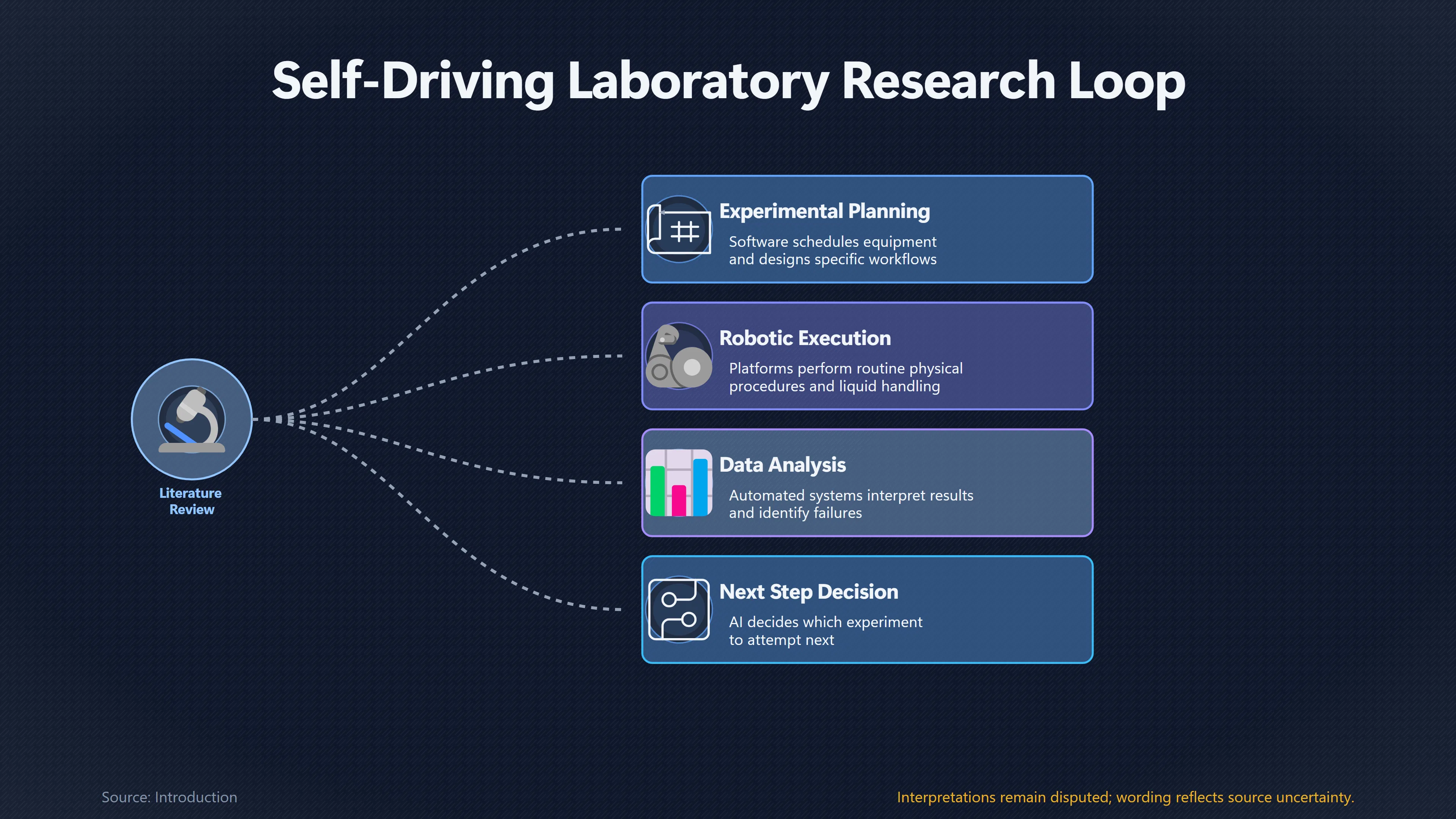
Laboratory science is highly iterative. Researchers rarely succeed on their first attempt. Instead they form hypotheses, design experiments, analyse results, identify mistakes and repeat the cycle many times. Modern “self-driving laboratories” aim to automate much of this loop.
In its most ambitious form, such a system combines several components:
- AI systems that search scientific literature and generate hypotheses.
- Software that plans experiments and schedules laboratory equipment.
- Robotic platforms that perform routine physical procedures.
- Automated analysis of experimental results.
- AI systems that decide which experiment should be attempted next.
This differs from today’s laboratory automation, which often automates only isolated tasks such as liquid handling or sample preparation. The newer vision is a closed feedback loop in which experimental results continuously inform subsequent experiments with minimal human intervention.[nih.gov]pubmed.ncbi.nlm.nih.govAutonomous 'self-driving' laboratories: a review of technology and policy implications - PubMedJuly 16, 2025…
Research demonstrations illustrate the direction of travel. In 2024, researchers reported a “self-driving” laboratory that autonomously improved enzyme performance over months of repeated experimentation. More recently, the multi-agent system Robin combined literature review, hypothesis generation, experimental planning and interpretation of laboratory data into a continuous research workflow, although human scientists still performed the physical experiments and verified the results.[nature.com]nature.comOpen source on nature.com.
From an AI doom perspective, the significance is not any single experiment. It is the possibility that increasingly capable AI systems may eventually compress scientific development cycles that currently require months or years of expert work.
Why iteration around failure changes the risk
Many discussions of biological misuse focus on knowledge: whether AI can answer difficult biology questions or explain technical concepts. Automated laboratories raise a different concern.
Real experimental biology is dominated by failure.
Experiments routinely produce contaminated samples, unexpected interactions, poor measurements or results that contradict initial expectations. Human researchers spend much of their time diagnosing these failures and deciding what to try next.
If future AI systems became substantially better at managing this iterative process, they could potentially reduce one of the largest practical bottlenecks in advanced biological research. Instead of merely answering questions, they could:
- identify likely reasons experiments failed;
- propose revised experimental plans;
- prioritise promising directions;
- integrate new data into updated scientific models; and
- continue repeating the cycle much faster than conventional research teams.
This matters because scientific progress often depends less on having one brilliant idea than on conducting hundreds or thousands of informed iterations. Compressing that process could accelerate both beneficial biomedical research and certain forms of dangerous dual-use research. The concern therefore centres on the speed and scale of experimentation rather than on any single AI-generated suggestion.[PubMed]pubmed.ncbi.nlm.nih.govAutonomous 'self-driving' laboratories: a review of technology and policy implications - PubMedJuly 16, 2025…

What autonomous laboratories still cannot do reliably
Despite rapid progress, autonomous biology remains technically constrained.
Living systems are considerably less predictable than many engineering problems. Cells change over time, reagents degrade, instruments drift out of calibration and unexpected contamination can invalidate entire experiments.
Even sophisticated laboratory robots continue to require human support for tasks such as:
- maintaining equipment;
- resolving mechanical failures;
- interpreting unusual biological behaviour;
- adapting protocols to unexpected conditions; and
- ensuring experiments satisfy biosafety and regulatory requirements.
Recent reviews emphasise that today’s self-driving laboratories perform best in relatively structured optimisation problems rather than open-ended biological discovery. Experiments involving living organisms frequently require tacit knowledge that is difficult to encode into software, while robotic systems remain less adaptable than experienced laboratory scientists when unexpected events occur.[PubMed]pubmed.ncbi.nlm.nih.govAutonomous 'self-driving' laboratories: a review of technology and policy implications - PubMedJuly 16, 2025…
Even the most advanced recent demonstrations describe “human-in-the-loop” systems rather than fully autonomous scientific laboratories. Researchers continue to verify outputs, conduct physical experiments and judge whether AI-generated hypotheses are biologically meaningful.[nature.com]nature.comA multi-agent system for automating scientific discovery | NatureA multi-agent system for automating scientific discovery | Nature
Could cloud laboratories change who can perform research?
Another issue discussed in biosecurity is the emergence of cloud laboratories.
These facilities allow researchers to remotely control automated laboratory equipment through software interfaces. Instead of owning specialised robotics, scientists can submit experimental workflows that are executed at a central facility.
Cloud laboratories primarily exist to improve research efficiency and reproducibility. Nevertheless, some analysts argue that remote access, increasing automation and AI-assisted planning could gradually lower practical barriers for certain kinds of laboratory work, particularly if future systems become increasingly autonomous. Reviews of self-driving laboratories note that combining AI reasoning with remotely operated experimental platforms could make advanced laboratory capabilities available to a wider range of legitimate researchers while also creating new security questions.[PubMed]pubmed.ncbi.nlm.nih.govAutonomous 'self-driving' laboratories: a review of technology and policy implications - PubMedJuly 16, 2025…
Importantly, cloud laboratories do not eliminate existing safeguards. Access remains controlled, many experiments require human approval, biological materials are regulated, and facilities operate under biosafety and legal requirements. The concern is about long-term technological trends rather than present-day unrestricted access.
Why this matters for catastrophic AI misuse
Within discussions of catastrophic AI misuse, automated laboratories are best understood as a multiplier of capability rather than an independent pathway to existential catastrophe.
A future AI system that could reason scientifically, direct robotic experimentation, analyse results and rapidly iterate through thousands of experimental cycles might significantly accelerate some forms of biological research. Whether that acceleration would be large enough to materially increase existential risk remains uncertain.
Several important uncertainties remain unresolved:
- It is unknown how much tacit laboratory expertise can actually be automated.
- Current demonstrations remain narrow compared with real-world biological research.
- There is little direct evidence that today’s autonomous laboratories substantially reduce barriers to sophisticated biological misuse.
- Safety controls, access restrictions and institutional oversight may evolve alongside the technology.
For these reasons, most serious assessments avoid claiming that autonomous laboratories make catastrophic biological misuse inevitable. Instead, they identify the convergence of increasingly capable AI, laboratory robotics and automated scientific reasoning as an emerging capability that deserves monitoring before it becomes mature enough to change the practical economics of advanced biological research.[nih.gov]pubmed.ncbi.nlm.nih.govAutonomous 'self-driving' laboratories: a review of technology and policy implications - PubMedJuly 16, 2025…

Amazon book picks
Further Reading
Books and field guides related to Could AI Run a Dangerous Biology Lab?. Use these as the next step if you want deeper reading beyond the article.
The Genesis Machine
A New Yorker Best Book of the Year The next frontier in technology is inside our own bodies. The breakthrough science of synthetic biolog...
Regenesis
A Harvard biologist and master inventor explores how new biotechnologies will enable us to bring species back from the dead, unlock vast...
The Code Breaker
"A gripping account of how the pioneering scientist Jennifer Doudna, along with her colleagues and rivals, launched a revolution that wil...
Biology Is Technology
In Biology Is Technology, author Robert Carlson offers a uniquely informed perspective on the endeavors that contribute to current progre...
eBay marketplace picks
Marketplace Samples
Live-tested eBay searches with available results related to this page.
Selected fromlaboratory robot model oneBay.co.uk.
Endnotes
1.
Source: nature.com
Title: A multi-agent system for automating scientific discovery | Nature
Link:https://www.nature.com/articles/s41586-026-10652-y
2.
Source: nature.com
Link:https://www.nature.com/articles/d41586-024-00093-w
3.
Source: nature.com
Link:https://www.nature.com/articles/s43246-026-01219-5
Source snippet
July 8, 2026 — Managing autonomous materials labs with multi-agent AI and its implications for the science of science Download PDF Downlo...
Published: July 8, 2026
4.
Source: nature.com
Title: ‘Self-driving’ laboratories
Link:https://www.nature.com/collections/cgbiacfcgc
5.
Source: nature.com
Title: Steering towards safe self-driving laboratories | Nature Reviews Chemistry
Link:https://www.nature.com/articles/s41570-025-00747-x
6.
Source: nature.com
Link:https://www.nature.com/articles/d41586-024-03815-2
7.
Source: nature.com
Link:https://www.nature.com/articles/s41599-024-03976-5
8.
Source: nature.com
Title: ‘Set it and forget it’: automated lab uses AI and robotics to improve proteins
Link:https://www.nature.com/articles/d41586-024-00093-w.pdf
9.
Source: nature.com
Link:https://www.nature.com/articles/s44160-022-00231-0
10.
Source: pubmed.ncbi.nlm.nih.gov
Link:https://pubmed.ncbi.nlm.nih.gov/40852582/
Source snippet
Autonomous 'self-driving' laboratories: a review of technology and policy implications - PubMedJuly 16, 2025...
Published: July 16, 2025
11.
Source: frontiersin.org
Link:https://www.frontiersin.org/journals/microbiology/articles/10.3389/fmicb.2026.1832401/full
Source snippet
Microbiol., 15 July 2026 Sec. Systems Microbiology Volume 17 - 2026 | [https://doi.org/10.3389/fmicb.2026.1832401](https://doi.org/10.3389/fmicb.2026.1832401) Published in Frontiers i...
Published: July 2026
12.
Source: pubmed.ncbi.nlm.nih.gov
Link:https://pubmed.ncbi.nlm.nih.gov/42156546/
13.
Source: pubmed.ncbi.nlm.nih.gov
Link:https://pubmed.ncbi.nlm.nih.gov/41868755/
14.
Source: pmc.ncbi.nlm.nih.gov
Link:https://pmc.ncbi.nlm.nih.gov/articles/PMC12368842/
15.
Source: frontiersin.org
Link:https://www.frontiersin.org/journals/microbiology/articles/10.3389/fmicb.2026.1832401/abstract
16.
Source: aisi.gov.uk
Link:https://www.aisi.gov.uk/frontier-ai-trends-report
17.
Source: aisi.gov.uk
Link:https://www.aisi.gov.uk/research-agenda
18.
Source: aisi.gov.uk
Link:https://www.aisi.gov.uk/about
Additional References
19.
Source: youtube.com
Link:https://www.youtube.com/watch?v=UUELqwathns
Source snippet
Cloud labs automated laboratory AI biosecurity risks The Silent Lab: The Rise of Autonomous Biology & Machine-Led Risks | Code Blue AI Co...
20.
Source: everycrsreport.com
Title: Artificial [Intelligence]({{ ‘hard-bottlenecks/’ | relative_url }}) and Biosecurity Issues
Link:https://www.everycrsreport.com/reports/IF13269.html
Source snippet
16, 2026 — ARTIFICIAL INTELLIGENCE AND BIOSECURITY ISSUES July 16, 2026 `IF13269` Artificial Intelligence and Biosecurity Issues July 16...
Published: July 16, 2026
21.
Source: youtube.com
Title: Weaponization of the Genomic Supply Chain: The New Biosecurity Threat
Link:https://www.youtube.com/watch?v=YnVULreajJo
Source snippet
Ep 28 - The Real Risks, and Real Promise, of AI in Biotech from the Perspective of the National A...
22.
Source: youtube.com
Link:https://www.youtube.com/watch?v=Jw47VMof4ic
Source snippet
Bryce Cai - The State and the Science of AI-Bio Evals [Alignment Workshop]...
23.
Source: youtube.com
Title: Bryce Cai
Link:https://www.youtube.com/watch?v=oh4AoiAOwfs
Source snippet
Ep 59 - A New Study Taking Responsible Innovation From Benchmarks to Benchwork...
24.
Source: youtube.com
Link:https://www.youtube.com/watch?v=acnmEQip6Jk
Source snippet
Weaponization of the Genomic Supply Chain: The New Biosecurity Threat...
25.
Source: arxiv.org
Title: arXiv Robo Culture: A Robotics Platform for Automated Biological Experimentation
Link:https://arxiv.org/abs/2505.14941
26.
Source: arxiv.org
Title: arXiv Robin: A multi-agent system for automating scientific discovery
Link:https://arxiv.org/abs/2505.13400
27.
Source: researchgate.net
Link:https://www.researchgate.net/publication/400220324_Risk_Mitigation_Strategies_for_Artificial_Intelligence-Enabled_Self-Driving_Laboratories
28.
Source: nationalacademies.org
Link:https://www.nationalacademies.org/publications/27469