Within Algorithmic Gains
Could AI Improve Faster Without More Chips?
Reusable software improvements could let each model generation speed up the research that produces the next one.
On this page
- How AI assisted research shortens development cycles
- Why reusable improvements can compound
- Conditions needed for a genuine intelligence explosion
Page outline Jump by section
Introduction
One of the key questions in debates about AI doom is whether AI progress must slow if the supply of advanced chips becomes constrained. A growing body of research suggests the answer may be “not necessarily”. If AI systems become increasingly useful at helping researchers design better algorithms, write code, analyse experiments and discover training improvements, then each generation of models could shorten the development time for the next. This creates a research feedback loop: software improvements accelerate the research that produces further software improvements, even without major increases in computing hardware.
This possibility does not mean a runaway intelligence explosion is inevitable. Today’s frontier systems still depend heavily on human researchers, expensive experiments and physical infrastructure. However, many researchers on both sides of the AI risk debate agree that AI-assisted research is already becoming a meaningful accelerator of machine learning progress. The central disagreement is over whether this acceleration eventually levels off or compounds into something much faster.[OpenAI]OpenAIai and efficiencyMay 5, 2020…
How AI-assisted research shortens development cycles
Most discussions of recursive improvement imagine an AI redesigning itself directly. In practice, the first feedback loops are likely to be much less dramatic.
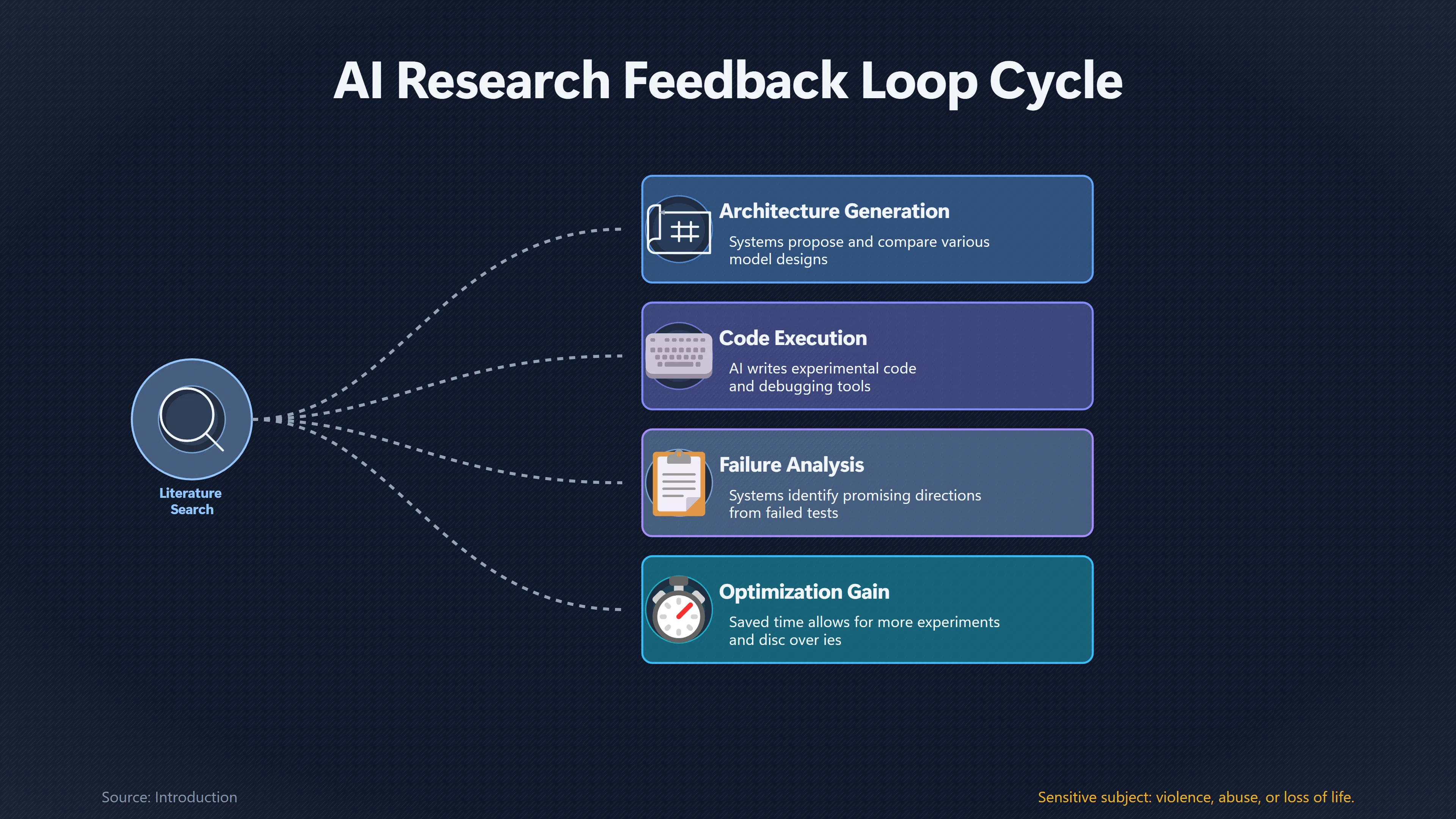
Instead of rewriting their own source code from scratch, advanced AI systems can assist human teams throughout the research process. They can:
- search enormous scientific literatures far faster than people;
- generate and compare alternative model architectures;
- write experimental code and debugging tools;
- analyse failed experiments to identify promising directions;
- automate hyperparameter searches and evaluation pipelines;
- suggest optimisations that researchers might otherwise overlook.
Each improvement saves researcher time. Saved time allows more experiments. More experiments increase the chance of discovering another improvement, which then saves still more time.
Importantly, this loop operates through research productivity rather than autonomous self-modification. Human researchers remain involved, but their effective output rises because increasingly capable AI systems act as research assistants, programmers and analytical tools. This makes software progress partially self-reinforcing even if the underlying hardware remains unchanged.[arXiv]arxiv.orgarXiv AI-Researcher: Autonomous Scientific InnovationAI-Researcher: Autonomous Scientific InnovationMay 24, 2025…
A useful comparison is software development itself. Better compilers, debuggers and version-control systems did not replace programmers, but they substantially increased how much software each programmer could produce. AI-assisted research could become a similar multiplier for machine learning research.
Why reusable improvements can compound
The crucial feature of this mechanism is that many algorithmic discoveries are reusable.
Building a larger data centre provides one organisation with more computing power. Discovering a more efficient optimisation algorithm, a better neural architecture or a faster attention mechanism can benefit every future training run that adopts it.
Because software improvements persist, they accumulate over time.
Suppose one generation of researchers discovers a training method that reduces compute requirements by 20%. Every subsequent project begins from that improved baseline rather than rediscovering it from scratch. If later AI systems help discover another improvement, the gains stack rather than replacing one another.
OpenAI’s work on algorithmic efficiency illustrates why this matters. The organisation estimated that between 2012 and 2019 the compute required to achieve AlexNet-level image classification performance fell by roughly 44 times through algorithmic improvements alone, corresponding to a doubling in efficiency about every 16 months. These gains compounded alongside hardware improvements instead of replacing them.[OpenAI]OpenAIai and efficiencyMay 5, 2020…
In recursive improvement arguments, this persistence matters more than any single breakthrough. The concern is not one unusually clever algorithm but an expanding library of techniques that every future model and research team can immediately exploit.
Could AI eventually become part of the research workforce?
Recent research systems suggest an incremental path towards greater research automation rather than an abrupt transition.
Experimental systems now attempt to automate substantial portions of scientific work, including literature review, hypothesis generation, coding, experiment execution and drafting research papers. These systems remain imperfect, but they demonstrate that increasingly large fractions of the research pipeline can be delegated to AI.[arXiv]arxiv.orgarXiv AI-Researcher: Autonomous Scientific InnovationAI-Researcher: Autonomous Scientific InnovationMay 24, 2025…
This creates an important distinction between two ideas:
- Automating research tasks means AI performs parts of the scientific workflow while humans supervise the overall process.
- Autonomous recursive self-improvement would require AI systems to drive most or all of the improvement cycle with minimal human involvement.
Current evidence supports the first much more strongly than the second.
Independent evaluations of systems such as Sakana AI’s “AI Scientist” found impressive reductions in research costs and time but also frequent coding failures, poor novelty assessment, hallucinated results and weak experimental judgement. These limitations suggest today’s systems are useful assistants rather than autonomous inventors.[arXiv]arxiv.orgEvaluating Sakana's AI Scientist for Autonomous Research: Wishful Thinking or an Emerging Reality Towards 'Artificial Research Intel…
Conditions needed for a genuine intelligence explosion
AI doom arguments based on research feedback loops generally require several conditions to hold simultaneously.
First, AI must become genuinely useful across most stages of AI research rather than only narrow tasks like coding or summarisation.
Second, each generation of models must improve research productivity enough that development cycles shorten substantially.
Third, the resulting improvements must themselves increase research capability, creating a positive feedback loop rather than a one-off gain.
Finally, the loop must outpace slowing forces such as hardware shortages, limited data, difficult experiments or diminishing algorithmic returns.
The chain is only as strong as its weakest link. If any stage saturates, overall acceleration may remain significant but not explosive.
This explains why researchers disagree sharply about the likelihood of recursive improvement. They often agree on the individual mechanisms while differing about whether the gains remain large enough to compound over many generations.[arXiv]arxiv.orgarXiv Will Compute Bottlenecks Prevent an Intelligence Explosion?arXiv Will Compute Bottlenecks Prevent an Intelligence Explosion?
Why hardware may still matter
Research feedback loops without additional hardware are sometimes misunderstood as implying chips become irrelevant.
In reality, software and hardware usually complement each other.
A more efficient algorithm can reduce the compute needed for a particular capability. The resulting savings may then be reinvested into training larger or more capable models, which still require substantial computing resources.
Similarly, better AI researchers may discover algorithms that make larger hardware deployments more productive. The interaction therefore becomes multiplicative rather than either software or hardware acting alone.
Economic analyses of frontier AI research reach mixed conclusions on exactly this point. Some modelling suggests compute and research labour can substitute for one another to a degree, while other models indicate they remain complements. The available evidence is not yet sufficient to determine which relationship dominates as AI capability increases.[arXiv]arxiv.orgarXiv Will Compute Bottlenecks Prevent an Intelligence Explosion?arXiv Will Compute Bottlenecks Prevent an Intelligence Explosion?
What evidence exists today?
Several observations support the idea that research feedback loops have begun, albeit in limited form.
AI coding assistants measurably improve programmer productivity in many settings, allowing researchers to implement and test ideas faster than before. Experimental autonomous research systems now complete substantial parts of research workflows that previously required human effort. AI is increasingly used for literature analysis, experimental design, theorem proving and scientific hypothesis generation across multiple disciplines.[arxiv.org]arxiv.orgarXiv AI-Researcher: Autonomous Scientific InnovationAI-Researcher: Autonomous Scientific InnovationMay 24, 2025…
However, the evidence also highlights important limits.
Scientific research often depends on physical experiments, expensive training runs, careful interpretation and creative judgement that remain difficult to automate. Independent evaluations of autonomous research agents continue to find substantial reliability problems, including poor reasoning about novelty, coding failures and fabricated results.[arXiv]arxiv.orgEvaluating Sakana's AI Scientist for Autonomous Research: Wishful Thinking or an Emerging Reality Towards 'Artificial Research Intel…
These limitations mean current systems appear to accelerate human researchers rather than replace them.
Why this mechanism matters for AI doom debates
Within AI doom discussions, research feedback loops matter because they weaken a common assumption that physical hardware places a firm upper bound on the speed of AI progress.
If increasingly capable AI systems can help create the next generation of algorithms, then software itself becomes a force multiplier. Even moderate improvements in research productivity could shorten development cycles enough to produce faster capability growth than hardware trends alone would predict.
Critics argue that this possibility is often overstated. Scientific discovery may exhibit diminishing returns, physical experiments cannot be compressed indefinitely, and many apparent software gains eventually become harder to find. The existence of positive feedback does not guarantee exponential growth.
As a result, the mechanism remains plausible but unresolved. There is broad agreement that AI is beginning to assist AI research. The central uncertainty is whether these assistance effects plateau as ordinary productivity tools or whether they eventually become strong enough to sustain a genuine recursive improvement process that materially increases existential risk.
Amazon book picks
Further Reading
Books and field guides related to Could AI Improve Faster Without More Chips?. Use these as the next step if you want deeper reading beyond the article.
Human Compatible
A leading artificial intelligence researcher lays out a new approach to AI that will enable us to coexist successfully with increasingly...
Superintelligence
This profoundly ambitious and original book picks its way carefully through a vast tract of forbiddingly difficult intellectual terrain.
Artificial Intelligence
Rating: 4.5/5 from 10 Google Books ratings
Artificial intelligence: A Modern Approach, 3e,is ideal for one or two-semester, undergraduate or graduate-level courses in Artificial In...
Artificial Intelligence: A Modern Approach
Rating: 4.5/5 from 10 Google Books ratings
Artificial intelligence: A Modern Approach, 3e,is ideal for one or two-semester, undergraduate or graduate-level courses in Artificial In...
eBay marketplace picks
Marketplace Samples
Live-tested eBay searches with available results related to this page.
Selected frommachine learning wall art oneBay.co.uk.

Current eBay listing
Machine Learning Framed Wall Art Poster Canvas Print Picture


Current eBay listing
Machine Learning Framed Wall Art Poster Canvas Print Picture
Endnotes
1.
Source: OpenAI
Title: ai and efficiency
Link:https://openai.com/index/ai-and-efficiency/
Source snippet
May 5, 2020...
Published: May 5, 2020
2.
Source: arxiv.org
Title: arXiv Will Compute Bottlenecks Prevent an [Intelligence]({{ ‘hard-bottlenecks/’ | relative_url }}) Explosion?
Link:https://arxiv.org/abs/2507.23181
3.
Source: arxiv.org
Title: arXiv AI-Researcher: Autonomous Scientific [Innovation]({{ ‘false-positives/’ | relative_url }})
Link:https://arxiv.org/abs/2505.18705
Source snippet
AI-Researcher: Autonomous Scientific InnovationMay 24, 2025...
Published: May 24, 2025
4.
Source: arxiv.org
Title: arXiv Measuring the Algorithmic Efficiency of Neural Networks
Link:https://arxiv.org/abs/2005.04305
5.
Source: arxiv.org
Link:https://arxiv.org/abs/2502.14297
Source snippet
Evaluating Sakana's AI Scientist for Autonomous Research: Wishful Thinking or an Emerging Reality Towards 'Artificial Research Intel...
6.
Source: OpenAI
Title: Open AIAI and compute | Open AI
Link:https://openai.com/index/ai-and-compute/
Source snippet
AI and compute | OpenAI...
7.
Source: nature.com
Link:https://www.nature.com/articles/s41586-025-09922-y
8.
Source: OpenAI
Link:https://openai.com/index/accelerating-biological-research-in-the-wet-lab/
Source snippet
Measuring AI’s capability to accelerate biological research in the wet lab | OpenAI...
9.
Source: sakana.ai
Link:https://sakana.ai/ai-scientist-nature/
10.
Source: nature.com
Link:https://www.nature.com/articles/s41586-025-10072-4
11.
Source: nature.com
Title: A I tools boost individual scientists but could limit research as a whole
Link:https://www.nature.com/articles/d41586-025-04092-3
12.
Source: OpenAI
Title: accelerating science gpt 5
Link:https://openai.com/index/accelerating-science-gpt-5/
13.
Source: OpenAI
Title: learning complex goals with iterated amplification
Link:https://openai.com/index/learning-complex-goals-with-iterated-amplification/
Additional References
14.
Source: metr.org
Title: The Economics of Recursive Self-Improvement
Link:https://metr.org/notes/2026-07-22-economics-of-recursive-self-improvement/
Source snippet
July 22, 2026 — Research note: The Economics of Recursive Self-Improvement CONTRIBUTORS Parker Whitfill and Tom Cunningham DATE July...
Published: July 22, 2026
15.
Source: evals.alignment.org
Title: 2026 07 21 expenditure horizon
Link:https://evals.alignment.org/blog/2026-07-21-expenditure-horizon/
Source snippet
Horizon: Measuring Optimization Ability, with an Application to NanoGPT - METRJuly 21, 2026 — Expenditure Horizon: Measuring Optimization...
Published: July 21, 2026
16.
Source: youtube.com
Title: First Steps Toward [Automated]({{ ‘full-research-loop/’ | relative_url }}) AI Research — Richard Socher, CEO Recursive AI
Link:https://www.youtube.com/watch?v=pWXUkLP9uWM
Source snippet
Recursive Self-Improvement Just Got Real (Anthropic + Recursive)...
17.
Source: youtube.com
Title: Recursive Self-Improvement Just Got Real (Anthropic + Recursive)
Link:https://www.youtube.com/watch?v=RB8vjn1QPeM
Source snippet
The AI Scientist: Fully Automated Scientific Discovery...
18.
Source: youtube.com
Title: The AI Scientist: Fully Automated Scientific Discovery
Link:https://www.youtube.com/watch?v=3y5RwwSwVpM
Source snippet
Recursive Self-Improvement (Ep. 1004 with Jon Krohn)...
19.
Source: lifepillarinstitute.org
Link:https://www.lifepillarinstitute.org/scientific-papers/structural-misidentification-of-recursion-in-artificial-intelligence-a-falsification-study-of-the-i
20.
Source: youtube.com
Link:https://www.youtube.com/watch?v=M7esJPTwBbQ
Source snippet
Path to AGI by 2027 (Leopold Aschenbrenner)...
21.
Source: futuretech.mit.edu
Link:https://futuretech.mit.edu/publication/the-price-of-progress-algorithmic-efficiency-and-the-falling-cost-of-ai-inference?b182cb30_page=2&bed3467a_page=4
22.
Source: research.google
Title: Accelerating scientific discovery with AI-powered Empirical Research Assistance
Link:https://research.google/blog/accelerating-scientific-discovery-with-ai-powered-empirical-software/
23.
Source: sciencedirect.com
Title: The impact of artificial intelligence on research efficiency
Link:https://www.sciencedirect.com/science/article/pii/S2590123025008205