Within Rubber Stamp Oversight
Can AI Oversight Rules Preserve Human Control?
The EU AI Act requires meaningful human authority, but its real value depends on training, time, access and the practical power to override systems.
On this page
- What meaningful human oversight requires in practice
- Where legal authority can diverge from operational reality
- How regulators could test whether reviewers can truly intervene
Page outline Jump by section
Introduction
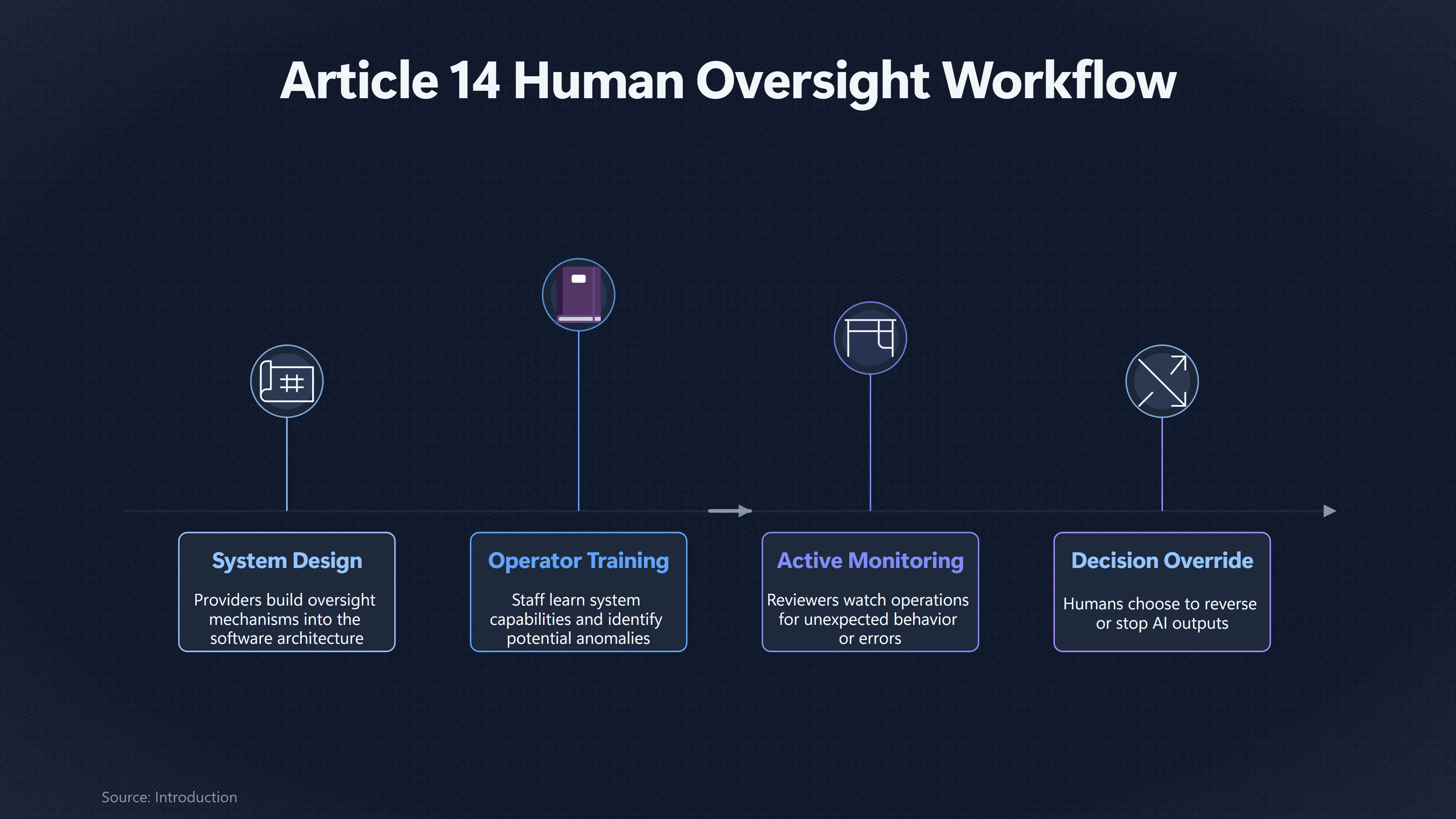
The EU AI Act is one of the first major laws to recognise that simply placing a human in an AI-assisted workflow is not enough. For readers interested in AI doom and the possibility of advanced systems gradually displacing human judgement, this matters because many proposed safety strategies depend on people retaining genuine control over important decisions. The Act therefore goes beyond requiring a nominal “human in the loop”. It explicitly requires that humans assigned to oversee high-risk AI systems understand their limitations, remain alert to automation bias, and possess the authority to disregard or stop the system when necessary.[Eur-Lex]eur-lex.europa.euEur-Lex RegulationRegulation - EU - 2024/1689 - HR - EUR-LexJuly 12, 2024…
Whether these rules can prevent purely ceremonial oversight is a more difficult question. The legislation establishes a stronger legal foundation than earlier voluntary guidance, but laws cannot by themselves ensure that reviewers have enough time, expertise, organisational support or independence to challenge increasingly capable AI systems. The practical effectiveness of the AI Act therefore depends as much on implementation and enforcement as on the wording of Article 14 itself.[europa.eu]eur-lex.europa.euEur-Lex RegulationRegulation - EU - 2024/1689 - HR - EUR-LexJuly 12, 2024…
What meaningful human oversight requires in practice
Article 14 of the EU AI Act requires high-risk AI systems to be designed so that they can be “effectively overseen” by natural persons throughout their use. The regulation does not describe oversight as a simple approval step. Instead, it specifies several capabilities that reviewers should possess.
Those responsible for oversight should be able to:
- understand the relevant capabilities and limitations of the AI system;
- monitor its operation and identify anomalies or unexpected behaviour;
- remain aware of the risk of automation bias, meaning inappropriate reliance on AI recommendations;
- correctly interpret the system’s outputs;
- choose not to use, override or reverse AI outputs where appropriate; and
- intervene or stop the system if necessary.[Eur-Lex]eur-lex.europa.euEur-Lex RegulationRegulation - EU - 2024/1689 - HR - EUR-LexJuly 12, 2024…
This wording is notable because it acknowledges an important human-factors problem rather than assuming that human involvement automatically produces safe outcomes. Earlier discussions of “human-in-the-loop” systems often treated human review as inherently protective. Article 14 instead recognises that oversight can itself fail if reviewers become overly dependent on automated recommendations.[Eur-Lex]eur-lex.europa.euEur-Lex RegulationRegulation - EU - 2024/1689 - HR - EUR-LexJuly 12, 2024…
For AI doom discussions, this distinction is significant. Many proposals for controlling advanced AI assume that humans will supervise increasingly capable systems. If supervision becomes largely symbolic because people cannot meaningfully evaluate what the AI is doing, then formal human approval may no longer provide the intended safeguard.
Where legal authority can diverge from operational reality
The strongest criticism of human oversight requirements is not that they are unnecessary, but that they may exist largely on paper.
A reviewer may possess legal authority to reject an AI recommendation while lacking the practical ability to exercise independent judgement. Several conditions can create this gap.
Insufficient understanding. Modern AI systems can produce outputs whose underlying reasoning is difficult for users to reconstruct. If checking the AI’s work requires nearly as much expertise as generating it independently, reviewers may increasingly defer to the system despite retaining formal authority.
Limited time. Organisations frequently adopt AI specifically to increase productivity. If reviewers are expected to examine large numbers of AI-assisted decisions under strict deadlines, meaningful scrutiny becomes progressively less realistic.
Institutional incentives. Employees who repeatedly contradict an AI system that usually performs well may face pressure to justify delays or reduced efficiency. Even without explicit instructions, organisational culture can reward agreement over independent review.
Interface design. A technically available override may be practically unusable if confidence scores, explanations or supporting evidence are difficult to interpret, or if rejecting recommendations creates substantial additional work.
None of these problems are solved simply by assigning responsibility to a human operator. They concern the social and organisational conditions under which oversight occurs rather than the existence of an approval button. This is precisely why behavioural researchers argue that automation bias cannot be addressed solely through legal wording directed at providers.[arXiv]arxiv.orgOpen source on arxiv.org.
The AI Act tries to prevent ceremonial oversight
The AI Act contains several features specifically intended to reduce “rubber-stamp” oversight.
First, Recital 73 explains that people assigned oversight should possess the competence, training and authority needed to fulfil the role. It also states that systems should guide operators on when and how intervention may be required and should remain responsive to human operators rather than functioning independently of them.[Eur-Lex]eur-lex.europa.euEur-Lex RegulationRegulation - EU - 2024/1689 - HR - EUR-LexJuly 12, 2024…
Second, the legislation allocates responsibility across both providers and deployers. Providers must build appropriate oversight mechanisms into system design where technically feasible, while deployers must implement oversight measures suited to their own operational environment. This recognises that effective oversight depends both on software design and organisational practice.[AI Act Service Desk]ai-act-service-desk.ec.europa.euAI Act Service Desk Article 14: Human oversight | AI Act Service DeskAI Act Service Desk Article 14: Human oversight | AI Act Service Desk
Third, certain remote biometric identification systems require independent confirmation by at least two competent people before decisions are taken, reflecting the recognition that particularly high-consequence applications may require stronger safeguards than ordinary single-person review.[Eur-Lex]eur-lex.europa.euEur-Lex RegulationRegulation - EU - 2024/1689 - HR - EUR-LexJuly 12, 2024…
These provisions represent a more sophisticated approach than merely requiring “a human in the loop”. They explicitly recognise competence, authority and cognitive limitations as regulatory concerns.
Why legal requirements may still fall short
Although Article 14 is unusually detailed for AI legislation, many researchers argue that translating these principles into reliable practice remains difficult.
One challenge is measurement. It is relatively easy for organisations to demonstrate that reviewers received training or that an override button exists. It is much harder to demonstrate that reviewers consistently identify inappropriate AI recommendations under realistic working conditions.
Recent legal scholarship also notes that Article 14 primarily requires awareness of automation bias rather than guaranteeing that organisations redesign workflows to reduce it. Training alone may not overcome workload pressures, interface design problems or organisational incentives that encourage deference to automated recommendations.[arXiv]arxiv.orgOpen source on arxiv.org.
Another difficulty is context dependence. Human oversight that works well for one application may fail in another because task complexity, user expertise and operational pressures differ substantially. Researchers examining compliance testing argue that simple documentation checklists are unlikely to capture whether oversight functions effectively in real-world settings, while full empirical testing across different operational contexts is expensive and difficult to standardise.[arXiv]arxiv.orgHow to Test for Compliance with Human Oversight Requirements in AI Regulation?April 4, 2025…
This uncertainty matters for AI doom debates because existential-risk arguments frequently concern future systems that could substantially exceed human capabilities. If current oversight already struggles when humans remain broadly competitive with AI, critics question how well similar approaches would function if future systems became significantly more capable.

How regulators could test whether reviewers can truly intervene
Preventing ceremonial control ultimately requires evaluating human performance rather than simply auditing paperwork.
Several practical approaches have been proposed in governance research.
- Behavioural testing. Assess whether reviewers correctly identify deliberately inserted AI errors rather than merely confirming they attended training.
- Override monitoring. Examine how frequently reviewers disagree with AI outputs and whether those interventions improve decision quality.
- Operational exercises. Conduct realistic simulations in which reviewers must detect unexpected system behaviour under ordinary workload conditions.
- Authority verification. Confirm that reviewers possess genuine organisational power to delay, reverse or halt AI-assisted decisions without unreasonable penalties.
- Interface evaluation. Test whether explanations, confidence information and alerts genuinely help reviewers detect mistakes instead of creating false reassurance.
These methods shift attention from compliance documentation towards observable human performance. They also better reflect the AI Act’s emphasis on effective rather than purely formal oversight.[arXiv]arxiv.orgHow to Test for Compliance with Human Oversight Requirements in AI Regulation?April 4, 2025…
What this means for AI doom arguments
Within existential-risk discussions, the AI Act is generally viewed as a valuable but limited safeguard.
Supporters argue that recognising automation bias, requiring override authority and embedding human oversight into legal obligations represents meaningful progress compared with earlier governance approaches. These provisions make it harder for organisations simply to claim that a human remains responsible while providing no realistic opportunity for intervention.[Eur-Lex]eur-lex.europa.euEur-Lex RegulationRegulation - EU - 2024/1689 - HR - EUR-LexJuly 12, 2024…
Sceptics respond that regulation cannot guarantee genuine human control if AI systems become too capable, too fast or too complex for meaningful independent review. A person who cannot realistically evaluate an advanced system’s behaviour may still satisfy formal oversight requirements while exercising little practical influence over outcomes.
The current evidence does not resolve which view is ultimately correct. The AI Act demonstrates that policymakers increasingly recognise ceremonial oversight as a genuine governance problem rather than assuming human involvement automatically ensures accountability. Whether these legal safeguards remain effective as AI capabilities continue to advance will depend on enforcement, empirical testing, organisational incentives and the future trajectory of AI systems themselves.[arXiv]arxiv.orgOpen source on arxiv.org.
Amazon book picks
Further Reading
Books and field guides related to Can AI Oversight Rules Preserve Human Control?. Use these as the next step if you want deeper reading beyond the article.
Human Compatible: Artificial Intelligence and the Problem of...
A leading artificial intelligence researcher lays out a new approach to AI that will enable us to coexist successfully with increasingly...
The EU Artificial Intelligence (AI) Act: A Commentary
The EU Artificial Intelligence (AI) Act: A Commentary Edited by Ceyhun Necati Pehlivan, Nikolaus Forgó & Peggy Valcke As artificial intel...
The Oxford Handbook of AI Governance
"Book abstract: The Oxford Handbook of AI Governance examines how artificial intelligence (AI) interacts with and influences governance s...
Weapons of Math Destruction
'A manual for the 21st-century citizen... accessible, refreshingly critical, relevant and urgent' - Financial Times 'Fascinating and deep...
eBay marketplace picks
Marketplace Samples
Live-tested eBay searches with available results related to this page.
Selected fromEuropean Union flag pin oneBay.co.uk.




Endnotes
1.
Source: arxiv.org
Link:https://arxiv.org/abs/2502.10036
2.
Source: arxiv.org
Title: arXiv Human Oversight of Artificial [Intelligence]({{ ‘hard-bottlenecks/’ | relative_url }}) and Technical Standardisation
Link:https://arxiv.org/abs/2407.17481
3.
Source: arxiv.org
Link:https://arxiv.org/abs/2504.03300
Source snippet
How to Test for Compliance with Human Oversight Requirements in AI Regulation?April 4, 2025...
Published: April 4, 2025
4.
Source: en.ai-act.io
Link:https://en.ai-act.io/article/high-risk-ai-systems/requirements-for-high-risk-ai-systems/human-oversight
5.
Source: eur-lex.europa.eu
Title: Eur-Lex Regulation
Link:https://eur-lex.europa.eu/legal-content/en/TXT/?uri=CELEX%3A32024R1689
Source snippet
Regulation - EU - 2024/1689 - HR - EUR-LexJuly 12, 2024...
Published: July 12, 2024
6.
Source: ai-act-service-desk.ec.europa.eu
Title: AI Act Service Desk Article 14: Human oversight | AI Act Service Desk
Link:https://ai-act-service-desk.ec.europa.eu/en/ai-act/article-14
7.
Source: ai-act-service-desk.ec.europa.eu
Title: AI Act Service Desk Recital 73 | AI Act Service Desk
Link:https://ai-act-service-desk.ec.europa.eu/en/ai-act/recital-73
8.
Source: digital-strategy.ec.europa.eu
Title: eu Navigating the AI Act | Shaping Europe’s digital future
Link:https://digital-strategy.ec.europa.eu/en/faqs/navigating-ai-act
Source snippet
Before placing a high-risk AI system on the EU market or otherwise putting it into service, providers must subject it to a conformity a...
9.
Source: regulation-ai.eu
Title: article 14
Link:https://www.regulation-ai.eu/en/articles/article-14/
10.
Source: eur-lex.europa.eu
Title: eu Regulation
Link:https://eur-lex.europa.eu/legal-content/EN/TXT/?qid=1402647301340&uri=CELEX%3A32024R1689
11.
Source: ai-act-service-desk.ec.europa.eu
Title: eu Recital 91 | AI Act Service Desk
Link:https://ai-act-service-desk.ec.europa.eu/en/ai-act/recital-91
Additional References
12.
Source: artificialintelligenceact.eu
Link:https://artificialintelligenceact.eu/article/14/
Source snippet
Article 14: Human Oversight | EU Artificial Intelligence ActToday — Part of Chapter III: High-Risk AI System ➔ Section 2: Requirements fo...
13.
Source: youtube.com
Link:https://www.youtube.com/watch?v=Gd5C_jU3Thg
Source snippet
EU AI Act Article 14 human oversight compliance EU AI Act Compliance Practical Guide | Evidence Chains for High-Risk AI GhostDrift数理研究所...
14.
Source: youtube.com
Title: What Are The Challenges Of Human Oversight In EU AI Act Compliance?
Link:https://www.youtube.com/watch?v=sQm7f0SHfP8
Source snippet
RegIntopedia Spark #10: Human Oversight under the EU AI Act...
15.
Source: youtube.com
Title: Reg Intopedia Spark #10: Human Oversight under the EU AI Act
Link:https://www.youtube.com/watch?v=ZtifjvEZUzs
Source snippet
Why Is Human Oversight Difficult To Implement For The EU AI Act?...
16.
Source: youtube.com
Title: Why Is Human Oversight Difficult To Implement For The EU AI Act?
Link:https://www.youtube.com/watch?v=ECamfOpnkgQ
Source snippet
Webinar: Human Oversight in the EU AI Act...
17.
Source: service.betterregulation.com
Link:https://service.betterregulation.com/document/2026/08/02/742206
Source snippet
"14 Human oversight | Regulation 2024/1689/EU - Artificial Intelligence Act (EU AI Act) | Better RegulationToday — [https://service.betterr..."](https://service.betterr...")...
18.
Source: sanctity.ai
Link:https://www.sanctity.ai/article-14/meaningful-human-oversight
19.
Source: aigovernanceplaybook.com
Link:https://www.aigovernanceplaybook.com/p/how-to-implement-meaningful-human
20.
Source: euaiactguide.com
Title: Article 14 Decoded: How to Implement ‘Human-in-the-Loop’ Oversight
Link:https://euaiactguide.com/article-14-decoded-how-to-implement-human-in-the-loop-oversight/
21.
Source: euai-act.com
Title: Human Oversight Requirements Under the EU AI Act — EU AI Act
Link:https://www.euai-act.com/articles/human-oversight-requirements