Within Task Horizons
Do Software Benchmarks Overstate Real AI Autonomy?
Strong results on well-specified technical tasks do not show that AI can manage equally long projects in messy social or physical settings.
On this page
- Why software tasks are unusually easy to specify and check
- Capabilities missing from open ended real world projects
- What broader evidence would justify stronger autonomy claims
Page outline Jump by section
Introduction
Task-horizon benchmarks are designed to answer a practical question: how long can an AI reliably complete a task without human intervention? That makes them more informative than traditional exam-style benchmarks when discussing dangerous AI autonomy. However, it is easy to over-interpret what these measurements mean.

The most widely discussed task-horizon evaluations are heavily concentrated in software engineering, machine learning, cybersecurity and other digital work where tasks can be precisely specified and automatically checked. Strong performance in these environments does not automatically show that an AI can independently manage equally long projects in businesses, laboratories, governments or the physical world. This distinction matters in debates about AI doom because many loss-of-control scenarios assume broad, adaptable autonomy rather than competence on carefully designed technical tasks. The central question is therefore not whether software benchmarks are useful—they clearly are—but how far their results can reasonably be generalised.[Metr]metr.orgTask-Completion Time Horizons of Frontier AI ModelsTask-Completion Time Horizons of Frontier AI Models - METRMay 8, 2026…
Why software tasks are unusually easy to specify and check
Software engineering has several properties that make it unusually suitable for benchmarking autonomous AI systems.
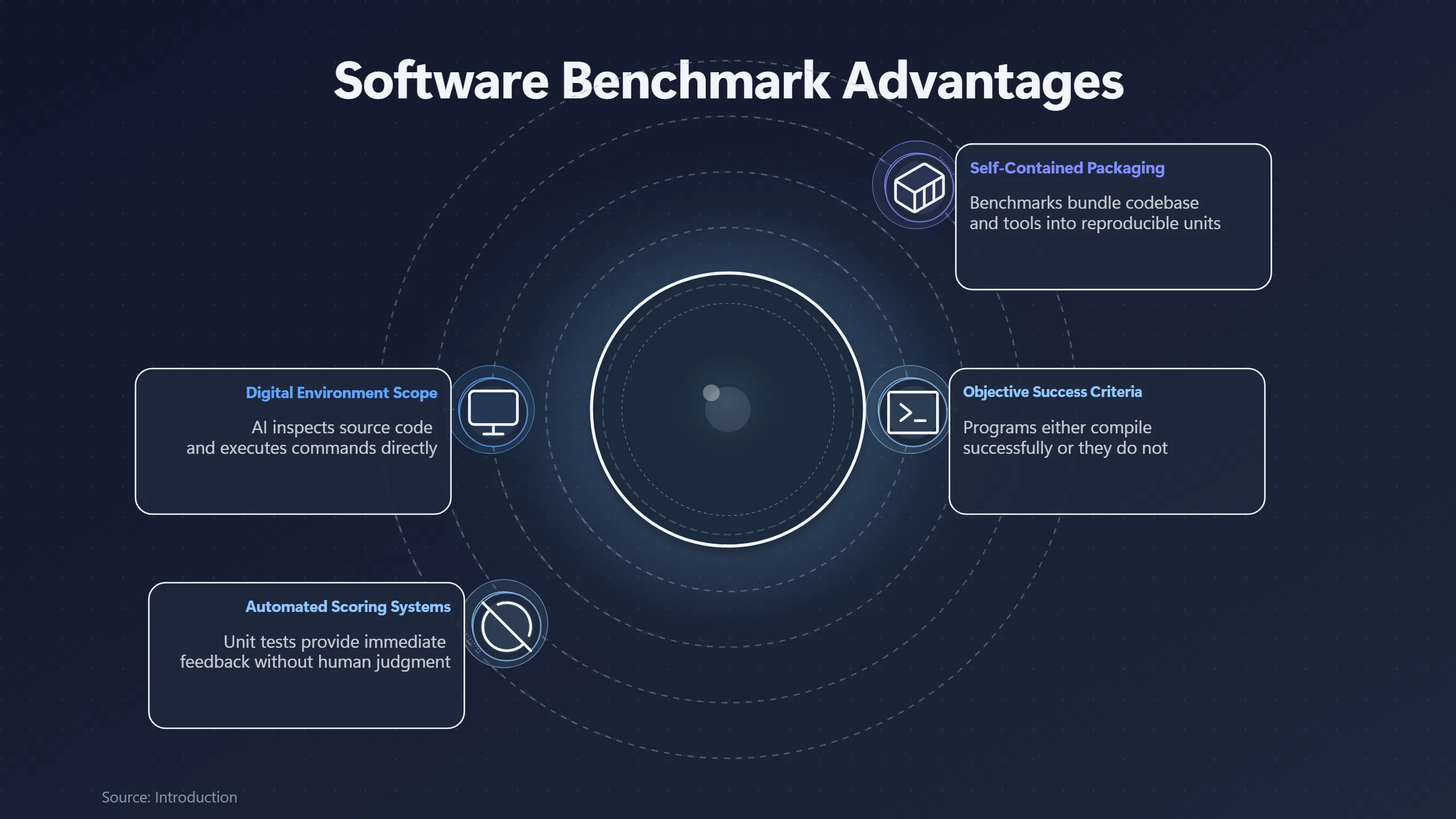
First, success criteria are often objective. A program either compiles or it does not. Unit tests pass or fail. Security vulnerabilities are reproduced or eliminated. Researchers can therefore score thousands of agent actions without relying heavily on subjective human judgement.
Second, the entire environment is digital. An AI can inspect source code, run commands, execute tests and receive immediate feedback. Unlike many real-world activities, there is little ambiguity about what happened after each action.
Third, many software tasks are self-contained. A benchmark can package the codebase, documentation and required tools into a reproducible environment that every model encounters under identical conditions. This greatly improves scientific repeatability but removes many of the complications found outside benchmark settings.[Evaluations]evaluations.metr.orgEvaluations Autonomy Evaluation ResourcesAutonomy Evaluation Resources - METR…
These characteristics explain why organisations such as Model Evaluation & Threat Research (METR) have concentrated on software-heavy evaluations. Their published task suites explicitly note that they focus on areas where frontier language models are comparatively strong and where reliable automated evaluation is feasible. That design choice is a methodological strength for measurement, but it also creates limits on what the results can demonstrate.[Evaluations]evaluations.metr.orgEvaluations Autonomy Evaluation ResourcesAutonomy Evaluation Resources - METR…
Why success on coding does not automatically imply broad autonomy
The temptation is to equate a model completing a software project that takes a human several hours with an ability to autonomously manage any project of similar duration. That inference is much stronger than the available evidence supports.
Outside software, long projects typically involve problems that benchmarks deliberately minimise:
- goals that evolve while work is underway;
- incomplete or contradictory information;
- negotiation with multiple people;
- uncertain success criteria;
- conflicting incentives;
- interruptions and changing priorities;
- physical actions with irreversible consequences.
These difficulties are not simply “more steps”. They require judgement about ambiguous situations where there may be no objectively correct answer.
For example, writing production software usually has a binary outcome that can be tested automatically. Running a political campaign, managing a hospital ward or directing emergency disaster relief does not. Progress depends on social interaction, persuasion, institutional constraints and adapting to events that cannot be simulated in advance.
As a result, an AI that performs extremely well on long coding tasks may still struggle when required to coordinate people, revise objectives or recognise that the original problem statement itself has become outdated.
Capabilities still missing from open-ended projects
Current software benchmarks capture some ingredients of autonomy—planning, tool use, debugging and recovery from errors—but they leave many others only lightly tested.
Working through changing environments
Benchmark environments are intentionally stable enough for fair comparison across models. Real organisations are not.
An autonomous system managing a months-long project may face changing regulations, unavailable colleagues, supplier failures, conflicting instructions or unexpected external events. Deciding how to respond often matters more than solving the original technical problem.
This kind of adaptation is difficult to evaluate using standard benchmark methodology because every run would naturally diverge.
Managing social complexity
Many important real-world tasks depend less on technical reasoning than on interacting successfully with humans.
Examples include:
- persuading stakeholders;
- recognising when instructions are politically sensitive;
- identifying when someone has misunderstood a request;
- negotiating between competing objectives;
- deciding when escalation is appropriate.
Software benchmarks usually avoid these factors because they reduce reproducibility. Yet they are central to many forms of real autonomy relevant to civilisation-scale decision-making.
Knowing when success has really been achieved
In software engineering, “finished” often has an objective meaning.
Many real projects do not.
Launching a public-health campaign, conducting scientific research or managing corporate strategy involves continuous judgement about whether goals have changed, evidence is sufficient or further investigation is worthwhile. Success cannot always be determined by executing a test suite.
Recent research on AI agents for scientific work illustrates this distinction. Systems often perform well on structured analysis tasks but remain much weaker at sustained open-ended exploration, generating genuinely novel insights and directing their own research agenda over extended periods.[microsoft.com]microsoft.comBenchmarking AI Agents for Addressing Scientific Challenges Across ScalesMicrosoft ResearchJune 1, 2026…
Benchmark design can create selection effects
Benchmark developers are generally explicit that every benchmark reflects choices about what is practical to measure.
Task suites require problems that:[evaluations.metr.org]evaluations.metr.orgclaude 3 5 sonnet reportclaude 3 5 sonnet report
- can be distributed safely;
- can be repeated consistently;
- have reasonably objective answers;
- avoid excessive evaluation costs.
Those constraints naturally favour software and digital tasks over complex organisational or physical ones.
METR itself emphasises that its task distribution primarily covers software engineering, machine learning, cybersecurity and related technical work rather than all forms of economically valuable activity. The organisation also notes that benchmark construction inevitably involves trade-offs between realism, diversity and the cost of producing high-quality evaluations.[Evaluations]evaluations.metr.orgEvaluations Autonomy Evaluation ResourcesAutonomy Evaluation Resources - METR…
This means benchmark performance should not automatically be interpreted as a universal measure of autonomy.
Why this distinction matters for AI doom arguments
Arguments about AI doom often depend on systems performing long sequences of competent actions with little or no human oversight.
If software task horizons generalise broadly, then rapidly increasing benchmark performance could indicate meaningful progress towards dangerous autonomy.
If instead improvements remain concentrated in narrowly specified digital work, then extrapolating directly from coding benchmarks to civilisation-scale takeover scenarios becomes considerably less secure.
This does not mean software evaluations are irrelevant. Many existential-risk pathways involve cyber operations, software development, scientific automation or AI-assisted research where these capabilities genuinely matter.
However, the evidence supports a narrower claim:
- current benchmarks provide strong evidence about increasingly capable autonomous performance on certain classes of technical digital tasks;
- they provide much weaker evidence about autonomous performance across messy human institutions, politics, physical infrastructure or open-ended organisational management.
Recognising that distinction helps avoid both complacency and exaggeration.

What evidence would justify stronger claims about general autonomy?
Researchers increasingly recognise that broader evidence is needed before concluding that AI systems possess robust long-horizon autonomy across society rather than within software.
Useful future evidence would include successful evaluation across substantially more varied environments, such as:
- extended scientific research with independently verified discoveries;
- complex administrative work involving changing information;
- long-running business projects requiring coordination across teams;
- realistic physical robotics tasks with uncertain environments;
- mixed human-AI settings where objectives evolve over time rather than remaining fixed.
Researchers are already beginning to develop benchmarks that move beyond conventional coding problems into more realistic scientific and organisational workflows, although current systems continue to show uneven performance as tasks become more open-ended and exploratory.[microsoft.com]microsoft.comBenchmarking AI Agents for Addressing Scientific Challenges Across ScalesMicrosoft ResearchJune 1, 2026…
The balanced interpretation
Software-heavy task-horizon benchmarks are among the most informative measures available for tracking improvements in AI agents. They are substantially closer to real autonomous work than traditional multiple-choice or coding-question benchmarks, and they reveal meaningful progress in planning, tool use and sustained problem solving.[Metr]metr.orgTask-Completion Time Horizons of Frontier AI ModelsTask-Completion Time Horizons of Frontier AI Models - METRMay 8, 2026…
At the same time, their strengths can become a source of misunderstanding. Because software tasks are unusually well specified, fully digital and objectively verifiable, success on them may overstate how readily those capabilities transfer to open-ended real-world projects.
For readers interested in AI doom, the appropriate takeaway is therefore a nuanced one. Software task horizons are valuable evidence that frontier AI systems are becoming capable of handling increasingly demanding technical work with less supervision. They are not, by themselves, proof that today’s systems possess the broad, adaptable autonomy required for the strongest loss-of-control scenarios. Whether progress in software generalises to the far messier environments that dominate human civilisation remains one of the most important open empirical questions in AI risk research.[Metr]metr.orgClarifying limitations of time horizonClarifying limitations of time horizon - METR…
Amazon book picks
Further Reading
Books and field guides related to Do Software Benchmarks Overstate Real AI Autonomy?. Use these as the next step if you want deeper reading beyond the article.
Human Compatible
A leading artificial intelligence researcher lays out a new approach to AI that will enable us to coexist successfully with increasingly...
The Alignment Problem
Finalist for the Los Angeles Times Book Prize A jaw-dropping exploration of everything that goes wrong when we build AI systems and the m...
Artificial Intelligence: A Modern Approach
Rating: 4.5/5 from 10 Google Books ratings
Artificial intelligence: A Modern Approach, 3e,is ideal for one or two-semester, undergraduate or graduate-level courses in Artificial In...
Artificial Intelligence
Rating: 4.5/5 from 10 Google Books ratings
Artificial intelligence: A Modern Approach, 3e,is ideal for one or two-semester, undergraduate or graduate-level courses in Artificial In...
eBay marketplace picks
Marketplace Samples
Live-tested eBay searches with available results related to this page.
Selected fromprogrammer poster oneBay.co.uk.


Endnotes
1.
Source: metr.org
Title: Task-Completion [Time Horizons]({{ ‘time-horizons/’ | relative_url }}) of Frontier AI Models
Link:https://metr.org/time-horizons/
Source snippet
Task-Completion Time Horizons of Frontier AI Models - METRMay 8, 2026...
Published: May 8, 2026
2.
Source: evaluations.metr.org
Title: Evaluations Autonomy Evaluation Resources
Link:https://evaluations.metr.org/
Source snippet
Autonomy Evaluation Resources - METR...
3.
Source: microsoft.com
Title: Benchmarking AI Agents for Addressing Scientific Challenges Across Scales
Link:https://www.microsoft.com/en-us/research/publication/benchmarking-ai-agents-for-addressing-scientific-challenges-across-scales/
Source snippet
Microsoft ResearchJune 1, 2026...
Published: June 1, 2026
4.
Source: arxiv.org
Title: arXiv Benchmarking AI Agents for Addressing Scientific Challenges Across Scales
Link:https://arxiv.org/abs/2606.12736
5.
Source: metr.org
Title: Clarifying limitations of time horizon
Link:https://metr.org/notes/2026-01-22-time-horizon-limitations/
Source snippet
Clarifying limitations of time horizon - METR...
6.
Source: arxiv.org
Link:https://arxiv.org/abs/2506.22598
7.
Source: arxiv.org
Title: arXiv HCAST: Human-Calibrated Autonomy Software Tasks
Link:https://arxiv.org/abs/2503.17354
8.
Source: evaluations.metr.org
Title: openai o3 report
Link:https://evaluations.metr.org/openai-o3-report/
9.
Source: evaluations.metr.org
Title: claude 3 7 report
Link:https://evaluations.metr.org/claude-3-7-report/
10.
Source: metr.org
Title: Measuring AI Ability to Complete Long Tasks
Link:https://metr.org/blog/2025-03-19-measuring-ai-ability-to-complete-long-tasks/?_bhlid=669fa8f8aa63a0d82f063205edc67f094a1d2b18
11.
Source: metr.org
Title: Measuring AI Ability to Complete Long Tasks
Link:https://metr.org/blog/2025-03-19-measuring-ai-ability-to-complete-long-tasks/?_bhlid=61e412993163f9f4515c0843ab5c9396a8bb201e
12.
Source: evaluations.metr.org
Title: claude 3 5 sonnet report
Link:https://evaluations.metr.org/claude-3-5-sonnet-report/
13.
Source: metr.org
Link:https://metr.org/research/
14.
Source: metr.org
Link:https://metr.org/index.html
15.
Source: metr.substack.com
Title: 2026 01 22 time horizon limitations
Link:https://metr.substack.com/p/2026-01-22-time-horizon-limitations
Additional References
16.
Source: evals.alignment.org
Link:https://evals.alignment.org/time-horizons/
Source snippet
alignment.orgTask-Completion Time Horizons of Frontier AI Models - METRMay 8, 2026 — FREQUENTLY ASKED QUESTIONS DOES “TIME HORIZON” MEAN...
Published: May 8, 2026
17.
Source: evals.alignment.org
Title: 2026 07 21 expenditure horizon
Link:https://evals.alignment.org/blog/2026-07-21-expenditure-horizon/
Source snippet
Horizon: Measuring Optimization Ability, with an Application to NanoGPT - METRJuly 21, 2026 — Expenditure Horizon: Measuring Optimization...
Published: July 21, 2026
18.
Source: youtube.com
Link:https://www.youtube.com/watch?v=Sf9vENm2GnE
Source snippet
The AI Progress Chart Everyone Is Misreading — Beth Barnes & David Rein...
19.
Source: youtube.com
Title: Measuring AI Progress: The Task Completion Time Horizon
Link:https://www.youtube.com/watch?v=xoDw7UFfj8A
Source snippet
OpenAI Diagnosis: The Truth Behind the 30% Failure Rate in the SWE-Bench Pro AI Coding Benchmark...
20.
Source: youtube.com
Title: The AI Progress Chart Everyone Is Misreading — Beth Barnes & David Rein
Link:https://www.youtube.com/watch?v=zSAGzfspuDE
Source snippet
The Most Important Graph in AI Right Now | Beth Barnes, CEO of METR...
21.
Source: youtube.com
Title: The Most Important Graph in AI Right Now | Beth Barnes, CEO of METR
Link:https://www.youtube.com/watch?v=jXtk68Kzmms
Source snippet
Measuring AI Progress: The Task Completion Time Horizon...
22.
Source: nature.com
Link:https://www.nature.com/articles/s41586-026-10303-2
23.
Source: researchgate.net
Link:https://www.researchgate.net/publication/401473787_BENCHMARKING_AUTONOMOUS_SOFTWARE_DEVELOPMENT_AGENTS_TASKS_METRICS_AND_FAILURE_MODES
24.
Source: linkedin.com
Link:https://www.linkedin.com/posts/metr-evals_we-tested-how-autonomous-ai-agents-perform-activity-7361538311363944448-kSN7
25.
Source: biorxiv.org
Link:https://www.biorxiv.org/content/10.64898/2026.01.05.697809v1.full