Within Hard Bottlenecks
Can AI Think Faster Than It Can Test?
Faster idea generation may not accelerate AI progress when each training run still takes time, compute and sequential validation.
On this page
- Why promising AI ideas still need costly trials
- When sequential experiments block full parallelisation
- How experimental bottlenecks change fast takeoff forecasts
Page outline Jump by section
Introduction
A central question in debates about AI doom is whether an advanced AI could improve itself so quickly that humans lose the ability to understand or control what is happening. One of the strongest reasons for doubting an extremely fast “intelligence explosion” is that successful AI research depends on experiments, not just ideas. Even if an AI could generate thousands of promising improvements every hour, those ideas would still have to be tested through expensive training runs, evaluations and engineering work before anyone could know which ones actually improve performance.[Forethought]forethought.orgWill Compute Bottlenecks Prevent a Software Intelligence Explosion?Will Compute Bottlenecks Prevent a Software Intelligence Explosion?April 4, 2025…
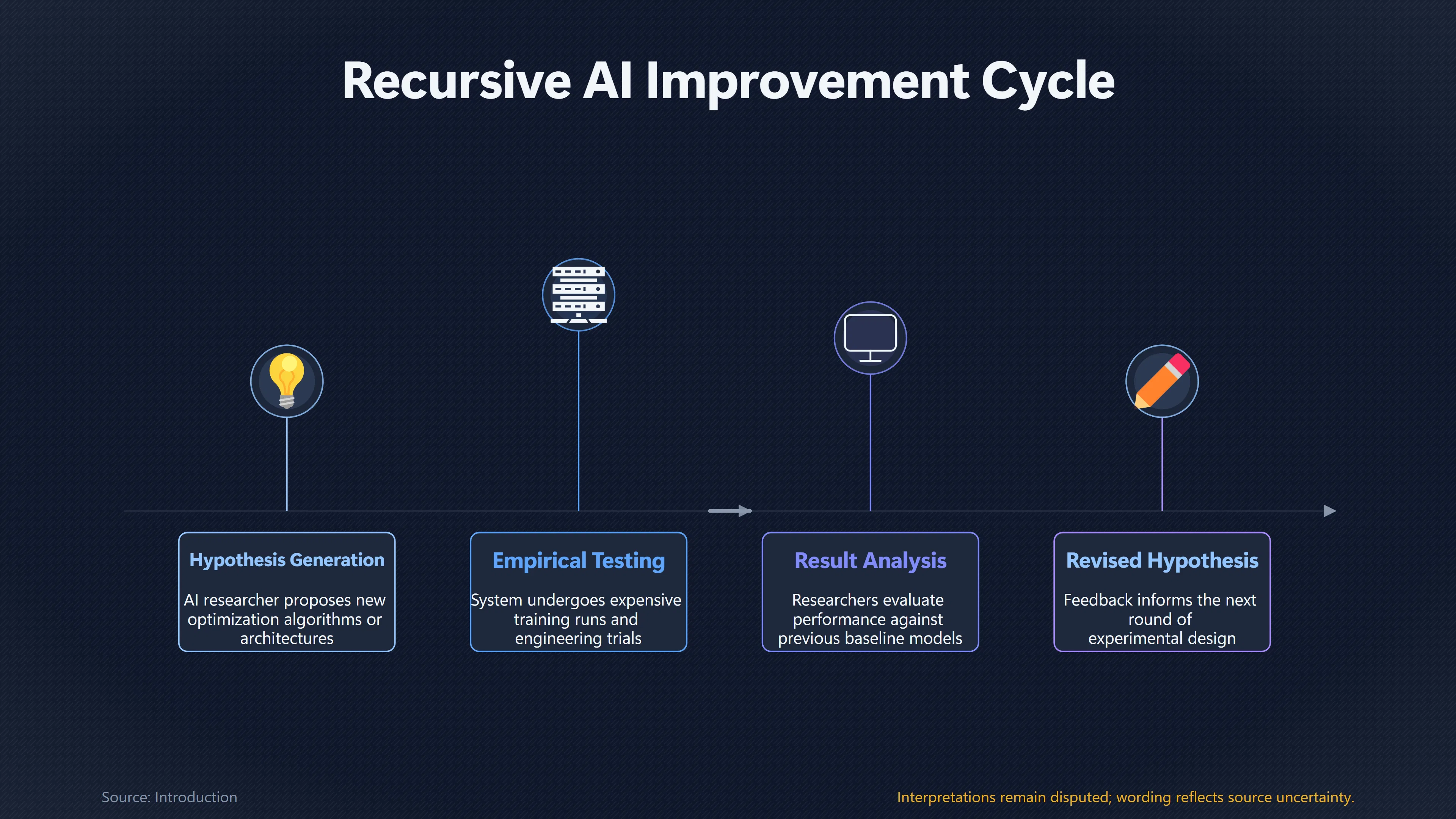
This distinction between thinking and testing matters because AI research is an empirical science. Unlike mathematics, where some results can be proved directly, machine learning advances usually emerge from repeated trial and error. If experiments consume days or weeks of computing time and many discoveries depend on earlier results, experimentation itself may impose a hard speed limit on recursive AI improvement. Whether that limit is strong enough to prevent an intelligence explosion remains disputed.
Why promising AI ideas still need costly trials
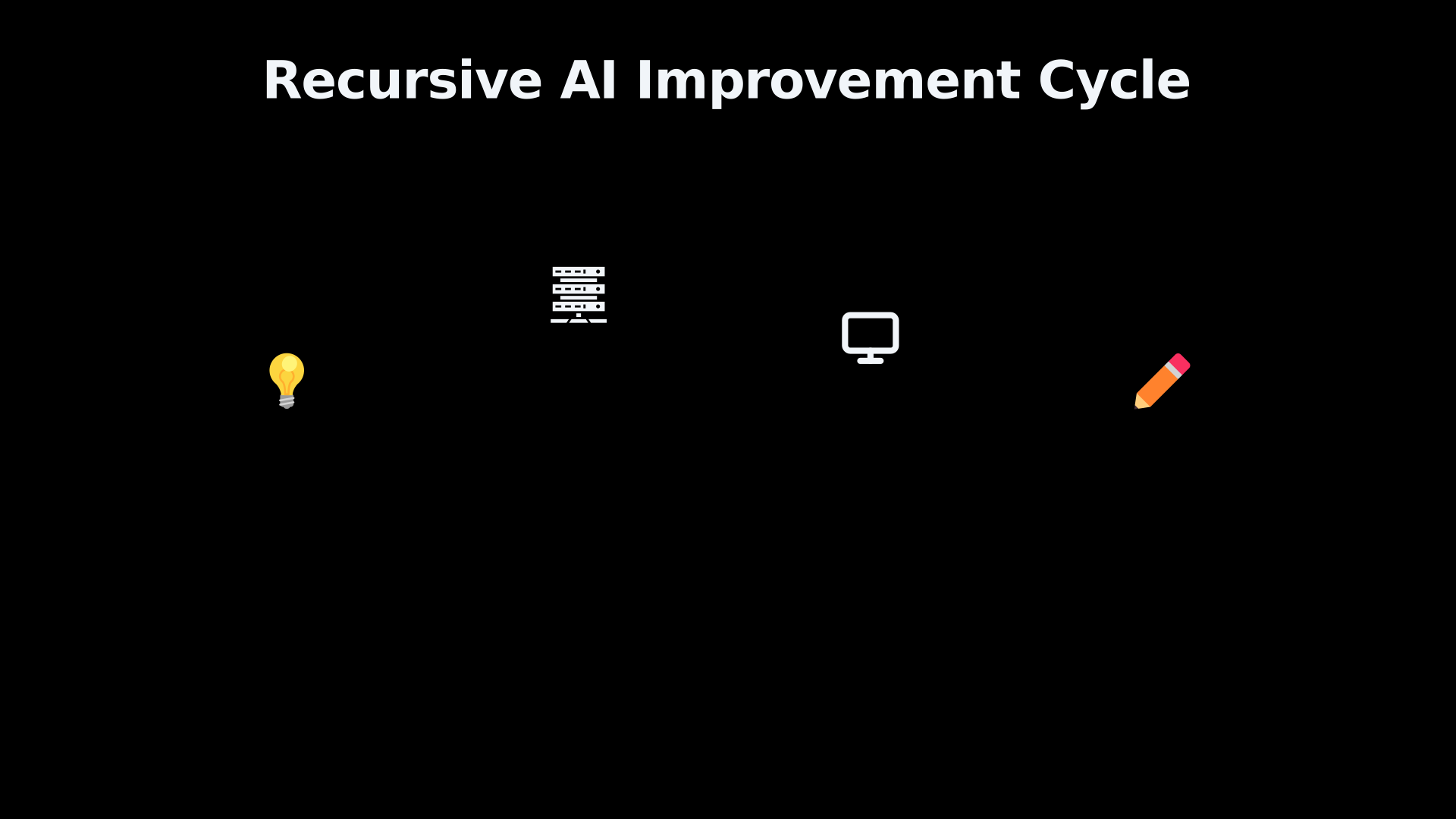
Modern AI systems are designed through a continual cycle of hypothesis, implementation and measurement. Researchers rarely know in advance whether a new training method, model architecture or data mixture will improve performance. Instead, they build the system, train it, evaluate it and compare the results with previous approaches.
That empirical process is unusually expensive at the frontier. A single large training run may consume enormous computing resources, require specialised engineering support and take weeks or months to complete. Smaller-scale experiments are faster, but they often provide only partial evidence about whether an idea will continue to work when scaled to frontier models.[OpenAI]OpenAIOpen AIScaling laws for neural language models | Open AIScaling laws for neural language models | OpenAI…
This creates an asymmetry between idea generation and evidence generation.
An advanced AI researcher might rapidly produce:
- dozens of candidate optimisation algorithms;
- alternative neural network architectures;
- improved training schedules;
- novel data filtering techniques; or
- better evaluation methods.
However, most of those ideas would still require empirical validation. Until experiments identify which proposals genuinely improve capability, the ideas themselves have little practical value.
This is why many researchers distinguish between cognitive labour and experimental throughput. Intelligence may generate hypotheses quickly, but scientific progress also depends on obtaining reliable feedback from the real world.
When sequential experiments block full parallelisation
It is tempting to imagine simply running every possible experiment simultaneously. In practice, AI research is rarely that parallel.
Many important decisions depend on the results of earlier experiments. For example, researchers might first compare several optimisation methods before deciding which one deserves a larger training run. They may then discover an unexpected failure mode that changes the next round of experiments entirely.
This creates a chain of dependencies:
- Propose an improvement.
- Run experiments.
- Analyse the results.
- Generate revised hypotheses.
- Repeat.
Each cycle produces information needed for the next one.
Some experiments can certainly proceed in parallel, especially independent ablation studies or small prototype models. Yet complete parallelisation is often impossible because later questions cannot even be formulated until earlier evidence exists. This is a familiar feature of scientific research generally, not just machine learning.
The consequence is that faster thinking does not necessarily eliminate elapsed time. If every important research cycle requires a period of observation before the next decision, recursive improvement retains an irreducible sequential component.[Forethought]forethought.orgWill Compute Bottlenecks Prevent a Software Intelligence Explosion?Will Compute Bottlenecks Prevent a Software Intelligence Explosion?April 4, 2025…
Why more compute does not automatically remove the bottleneck
One obvious response is to allocate more computing power and run many more experiments simultaneously.
This certainly helps, but only up to a point.
Large AI laboratories already divide available compute across many competing research projects. As models become larger, each frontier experiment consumes a greater share of total computing resources. Eventually researchers must choose which hypotheses deserve scarce compute rather than testing everything.
Moreover, simply multiplying experiments does not guarantee proportional progress.
Some experiments duplicate one another. Others fail because they investigate the wrong question. Many produce ambiguous results requiring follow-up work. Scientific discovery therefore depends not only on the number of experiments but also on selecting informative ones.
This is one reason forecasts of recursive self-improvement often focus on effective experimentation, not merely raw computational capacity. Better experimental design can accelerate research, but poor experiments merely consume resources faster.
Could AI make experiments themselves more efficient?
Supporters of faster take-off scenarios argue that experimental bottlenecks need not remain fixed.
An AI capable of automating AI research might improve the entire research pipeline rather than simply proposing more ideas. Possible improvements include:
- designing more informative experiments;
- predicting unsuccessful approaches before training them;
- extracting more information from small-scale models;
- developing better scaling laws that reduce uncertainty; and
- discovering algorithms that require much less compute.
Historically, algorithmic improvements have often delivered large efficiency gains, allowing researchers to achieve previous performance levels using far less computation than before. That history suggests experimentation itself may become increasingly efficient rather than remaining permanently constrained by today’s methods.[OpenAI]OpenAIOpen AIScaling laws for neural language models | Open AIScaling laws for neural language models | OpenAI…
Critics respond that these gains cannot continue indefinitely. Eventually, they argue, genuinely new capabilities may still require expensive frontier-scale validation regardless of how intelligently experiments are chosen.
This disagreement lies at the centre of current debates rather than being settled by existing evidence.
How experimental bottlenecks change fast-takeoff forecasts
Within AI doom discussions, experimental limits primarily affect timing, not necessarily the possibility of highly capable AI.
If experimentation imposes a strong speed limit:
- recursive improvement may unfold over years rather than weeks;
- governments, competing laboratories and safety researchers gain more time to react;
- alignment research can incorporate observations from intermediate systems; and
- warning signs of dangerous behaviour may become visible before capability jumps become overwhelming.
If the bottleneck proves weak, the opposite becomes more plausible. Highly capable AI systems might automate increasing portions of AI research, shorten experimental cycles, improve algorithmic efficiency and accelerate successive generations quickly enough that human institutions struggle to keep pace.[Forethought]forethought.orgWill AI R&D Automation Cause a Software Intelligence Explosion?Will AI R&D Automation Cause a Software Intelligence Explosion?…
Notice that these are not all-or-nothing possibilities. A substantial acceleration—from years to months, for example—could still create governance and control challenges even if a truly instantaneous intelligence explosion never occurs.

What evidence would change the debate?
The disagreement is partly empirical because no AI system has yet demonstrated fully autonomous recursive improvement at the frontier.
Evidence supporting a stronger experimental bottleneck would include:
- frontier training runs continuing to require long, largely unavoidable validation periods;
- diminishing returns from running more experiments in parallel;
- discoveries depending heavily on sequential learning from previous trials; and
- hardware and experimental throughput remaining difficult to substitute with additional AI researchers.
Evidence supporting a weaker bottleneck would include:
- AI systems reliably designing experiments that outperform human researchers;
- algorithmic advances dramatically reducing the compute required for frontier validation;
- successful prediction of large-scale training outcomes from much smaller experiments; and
- increasingly autonomous research systems completing many validated improvement cycles with minimal human intervention.
Recent theoretical work reflects this uncertainty. Some analyses argue compute and experiments may cap the speed of software-only recursive improvement, while others contend that better algorithms, more efficient experimentation and improved allocation of compute could postpone those limits until much later stages. Both sides acknowledge that the key uncertainty is not whether experiments matter, but how much they can themselves be accelerated.[Forethought]forethought.orgWill Compute Bottlenecks Prevent a Software Intelligence Explosion?Will Compute Bottlenecks Prevent a Software Intelligence Explosion?April 4, 2025…
The bottom line
The idea that AI experiments impose a hard speed limit rests on a simple observation: discovering good ideas is only part of scientific progress. Those ideas must also survive empirical testing.
For AI doom forecasts, this distinction is significant. Recursive self-improvement depends not only on how quickly an AI can think, but also on how quickly reality can tell it whether those thoughts are correct. If experiments remain slow, expensive and partly sequential, they could substantially slow any intelligence explosion. If AI systems eventually learn to compress or automate the experimental process itself, that constraint may weaken.
Current evidence does not decisively favour either conclusion. Experimental bottlenecks are therefore best understood as one of the main uncertainties shaping forecasts about whether advanced AI would improve gradually enough for society to respond, or rapidly enough to outpace meaningful human oversight.[Forethought]forethought.orgWill Compute Bottlenecks Prevent a Software Intelligence Explosion?Will Compute Bottlenecks Prevent a Software Intelligence Explosion?April 4, 2025…
Amazon book picks
Further Reading
Books and field guides related to Can AI Think Faster Than It Can Test?. Use these as the next step if you want deeper reading beyond the article.
Human Compatible
A leading artificial intelligence researcher lays out a new approach to AI that will enable us to coexist successfully with increasingly...
The Alignment Problem
Finalist for the Los Angeles Times Book Prize A jaw-dropping exploration of everything that goes wrong when we build AI systems and the m...
Artificial Intelligence: A Modern Approach
Rating: 4.5/5 from 10 Google Books ratings
Artificial intelligence: A Modern Approach, 3e,is ideal for one or two-semester, undergraduate or graduate-level courses in Artificial In...
Deep Learning
Rating: 3.5/5 from 6 Google Books ratings
An introduction to a broad range of topics in deep learning, covering mathematical and conceptual background, deep learning techniques us...
eBay marketplace picks
Marketplace Samples
Live-tested eBay searches with available results related to this page.
Selected frommachine learning sticker oneBay.co.uk.



Endnotes
1.
Source: forethought.org
Title: Will Compute Bottlenecks Prevent a Software Intelligence Explosion?
Link:https://www.forethought.org/research/will-compute-bottlenecks-prevent-a-software-intelligence-explosion
Source snippet
Will Compute Bottlenecks Prevent a Software Intelligence Explosion?April 4, 2025...
Published: April 4, 2025
2.
Source: forethought.org
Title: Will AI R&D Automation Cause a Software Intelligence Explosion?
Link:https://www.forethought.org/research/will-ai-r-and-d-automation-cause-a-software-intelligence-explosion
Source snippet
Will AI R&D Automation Cause a Software Intelligence Explosion?...
3.
Source: OpenAI
Title: Open AIScaling laws for neural language models | Open AI
Link:https://openai.com/index/scaling-laws-for-neural-language-models/
Source snippet
Scaling laws for neural language models | OpenAI...
4.
Source: newsletter.forethought.org
Link:https://newsletter.forethought.org/p/ai-for-ai-for-epistemics
5.
Source: newsletter.forethought.org
Title: how quick and big would a software
Link:https://newsletter.forethought.org/p/how-quick-and-big-would-a-software
6.
Source: forethought.org
Title: Three Types of Intelligence Explosion
Link:https://www.forethought.org/research/three-types-of-intelligence-explosion
7.
Source: newsletter.forethought.org
Title: three types of intelligence explosion
Link:https://newsletter.forethought.org/p/three-types-of-intelligence-explosion
8.
Source: OpenAI
Title: how ai training scales
Link:https://openai.com/index/how-ai-training-scales/
9.
Source: forethought.org
Link:https://www.forethought.org/research
10.
Source: forethought.org
Link:https://www.forethought.org/
11.
Source: amodei.co
Link:https://www.amodei.co/resources.html
Additional References
12.
Source: marlowblog.us
Link:https://marlowblog.us/post/unbundling-the-intelligence-explosion/
Source snippet
Unbundling the intelligence explosion — MarlowJune 4, 2026 — UNBUNDLING THE INTELLIGENCE EXPLOSION Jun 4, 2026 Recursive self-improvement...
Published: June 4, 2026
13.
Source: blog.terabox.com
Title: dario amodei ai scaling laws path to agi
Link:https://blog.terabox.com/insights/dario-amodei-ai-scaling-laws-path-to-agi
Source snippet
Amodei On AI Scaling Laws And The Path To AGIJuly 27, 2026 — DARIO AMODEI ON AI SCALING LAWS AND THE PATH TO AGI Insights flextech-admin...
Published: July 27, 2026
14.
Source: howardism.dev
Title: Genetic (genotypic RSI) — impr
Link:https://www.howardism.dev/articles/intelligence-explosion-dynamics
Source snippet
Intelligence Explosion DynamicsJune 15, 2026 — FOUR MECHANISMS (MAPPED TO HUMAN EVOLUTION)# The report maps recursive-improve...
Published: June 15, 2026
15.
Source: youtube.com
Title: From AGI to ASI: Pathways, Bottlenecks, and the Limits of Machine Intelligence
Link:https://www.youtube.com/watch?v=4q2XeMAOwUw
Source snippet
The AI Intelligence Explosion: Why Recursive Self-Improvement Changes Everything...
16.
Source: youtube.com
Title: A.I. ‐ Humanity’s Final Invention?
Link:https://www.youtube.com/watch?v=fa8k8IQ1_X0
Source snippet
Des Robots qui Construisent des Usines de Robots – avec Tom Davidson (Forethought Institute) The Flares · 1.7K views...
17.
Source: youtube.com
Title: The AI Intelligence Explosion: Why Recursive Self-Improvement Changes Everything
Link:https://www.youtube.com/watch?v=xRQQFCWhobc
Source snippet
AI 2027: A Realistic Scenario of AI Takeover...
18.
Source: youtube.com
Title: Is runaway AI coming in years or decades?
Link:https://www.youtube.com/watch?v=nqjSLxDHskc
Source snippet
From AGI to ASI: Pathways, Bottlenecks, and the Limits of Machine Intelligence...
19.
Source: naotonakada.org
Title: An AI that
Link:https://naotonakada.org/blog/intelligence-explosion-recursive-self-improvement/
Source snippet
The Intelligence Explosion, Explained | Nakada FoundationMay 12, 2026 — Blog / Explainer EXPLAINER · MAY 12, 2026 THE INTELLIGENCE Explos...
Published: May 12, 2026
20.
Source: idavidrein.com
Title: a softwa
Link:https://idavidrein.com/posts/compute-bottleneck.html
Source snippet
The Compute Bottleneck Intuition Is Formed Under Unusual Conditions - David ReinApril 13, 2026 — THE COMPUTE BOTTLENECK INTUITION IS FORM...
Published: April 13, 2026
21.
Source: arxiv.org
Title: arXiv Will Compute Bottlenecks Prevent an Intelligence Explosion?
Link:https://arxiv.org/abs/2507.23181