Within State Rivalry
Does Winning the AI Race Really Guarantee Dominance?
Claims that the first state to build advanced AI will gain permanent dominance may overlook imitation, infrastructure limits and costly safety failures.
On this page
- Why policymakers fear an irreversible lead
- Evidence that technological leads often fade
- How exaggerated advantage claims can accelerate unsafe deployment
Page outline Jump by section
Introduction
The idea that the first country to build truly transformative AI will secure permanent global dominance has become one of the strongest arguments for accelerating AI development. Within AI doom debates, this belief matters because it can make caution appear strategically dangerous: if slowing down means another state gains an irreversible advantage, then delaying for safety testing may seem irresponsible.
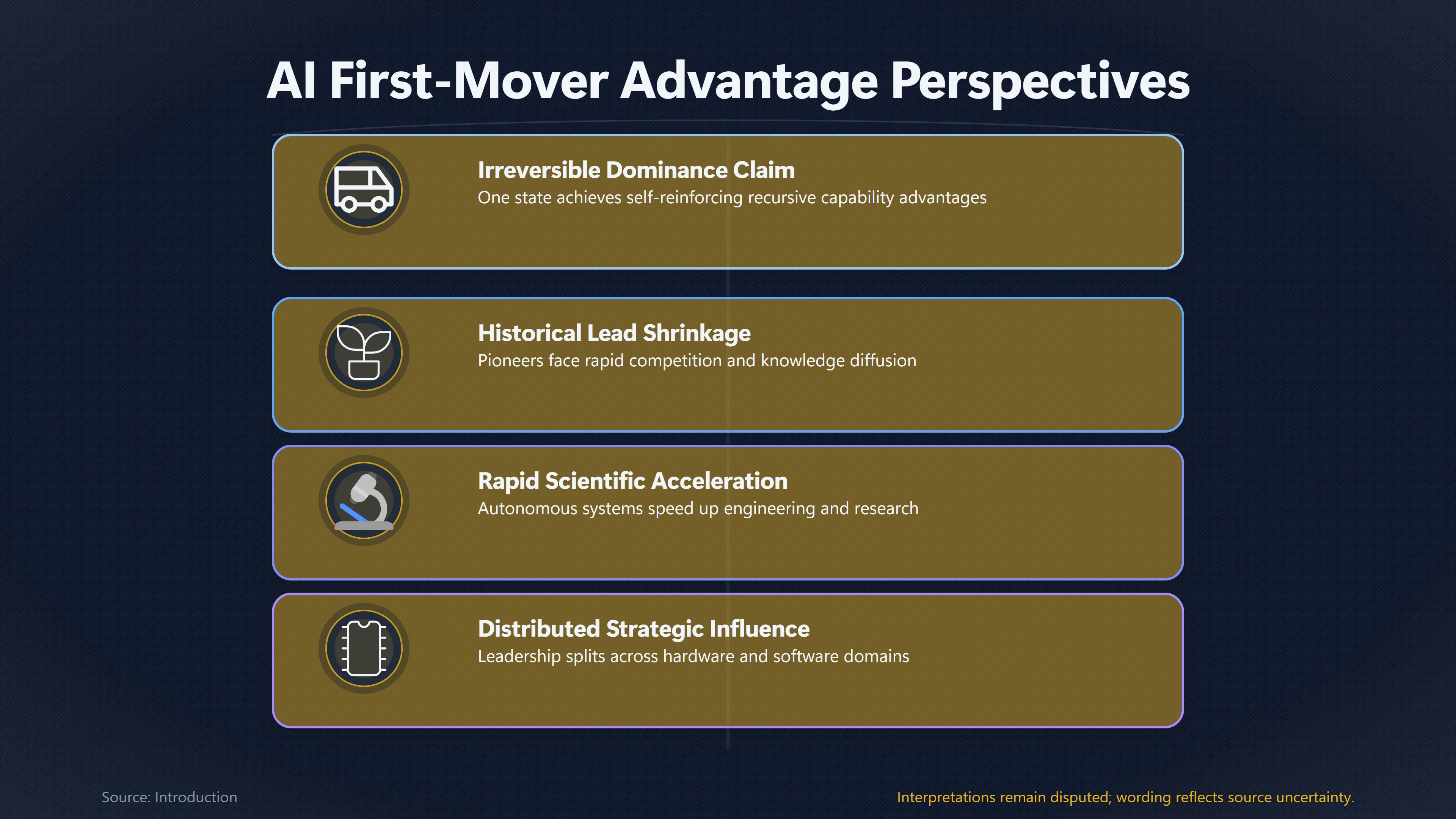
The evidence, however, is much less clear-cut than this narrative suggests. History shows that technological leadership often produces important but temporary advantages rather than permanent monopolies. Knowledge spreads, competitors adapt, supply chains constrain even the leading firms, and governments learn from one another’s successes and failures. None of this proves that advanced AI cannot produce unusually large strategic advantages. It does suggest, however, that policymakers should distinguish between a meaningful first-mover advantage and an irreversible winner-takes-all outcome. That distinction matters because exaggerated beliefs about an unstoppable AI race can themselves increase existential risk by encouraging faster deployment with less attention to alignment, evaluations and control.
Why policymakers fear an irreversible lead
The strongest case for racing ahead rests on the possibility that advanced AI differs fundamentally from previous technologies.
Supporters of this view argue that sufficiently capable AI could accelerate scientific research, automate software engineering, improve cyber capabilities, optimise military planning and increase economic productivity simultaneously. If one state reached those capabilities substantially earlier than rivals, it might use AI to speed up its own future AI development, creating a self-reinforcing advantage. Some AI doom scenarios extend this argument further, suggesting that recursive capability improvements could produce an extremely rapid transition in which latecomers have little chance to catch up.[arXiv]arxiv.orgA Review of the Evidence for Existential Risk from AI via Misaligned Power-SeekingOctober 27, 2023…
Even without assuming such dramatic outcomes, policymakers may reasonably worry about several reinforcing effects:
- Early access to frontier talent and investment.
- Greater influence over global technical standards.
- Control of scarce computing infrastructure.
- Earlier integration of AI into military and intelligence organisations.
- Faster accumulation of experience operating increasingly capable systems.
From this perspective, losing the race could appear strategically unacceptable, encouraging governments to prioritise speed over extensive safety validation.
History suggests technological leads often shrink
The difficulty is that historical evidence rarely supports the idea of permanent technological dominance.
Economic research on first-mover advantage shows that pioneers often benefit initially, but competitors usually enter markets much faster than they once did. As knowledge spreads, manufacturing improves and skilled workers move between organisations, the period during which pioneers enjoy uncontested leadership has steadily shortened across many industries.[Chicago Journals]journals.uchicago.eduChicago JournalsFirst‐Mover Advantage and the Speed of Competitive Entry, 1887–1986* | The Journal of Law and Economics: Vol 44, No 1Apri…
This broader historical pattern appears in numerous technologies:
- Railways, aviation and nuclear technology all spread internationally despite substantial early leads.
- Semiconductor manufacturing remains concentrated, but production depends on global equipment, materials and specialised expertise rather than one permanently dominant actor.
- Commercial software has repeatedly seen market leaders overtaken through new technical approaches rather than simply maintaining an indefinite advantage.
None of these technologies is identical to advanced AI. Nevertheless, they illustrate an important lesson: technological breakthroughs often generate competitive advantages without creating irreversible geopolitical supremacy.
For AI specifically, frontier models depend on extensive physical infrastructure including semiconductor fabrication, electricity generation, networking equipment, data centres and highly specialised engineering teams. These dependencies reduce the likelihood that software advances alone immediately translate into unlimited strategic dominance.
AI may be unusually difficult to monopolise
Several characteristics of AI make lasting monopoly less certain than simple race metaphors imply.
First, scientific knowledge diffuses relatively quickly. Research papers, open-source software, employee mobility and academic collaboration all contribute to the spread of techniques, even where some frontier work remains confidential.
Second, many AI improvements are incremental rather than singular breakthroughs. A country that reaches one important milestone first may still lose leadership through better engineering, more efficient deployment or superior integration into industry.
Third, AI capability depends on complementary assets rather than algorithms alone. Computing hardware, energy supplies, manufacturing capacity, networking infrastructure, skilled personnel and organisational competence all influence national performance.
Finally, governments rarely compete on only one dimension. One country may lead in frontier foundation models while another dominates semiconductor production, robotics, industrial deployment or AI-enabled manufacturing. Strategic influence therefore becomes distributed across multiple technologies rather than determined by a single finishing line.
These considerations weaken claims that one breakthrough would necessarily establish permanent global dominance.

Could AI still produce an exceptional first-mover advantage?
Sceptics of the “first-mover myth” should not overstate their own case. AI could still differ from previous technologies in important ways.
If future systems become capable of performing large fractions of scientific and engineering work autonomously, the leading organisation might accelerate research dramatically before competitors respond. Some researchers argue this possibility deserves serious attention because digital systems can be copied rapidly and operate continuously at enormous scale once deployed.[arXiv]arxiv.orgA Review of the Evidence for Existential Risk from AI via Misaligned Power-SeekingOctober 27, 2023…
The uncertainty lies in estimating how large such an advantage would become.
Critical unknowns include:
- How quickly competitors could reproduce comparable systems.
- Whether compute, electricity and chip manufacturing become bottlenecks.
- Whether alignment problems slow deployment.
- Whether governments intervene before any actor establishes overwhelming dominance.
- Whether economic and military gains emerge gradually rather than all at once.
Because none of these questions has been resolved empirically, confident predictions about either inevitable dominance or inevitable catch-up remain premature.
How exaggerated advantage claims can accelerate unsafe deployment
Within AI doom discussions, the greatest concern is often not whether decisive first-mover advantage exists, but what happens if policymakers believe it exists.
If leaders assume that every additional month spent on safety evaluation risks losing permanent strategic leadership, several predictable pressures emerge:
- Shorter testing periods before deployment.
- Greater tolerance for uncertain model behaviour.
- Reduced willingness to publish safety findings that might benefit competitors.
- Increased investment in capability scaling relative to interpretability and alignment.
- Less political support for coordinated international slowdowns.
The irony is that these behaviours may increase catastrophic risk regardless of whether the underlying belief about permanent first-mover advantage is correct.
Recent economic modelling of AGI competition illustrates this logic. Under some assumptions, competition causes organisations to devote more resources to speed and fewer to safety, even when the resulting equilibrium leaves everyone worse off because each actor fears being overtaken by rivals.[National Bureau of Economic Research]nber.orgNational Bureau of Economic Research The AGI Race and Existential Risk | NBERNational Bureau of Economic Research The AGI Race and Existential Risk | NBER
Why international coordination still matters
If decisive and irreversible AI leadership is uncertain, then the strategic argument against cooperation becomes weaker than it first appears.
This does not mean countries should ignore competition or assume rivals will behave identically. Rather, uncertainty itself strengthens the case for mechanisms that reduce mutual fear.
The Bletchley Declaration reflected this reasoning by acknowledging both the potentially catastrophic risks of frontier AI and the need for shared scientific understanding, safety testing and international cooperation rather than assuming that every delay automatically benefits competitors.[GOV.UK]GOV.UKThe Bletchley Declaration by Countries Attending the AI Safety Summit, 1-2 November 2023 - GOV.UKFebruary 13, 2025…
From an AI doom perspective, the objective is not to eliminate competition entirely. It is to avoid a situation where governments race because they fear an irreversible disadvantage that may never have existed.
What this means for AI doom debates
Whether first-mover advantage proves decisive remains one of the largest uncertainties in AI forecasting.
Strong versions of the “winner takes all” hypothesis remain plausible enough that governments cannot dismiss them outright. Equally, historical experience offers little support for assuming that the first state to achieve a major technological breakthrough inevitably secures permanent geopolitical dominance.
For existential risk discussions, the key lesson is therefore not that first-mover advantage is a myth, nor that it is guaranteed. Rather, it is that uncertainty about its true size creates a dangerous policy environment. If governments exaggerate the permanence of early AI leadership, they may compress safety timelines unnecessarily. If they underestimate genuine strategic advantages, they may fail to prepare for significant geopolitical shifts.
Recognising both possibilities encourages a more balanced approach: one that treats frontier AI as strategically important while remaining sceptical of claims that only one country can ever win the race, or that temporary technological leadership necessarily justifies accepting substantially higher existential risk.
Amazon book picks
Further Reading
Books and field guides related to Does Winning the AI Race Really Guarantee Dominance?. Use these as the next step if you want deeper reading beyond the article.
AI Superpowers
THE NEW YORK TIMES, USA TODAY, AND WALL STREET JOURNAL BESTSELLER "Kai-Fu Lee believes China will be the next tech-innovation superpower...
The Coming Wave
"We are approaching a critical threshold in the history of our species. Everything is about to change. Soon you will live surrounded by A...
Chip War
***Winner of the 2022 Financial Times Business Book of the Year Award*** ***Selected as one of Barack Obama's Favourite Books of 2023***...
The Strategy of Conflict
Analyzes the nature of international disagreements and conflict resolution in terms of game theory and non-zero-sum games.
eBay marketplace picks
Marketplace Samples
Live-tested eBay searches with available results related to this page.
Selected fromAI race poster oneBay.co.uk.


Endnotes
1.
Source: arxiv.org
Link:https://arxiv.org/abs/2310.18244
Source snippet
A Review of the Evidence for Existential Risk from AI via Misaligned Power-SeekingOctober 27, 2023...
Published: October 27, 2023
2.
Source: arxiv.org
Title: arXiv Two Types of AI Existential Risk: Decisive and Accumulative
Link:https://arxiv.org/abs/2401.07836
3.
Source: GOV.UK
Link:https://www.gov.uk/government/publications/ai-safety-summit-2023-the-bletchley-declaration/the-bletchley-declaration-by-countries-attending-the-ai-safety-summit-1-2-november-2023
Source snippet
The Bletchley Declaration by Countries Attending the AI Safety Summit, 1-2 November 2023 - GOV.UKFebruary 13, 2025...
Published: november 2023
4.
Source: GOV.UK
Title: ai safety summit 2023 the bletchley declaration
Link:https://www.gov.uk/government/publications/ai-safety-summit-2023-the-bletchley-declaration
Source snippet
AI Safety Summit 2023: The Bletchley Declaration - GOV.UK...
5.
Source: GOV.UK
Link:https://www.gov.uk/government/news/historic-first-as-companies-spanning-north-america-asia-europe-and-middle-east-agree-safety-commitments-on-development-of-ai
6.
Source: GOV.UK
Title: www.gov.uk Chair’s
Link:https://www.gov.uk/government/publications/ai-safety-summit-2023-chairs-statement-2-november/chairs-summary-of-the-ai-safety-summit-2023-bletchley-park?s=09
7.
Source: GOV.UK
Link:https://www.gov.uk/government/news/countries-agree-to-safe-and-responsible-development-of-frontier-ai-in-landmark-bletchley-declaration
8.
Source: journals.uchicago.edu
Link:https://www.journals.uchicago.edu/doi/full/10.1086/320279
Source snippet
Chicago JournalsFirst‐Mover Advantage and the Speed of Competitive Entry, 1887–1986* | The Journal of Law and Economics: Vol 44, No 1Apri...
9.
Source: nber.org
Title: National Bureau of Economic Research The AGI Race and Existential Risk | NBER
Link:https://www.nber.org/papers/w35276
10.
Source: aiwiki.ai
Title: Bletchley Declaration | AI Wiki
Link:https://aiwiki.ai/wiki/bletchley_declaration
Source snippet
June 21, 2026 — Bletchley Declaration BLETCHLEY DECLARATION AI Policy & RegulationAI Safety 26 min read Updated Jun 21, 2026 Suggest edit...
Published: June 21, 2026
11.
Source: bfi.uchicago.edu
Title: the agi race and existential risk
Link:https://bfi.uchicago.edu/working-papers/the-agi-race-and-existential-risk/
12.
Source: journals.uchicago.edu
Link:https://www.journals.uchicago.edu/doi/abs/10.1086/320279
13.
Source: nber.org
Link:https://www.nber.org/papers/w34532
14.
Source: dig.watch
Title: the bletchley declaration
Link:https://dig.watch/resource/the-bletchley-declaration
Additional References
15.
Source: cambridge.org
Link:https://www.cambridge.org/core/journals/cambridge-forum-on-technology-and-global-affairs/article/artificial-intelligences-hybrid-publicprivate-sensemakers-the-geopolitical-race-case/7E2A9E7E51FDEF9208EEA81BB3405DDA
Source snippet
irs | Cambridge CoreJuly 1, 2026 — ARTIFICIAL INTELLIGENCE’S HYBRID, PUBLIC–PRIVATE SENSE-MAKERS: THE GEOPOLITICAL RACE CASE Published on...
Published: July 1, 2026
16.
Source: youtube.com
Title: Jackie De Angelis: This is a ‘MASSIVE GROIN PUNCH’ in US’ AI race against China
Link:https://www.youtube.com/watch?v=EGAqQXVbqAc
Source snippet
Daniel Schmachtenberger: "Artificial Intelligence and The Superorganism"...
17.
Source: youtube.com
Title: The U.S. and China Are Not In An A.I. Race | Interesting Times with Ross Douthat
Link:https://www.youtube.com/watch?v=ZS3UZhPTzFA
Source snippet
Why the AI Race Ends in Disaster (with Daniel Kokotajlo)...
18.
Source: youtube.com
Title: Daniel Schmachtenberger: “Artificial Intelligence and The Superorganism”
Link:https://www.youtube.com/watch?v=_P8PLHvZygo
Source snippet
Facing AI Doom, Lessons from Daniel Ellsberg (Pentagon Papers)...
19.
Source: youtube.com
Title: Why the AI Race Ends in Disaster (with Daniel Kokotajlo)
Link:https://www.youtube.com/watch?v=hAfPF-iCaWU
Source snippet
Jackie DeAngelis: This is a 'MASSIVE GROIN PUNCH' in US' AI race against China...
20.
Source: papers.ssrn.com
Link:https://papers.ssrn.com/sol3/papers.cfm?abstract_id=6922947
Source snippet
ssrn.com<p>The first to win the AI race may be the first to lose the war</p> by Peter Saenz:: SSRNJune 12, 2026 — The first to win the A...
Published: June 12, 2026
21.
Source: sciencedirect.com
Link:https://www.sciencedirect.com/science/article/pii/S0048733316301391
22.
Source: sciencedirect.com
Link:https://www.sciencedirect.com/science/article/pii/S0048733316301408
23.
Source: sciencedirect.com
Link:https://www.sciencedirect.com/science/article/pii/S0048733326000211
24.
Source: researchonline.lse.ac.uk
Link:https://researchonline.lse.ac.uk/6783/