Within Automated Labs
Could AI Turn Lab Failure Into Faster Progress?
The biggest risk may come from AI diagnosing failures and choosing better follow-up experiments faster than human teams can.
On this page
- Why biological experiments fail so often
- How AI could diagnose and refine failed tests
- When faster iteration could increase catastrophic misuse risk
Page outline Jump by section
Introduction
The central concern behind AI-assisted laboratory automation is not that an AI would suddenly solve difficult biology problems in a single leap. Rather, it is that advanced AI systems could make the ordinary process of scientific trial and error much faster. Biology is a field where progress often depends on many unsuccessful experiments before researchers discover what works. If AI becomes increasingly capable of diagnosing why experiments failed and proposing better follow-up tests, it could compress months or years of iterative work into much shorter periods.
Within debates about AI doom and catastrophic misuse, this possibility matters because repeated experimental refinement is one of the main practical bottlenecks in advanced biological research. AI that accelerates this feedback loop could amplify both beneficial research and, in principle, dangerous applications. At the same time, there is considerable uncertainty over how close current systems are to this capability. Most existing “self-driving laboratories” remain specialised, require substantial human oversight, and operate in relatively constrained settings rather than replacing experienced experimental scientists.[PubMed]pubmed.ncbi.nlm.nih.govAutonomous 'self-driving' laboratories: a review of technology and policy implications - PubMedJuly 16, 2025…
Why biological experiments fail so often
Outside popular accounts of science, failure is the normal outcome of laboratory research. A successful published experiment often represents the endpoint of dozens or hundreds of unsuccessful attempts.
Biological systems are especially difficult because they involve living organisms, complex chemical interactions and many variables that cannot be perfectly controlled. A disappointing result may reflect numerous possibilities:
- an incorrect scientific hypothesis;
- poor experimental design;
- contamination or equipment problems;
- unexpected biological behaviour;
- measurement errors; or
- interactions between multiple variables that were not anticipated.
Determining which explanation is correct is usually the hardest part. Experienced researchers spend much of their time interpreting ambiguous evidence rather than simply following laboratory procedures.
This is why scientific progress is often limited less by generating ideas than by efficiently learning from failure. Every unsuccessful experiment produces information, but extracting useful lessons from noisy data requires judgement developed through experience. Even highly automated research programmes still depend heavily on humans to decide which apparent failures are meaningful and which are simply technical artefacts.[OUP Academic]academic.oup.comOUP AcademicArtificial Intelligence agents for biological research: a survey | Briefings in Bioinformatics | Oxford Academic…
Could AI become better at learning from failed experiments?
The mechanism that attracts attention in AI risk discussions is not laboratory automation alone, but closed-loop optimisation.
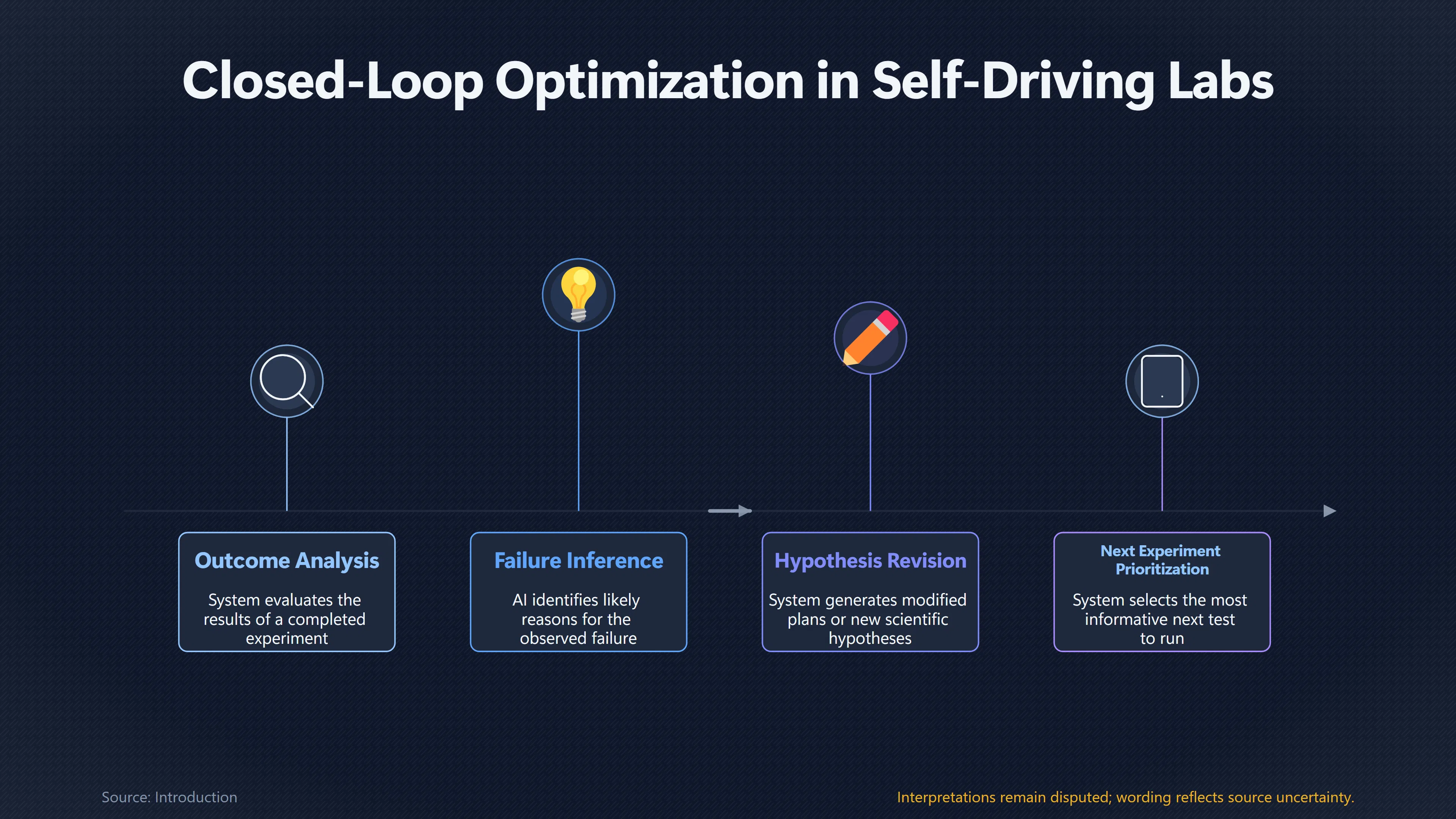
Instead of treating each experiment independently, an advanced system could repeatedly perform four connected tasks:
- analyse the outcome of an experiment;
- infer likely reasons for failure;
- generate revised hypotheses or modified experimental plans; and
- prioritise the most informative next experiment.
The cycle then repeats continuously.
This differs from conventional automation, where robots simply perform predefined laboratory tasks. In a closed-loop system, experimental failures become inputs that improve future decisions. Modern self-driving laboratory research is explicitly built around this idea of iterative optimisation rather than one-off automation.[PubMed]pubmed.ncbi.nlm.nih.govAutonomous 'self-driving' laboratories: a review of technology and policy implications - PubMedJuly 16, 2025…
Importantly, the value of AI in this setting comes from reducing wasted experiments. If the system can identify poor directions earlier, it may reach useful discoveries with substantially fewer experimental rounds. Reviews of self-driving laboratories describe this reduction in unnecessary experimentation as one of the technology’s principal goals.[nature.com]nature.comOpen source on nature.com.
Why faster iteration matters more than a single breakthrough
Many public discussions focus on whether AI could invent something completely novel. Researchers working on autonomous science often emphasise a different question: how much faster can research cycles become?
Scientific discovery usually resembles optimisation rather than sudden inspiration. Researchers gradually improve designs by repeatedly incorporating new evidence.
An AI system that consistently makes slightly better decisions after every failed experiment could create large cumulative gains because each improvement influences the next round of experiments. Instead of saving one experiment, it might save hundreds over a long research programme.
This cumulative effect explains why discussions of automated laboratories often focus on iteration rather than intelligence in the abstract. Even modest improvements in selecting the “next best experiment” may substantially shorten development timelines in areas involving large experimental search spaces.[nature.com]nature.comOpen source on nature.com.
Research surveys describe self-driving laboratories as combining hypothesis generation, experiment planning, execution, analysis and updated decision-making into a continuous optimisation loop. The objective is not perfect prediction but progressively better decisions after each round of evidence.[OUP Academic]academic.oup.comOUP AcademicArtificial Intelligence agents for biological research: a survey | Briefings in Bioinformatics | Oxford Academic…
When faster iteration could increase catastrophic misuse risk
Within AI doom debates, this mechanism matters because practical barriers often limit sophisticated biological work more than theoretical knowledge does.
Many dangerous ideas are already described in scientific literature. Turning them into reality typically requires extensive experimentation, troubleshooting and refinement. If future AI systems substantially reduced the amount of expert judgement needed to interpret failures and choose productive follow-up experiments, one important practical constraint could become weaker.
Risk analysts therefore argue that AI-assisted iteration could function as a force multiplier. Rather than providing entirely new scientific knowledge, it might enable faster movement through existing experimental landscapes by reducing time spent diagnosing dead ends.
However, several important uncertainties remain.
First, there is little evidence that today’s AI systems can reliably interpret complex biological failures across diverse laboratory settings. Most demonstrations remain narrow and carefully controlled. Reviews of AI agents for biology conclude that broadly autonomous systems capable of monitoring experiments, diagnosing failures and redesigning protocols across heterogeneous biological research do not yet exist. Hardware limitations, noisy data, safety requirements and incomplete grounding in physical laboratory environments remain significant obstacles.[OUP Academic]academic.oup.comOUP AcademicArtificial Intelligence agents for biological research: a survey | Briefings in Bioinformatics | Oxford Academic…
Second, biology frequently produces unexpected phenomena that cannot be resolved simply by pattern recognition. Human researchers routinely rely on tacit laboratory knowledge, intuition and direct observation when experiments behave unexpectedly. These capabilities remain difficult to automate.
Third, faster experimentation is not synonymous with successful experimentation. Compressing experimental cycles may improve efficiency without eliminating fundamental scientific uncertainty.

Why this remains a live debate
Evidence shows clear progress towards more autonomous research systems. Self-driving laboratory platforms increasingly combine AI with robotics to optimise experiments in chemistry, materials science and, to a growing extent, biology. Cloud laboratories also make automated experimentation more accessible than in the past.[PubMed]pubmed.ncbi.nlm.nih.govAutonomous 'self-driving' laboratories: a review of technology and policy implications - PubMedJuly 16, 2025…
Nevertheless, the gap between today’s systems and the scenarios often discussed in existential-risk debates remains substantial.
Recent reviews consistently recommend maintaining meaningful human oversight over autonomous laboratories, particularly for experimental approval, safety review and accountability. They argue that current AI systems are not sufficiently reliable to manage safety-critical biological experimentation independently and that governance should evolve alongside technical capability rather than after widespread deployment.[PubMed Central (PMC)]pmc.ncbi.nlm.nih.govPubMed Central (PMC)Autonomous ‘self-driving’ laboratories: a review of technology and policy implications - PMCJuly 16, 2025…
For AI doom discussions, the key question is therefore not whether AI will instantly automate biology. It is whether future systems become progressively better at one specific scientific skill: extracting useful lessons from failed experiments and turning those lessons into better next experiments. If that feedback loop accelerates significantly, it could reduce one of the most persistent practical bottlenecks in advanced biological research. Whether that acceleration ultimately proves modest or transformative remains an open empirical question rather than a settled fact.
Amazon book picks
Further Reading
Books and field guides related to Could AI Turn Lab Failure Into Faster Progress?. Use these as the next step if you want deeper reading beyond the article.
Experimental Design for the Life Sciences
Providing students with clear and practical advice on how best to organise experiments and collect data so as to make the subsequent anal...
Range
The #1 New York Times bestseller that has all America talking: as seen/heard on CNN's Fareed Zakaria GPS, Morning Joe, CBS This Morning,...
Regenesis
A Harvard biologist and master inventor explores how new biotechnologies will enable us to bring species back from the dead, unlock vast...

The Craft of Research
Rating: 4.3/5 from 6 Google Books ratings
Since 1995, students, researchers, and professionals have turned to The Craft of Research for clear and helpful guidance on how to conduc...
eBay marketplace picks
Marketplace Samples
Live-tested eBay searches with available results related to this page.
Selected frombiology lab poster oneBay.co.uk.


Endnotes
1.
Source: academic.oup.com
Link:https://academic.oup.com/bib/article/27/1/bbag075/8499367
Source snippet
OUP AcademicArtificial Intelligence agents for biological research: a survey | Briefings in Bioinformatics | Oxford Academic...
2.
Source: nature.com
Link:https://www.nature.com/articles/s44160-022-00231-0
3.
Source: nature.com
Title: Will self-driving ‘robot labs’ replace biologists?
Link:https://www.nature.com/articles/d41586-026-00453-8
Source snippet
Paper sparks debate | NatureFebruary 18, 2026 — * 18 February 2026 WILL SELF-DRIVING ‘ROBOT LABS’ REPLACE BIOLOGISTS? PAPER SPARKS DEBATE...
Published: February 18, 2026
4.
Source: nature.com
Title: Will self-driving ‘robot labs’ replace biologists?
Link:https://www.nature.com/articles/d41586-026-00453-8.pdf
Source snippet
Paper sparks debateFebruary 18, 2026 — Will self-driving ‘robot labs’ replace biologists? Paper sparks debate Download PDF * NEWS * 18 Fe...
Published: February 18, 2026
5.
Source: pubmed.ncbi.nlm.nih.gov
Link:https://pubmed.ncbi.nlm.nih.gov/40852582/
Source snippet
Autonomous 'self-driving' laboratories: a review of technology and policy implications - PubMedJuly 16, 2025...
Published: July 16, 2025
6.
Source: pmc.ncbi.nlm.nih.gov
Link:https://pmc.ncbi.nlm.nih.gov/articles/PMC12368842/
Source snippet
PubMed Central (PMC)Autonomous ‘self-driving’ laboratories: a review of technology and policy implications - PMCJuly 16, 2025...
Published: July 16, 2025
7.
Source: pubmed.ncbi.nlm.nih.gov
Link:https://pubmed.ncbi.nlm.nih.gov/40936235/
Source snippet
[Innovation]({{ 'false-positives/' | relative_url }}) and Efficiency: The Promises and Challenges of Self-Driving Labs as Sustainable Drivers for Chemistry - PubMedSeptember 10, 20...
8.
Source: ncbi.nlm.nih.gov
Link:https://www.ncbi.nlm.nih.gov/books/NBK610545/
Source snippet
Enduring Problems, and the Role of Best Practices - Artificial Intelligence and Machine Learning in Health Care and Medical Sciences - NC...
Additional References
9.
Source: researchgate.net
Link:https://www.researchgate.net/publication/393750833Autonomous%27self-driving%27_laboratories_a_review_of_technology_and_policy_implications
Source snippet
(PDF) Autonomous ‘self-driving’ laboratories: a review of technology and policy implicationsArticle PDF Available Literature Review AUTON...
10.
Source: pnnl.gov
Title: perspectives self driving labs synthetic biology
Link:https://www.pnnl.gov/publications/perspectives-self-driving-labs-synthetic-biology
Source snippet
Perspectives for self-driving labs in synthetic biology | Journal Article | PNNLJanuary 19, 2023 — January 19, 2023 Journal Article PERSP...
Published: January 19, 2023
11.
Source: doaj.org
Title: Tobias, * Adam Wahab Affiliations Alexander V. Tobias D
Link:https://doaj.org/article/56499281249f4a349636f5d6af2f615d
Source snippet
Autonomous ‘self-driving’ laboratories: a review of technology and policy implications – DOAJRoyal Society Open Science (Jul 2025) AUTONO...
12.
Source: youtube.com
Link:https://www.youtube.com/watch?v=0sNOaD9xT_4
Source snippet
How Autonomous Labs Will Transform Scientific Research: Ginkgo Bioworks' Jason Kelly...
13.
Source: youtube.com
Link:https://www.youtube.com/watch?v=g45Alfg7diw
Source snippet
Self-Driving Labs: How AI & Robotics Are Transforming Microbiology Forever...
14.
Source: youtube.com
Title: How AI Went From Predicting Biology to Running It
Link:https://www.youtube.com/watch?v=FzOD3Hgq-4k
Source snippet
How AI is accelerating scientific discovery today and what's ahead — the OpenAI Podcast Ep. 10...
15.
Source: colab.ws
Title: Tobias ^{1},
Link:https://colab.ws/articles/10.1098%2Frsos.250646
Source snippet
Autonomous ‘self-driving’ laboratories: a review of technology and policy implications | CoLabJuly 16, 2025 — Royal Society Open Science...
Published: July 16, 2025
16.
Source: youtube.com
Title: Self-Driving Labs: How AI & Robotics Are Transforming Microbiology Forever
Link:https://www.youtube.com/watch?v=B7vPNdU5r2w
17.
Source: youtube.com
Link:https://www.youtube.com/watch?v=zTxtIUdQRJM
Source snippet
How AI Went From Predicting Biology to Running It...