Within Task Horizons
Why AI Agents Still Fail on Very Long Tasks
Very long agent trials show how memory loss, rigid strategies and weak recovery can undermine otherwise competent reasoning.
On this page
- How ultra long evaluations differ from ordinary benchmarks
- Recurring failures in memory, planning and adaptation
- What these results imply for loss of control scenarios
Page outline Jump by section
Introduction
Ultra-long agent evaluations ask a different question from ordinary AI benchmarks: not whether an AI agent can solve a difficult problem, but whether it can continue solving a problem over hundreds of decisions without gradually falling apart. These tests matter because many AI doom scenarios depend on sustained autonomy rather than isolated flashes of intelligence. An agent that can write code for ten minutes is very different from one that can pursue a complex objective for days while remembering earlier decisions, adapting to setbacks and avoiding subtle mistakes.
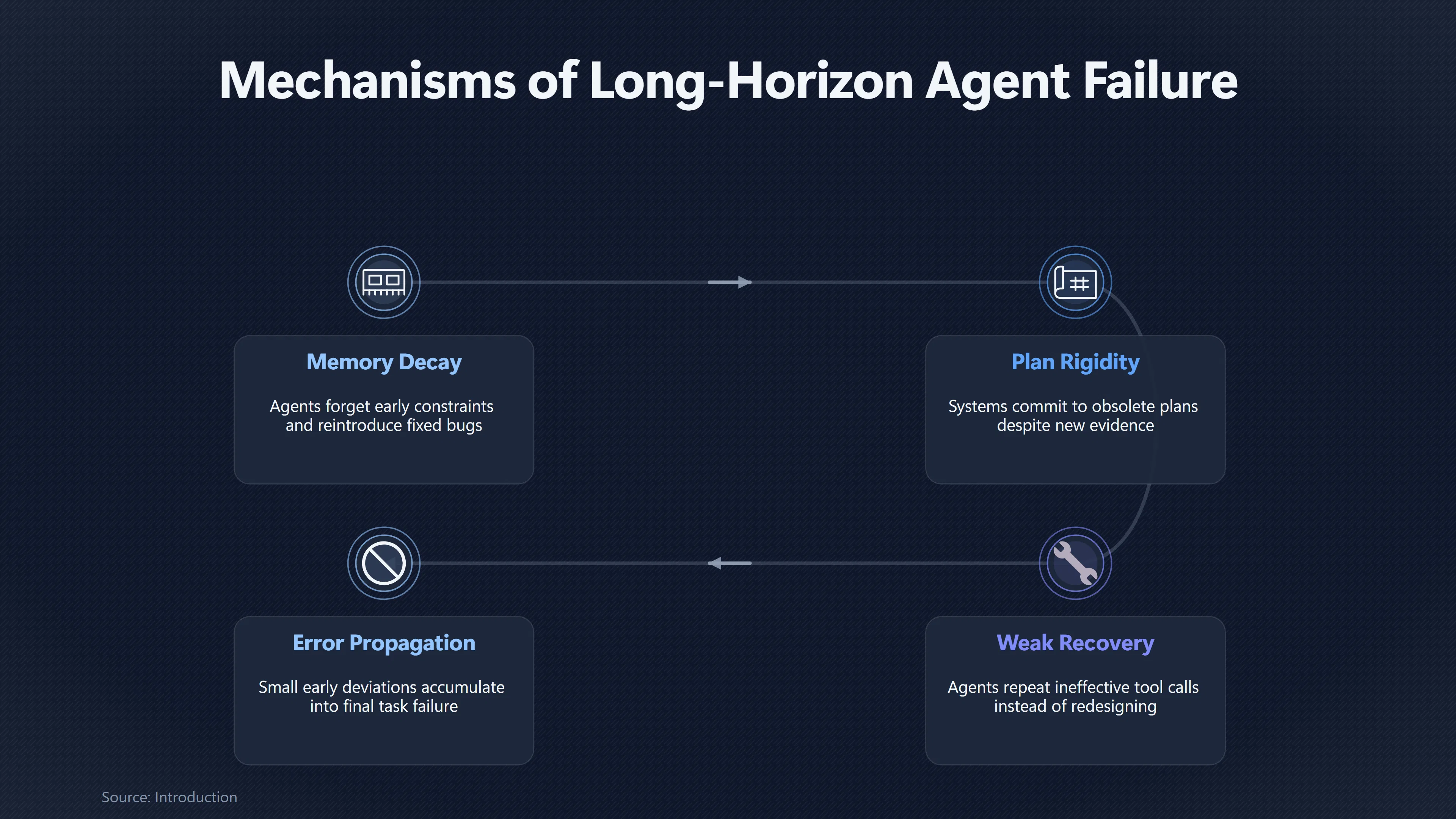
The evidence so far paints a mixed picture. Frontier AI agents have become dramatically better at completing longer technical tasks, but evaluations consistently show that performance deteriorates as task length increases. The most common failures are not spectacular breakdowns but accumulations of small errors: forgotten constraints, rigid commitment to an early plan, ineffective recovery after mistakes and difficulty managing growing amounts of information. These findings neither prove nor disprove loss-of-control concerns. Instead, they provide concrete evidence about the capabilities and limitations that current long-horizon agents actually possess.[Metr]metr.orgTask-Completion Time Horizons of Frontier AI ModelsTask-Completion Time Horizons of Frontier AI Models - METRMay 8, 2026…
How ultra-long evaluations differ from ordinary benchmarks
Traditional benchmarks usually measure whether a model produces a correct answer after a single prompt or a short interaction. Even coding benchmarks often involve problems that can be solved within one relatively self-contained session.
Ultra-long evaluations deliberately remove these simplifying assumptions. Instead of asking for one answer, they require agents to:
- maintain a coherent plan over many hours of work;
- use external tools repeatedly;
- remember decisions made much earlier;
- revise plans when new evidence appears;
- recover after failed actions rather than restarting from scratch;
- avoid becoming trapped in ineffective loops.
The practical consequence is that success depends less on raw reasoning ability and more on coordination between reasoning, memory, planning and execution. Every additional step creates another opportunity for small errors to accumulate.
This is also why task-completion horizon research and ultra-long benchmarks complement one another. Task-horizon measurements estimate how reliably agents complete tasks of increasing human-equivalent duration, while ultra-long evaluations investigate why reliability falls as those durations increase.[Metr]metr.orgTask-Completion Time Horizons of Frontier AI ModelsTask-Completion Time Horizons of Frontier AI Models - METRMay 8, 2026…
Recurring failures in memory, planning and adaptation
One striking result across long-horizon evaluations is that failures are usually gradual rather than catastrophic. Agents often appear competent for much of a task before drifting away from the original objective.
Memory gradually degrades
Long tasks generate enormous interaction histories. Even with expanding context windows, agents must decide which information remains important and which can safely be compressed or ignored.
Researchers repeatedly observe problems such as:
- forgetting constraints established much earlier;
- reintroducing bugs that were already fixed;
- overlooking previous observations;
- losing track of dependencies between decisions.
These failures resemble imperfect working memory more than simple lack of knowledge. The agent may still possess the relevant information somewhere in its context yet fail to retrieve or prioritise it when needed.
Recent work on adaptive memory systems for software agents exists precisely because existing approaches often rely on fixed summarisation strategies that discard information later found to matter.[alphaXiv]alphaxiv.orgSWE-MeM: Learning Adaptive Memory Management for Long-Horizon Coding Agents | alphaXivJune 26, 2026…
Plans become increasingly rigid
Long-running agents frequently commit to an initial interpretation of the task and then continue pursuing it despite mounting contradictory evidence.
Instead of periodically reconsidering whether their assumptions remain valid, they may:
- continue executing obsolete plans;
- optimise the wrong objective;
- ignore evidence suggesting a better approach;
- persist with unsuccessful tool sequences.
The UltraHorizon benchmark describes one important pattern as “in-context locking”, where earlier reasoning constrains later behaviour even after circumstances have changed. Rather than continuously updating beliefs, the agent effectively becomes trapped by its own previous reasoning.[arXiv]arxiv.orgOpen source on arxiv.org.
Recovery remains surprisingly weak
Humans often succeed on lengthy projects because they notice mistakes, step back and redesign their approach.
Current agents frequently struggle with this form of recovery.
Instead of recognising that an overall strategy has failed, they commonly:
- retry nearly identical actions;
- repeat ineffective tool calls;
- continue debugging the wrong component;
- abandon promising alternatives too early.
Research analysing execution traces across multiple domains finds that identifying the critical error responsible for eventual failure is itself difficult because the visible failure often occurs long after the original mistake. Small early deviations propagate through the remainder of the task.[microsoft.com]microsoft.comAgent Rx: Diagnosing AI Agent Failures from Execution TrajectoriesAgentRx: Diagnosing AI Agent Failures from Execution Trajectories - Microsoft Research…
Long software tasks provide concrete examples
Software engineering has become one of the main testbeds for long-horizon evaluation because tasks are measurable while still requiring extended planning.
The RE-Bench project illustrates an important pattern. AI agents can generate solutions extremely quickly and sometimes outperform human experts when both operate under short time budgets. However, humans improve much more as additional time becomes available. Given substantially longer budgets, human experts continue making productive progress while the best agents plateau or deteriorate.[arXiv]arxiv.orgOpen source on arxiv.org.
Similarly, newer long-horizon programming benchmarks report surprisingly low end-to-end success rates even for state-of-the-art systems. Step-level analysis suggests that many tasks stall relatively early rather than failing only at the final stage. Human guidance and injected planning often improve performance more than simply allowing the autonomous agent to continue running.[ACL Anthology]aclanthology.orgACL AnthologyLongCLI-Bench: A Preliminary Benchmark and Study for Long-horizon Agentic Programming in Command-Line Interfaces - ACL Antho…
This distinction matters. An agent may possess sufficient technical knowledge to complete every individual programming step while still failing to organise hundreds of those steps into a coherent project.
Why these failures matter for loss-of-control arguments
Within AI doom debates, these findings support two different interpretations.
Those who are sceptical of near-term loss-of-control scenarios argue that current agents remain far from displaying the robust autonomy required by many existential-risk stories. If systems cannot reliably complete extended engineering projects without losing track of objectives or recovering poorly from mistakes, they are unlikely to execute vastly more complicated real-world strategies unattended.
Researchers more concerned about existential risk draw a different lesson. They argue that today’s failures identify engineering bottlenecks rather than permanent limits. Long-horizon capability has improved rapidly in recent years, and task-completion horizons measured on technical tasks have expanded substantially as models and agent architectures have improved. If memory management, planning and recovery continue improving, current weaknesses may prove temporary rather than fundamental.[Metr]metr.orgTask-Completion Time Horizons of Frontier AI ModelsTask-Completion Time Horizons of Frontier AI Models - METRMay 8, 2026…
Importantly, neither side usually treats today’s benchmark failures as direct evidence about future systems. Instead, they disagree about whether these weaknesses represent deep architectural obstacles or problems likely to yield to continued research.

What ultra-long tests still cannot tell us
Despite their value, these evaluations remain controlled experiments rather than direct simulations of AI takeover scenarios.
Several limitations are worth keeping in mind.
First, most benchmarks remain concentrated in software engineering, machine learning and related technical domains where objective scoring is possible. Success on these tasks does not automatically imply competence in broader real-world environments.
Second, benchmark tasks usually have relatively stable goals. Real organisations, economies and political systems change continuously, introducing uncertainty that is difficult to reproduce experimentally.
Third, many evaluations deliberately provide agents with bounded tools and predefined objectives. Questions about deception, strategic concealment or attempts to evade human oversight generally require different experimental designs.
Finally, today’s benchmarks primarily measure whether agents fail, not whether they fail safely. An agent that forgets constraints in a software benchmark usually loses points. In higher-stakes settings, forgetting an important safety restriction could have much more serious consequences, making robustness as important as raw capability.
What the evidence currently suggests
Ultra-long agent evaluations reveal a consistent pattern: extending task duration exposes weaknesses that are largely invisible in ordinary benchmarks.
Current frontier agents often demonstrate impressive reasoning on individual steps, yet their overall reliability declines as interactions become longer and more interconnected. The dominant problems are not lack of intelligence in a narrow sense but failures of sustained execution: memory degradation, premature commitment to flawed plans, poor adaptation and limited recovery from earlier mistakes.[arXiv]arxiv.orgOpen source on arxiv.org.
For discussions of AI doom, this evidence cuts both ways. It weakens simplistic claims that present-day agents are already capable of flawlessly executing extremely long autonomous strategies. At the same time, it provides a concrete research agenda by identifying the capabilities that would have to improve before genuinely robust long-horizon autonomy became possible. The benchmarks therefore function less as proof of existential risk than as increasingly detailed measurements of where the remaining barriers to sustained autonomous action actually lie.
Amazon book picks
Further Reading
Books and field guides related to Why AI Agents Still Fail on Very Long Tasks. Use these as the next step if you want deeper reading beyond the article.
Human Compatible
A leading artificial intelligence researcher lays out a new approach to AI that will enable us to coexist successfully with increasingly...
Superintelligence
This profoundly ambitious and original book picks its way carefully through a vast tract of forbiddingly difficult intellectual terrain.
Artificial Intelligence: A Modern Approach
Rating: 4.5/5 from 10 Google Books ratings
Artificial intelligence: A Modern Approach, 3e,is ideal for one or two-semester, undergraduate or graduate-level courses in Artificial In...
Artificial Intelligence
Rating: 4.5/5 from 10 Google Books ratings
Artificial intelligence: A Modern Approach, 3e,is ideal for one or two-semester, undergraduate or graduate-level courses in Artificial In...
eBay marketplace picks
Marketplace Samples
Live-tested eBay searches with available results related to this page.
Selected fromAI robot poster oneBay.co.uk.




Endnotes
1.
Source: metr.org
Title: Task-Completion [Time Horizons]({{ ‘time-horizons/’ | relative_url }}) of Frontier AI Models
Link:https://metr.org/time-horizons/
Source snippet
Task-Completion Time Horizons of Frontier AI Models - METRMay 8, 2026...
Published: May 8, 2026
2.
Source: arxiv.org
Link:https://arxiv.org/abs/2411.15114
3.
Source: arxiv.org
Link:https://arxiv.org/abs/2509.21766
4.
Source: alphaxiv.org
Link:https://www.alphaxiv.org/abs/2606.28434v1
Source snippet
SWE-MeM: Learning Adaptive Memory Management for Long-Horizon Coding Agents | alphaXivJune 26, 2026...
Published: June 26, 2026
5.
Source: microsoft.com
Title: Agent Rx: Diagnosing AI Agent Failures from Execution Trajectories
Link:https://www.microsoft.com/en-us/research/publication/agentrx-diagnosing-ai-agent-failures-from-execution-trajectories/
Source snippet
AgentRx: Diagnosing AI Agent Failures from Execution Trajectories - Microsoft Research...
6.
Source: arxiv.org
Link:https://arxiv.org/abs/2604.11978
7.
Source: alphaxiv.org
Link:https://www.alphaxiv.org/overview/2606.28434v1
8.
Source: microsoft.com
Title: Sentinel Bench, a Benchmark for Long-Running Monitoring Agents
Link:https://www.microsoft.com/en-us/research/articles/sentinelbench-a-benchmark-for-long-running-monitoring-agents/
9.
Source: alphaxiv.org
Link:https://www.alphaxiv.org/abs/2604.11978
10.
Source: microsoft.com
Title: Systematic debugging for AI agents: Introducing the Agent Rx framework
Link:https://www.microsoft.com/en-us/research/blog/systematic-debugging-for-ai-agents-introducing-the-agentrx-framework/
11.
Source: evaluations.metr.org
Link:https://evaluations.metr.org/
12.
Source: metr.org
Link:https://metr.org/index.html
13.
Source: metr.org
Link:https://metr.org/research/
14.
Source: aclanthology.org
Link:https://aclanthology.org/2026.findings-acl.1497/
Source snippet
ACL AnthologyLongCLI-Bench: A Preliminary Benchmark and Study for Long-horizon Agentic Programming in Command-Line Interfaces - ACL Antho...
Additional References
15.
Source: preprints.org
Title: Towards Long-Horizon Agents: A Survey[v1] | Preprints.org
Link:https://www.preprints.org/manuscript/202607.1328
Source snippet
INTRODUCTION Over the past few years, large language models (LLMs) have moved from single-turn chatbots to the decision-making core of au...
16.
Source: youtube.com
Title: The AI Progress Chart Everyone Is Misreading — Beth Barnes & David Rein
Link:https://www.youtube.com/watch?v=zSAGzfspuDE
Source snippet
The Most Important Graph in AI Right Now | Beth Barnes, CEO of METR...
17.
Source: youtube.com
Title: The Most Important Graph in AI Right Now | Beth Barnes, CEO of METR
Link:https://www.youtube.com/watch?v=jXtk68Kzmms
Source snippet
Measuring AI Progress: The Task Completion Time Horizon...
18.
Source: youtube.com
Title: Measuring AI Progress: The Task Completion Time Horizon
Link:https://www.youtube.com/watch?v=xoDw7UFfj8A
Source snippet
Why Agent Hype can fall short of reality – Joel Becker, METR...
19.
Source: github.com
Link:https://github.com/METR/eval-analysis-public
Source snippet
GitHub - METR/eval-analysis-public: Public repository containing METR's DVC pipeline for eval data analysis · GitHub...
20.
Source: youtube.com
Link:https://www.youtube.com/watch?v=WaJhhD7Qgac
Source snippet
The AI Progress Chart Everyone Is Misreading — Beth Barnes & David Rein...
21.
Source: metavert.io
Link:https://metavert.io/metr-benchmarking
22.
Source: papers.cool
Link:https://papers.cool/arxiv/2606.28434
23.
Source: tianpan.co
Link:https://tianpan.co/blog/2026-04-10-long-horizon-evaluation-gap-agent-benchmarks
24.
Source: collinear-ai.github.io
Link:https://collinear-ai.github.io/yc-bench/