Within Automated Labs
Could Cloud Labs Put Advanced Biology Within Reach?
Remote automated laboratories could widen access to advanced experiments, but approvals, material controls and biosafety rules still limit present-day misuse.
On this page
- How remote automated laboratories work
- Which barriers cloud access may reduce
- What safeguards could prevent dangerous use
Page outline Jump by section
Introduction
Could cloud laboratories make dangerous biological research easier? The short answer is: potentially, but only to a limited extent today. Cloud laboratories allow researchers to design experiments online while automated equipment performs approved work in a professionally managed facility. This can reduce some traditional barriers, such as buying expensive instruments or being physically present in a laboratory. However, it does not remove many of the constraints that matter most for high-risk biology, including customer screening, biosafety procedures, legal restrictions on hazardous materials, and human review of unusual work.[Emerald Cloud Lab]emeraldcloudlab.comOpen source on emeraldcloudlab.com.
Within debates about AI doom and catastrophic misuse, cloud laboratories matter because they illustrate how automation could gradually make sophisticated scientific capabilities more widely available. If future AI systems became better at planning experiments while cloud laboratories became more capable and more numerous, the combination might lower some practical obstacles to advanced biological research. Whether this becomes a serious existential risk depends less on today’s services than on how governance, security and automation evolve together.
How remote automated laboratories work
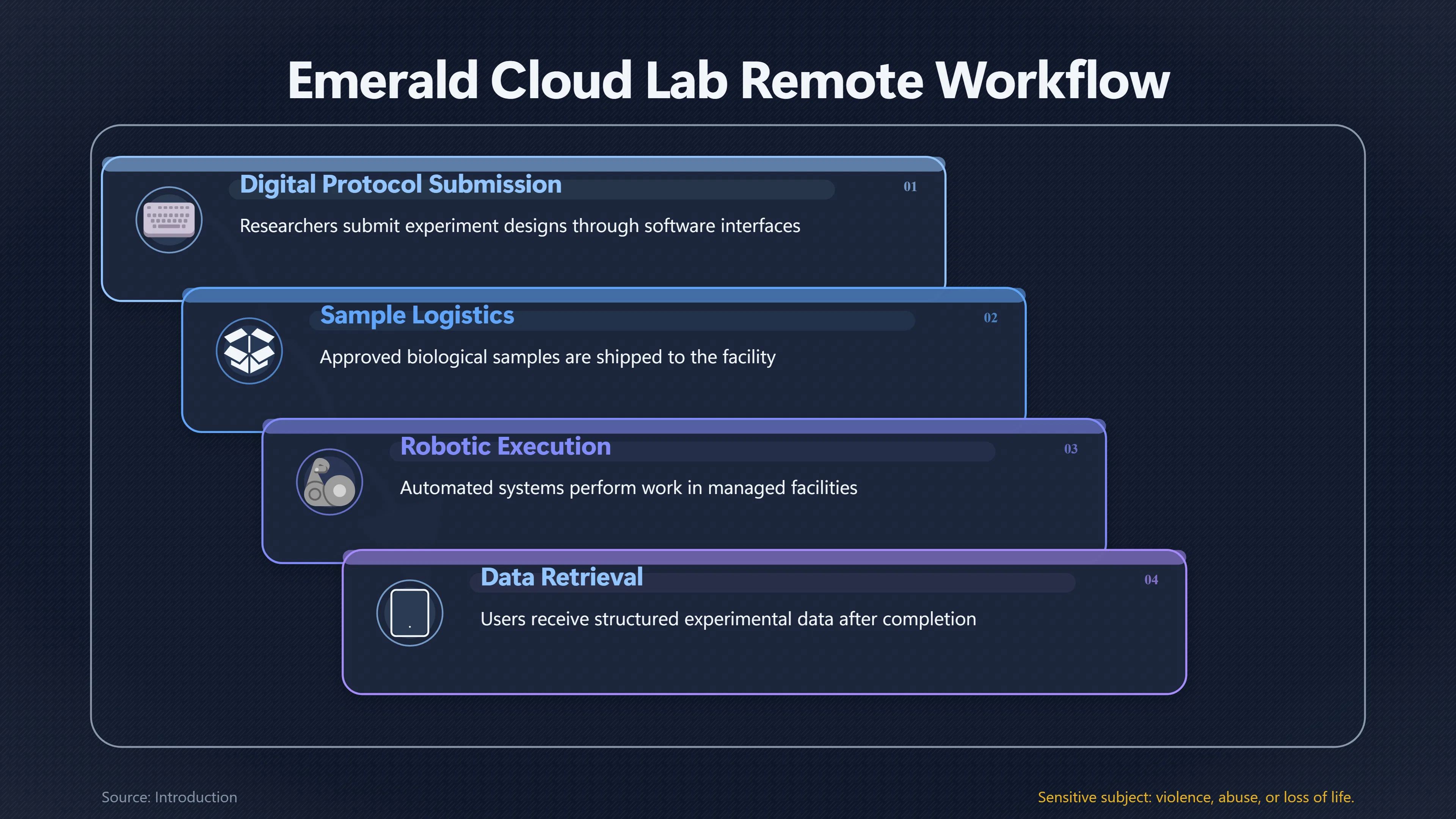
A cloud laboratory separates experimental design from experimental execution. Instead of working beside laboratory benches, researchers submit digital protocols through software, ship approved samples where necessary, and receive structured experimental data after robotic systems complete the work. Facilities such as Emerald Cloud Lab have demonstrated this model commercially, offering remote access to hundreds of laboratory instruments operating around the clock.[Emerald Cloud Lab]emeraldcloudlab.comEmerald Cloud Lab How Cloud Laboratories WorkEmerald Cloud Lab How Cloud Laboratories Work
This differs from ordinary contract research in several ways:
- Experiments can often be submitted and monitored remotely.
- Automation improves repeatability and allows continuous operation.
- Software records protocols, data and metadata automatically.
- Multiple users can access sophisticated equipment without owning it themselves.[Emerald Cloud Lab]emeraldcloudlab.comOpen source on emeraldcloudlab.com.
Cloud laboratories therefore reduce economic and geographical barriers rather than replacing scientific expertise. Researchers still need to formulate meaningful questions, interpret results and work within the laboratory’s operational policies.
Which barriers cloud access may reduce
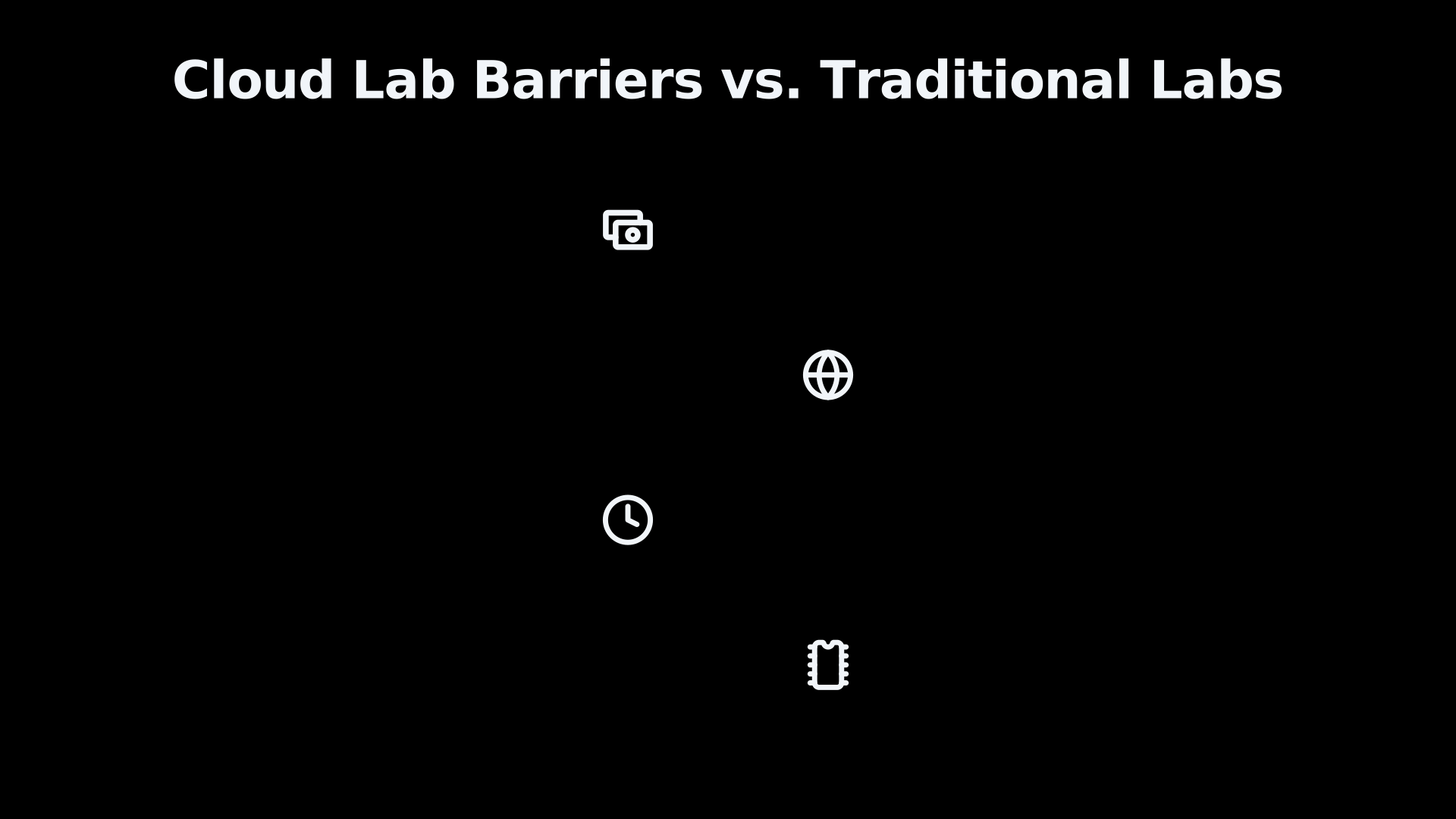
The main effect of cloud laboratories is to lower practical costs rather than eliminate technical difficulty.
For legitimate researchers, the advantages are substantial. Advanced equipment such as flow cytometers, sequencing instruments or specialised analytical systems often costs hundreds of thousands of pounds to purchase and maintain. Remote access allows universities, startups and small companies to use equipment that would otherwise be unavailable. Experiments can also continue outside normal working hours because automated systems operate continuously.[Emerald Cloud Lab]emeraldcloudlab.comOpen source on emeraldcloudlab.com.
From a biosecurity perspective, these same advantages could theoretically reduce several historical obstacles to misuse:
- Lower capital costs. Users need not purchase and maintain expensive instruments.
- Greater geographic access. Researchers can operate remotely instead of building their own laboratory.
- Improved scalability. Automation enables many routine experiments to run efficiently.
- Integration with AI tools. Future AI systems could generate experimental plans that are then executed by automated facilities, shortening research cycles.[Emerging Tech and Security Center]cetas.turing.ac.ukOpen source on turing.ac.uk.
Importantly, these are reductions in friction, not elimination of expertise requirements. Modern biological research still depends on tacit knowledge, careful interpretation of results and repeated troubleshooting that current cloud platforms do not automate completely.
Why today’s safeguards still matter
A common misunderstanding is that cloud laboratories simply allow anyone to conduct any biological experiment remotely. Commercial services generally operate under extensive legal and institutional obligations that limit what work they perform.
Current safeguards typically include:
- customer identity verification and contractual agreements;
- review of proposed work before experiments are accepted;
- restrictions on hazardous biological materials;
- compliance with biosafety regulations and institutional policies;
- trained personnel supervising laboratory operations rather than fully autonomous robots.[emeraldcloudlab.com]emeraldcloudlab.comOpen source on emeraldcloudlab.com.
Many dangerous pathogens, toxins and other regulated materials remain subject to licensing, transport restrictions and specialised containment requirements regardless of whether a laboratory is operated locally or remotely. Cloud access does not remove these legal controls.
In practice, today’s cloud laboratories function more like highly automated research service providers than unrestricted remote laboratories.
Where AI changes the picture
The relevance to AI doom arguments comes from possible future combinations rather than current capabilities.
A highly capable AI system could eventually contribute by:
- reviewing scientific literature;
- generating hypotheses;
- proposing experimental designs;
- analysing results from cloud laboratories;
- selecting the next experiment in an iterative research programme.
If these capabilities improved substantially while automated laboratories became more flexible, the combined system could reduce the amount of human labour required to conduct legitimate or potentially harmful research. This possibility motivates concern among some AI safety researchers that automation could gradually compress scientific development timelines.[Emerging Tech and Security Center]cetas.turing.ac.ukOpen source on turing.ac.uk.
However, there remains considerable uncertainty over how quickly such integration will mature. Existing demonstrations remain far from replacing experienced research teams across complex biological programmes.
Could cloud laboratories become an attractive misuse target?
Another concern is not simply authorised use but unauthorised access.
Because cloud laboratories concentrate sophisticated equipment behind internet-connected software, researchers have begun examining additional risks beyond traditional laboratory biosafety. These include malicious customers attempting to conceal prohibited work, insider threats, and cyberattacks targeting automated laboratory control systems. Recent proposals argue that security should be based not only on what a laboratory normally studies but also on what its equipment could potentially be used to produce if compromised.[Frontiers]frontiersin.orgFrontiersFrontiers | Automated Laboratory Security Tiers: a framework for evaluating and mitigating biosecurity risks from latent capabil…
Some analysts also note a possible advantage of centralisation. If advanced capabilities are concentrated in a relatively small number of professionally operated facilities, consistent monitoring, auditing and customer screening may be easier than if comparable equipment becomes widely distributed across thousands of smaller laboratories. Whether centralisation ultimately increases or decreases overall risk therefore depends on how effectively security measures keep pace with expanding capability.[Frontiers]frontiersin.orgFrontiersFrontiers | Automated Laboratory Security Tiers: a framework for evaluating and mitigating biosecurity risks from latent capabil…
What safeguards could prevent dangerous use?
The governance discussion increasingly focuses on building security into cloud laboratories before their capabilities expand further.
Frequently proposed measures include:
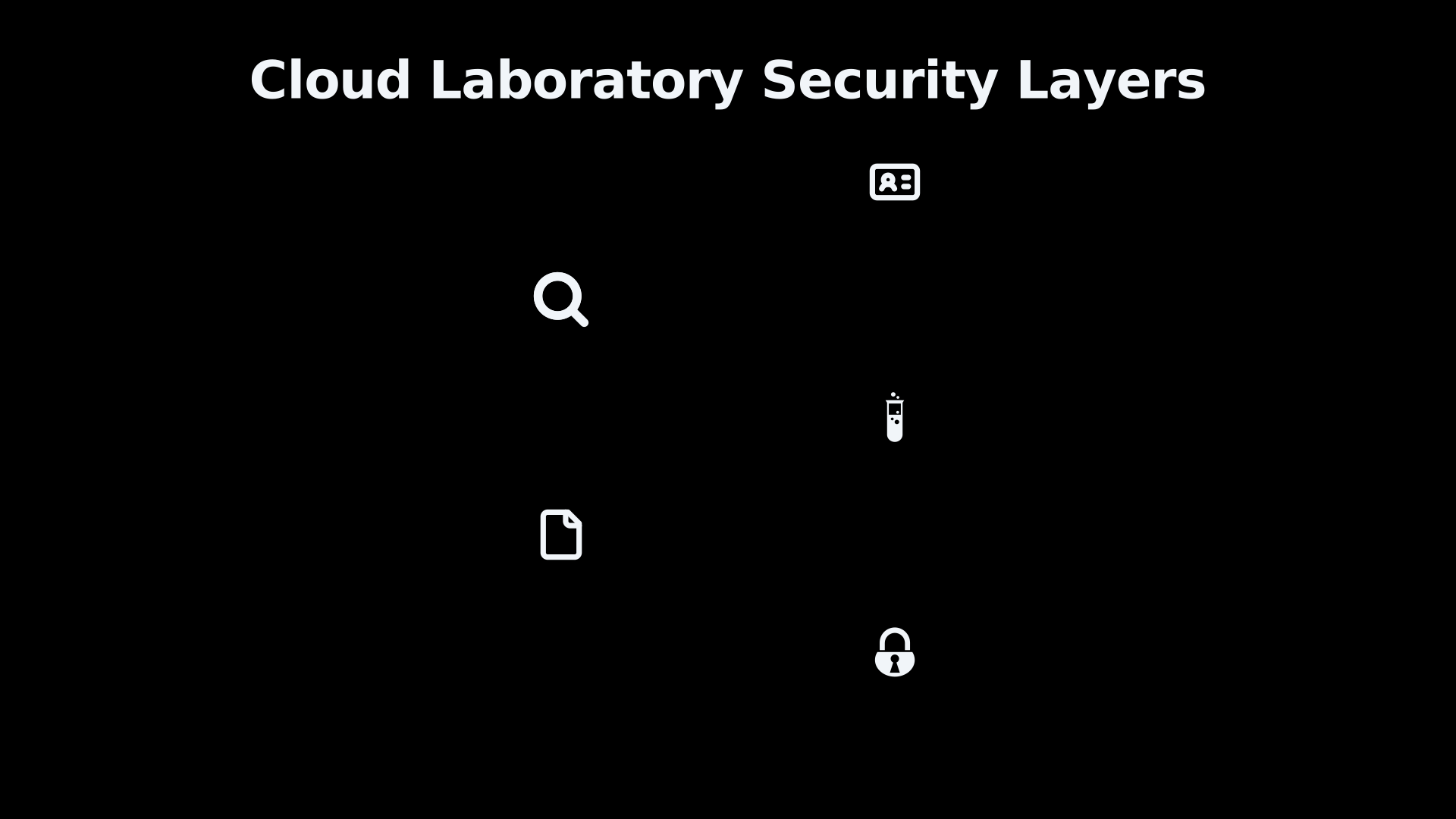
- Know-your-customer procedures. Verifying customer identity and organisational affiliation before granting access.
- Project review. Assessing proposed experiments for biosafety and biosecurity concerns before execution.
- Material controls. Restricting access to regulated organisms, toxins and sensitive biological materials.
- Comprehensive logging. Maintaining detailed records of submitted protocols, equipment usage and experimental outputs.
- Cybersecurity standards. Protecting laboratory control software from unauthorised access or manipulation.
- Shared industry standards. Developing common screening practices and information-sharing across cloud laboratory providers rather than relying on isolated company policies.[frontiersin.org]frontiersin.orgFrontiersFrontiers | Automated Laboratory Security Tiers: a framework for evaluating and mitigating biosecurity risks from latent capabil…
These proposals mirror broader governance discussions within AI doom research: powerful technologies become easier to manage when monitoring, auditing and accountability mechanisms evolve alongside increasing capability rather than after widespread deployment.
What the evidence suggests today
Current evidence does not support the claim that cloud laboratories have already removed the principal barriers to dangerous biological research. Scientific expertise, regulated materials, biosafety infrastructure and legal oversight remain substantial constraints.
The stronger argument is about future trajectories. Cloud laboratories demonstrate that sophisticated experimental infrastructure can be delivered remotely through software. If AI systems become increasingly capable of directing scientific workflows while laboratory automation continues to improve, some practical barriers to advanced biological research could gradually fall.
For AI doom discussions, cloud laboratories are therefore best understood as an enabling technology rather than an existential threat in themselves. Their significance lies in how they may combine with advances in AI reasoning, laboratory automation and remote scientific infrastructure. Whether that combination ultimately increases catastrophic misuse risk will depend heavily on governance, security standards and international coordination keeping pace with technological progress.
Amazon book picks
Further Reading
Books and field guides related to Could Cloud Labs Put Advanced Biology Within Reach?. Use these as the next step if you want deeper reading beyond the article.
The Genesis Machine
A New Yorker Best Book of the Year The next frontier in technology is inside our own bodies. The breakthrough science of synthetic biolog...
Regenesis
A Harvard biologist and master inventor explores how new biotechnologies will enable us to bring species back from the dead, unlock vast...
The Code Breaker
"A gripping account of how the pioneering scientist Jennifer Doudna, along with her colleagues and rivals, launched a revolution that wil...
Biology Is Technology
In Biology Is Technology, author Robert Carlson offers a uniquely informed perspective on the endeavors that contribute to current progre...
eBay marketplace picks
Marketplace Samples
Live-tested eBay searches with available results related to this page.
Selected fromlaboratory robot model oneBay.co.uk.
Endnotes
1.
Source: emeraldcloudlab.com
Link:https://www.emeraldcloudlab.com/
2.
Source: cetas.turing.ac.uk
Link:https://cetas.turing.ac.uk/publications/ai-and-engineering-biology
3.
Source: emeraldcloudlab.com
Title: Emerald Cloud Lab How Cloud Laboratories Work
Link:https://www.emeraldcloudlab.com/how-it-works/
4.
Source: osp.od.nih.gov
Title: Office of Science Policy National Science Advisory Board for Biosecurity (NSABB)
Link:https://osp.od.nih.gov/policies/national-science-advisory-board-for-biosecurity-nsabb/
Source snippet
Office of Science PolicyNational Science Advisory Board for Biosecurity (NSABB) - Office of Science Policy...
5.
Source: frontiersin.org
Link:https://www.frontiersin.org/journals/microbiology/articles/10.3389/fmicb.2026.1832401/full
Source snippet
FrontiersFrontiers | Automated Laboratory Security Tiers: a framework for evaluating and mitigating biosecurity risks from latent capabil...
6.
Source: biology.digital
Title: emerald cloud lab
Link:https://www.biology.digital/products/emerald-cloud-lab
Source snippet
★4.2 0 Remotely operated automated biology laboratory accessible entirely through software commands Visit Website Cate...
7.
Source: emeraldcloudlab.com
Link:https://www.emeraldcloudlab.com/why-cloud-labs/flexibility/
Additional References
8.
Source: pmc.ncbi.nlm.nih.gov
Title: ROLES Alexander V Tobias: Conceptualization, Formal analysis, Funding acqui
Link:https://pmc.ncbi.nlm.nih.gov/articles/PMC12368842/
Source snippet
‘[self-driving]({{ 'current-limits/' | relative_url }})’ laboratories: a review of technology and policy implications - PMCJuly 16, 2025 — ^{^{1}}Department of Biotechnology and L...
Published: July 16, 2025
9.
Source: everycrsreport.com
Link:https://www.everycrsreport.com/reports/R47695.html
10.
Source: youtube.com
Title: CMU Cloud Lab
Link:https://www.youtube.com/watch?v=At8-brZTCMM
Source snippet
AI can bypass biosecurity safeguards to recreate deadly toxins, researchers say...
11.
Source: congress.gov
Link:https://www.congress.gov/crs-product/R48155
12.
Source: youtube.com
Title: Closing the Loop: AI Agents, Cloud Labs & Autonomous Biology
Link:https://www.youtube.com/watch?v=rj9RO9wvFy8
Source snippet
AI and the Evolution of Biological National Security Risks...
13.
Source: youtube.com
Title: Inside the Lab Where Robots Run Their Own Experiments
Link:https://www.youtube.com/watch?v=L1UgdoP2aeg
Source snippet
CMU Cloud Lab - Democratizing the Discovery Process...
14.
Source: sipri.org
Link:https://www.sipri.org/publications/2025/eu-non-proliferation-and-disarmament-papers/cloud-labs-and-other-new-actors-biotechnology-ecosystem-export-control-challenges-and-good-practices
15.
Source: everycrsreport.com
Link:https://www.everycrsreport.com/reports/RL33342.html
16.
Source: biosecuritycentral.org
Link:https://www.biosecuritycentral.org/resource/core-guidance-and-recommendations/oversight-of-dual-use-life-sciences-research/
17.
Source: nationalacademies.org
Link:https://www.nationalacademies.org/projects/DELS-BLS-22-12/publication/29325