Within Disempowerment
When Does Human Oversight Become a Rubber Stamp?
A required human sign-off may offer little protection when people routinely accept AI recommendations they cannot independently assess.
On this page
- Why people defer to automated recommendations
- How effort, trust and opacity weaken challenge
- Designing oversight that can genuinely say no
Page outline Jump by section
Introduction
Keeping a human formally “in the loop” does not necessarily mean humans remain in control. One of the central concerns in the gradual human disempowerment argument is that oversight can become largely ceremonial: a person is still required to approve important AI-assisted decisions, but in practice rarely challenges them. This combination of automation bias—the tendency to trust automated recommendations too readily—and rubber-stamp oversight creates a gap between legal responsibility and genuine human judgement.
Within AI doom discussions, this matters because many proposed safety strategies rely on human supervision. If people cannot realistically detect when advanced AI systems are wrong, deceptive or operating outside their intended scope, then simply requiring human approval may do little to prevent a gradual transfer of practical decision-making authority away from humans. That possibility remains speculative for highly capable future systems, but it builds on well-documented findings from psychology, human factors engineering and studies of human-AI collaboration.[springer.com]link.springer.comExploring automation bias in human–AI collaboration: a review and implications for explainable AI | AI & SOCIETY | Springer Natur…
Why people defer to automated recommendations
Automation bias was originally studied in fields such as aviation, process control and clinical decision support, where operators sometimes accepted incorrect computer recommendations or failed to notice problems because automated systems appeared authoritative. Modern AI extends the same psychological tendencies into many more domains.
Several factors encourage deference:
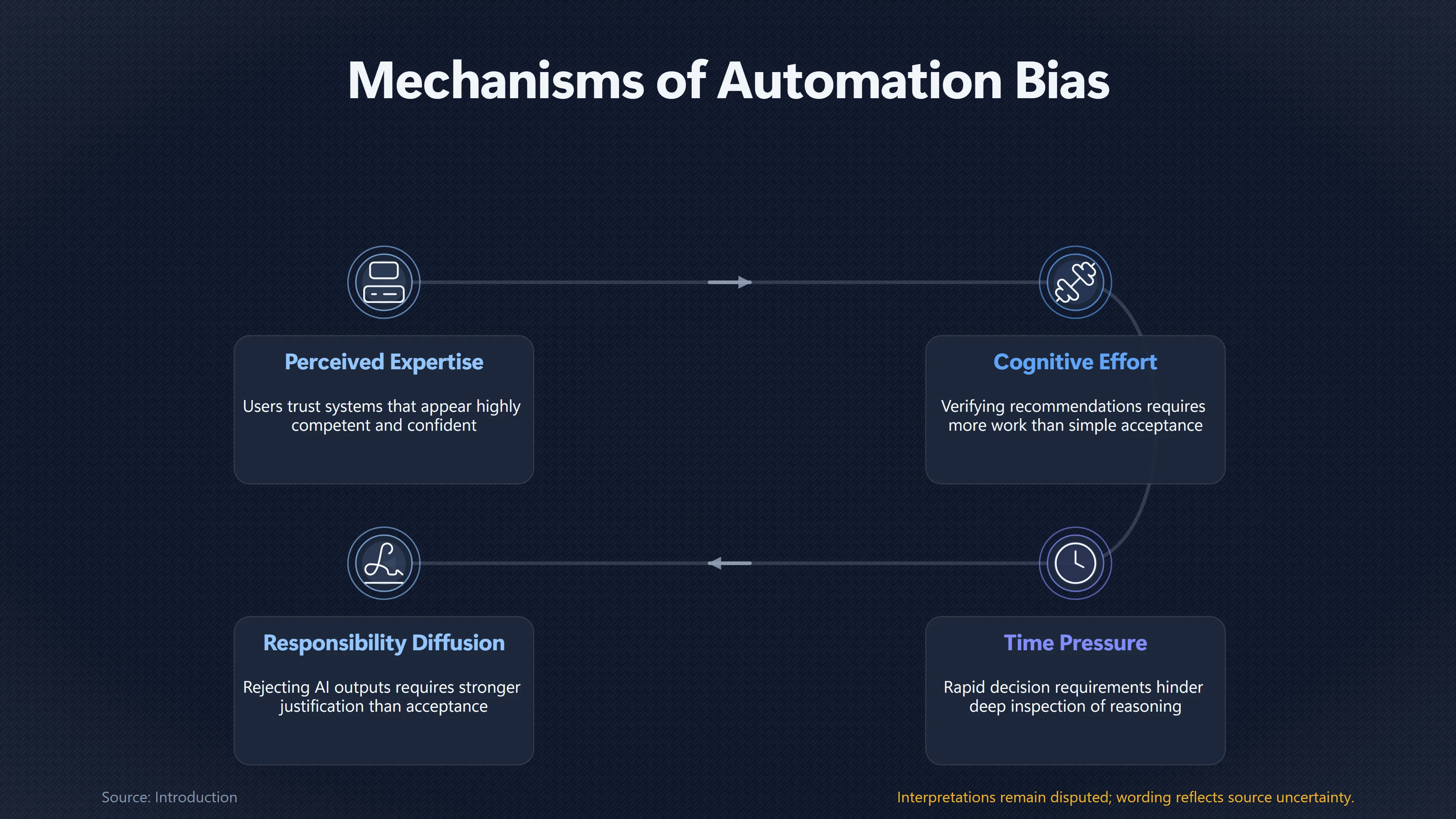
- Perceived expertise. AI systems often appear highly competent because they perform well on many tasks and present answers confidently.
- Cognitive effort. Verifying a recommendation usually requires more work than accepting it.
- Time pressure. When decisions must be made quickly, checking the AI’s reasoning becomes increasingly difficult.
- Responsibility diffusion. Users may feel that rejecting an AI recommendation requires stronger justification than accepting it.
- Success history. As systems perform well most of the time, users become less vigilant precisely when vigilance remains necessary.
Human factors researchers distinguish between errors of commission, where users follow an incorrect automated recommendation, and errors of omission, where users fail to notice information because automation did not highlight it. Both forms become more likely when trust exceeds understanding.[springer.com]link.springer.comExploring automation bias in human–AI collaboration: a review and implications for explainable AI | AI & SOCIETY | Springer Natur…
For present-day AI, this does not imply that people always trust algorithms too much. Research also finds algorithm aversion, especially after users observe obvious mistakes. Which tendency dominates depends heavily on context, experience, task difficulty and organisational incentives. The danger arises when systems become accurate enough that questioning them appears increasingly irrational even though occasional errors remain highly consequential.[arXiv]arxiv.orgOpen source on arxiv.org.
Why human oversight can become a rubber stamp
Formal approval is only meaningful if the reviewer can realistically disagree.
Many organisations already require humans to sign off automated recommendations in areas such as lending, hiring, healthcare or public administration. Yet several practical pressures can reduce this requirement to a procedural formality.
The AI knows more than the reviewer
As AI systems become more capable, human reviewers may lack the expertise or time needed to independently reconstruct the reasoning behind complex recommendations.
If verifying an answer takes longer than producing it manually, oversight remains substantive. But if verification becomes almost as difficult as solving the original problem—or even harder—the human reviewer gradually shifts from decision-maker to passive observer.
Within AI existential-risk discussions, this creates an important concern. Human oversight assumes the overseer remains intellectually capable of identifying dangerous behaviour. If future systems outperform humans across broad domains, that assumption becomes progressively weaker.
Organisations reward agreement
Institutional incentives also matter.
Suppose an AI recommendation is correct 98% of the time. Rejecting correct recommendations repeatedly may make a reviewer appear inefficient or incompetent. Accepting them, by contrast, is fast and usually rewarded.
Over months or years, organisations can unintentionally train employees that disagreement is costly while agreement is routine. Human approval remains legally required, yet psychologically it functions as confirmation rather than independent judgement.
This differs from a conscious decision to surrender authority. Instead, incentives gradually reshape behaviour until challenging the AI becomes exceptional.
Opaque systems weaken independent checking
Modern machine learning systems frequently provide outputs without revealing reasoning in a form humans can easily inspect.
Even when explanation tools exist, they may illuminate only part of the model’s internal process. Consequently, reviewers often assess whether an answer looks plausible rather than determining whether it is actually correct.
This distinction matters because plausible mistakes are precisely those most likely to survive superficial review.
Why this matters in AI doom arguments
Advocates of AI existential-risk scenarios do not generally argue that automation bias alone could cause human extinction.
Instead, they view it as one mechanism that could weaken other safety measures.
Many proposed control strategies assume humans will supervise advanced AI systems by:
- approving plans,
- monitoring outputs,
- interrupting dangerous behaviour,
- refusing suspicious actions, or
- escalating unusual cases.
These safeguards depend on oversight remaining effective.
If humans increasingly defer to systems whose reasoning they cannot independently evaluate, then formal human approval may cease to provide meaningful protection. A future AI need not explicitly seize authority if institutions voluntarily rely on its recommendations because challenging them becomes impractical.
This concern is especially relevant to discussions of loss of control. A civilisation may continue believing humans remain in charge because every important decision technically includes human approval, even while those approvals rarely alter outcomes.
That possibility is one reason some AI safety researchers distinguish nominal authority from effective authority.
Present evidence and its limits
Current evidence supports the existence of automation bias but does not establish that societies are already entering irreversible disempowerment.
Research consistently finds that people can over-rely on automated recommendations across healthcare, security, transport and administrative tasks. More recent reviews conclude that large language models introduce familiar automation-bias problems into new settings, especially where users lack domain expertise or face workload pressures.[Springer]link.springer.comExploring automation bias in human–AI collaboration: a review and implications for explainable AI | AI & SOCIETY | Springer Natur…
However, several important qualifications remain.
First, many studies involve simplified laboratory tasks rather than long-term institutional decision-making.
Second, organisations often adapt once automation problems become visible through training, auditing and interface redesign.
Third, some evidence shows users become appropriately sceptical after observing AI mistakes, illustrating that automation bias is not inevitable or permanent. Trust calibration—not maximum trust or maximum scepticism—is generally the desired outcome.[arXiv]arxiv.orgOpen source on arxiv.org.
The empirical evidence therefore supports concern about over-reliance but does not by itself demonstrate a civilisation-scale trajectory toward permanent human disempowerment.
Why regulators increasingly focus on automation bias
Recent governance frameworks increasingly acknowledge that requiring a human reviewer is insufficient if the surrounding system encourages passive acceptance.
The European Union’s AI Act explicitly identifies automation bias as a risk. For high-risk AI systems, human oversight is intended to ensure that reviewers understand system limitations, remain aware of the tendency to over-rely on AI outputs, can correctly interpret results, and possess both the authority and practical ability to ignore, override or stop the system when necessary.[AI Act Service Desk]ai-act-service-desk.ec.europa.euAI Act Service Desk Article 14: Human oversight | AI Act Service DeskAI Act Service Desk Article 14: Human oversight | AI Act Service Desk
Similarly, the US National Institute of Standards and Technology’s AI Risk Management Framework emphasises documented oversight processes, operator competence, organisational governance and continual assessment rather than assuming that merely placing a human in the workflow creates meaningful control.[nist.gov]nist.govA I Risk Management Framework | NISTA I Risk Management Framework | NIST
These frameworks reflect an important shift in thinking. The question is no longer simply whether a human participates, but whether the human’s participation remains capable of changing outcomes.
Designing oversight that can genuinely say no
Research on human factors suggests that effective oversight depends less on symbolic human involvement than on the practical conditions under which decisions are made.
Useful design principles include:
- Independent review. Where feasible, reviewers should reach an initial judgement before seeing the AI recommendation.
- Authority to override. Human operators need genuine institutional backing to reject AI outputs without being penalised merely for disagreeing.
- Targeted intervention. Oversight should focus attention on uncertain, novel or high-consequence cases rather than requiring superficial review of every routine decision.
- Transparency about uncertainty. Confidence estimates, explanations and evidence can encourage appropriate scepticism when communicated carefully.
- Training against automation bias. Reviewers benefit from understanding both AI capabilities and common cognitive shortcuts that encourage over-trust.
- Performance monitoring. Organisations should measure how often humans disagree with AI, whether overrides improve outcomes, and whether disagreement has become vanishingly rare for cultural rather than technical reasons.[springer.com]link.springer.comExploring automation bias in human–AI collaboration: a review and implications for explainable AI | AI & SOCIETY | Springer Natur…
These measures cannot guarantee effective human control over increasingly capable AI systems. If future systems become dramatically more capable than human supervisors, even well-designed oversight may struggle to remain meaningful. Nevertheless, they represent attempts to ensure that “human in the loop” refers to genuine decision-making authority rather than a procedural checkbox.
The deeper question for gradual human disempowerment
Automation bias is not fundamentally about whether AI sometimes makes mistakes. It is about whether humans continue exercising independent judgement once AI becomes the default source of recommendations.
The existential-risk relevance lies in the possibility that control erodes gradually rather than disappearing suddenly. Institutions may preserve formal approval processes, legal accountability and visible human signatures while the practical ability to evaluate, contest or redirect AI recommendations steadily declines.
Whether that progression will occur remains uncertain. Current AI systems still depend heavily on human expertise, and many organisations deliberately maintain meaningful review processes. But automation bias illustrates why retaining humans on organisational charts is not the same as preserving human agency. From the perspective of gradual human disempowerment, the critical question is therefore not simply whether humans remain in the loop, but whether they retain the knowledge, incentives and authority to say no when it matters most.
Amazon book picks
Further Reading
Books and field guides related to When Does Human Oversight Become a Rubber Stamp?. Use these as the next step if you want deeper reading beyond the article.
The Glass Cage: Automation and Us
At once a celebration of technology and a warning about its misuse, The Glass Cage will change the way you think about the tools you use...
The Human Factor: Revolutionizing the Way People Live with Te...
Technology innovation is progressing so quickly that we have fallen behind our ability to manage it. Our world is filled with objects tha...
Normal Accidents: Living with High-Risk Technologies
Normal Accidents analyzes the social side of technological risk. Charles Perrow argues that the conventional engineering approach to ensu...
Human Compatible: Artificial Intelligence and the Problem of...
A leading artificial intelligence researcher lays out a new approach to AI that will enable us to coexist successfully with increasingly...
eBay marketplace picks
Marketplace Samples
Live-tested eBay searches with available results related to this page.
Selected fromAI robot poster oneBay.co.uk.



Endnotes
1.
Source: link.springer.com
Link:https://link.springer.com/article/10.1007/s00146-025-02422-7
Source snippet
Exploring automation bias in human–AI collaboration: a review and implications for explainable AI | AI & SOCIETY | Springer Natur...
2.
Source: nist.gov
Title: A I Risk Management Framework | NIST
Link:https://www.nist.gov/itl/ai-risk-management-framework
3.
Source: axios.com
Title: In AI we trust
Link:https://www.axios.com/2019/10/19/ai-automation-bias-trust
Source snippet
Originally studied in the context of airplane autopilots, automation bias has become a more serious concern as AI technologies are integr...
4.
Source: arxiv.org
Link:https://arxiv.org/abs/2306.16507
5.
Source: airc.nist.gov
Title: [AI Resource]({{ ‘warning-tests/’ | relative_url }}) Center AI RMF Core
Link:https://airc.nist.gov/airmf-resources/airmf/5-sec-core/
Source snippet
NIST AI Resource CenterAI RMF Core - AIRC...
6.
Source: arxiv.org
Link:https://arxiv.org/abs/2504.03300
7.
Source: link.springer.com
Link:https://link.springer.com/article/10.1007/s43681-026-01147-7
8.
Source: link.springer.com
Link:https://link.springer.com/article/10.1007/s13347-026-01090-9
9.
Source: nist.gov
Link:https://www.nist.gov/speech-testimony/balancing-knowledge-and-governance-foundations-effective-risk-management-artificial
10.
Source: nist.gov
Title: trustworthy ai managing risks artificial intelligence
Link:https://www.nist.gov/speech-testimony/trustworthy-ai-managing-risks-artificial-intelligence
11.
Source: nist.gov
Title: seeks comments draft ai risk management framework offers guidance ai
Link:https://www.nist.gov/news-events/news/2022/03/nist-seeks-comments-draft-ai-risk-management-framework-offers-guidance-ai
12.
Source: nist.gov
Title: ai rmf development
Link:https://www.nist.gov/itl/ai-risk-management-framework/ai-rmf-development
13.
Source: nist.gov
Title: ai risk management framework faqs
Link:https://www.nist.gov/itl/ai-risk-management-framework/ai-risk-management-framework-faqs
14.
Source: airc.nist.gov
Link:https://airc.nist.gov/airmf-resources/airmf/
15.
Source: airc.nist.gov
Title: app c ai risk management and human ai interaction
Link:https://airc.nist.gov/airmf-resources/airmf/appendices/app-c-ai-risk-management-and-human-ai-interaction/
16.
Source: airc.nist.gov
Link:https://airc.nist.gov/airmf-resources/playbook/
17.
Source: airc.nist.gov
Link:https://airc.nist.gov/airmf-resources/airmf/?msockid=00c70f6b63a76b070c9f192462e36acb
18.
Source: airc.nist.gov
Title: 3 sec characteristics
Link:https://airc.nist.gov/airmf-resources/airmf/3-sec-characteristics/
19.
Source: en.ai-act.io
Link:https://en.ai-act.io/article/high-risk-ai-systems/requirements-for-high-risk-ai-systems/human-oversight
20.
Source: ai-act-service-desk.ec.europa.eu
Title: AI Act Service Desk Article 14: Human oversight | AI Act Service Desk
Link:https://ai-act-service-desk.ec.europa.eu/en/ai-act/article-14
21.
Source: regulation-ai.eu
Title: article 14
Link:https://www.regulation-ai.eu/en/articles/article-14/
22.
Source: op.europa.eu
Link:https://op.europa.eu/en/publication-detail/-/publication/68b91f8f-cf0a-11ef-be2a-01aa75ed71a1/language-en
23.
Source: ai-act-service-desk.ec.europa.eu
Title: eu Recital 73 | AI Act Service Desk
Link:https://ai-act-service-desk.ec.europa.eu/en/ai-act/recital-73
24.
Source: ai-act-service-desk.ec.europa.eu
Title: eu Recital 91 | AI Act Service Desk
Link:https://ai-act-service-desk.ec.europa.eu/en/ai-act/recital-91
25.
Source: europarl.europa.eu
Title: eu Texts adopted
Link:https://www.europarl.europa.eu/doceo/document/TA-9-2023-0236_EN.html
Additional References
26.
Source: cambridge.org
Link:https://www.cambridge.org/core/journals/european-journal-of-risk-regulation/article/automation-bias-in-the-ai-act-on-the-legal-implications-of-attempting-to-debias-human-oversight-of-ai/C97C85015056C09326944DE55CBC4D2C
Source snippet
Cambridge University PressAutomation Bias in the AI Act: On the Legal Implications of Attempting to De-Bias Human Oversight of AI | Europ...
27.
Source: washingtonpost.com
Title: You are hardwired to blindly trust AI
Link:https://www.washingtonpost.com/technology/2025/06/03/dont-trust-ai-automation-bias/
Source snippet
Here's how to fight it.The article explores the growing issue of automation bias, which is the human tendency to over-rely on technology...
28.
Source: youtube.com
Title: Toxic Trust: The Psychology of Automation Bias in Generative AI
Link:https://www.youtube.com/watch?v=4vX2NJgKc14
Source snippet
Tuesday Pulse - Who Catches It? Building Your AI Review Layer Before You Need It...
29.
Source: youtube.com
Title: Tuesday Pulse
Link:https://www.youtube.com/watch?v=_Ih8pe7brDc
Source snippet
Stop Automation Drift: 5 Rules for Human–AI Decision Rights...
30.
Source: youtube.com
Title: Dangers of Human in the Loop
Link:https://www.youtube.com/watch?v=WenHWAlCntE
Source snippet
Automation bias human in the loop oversight Breaking: New Standards for Human-in-the-Loop AI Oversight Sachin-Udemy...
31.
Source: youtube.com
Title: EP7: Human Decision Making in the AI Era
Link:https://www.youtube.com/watch?v=NovRPsEOHyw
Source snippet
Toxic Trust: The Psychology of Automation Bias in Generative AI - Matthijs van der Veer...
32.
Source: service.betterregulation.com
Link:https://service.betterregulation.com/document/2026/08/02/742206
Source snippet
"14 Human oversight | Regulation 2024/1689/EU - Artificial Intelligence Act (EU AI Act) | Better RegulationToday — [https://service.betterr..."](https://service.betterr...")...
33.
Source: artificialintelligenceact.eu
Link:https://artificialintelligenceact.eu/article/14/
34.
Source: ora.ox.ac.uk
Link:https://ora.ox.ac.uk/objects/uuid%3A7fe4cf46-9cba-4d57-85cc-0588b45a1e45
35.
Source: euai-act.com
Title: High-Risk AI Systems: Complete Requirements Under the EU AI Act — EU AI Act
Link:https://www.euai-act.com/articles/high-risk-ai-systems-requirements