Within AI Race
When an AI Release Cannot Be Taken Back
Once powerful model weights spread widely, developers may be unable to withdraw them, enforce safeguards or prevent dangerous modification.
On this page
- Why open weight releases attract competitive pressure
- What becomes difficult once model weights spread
- How openness benefits compare with catastrophic misuse concerns
Page outline Jump by section
Introduction
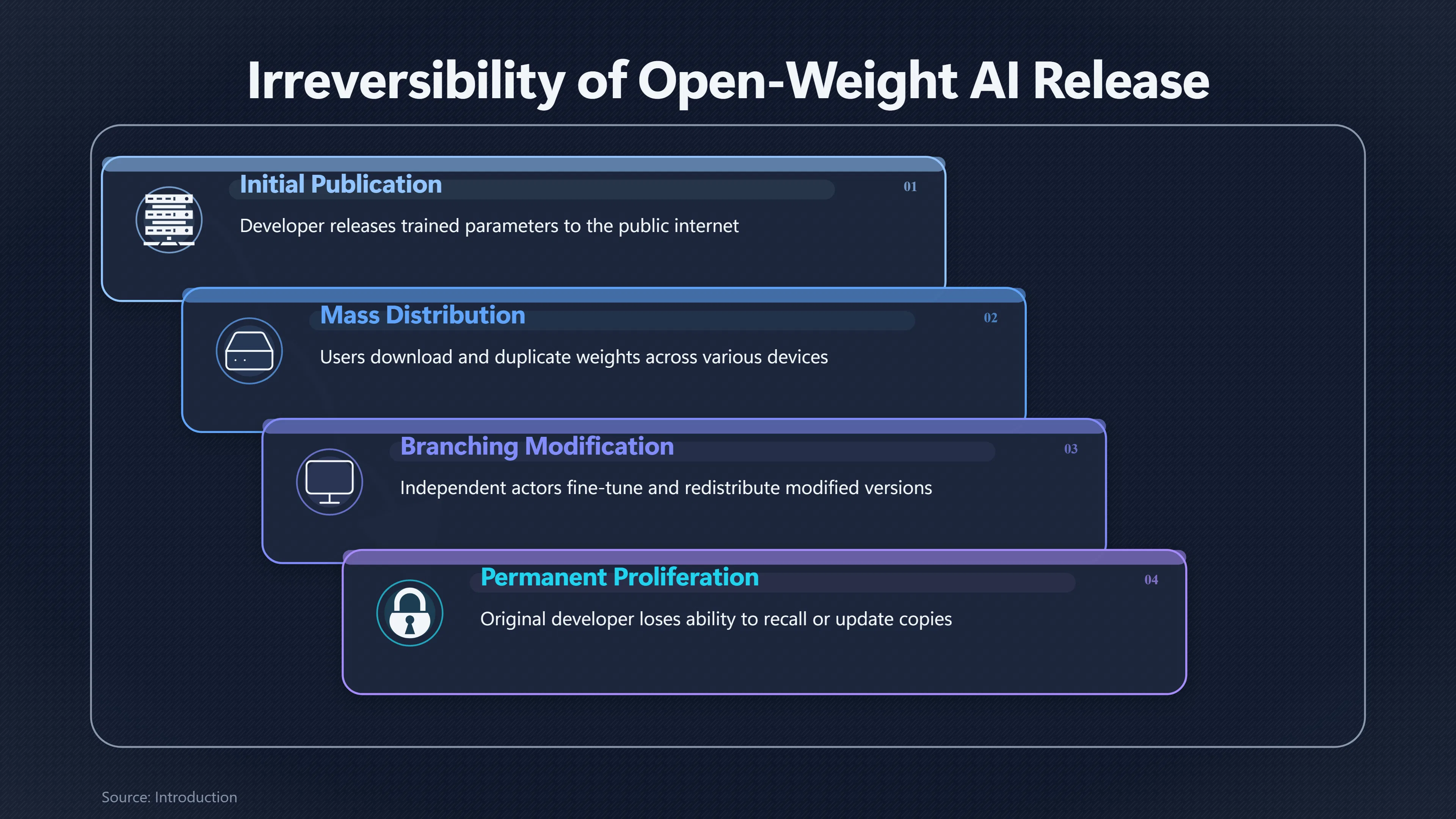
Open-weight AI models are systems whose trained parameters, or weights, are made available for others to download and run. They occupy a middle ground between fully proprietary systems and fully open-source software, because developers may release the weights without publishing every part of the training process. Within debates about AI doom and existential risk, the central concern is not that openness is inherently unsafe. Rather, it is that once a highly capable model’s weights spread across the internet, the original developer permanently loses much of its ability to control how that model is used, modified or redistributed. Unlike a cloud-based AI service, an open-weight release cannot realistically be recalled if serious risks emerge later.[International AI Safety Report]internationalaisafetyreport.orginternational ai safety report 2026International AI Safety ReportInternational AI Safety Report 2026 | International AI Safety ReportFebruary 3, 2026…
This matters because competitive pressure can encourage companies to release increasingly capable models before the implications are fully understood. If one organisation believes a rival is about to publish an open-weight frontier model, delaying for additional safety testing may carry commercial or strategic costs. Critics argue that this dynamic could make a single premature release effectively irreversible, while supporters argue that openness improves security research, transparency and scientific progress. The debate therefore centres less on whether open-weight AI is good or bad in general than on whether there are capability thresholds beyond which unrestricted release creates risks that cannot later be undone.[internationalaisafetyreport.org]internationalaisafetyreport.orginternational ai safety report 2026International AI Safety ReportInternational AI Safety Report 2026 | International AI Safety ReportFebruary 3, 2026…
Why open-weight releases attract competitive pressure
Publishing model weights can create major competitive advantages. Open-weight models often attract large research communities, become widely integrated into software ecosystems and encourage thousands of independent improvements. This can rapidly establish a model as a technical standard while increasing the developer’s reputation and influence.
These incentives may create pressure to release earlier than would otherwise seem prudent. If one company expects competitors to publish increasingly capable open-weight systems, holding back for additional evaluations may appear commercially risky. The decision is especially difficult because a delay of weeks or months could allow another laboratory to become the preferred platform for researchers and developers.
The result is a familiar collective-action problem. Every developer might prefer stronger evidence that a model is safe before releasing it openly, yet each may fear losing ground if others do not exercise similar restraint. This concern fits within broader discussions of AI racing dynamics, where competition changes incentives rather than proving that any particular release is dangerous.[internationalaisafetyreport.org]internationalaisafetyreport.orginternational ai safety report 2026International AI Safety ReportInternational AI Safety Report 2026 | International AI Safety ReportFebruary 3, 2026…
What becomes difficult once model weights spread
The defining feature of open-weight releases is that copies can be duplicated indefinitely. Once thousands of users have downloaded a model, no central authority can reliably delete every copy or require every user to install later safety updates.
This creates several practical consequences.
- Safety improvements cannot be universally deployed. A laboratory can improve its own hosted systems continuously, but downloaded copies continue operating with older behaviour unless their owners choose to update them.
- Safeguards can be removed. Fine-tuning allows users to alter model behaviour. Research has repeatedly shown that many refusal behaviours and safety layers can be weakened or removed through relatively modest retraining, although making safeguards more durable remains an active research area.[ICLR Proceedings]proceedings.iclr.ccProceedings Tamper-Resistant Safeguards for Open-Weight LLMsICLR ProceedingsTamper-Resistant Safeguards for Open-Weight LLMs…
- Redistribution becomes uncontrollable. Modified versions can be uploaded elsewhere, creating multiple independent branches beyond the original developer’s supervision.
- Usage becomes difficult to monitor. Cloud-hosted models allow providers to detect unusual activity, suspend accounts or deploy emergency mitigations. Downloaded models generally remove those options.
The UK International AI Safety Report identifies irreversibility as one of the defining differences between open-weight and closed-weight deployment. Once publicly released, there is no practical mechanism for a wholesale rollback of all copies.[International AI Safety Report]internationalaisafetyreport.orginternational ai safety report 2026International AI Safety ReportInternational AI Safety Report 2026 | International AI Safety ReportFebruary 3, 2026…
Why irreversibility matters in AI doom arguments
For researchers concerned about existential risk, irreversibility matters because many proposed safety strategies depend on retaining some ability to intervene after deployment.
If future frontier systems acquired capabilities that were initially underestimated—for example, unusually effective autonomous cyber operations, scientific assistance for dangerous research or sophisticated deceptive behaviour—a hosted model could at least in principle be withdrawn, updated or restricted. An open-weight release dramatically reduces those options because many independent copies would continue to exist regardless of the original developer’s decisions.[International AI Safety Report]internationalaisafetyreport.orginternational ai safety report 2026International AI Safety ReportInternational AI Safety Report 2026 | International AI Safety ReportFebruary 3, 2026…
The concern therefore is not simply that misuse becomes easier. It is that society may lose the ability to respond collectively after discovering an unexpected capability. If later evidence showed that a released model exceeded previously recognised danger thresholds, reversing the release could prove impossible.
This logic explains why some AI safety researchers argue that publication decisions should become more cautious as capabilities increase. The threshold itself remains disputed, but the irreversibility of distribution is widely acknowledged as a genuine governance challenge rather than merely a theoretical concern.[aisi.gov.uk]aisi.gov.ukOpen technical problems in open-weight AI model risk managementOpen technical problems in open-weight AI model risk management

How openness benefits compare with catastrophic misuse concerns
The debate is not one-sided. Many researchers argue that open-weight models provide substantial public benefits.
Supporters point to several advantages.
- Independent researchers can audit models for hidden weaknesses or biases.
- Universities and smaller companies gain access to technology that would otherwise remain concentrated within a handful of firms.
- Scientific results become easier to reproduce.
- Governments, hospitals and businesses can operate models locally without sending sensitive data to external providers.
- Competition may reduce excessive concentration of power among a few AI companies.[internationalaisafetyreport.org]internationalaisafetyreport.orginternational ai safety report 2026International AI Safety ReportInternational AI Safety Report 2026 | International AI Safety ReportFebruary 3, 2026…
Critics generally accept many of these benefits but argue that they weaken as model capability approaches frontier levels. Their claim is not that openness itself is undesirable, but that the balance between scientific openness and irreversible proliferation changes as systems become increasingly capable and adaptable.
This has led to proposals for more graduated release strategies rather than a simple choice between fully open and fully closed models. Suggested approaches include delayed publication, staged access, capability thresholds linked to independent evaluations, stronger cybersecurity before release and improved technical safeguards designed specifically for open-weight systems.[nature.com]nature.comReleasing open-weight AI in steps would alleviate risksMarch 3, 2026…
Can technical safeguards solve the problem?
Researchers are actively exploring methods to make open-weight models safer even after release. Recent work has investigated tamper-resistant safeguards that remain effective despite attempts to fine-tune the model. Early results suggest meaningful progress may be possible, but independent researchers caution that evaluating these defences is itself difficult and that current techniques should not be treated as complete solutions.[ICLR Proceedings]proceedings.iclr.ccProceedings Tamper-Resistant Safeguards for Open-Weight LLMsICLR ProceedingsTamper-Resistant Safeguards for Open-Weight LLMs…
The broader research agenda extends beyond individual safeguards. Recent work from the UK AI Security Institute and an international group of researchers identifies numerous unresolved technical questions involving evaluations, ecosystem monitoring, deployment practices, training methods and governance mechanisms tailored specifically to open-weight models. The field remains comparatively immature compared with research on hosted AI systems.[aisi.gov.uk]aisi.gov.ukOpen technical problems in open-weight AI model risk managementOpen technical problems in open-weight AI model risk management
Because of these uncertainties, many proposals emphasise defence in depth rather than relying on any single protection. Technical safeguards, careful release decisions, independent evaluations, monitoring of downstream ecosystems and coordinated governance are often presented as complementary measures rather than substitutes.
The central disagreement
The disagreement is ultimately about timing and thresholds rather than about openness in the abstract.
Those worried about AI doom argue that competitive pressure could encourage at least one organisation to release highly capable model weights before the associated risks are well understood. Once that happens, the release may be effectively permanent. Even if evidence later suggested the decision had been mistaken, society might no longer possess practical mechanisms to contain the technology.
Opponents of this view question whether such capability thresholds are near, whether open research ultimately improves security more than secrecy does, and whether concentrating advanced AI inside a few organisations introduces different but equally serious risks. They also note that many valuable scientific advances have depended on open publication and warn that excessive restrictions could slow safety research itself.
The strongest evidence available today supports a narrower conclusion than either extreme position. Open-weight releases provide genuine scientific and economic benefits, but they also introduce a distinctive governance challenge: unlike centrally hosted AI services, the widespread release of model weights largely removes the possibility of later withdrawal. Whether that characteristic becomes an existential risk depends on how capable future models become, how effective technical safeguards prove to be, and whether competitive deployment pressures outpace improvements in AI safety.
Amazon book picks
Further Reading
Books and field guides related to When an AI Release Cannot Be Taken Back. Use these as the next step if you want deeper reading beyond the article.
Human Compatible
A leading artificial intelligence researcher lays out a new approach to AI that will enable us to coexist successfully with increasingly...
The Coming Wave
"We are approaching a critical threshold in the history of our species. Everything is about to change. Soon you will live surrounded by A...
Sandworm
"With the nuance of a reporter and the pace of a thriller writer, Andy Greenberg gives us a glimpse of the cyberwars of the future while...
This is how They Tell Me the World Ends
WINNER OF THE FT & McKINSEY BUSINESS BOOK OF THE YEAR AWARD 2021The instant New York Times bestsellerA Financial Times and The Times Book...
eBay marketplace picks
Marketplace Samples
Live-tested eBay searches with available results related to this page.
Selected fromAI model pin oneBay.co.uk.



Endnotes
1.
Source: GOV.UK
Title: international ai safety report 2025
Link:https://www.gov.uk/government/publications/international-ai-safety-report-2025/international-ai-safety-report-2025
Source snippet
[Withdrawn] International AI Safety Report 2025 - GOV.UK...
2.
Source: aisi.gov.uk
Title: Open technical problems in open-weight AI model risk management
Link:https://www.aisi.gov.uk/research/open-technical-problems-in-open-weight-ai-model-risk-management
3.
Source: reuters.com
Link:https://www.reuters.com/commentary/breakingviews/open-source-ai-is-imperfect-hedge-against-us-clout-2026-07-29/
Source snippet
While closed models offer convenience, performance, and service guarantees, they come with higher costs and restrictions. Open-weight mod...
4.
Source: proceedings.iclr.cc
Title: Proceedings Tamper-Resistant Safeguards for Open-Weight LLMs
Link:https://proceedings.iclr.cc/paper_files/paper/2025/hash/fc49a629d33bc2461ed7a715ce44da68-Abstract-Conference.html
Source snippet
ICLR ProceedingsTamper-Resistant Safeguards for Open-Weight LLMs...
5.
Source: proceedings.iclr.cc
Title: Proceedings On Evaluating the Durability of Safeguards for Open-Weight LLMs
Link:https://proceedings.iclr.cc/paper_files/paper/2025/hash/9d3a4cdf6f70559e8c6fe02170fba568-Abstract-Conference.html
Source snippet
ICLR ProceedingsOn Evaluating the Durability of Safeguards for Open-Weight LLMs...
6.
Source: arxiv.org
Link:https://arxiv.org/abs/2405.16820
7.
Source: nature.com
Title: Releasing open-weight AI in steps would alleviate risks
Link:https://www.nature.com/articles/d41586-026-00679-6
Source snippet
March 3, 2026...
Published: March 3, 2026
8.
Source: arxiv.org
Title: arXiv Beyond the Binary: A nuanced path for open-weight advanced AI
Link:https://arxiv.org/abs/2602.19682
9.
Source: GOV.UK
Title: www.gov.uk Frontier AI: capabilities and risks – discussion paper
Link:https://www.gov.uk/government/publications/frontier-ai-capabilities-and-risks-discussion-paper/frontier-ai-capabilities-and-risks-discussion-paper
10.
Source: GOV.UK
Title: www.gov.uk Emerging processes for frontier AI safety
Link:https://www.gov.uk/government/publications/emerging-processes-for-frontier-ai-safety/emerging-processes-for-frontier-ai-safety
11.
Source: aisi.gov.uk
Link:https://www.aisi.gov.uk/blog/managing-risks-from-increasingly-capable-open-weight-ai-systems
12.
Source: aisi.gov.uk
Link:https://www.aisi.gov.uk/frontier-ai-trends-report
13.
Source: aisi.gov.uk
Link:https://www.aisi.gov.uk/blog/how-far-behind-the-frontier-are-leading-open-weight-models-on-cyber
14.
Source: internationalaisafetyreport.org
Title: international ai safety report 2026
Link:https://internationalaisafetyreport.org/publication/international-ai-safety-report-2026
Source snippet
International AI Safety ReportInternational AI Safety Report 2026 | International AI Safety ReportFebruary 3, 2026...
Published: February 3, 2026
15.
Source: internationalaisafetyreport.org
Title: international ai safety report 2025
Link:https://internationalaisafetyreport.org/publication/international-ai-safety-report-2025
Additional References
16.
Source: m.economictimes.com
Link:https://m.economictimes.com/ai/ai-insights/what-are-open-weight-ai-models-and-why-are-they-dividing-big-tech/articleshow/132758803.cms
Source snippet
Open weight models are neural networks whose parameters (weights) are made publicly accessible, allowing researchers and developers to un...
17.
Source: youtube.com
Title: The [Catastrophic]({{ ‘catastrophic-misuse/’ | relative_url }}) Risks of AI — and a Safer Path | Yoshua Bengio | TED
Link:https://www.youtube.com/watch?v=qe9QSCF-d88
Source snippet
Open source AI risk existential threat weights proliferation Is Generative AI an Existential Threat to the Human Species?...
18.
Source: ntia.gov
Link:https://www.ntia.gov/programs-and-initiatives/artificial-[intelligence
19.
Source: github.com
Link:https://github.com/Leading-AI-IO/frontier-grade-open-weights/blob/main/docs/en/frontier-grade-open-weights_EN.md
20.
Source: youtube.com
Title: Anthropic Declared War on Free AI?
Link:https://www.youtube.com/watch?v=qOnomx5pL4s
Source snippet
The Catastrophic Risks of AI — and a Safer Path | Yoshua Bengio | TED...
21.
Source: nist.gov
Title: updated guidelines managing misuse risk dual use foundation models
Link:https://www.nist.gov/news-events/news/2025/01/updated-guidelines-managing-misuse-risk-dual-use-foundation-models
22.
Source: nist.gov
Title: caisi evaluation deepseek ai models finds shortcomings and risks
Link:https://www.nist.gov/news-events/news/2025/09/caisi-evaluation-deepseek-ai-models-finds-shortcomings-and-risks
23.
Source: youtube.com
Title: Open-Source AI Enters Its Scary Era
Link:https://www.youtube.com/watch?v=8BF_0Imm7to
Source snippet
Risky Business (846): OpenAI built a fireplace out of wood...
24.
Source: nist.gov
Title: new report expanding ai evaluation toolbox statistical models
Link:https://www.nist.gov/news-events/news/2026/02/new-report-expanding-ai-evaluation-toolbox-statistical-models
25.
Source: far.ai
Title: Open Technical Problems in Open-Weight AI Model Risk Management | FAR.AI
Link:https://www.far.ai/research/open-technical-problems-in-open-weight-ai-model-risk-management