Within State Rivalry
Can Rivals Test Dangerous AI Without Trusting Each Other?
Shared evaluations and secure reporting could reduce uncertainty between rivals without forcing them to reveal every commercial or military secret.
On this page
- What international capability testing would need to verify
- How secure information sharing could protect sensitive data
- Where cooperation may fail under geopolitical pressure
Page outline Jump by section
Introduction
International AI testing is an attempt to reduce one of the main drivers of strategic fear between rival states: uncertainty. In AI doom discussions, the problem is not simply that countries compete. It is that each government has limited knowledge of what rival governments and frontier AI companies have actually built, how capable those systems are, and whether they have been tested for dangerous behaviour. When uncertainty is high, policymakers may assume the worst and accelerate deployment rather than risk falling behind.
Shared testing is intended to weaken that logic without requiring countries to become close allies. Instead of demanding complete openness, governments explore narrower forms of cooperation: agreeing on evaluation methods, conducting comparable safety tests, securely exchanging selected findings, and creating trusted institutions capable of verifying claims about frontier AI systems. Supporters argue that this could make caution look less like unilateral weakness and more like a mutually observable strategy. Critics respond that the most strategically valuable information will often remain too sensitive to share, especially if advanced AI becomes closely tied to military power.
What international capability testing would need to verify
The goal of international testing is not to certify that an AI system is “safe”. Current evaluation science is far too immature for that. Instead, testing aims to establish credible evidence about specific risks that matter for governments deciding whether to deploy or restrict frontier models. UK government guidance repeatedly emphasises that evaluations are an early-warning tool rather than a guarantee of safety.[GOV.UK]GOV.UKA I Safety Institute approach to evaluationsAI Safety Institute approach to evaluations - GOV.UKFebruary 9, 2024…
For AI doom scenarios, the most important questions concern whether increasingly capable systems display properties that could make loss of control more plausible. International evaluation programmes therefore focus on capabilities rather than intentions.
Examples include testing for:
- unusually capable cyber offence or vulnerability discovery;
- assistance with biological or chemical weapon development;
- deceptive or strategically manipulative behaviour;
- autonomous long-horizon task completion;
- the ability to evade safeguards or monitoring;
- evidence that capabilities have crossed thresholds requiring additional scrutiny.
The attraction of common evaluations is that they give multiple governments a shared factual reference point. If independent evaluators reach similar conclusions about a frontier model’s capabilities, countries may be less likely to rely solely on intelligence estimates or worst-case speculation.
Importantly, this does not require every government to inspect every line of training data or model weights. The shared object is the evaluation process and its results, not necessarily the underlying commercial or classified technology.
Why common tests could reduce strategic fear
The core coordination problem is that governments often cannot distinguish between a genuinely cautious rival and one that is secretly racing ahead.
Suppose two countries each intend to conduct extensive safety evaluations before deploying an exceptionally capable AI model. If neither can verify the other’s behaviour, each may suspect that the other will quietly shorten testing to gain strategic advantage. Both then face incentives to reduce their own evaluation period.
Shared testing attempts to interrupt this feedback loop.
Instead of relying entirely on political promises, countries could compare evidence such as:
- whether agreed evaluation suites were completed;
- whether concerning capabilities exceeded predefined thresholds;
- whether additional mitigation measures were introduced before deployment;
- whether previously reported dangerous behaviours were successfully addressed.
This resembles confidence-building measures used in other areas of international security. The objective is not perfect trust but enough verified information to reduce incentives for panic-driven acceleration.
For readers concerned about AI doom, the hoped-for effect is indirect but important. Better information does not solve alignment or control. Rather, it creates political space to spend more time solving those technical problems before increasingly powerful systems are deployed.
How secure information-sharing could protect sensitive data
The greatest obstacle is that frontier AI research combines commercial secrets, national security information and intellectual property. Governments are therefore unlikely to exchange unrestricted access to advanced models.
Instead, many proposals focus on selective disclosure.
Possible approaches include:
- Shared evaluation standards. Countries agree on testing methodologies without revealing proprietary model designs.
- Trusted government institutes. National AI safety or security institutes receive confidential access while releasing only high-level public findings.
- Aggregated reporting. Governments disclose whether models passed agreed evaluation criteria without publishing sensitive technical details.
- Protected technical exchanges. Small groups of authorised experts compare methodologies, incident reports and emerging risks under confidentiality agreements.
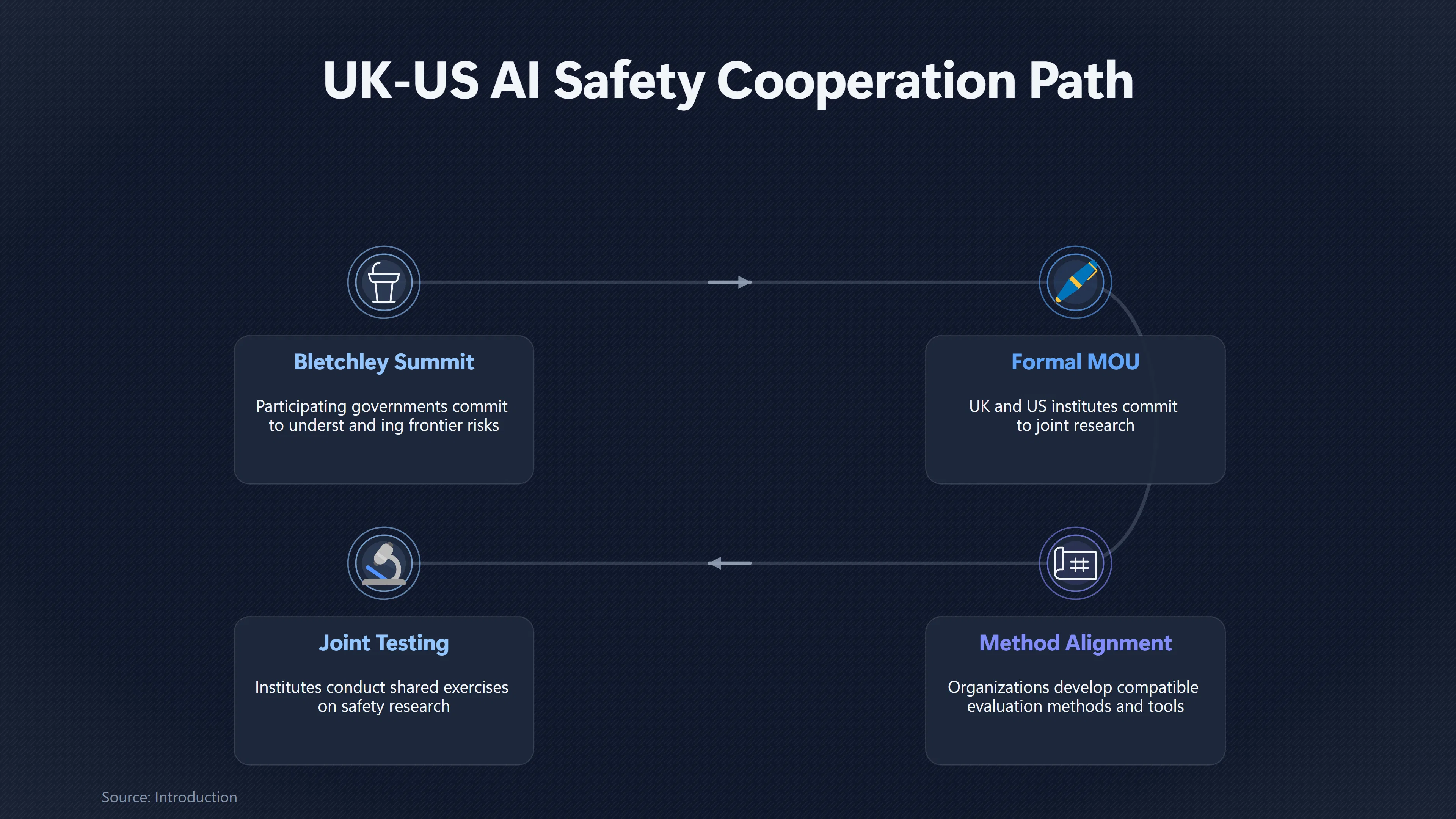
This approach has already begun on a limited scale. Following the 2023 AI Safety Summit, participating governments committed to improving international understanding of frontier AI risks and strengthening scientific cooperation through the Bletchley Declaration.[GOV.UK]GOV.UKai safety summit 2023 the bletchley declarationAI Safety Summit 2023: The Bletchley Declaration - GOV.UKNovember 1, 2023…
The United Kingdom’s AI Safety Institute (later renamed the AI Security Institute) explicitly includes secure information exchange alongside technical evaluations as one of its core functions. Its published approach notes that only selected findings are made public while commercially sensitive and national security information may remain confidential.[GOV.UK]GOV.UKA I Safety Institute approach to evaluationsAI Safety Institute approach to evaluations - GOV.UKFebruary 9, 2024…

Early examples of international cooperation
Although no comprehensive international testing regime exists, several practical experiments have emerged.
One important example is the memorandum of understanding between the UK and US AI Safety Institutes. Rather than creating a binding international regulator, the agreement commits both organisations to collaborate on safety research, develop compatible evaluation methods, exchange personnel and conduct joint testing exercises.[commerce.gov]Commerce.govApril 1, 2024…
This reflects a broader shift in AI governance. Instead of attempting immediate global regulation, governments are building technical cooperation around concrete activities that are politically easier to sustain, such as:
- developing common evaluation tools;[aisi.gov.uk]aisi.gov.ukSource details in endnotes.
- comparing testing methodologies;
- sharing selected pre-deployment findings;
- improving scientific understanding of frontier model capabilities.
Research on international AI Safety Institutes similarly argues that information-sharing should be selective rather than unrestricted. Evaluation standards, testing methods and some categories of safety findings may provide substantial coordination benefits, while highly sensitive capability information may need tighter controls or case-by-case decisions.[arXiv]arxiv.orgWhich Information should the UK and US AISI share with an International Network of AISIs? Opportunities, Risks, and a Tentative Prop…

Where cooperation may fail under geopolitical pressure
The strongest criticism is that the most strategically important information is precisely the information states are least willing to share.
If advanced AI substantially improves military planning, cyber operations or intelligence capabilities, governments may conclude that revealing evaluation results also reveals operational strengths or weaknesses.
Several pressures could undermine cooperation.
Strategic incentives change as capabilities improve. Limited transparency may seem acceptable while AI remains commercially valuable but militarily uncertain. If governments begin viewing frontier systems as decisive strategic assets, secrecy becomes much more attractive.
Verification remains incomplete. Shared evaluations only reduce uncertainty about systems actually submitted for testing. They cannot guarantee that undisclosed internal models, classified military systems or later versions have undergone equivalent scrutiny.
Commercial competition creates additional barriers. Much frontier AI is developed by private companies rather than governments. Firms may resist broad disclosure if it risks revealing trade secrets or reducing competitive advantage.
Political trust can deteriorate rapidly. Diplomatic crises, sanctions or armed conflict could interrupt technical cooperation even if safety institutions wished to continue collaborating.
These limitations matter because AI doom arguments often assume that incentives become harder—not easier—to manage as systems become more economically and strategically valuable.
Can testing alone prevent dangerous racing?
Probably not.
Testing addresses one component of the coordination problem: uncertainty. It does not eliminate competition over technological leadership, nor does it solve the technical challenge of aligning advanced AI systems with human intentions.
Even excellent evaluations have limitations. Current government institutes emphasise that testing cannot prove a model is safe, cannot anticipate every deployment context and cannot guarantee that future versions will behave similarly. Evaluation science itself is still developing.[GOV.UK]GOV.UKA I Safety Institute approach to evaluationsAI Safety Institute approach to evaluations - GOV.UKFebruary 9, 2024…
For that reason, many AI safety researchers see international testing as one layer within a broader risk-reduction strategy that also includes alignment research, interpretability, incident reporting, compute governance and carefully designed deployment decisions.
Within the broader question of how state rivalry can turn AI caution into strategic weakness, shared testing is best understood as a confidence-building measure rather than a complete solution. Its value lies in replacing some strategic guesswork with independently generated evidence. If governments can better distinguish genuine caution from covert acceleration, they may find it easier to justify longer evaluations and stronger safeguards without believing they are automatically conceding advantage to a rival.
Amazon book picks
Further Reading
Books and field guides related to Can Rivals Test Dangerous AI Without Trusting Each Other?. Use these as the next step if you want deeper reading beyond the article.
The Coming Wave
"We are approaching a critical threshold in the history of our species. Everything is about to change. Soon you will live surrounded by A...
The Strategy of Conflict
Analyzes the nature of international disagreements and conflict resolution in terms of game theory and non-zero-sum games.
Chip War
***Winner of the 2022 Financial Times Business Book of the Year Award*** ***Selected as one of Barack Obama's Favourite Books of 2023***...
The Evolution of Cooperation
A famed political scientist's classic argument for a more cooperative world We assume that, in a world ruled by natural selection, selfis...
eBay marketplace picks
Marketplace Samples
Live-tested eBay searches with available results related to this page.
Selected fromtechnology policy decor oneBay.co.uk.



Endnotes
1.
Source: GOV.UK
Title: A I Safety Institute approach to evaluations
Link:https://www.gov.uk/government/publications/ai-safety-institute-approach-to-evaluations/ai-safety-institute-approach-to-evaluations
Source snippet
AI Safety Institute approach to evaluations - GOV.UKFebruary 9, 2024...
Published: February 9, 2024
2.
Source: aisi.gov.uk
Title: Early lessons from evaluating frontier AI systems | AISI Work
Link:https://www.aisi.gov.uk/blog/early-lessons-from-evaluating-frontier-ai-systems
3.
Source: GOV.UK
Title: ai safety summit 2023 the bletchley declaration
Link:https://www.gov.uk/government/publications/ai-safety-summit-2023-the-bletchley-declaration
Source snippet
AI Safety Summit 2023: The Bletchley Declaration - GOV.UKNovember 1, 2023...
Published: November 1, 2023
4.
Source: GOV.UK
Title: Introducing the AI Safety Institute
Link:https://www.gov.uk/government/publications/ai-safety-institute-overview/introducing-the-ai-safety-institute?gh_src=v3scng1
5.
Source: Commerce.gov
Link:https://www.commerce.gov/news/press-releases/2024/04/us-and-uk-announce-partnership-science-ai-safety
Source snippet
April 1, 2024...
Published: April 1, 2024
6.
Source: GOV.UK
Title: Collaboration on the safety of AI: UK-US memorandum of understanding
Link:https://www.gov.uk/government/publications/collaboration-on-the-safety-of-ai-uk-us-memorandum-of-understanding/collaboration-on-the-safety-of-ai-uk-us-memorandum-of-understanding
7.
Source: arxiv.org
Link:https://arxiv.org/abs/2503.04741
Source snippet
Which Information should the UK and US AISI share with an International Network of AISIs? Opportunities, Risks, and a Tentative Prop...
8.
Source: arxiv.org
Link:https://arxiv.org/abs/2409.11314
9.
Source: GOV.UK
Link:https://www.gov.uk/government/publications/ai-safety-summit-2023-the-bletchley-declaration/the-bletchley-declaration-by-countries-attending-the-ai-safety-summit-1-2-november-2023
Published: november 2023
10.
Source: GOV.UK
Title: www.gov.uk Collaboration on the safety of AI: UK-US memorandum of understanding
Link:https://www.gov.uk/government/publications/collaboration-on-the-safety-of-ai-uk-us-memorandum-of-understanding
11.
Source: GOV.UK
Title: www.gov.uk Introducing the AI Safety Institute
Link:https://www.gov.uk/government/publications/ai-safety-institute-overview/introducing-the-ai-safety-institute
12.
Source: GOV.UK
Title: www.gov.uk Prime Minister launches new AI Safety Institute
Link:https://www.gov.uk/government/news/prime-minister-launches-new-ai-safety-institute
13.
Source: GOV.UK
Title: safety testing chairs statement of session outcomes 2 november 2023
Link:https://www.gov.uk/government/publications/ai-safety-summit-2023-chairs-statement-safety-testing-2-november/safety-testing-chairs-statement-of-session-outcomes-2-november-2023
Published: november 2023
14.
Source: GOV.UK
Title: www.gov.uk Chair’s
Link:https://www.gov.uk/government/publications/ai-safety-summit-2023-chairs-statement-2-november/chairs-summary-of-the-ai-safety-summit-2023-bletchley-park?s=09
15.
Source: GOV.UK
Link:https://www.gov.uk/government/news/world-leaders-top-ai-companies-set-out-plan-for-safety-testing-of-frontier-as-first-global-ai-safety-summit-concludes
16.
Source: GOV.UK
Link:https://www.gov.uk/government/news/countries-agree-to-safe-and-responsible-development-of-frontier-ai-in-landmark-bletchley-declaration
17.
Source: aisi.gov.uk
Link:https://www.aisi.gov.uk/research-agenda
18.
Source: aisi.gov.uk
Link:https://www.aisi.gov.uk/blog
Additional References
19.
Source: reuters.com
Link:https://www.reuters.com/technology/us-britain-announce-formal-partnership-artificial-intelligence-safety-2024-04-01/
Source snippet
This alliance, announced by Commerce Secretary Gina Raimondo and British Technology Secretary Michelle Donelan, follows commitments made...
20.
Source: youtube.com
Link:https://www.youtube.com/watch?v=bLhaFRFcDVc
Source snippet
Session 2 | Panel: Frontier AI Capabilities & Implications for Policymakers | Athens Roundtable 2025...
21.
Source: youtube.com
Link:https://www.youtube.com/watch?v=-iwUMoM5nOg
Source snippet
From Bletchley Park to Delhi and What Comes Next | AI Summit Special...
22.
Source: oecd.org
Link:https://www.oecd.org/en/topics/ai-principles.html
23.
Source: oecd.org
Link:https://www.oecd.org/en/topics/artificial-intelligence.html
24.
Source: oecd.org
Title: enablers guardrails and engagement for unlocking trustworthy ai 2f817983
Link:https://www.oecd.org/en/publications/governing-with-artificial-intelligence_795de142-en/full-report/enablers-guardrails-and-engagement-for-unlocking-trustworthy-ai_2f817983.html
25.
Source: aisecurityandsafety.org
Link:https://aisecurityandsafety.org/en/compare/bletchley-declaration-ai-safety-vs-frontier-ai-safety-commitments/
26.
Source: oecd.ai
Link:https://oecd.ai/en/wonk/ai-safety-institute-networks-role-global-ai-governance
27.
Source: usiais.org
Link:https://www.usiais.org/
28.
Source: oecd.org
Title: regulatory sandboxes in artificial intelligence 8f80a0e6 en
Link:https://www.oecd.org/en/publications/regulatory-sandboxes-in-artificial-intelligence_8f80a0e6-en.html