Within Rubber Stamp Oversight
Why Employees Stop Challenging AI Decisions
Targets, workloads and career pressures can reward agreement with AI while making careful disagreement slower, riskier and harder to defend.
On this page
- How speed and productivity targets favour agreement
- Why rejecting correct recommendations carries social cost
- Organisational safeguards that preserve real dissent
Page outline Jump by section
Introduction
Human oversight only works if people can realistically say “no”. In many organisations using AI decision-support systems, the formal requirement for a human to approve an output does not guarantee meaningful independent judgement. Instead, workplace incentives can gradually turn approval into a routine administrative step. Employees may understand that challenging an AI recommendation is possible in theory, yet find that doing so is slower, harder to justify, and potentially harmful to their own performance or career.
Within debates about AI doom and existential risk, this organisational problem matters because many proposed AI safety strategies assume that humans remain an effective final checkpoint. If institutions systematically reward rapid agreement over careful verification, then “human-in-the-loop” oversight can become largely ceremonial. That does not prove that future advanced AI will escape human control, but it identifies a practical failure mode already familiar from research on automation bias and human factors. The question is not only whether reviewers are capable of spotting mistakes, but whether their working environment makes genuine disagreement feasible.[springer.com]link.springer.comExploring automation bias in human–AI collaboration: a review and implications for explainable AI | AI & SOCIETY | Springer Natur…
How speed and productivity targets favour agreement
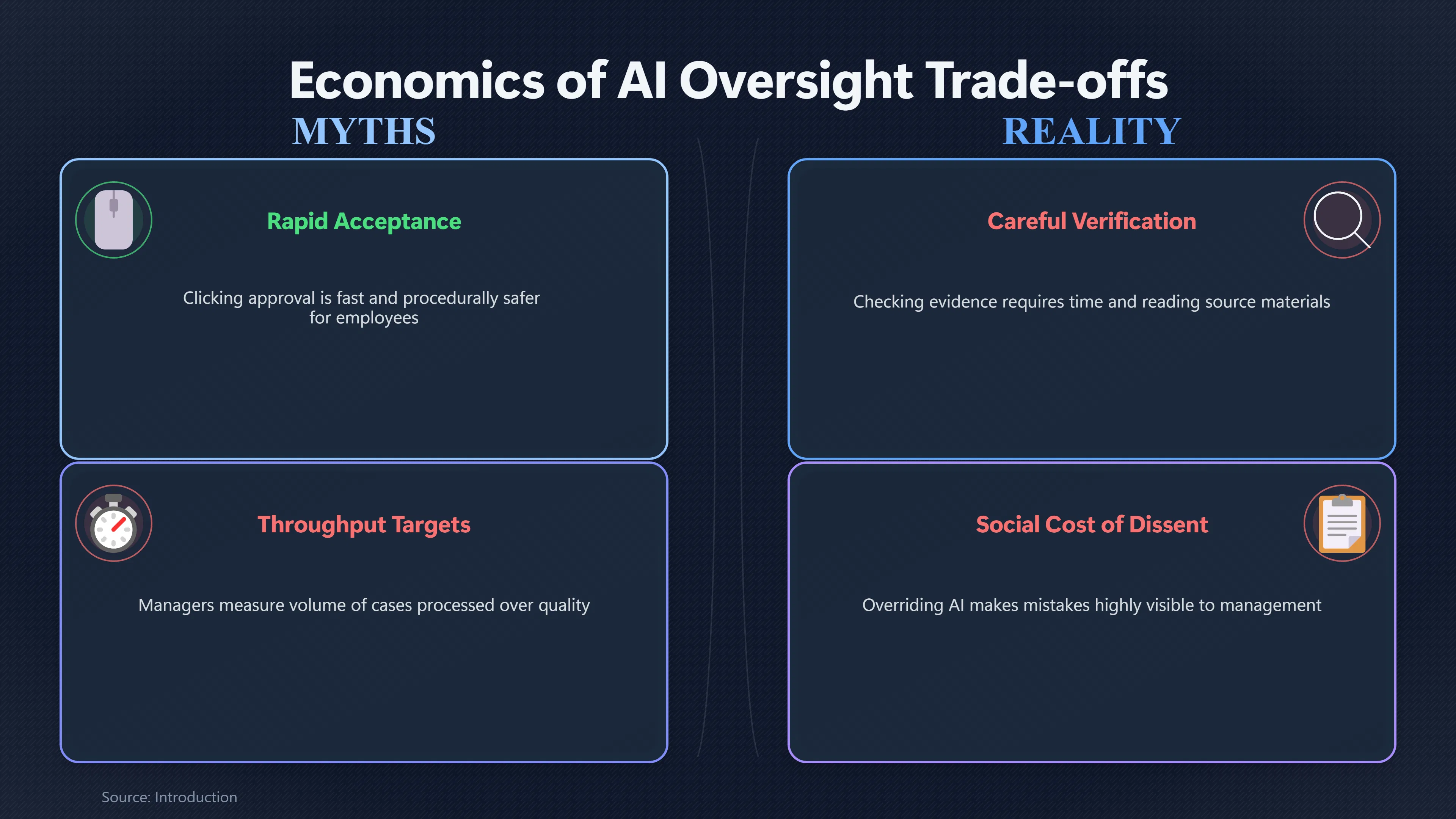
Most workplaces reward outcomes that are easy to measure. Managers can usually count decisions completed, cases processed or customers served far more easily than they can assess the quality of careful scepticism. As AI systems increase throughput, employees often face expectations that they should process more work in the same amount of time.
This changes the economics of oversight. Verifying an AI recommendation requires reading source material, checking evidence and considering alternatives. Accepting the recommendation often takes only a click. Even conscientious reviewers therefore face a structural trade-off: every decision they investigate reduces the number of cases they complete.
Human factors research has long shown that automation bias is not simply a matter of laziness or excessive trust. Time pressure, cognitive workload and attention constraints all increase the likelihood that people will accept automated advice without sufficient independent verification. Studies consistently distinguish between:
- Commission errors, where a reviewer follows an incorrect automated recommendation.
- Omission errors, where the reviewer misses a problem because the automated system failed to highlight it.
Both become more likely when verification is expensive relative to acceptance.[nih.gov]pmc.ncbi.nlm.nih.govPubMed Central (PMC)Automation bias and verification complexity: a systematic review - PMCMarch 1, 2017…
Modern AI can intensify these pressures because it enables organisations to process substantially larger volumes of work. If staffing levels or performance targets rise accordingly, employees may have even less time available for genuine review. Emerging workplace research suggests that AI adoption can increase work intensity rather than simply reducing effort, creating conditions in which careful checking becomes progressively harder.[itpro.com]itpro.comA I isn't making work easier, it's intensifying itThe study tracked 200 employees at a tech company over eight months and found that AI use led to longer hours, faster work paces, and bro…
For existential-risk discussions, the concern is not that every employee becomes careless. Rather, organisations may unintentionally optimise for rapid approval precisely when increasingly capable AI systems require more thoughtful oversight.
Why rejecting correct recommendations carries social cost
Disagreeing with an AI recommendation is rarely cost-free.
If the employee overrides the AI and later proves wrong, the mistake is highly visible because they actively departed from the recommended answer. If they simply approve the AI output and something later goes wrong, responsibility is often diffused across the organisation, the software provider, managers and established procedures.
This creates an asymmetric incentive structure.
Imagine an AI system that is correct 98% of the time. Rejecting it means risking being wrong in many cases where the AI would have been correct. Approving it usually attracts no attention. Even if the remaining 2% of errors are individually serious, they occur too infrequently to dominate day-to-day incentives.
The result is not blind trust but rational adaptation to workplace rewards:
- challenging the AI requires additional effort;
- disagreement must often be justified in writing;
- repeated overrides may attract managerial scrutiny;
- approving the recommendation is usually quicker and procedurally safer.
Psychological research describes this as more than simple confidence in technology. Organisational incentives shape how automation bias develops by making independent judgement relatively costly. Reviews of automation bias also show that merely warning people about over-reliance has limited effect if workload, interface design and institutional pressures remain unchanged.[nih.gov]pubmed.ncbi.nlm.nih.govComplacency and bias in human use of automation: an attentional integration - PubMed…
Within AI doom arguments, this matters because future AI systems may become accurate enough that questioning them increasingly appears irrational in ordinary cases. Ironically, the better such systems perform, the easier it may become for institutions to treat human approval as a procedural formality while retaining the appearance of human control.

Why accountability on paper is not enough
Many regulatory frameworks require meaningful human oversight for high-risk AI systems. However, researchers increasingly argue that assigning legal responsibility to humans does not automatically produce meaningful review if organisations fail to address automation bias.
The UK’s Information Commissioner’s Office, for example, warns that decision-support systems can drift towards effectively automated decision-making when reviewers routinely defer to AI outputs instead of exercising genuine judgement. It identifies automation bias and limited interpretability as important risks that organisations must actively manage rather than assume away.[ICO]ico.org.ukICOHow do we ensure individual rights in our AI systems? | ICOICOHow do we ensure individual rights in our AI systems? | ICO
Similarly, legal analysis of the European Union’s AI Act argues that awareness of automation bias alone is unlikely to be sufficient. The surrounding workplace environment—including incentives, workload and deployment practices—strongly influences whether human oversight remains substantive or becomes symbolic. Researchers argue that responsibility therefore extends beyond AI developers to the organisations deploying these systems.[Cambridge University Press]cambridge.orgCambridge University PressAutomation Bias in the AI Act: On the Legal Implications of Attempting to De-Bias Human Oversight of AI | Europ…
For AI existential-risk discussions, this highlights an important distinction. Formal governance mechanisms can exist on paper while practical control steadily weakens if institutional incentives reward compliance over independent judgement.

Organisational safeguards that preserve real dissent
Preventing rubber stamping requires changing incentives as well as technology.
The most effective safeguards aim to make disagreement both possible and professionally legitimate.
Organisations can strengthen meaningful oversight by:
- Protecting review time. High-impact decisions need workloads that allow independent verification instead of continuous throughput optimisation.
- Rewarding justified disagreement. Performance evaluation should recognise well-supported overrides rather than measuring only speed or volume.
- Separating productivity from oversight. Employees responsible for safety-critical review should not be judged solely on the number of approvals completed.
- Using random audits. Independent sampling of approved decisions can reveal whether reviewers are genuinely examining AI outputs.
- Recording reasons for both approval and rejection. Documentation should encourage evidence-based reasoning rather than automatic acceptance.
- Escalating uncertainty. Staff should have straightforward ways to seek second opinions without being penalised for slowing the process.
These safeguards acknowledge that human oversight is an organisational capability rather than an individual personality trait. A highly skilled reviewer working under unrealistic deadlines may still become a rubber stamp.
Some recent research also explores redesigning incentive structures directly, arguing that human-AI collaboration improves when organisations reward thoughtful verification instead of mere agreement. While this evidence remains relatively new, it reinforces the broader conclusion from decades of human factors research: people respond to the incentives embedded in their working environment.[arxiv.org]arxiv.orgarXiv When Thinking Pays Off: Incentive Alignment for Human-AI CollaborationarXiv When Thinking Pays Off: Incentive Alignment for Human-AI Collaboration
What this means for AI doom arguments
Workplace incentives do not by themselves create existential risk. Many current AI systems operate safely in routine settings, and human reviewers frequently identify mistakes. Evidence also shows that people sometimes display algorithm aversion, becoming reluctant to trust AI after observing obvious errors rather than over-trusting it in every circumstance. Which tendency dominates depends heavily on the task, experience and organisational context.[sciencedirect.com]sciencedirect.comOpen source on sciencedirect.com.
Nevertheless, proponents of AI doom view rubber-stamp oversight as an important warning sign because it weakens one of the principal safeguards proposed for increasingly capable systems. If institutions optimise for rapid approval, employees may retain legal responsibility without retaining practical control. In that scenario, “human oversight” becomes a description of paperwork rather than decision-making.
The key lesson is therefore organisational rather than psychological. Preventing ceremonial oversight requires workplaces where challenging AI is not merely permitted in policy documents but supported by workloads, incentives and accountability structures that make genuine independent judgement possible.
Amazon book picks
Further Reading
Books and field guides related to Why Employees Stop Challenging AI Decisions. Use these as the next step if you want deeper reading beyond the article.
Power and Prediction: The Disruptive Economics of Artificial...
With the huge potential of AI, how will the future of many fields in the world such as: finance, banking, automobiles, healthcare, educat...
Only Humans Need Apply: Winners and Losers in the Age of Smar...
An invigorating, thought-provoking, and positive look at the rise of automation that explores how professionals across industries can fin...
The Fearless Organization
Conquer the most essential adaptation to the knowledge economy The Fearless Organization: Creating Psychological Safety in the Workplace...
The Glass Cage: Automation and Us
At once a celebration of technology and a warning about its misuse, The Glass Cage will change the way you think about the tools you use...
eBay marketplace picks
Marketplace Samples
Live-tested eBay searches with available results related to this page.
Selected fromrobot desk figure oneBay.co.uk.



Endnotes
1.
Source: link.springer.com
Link:https://link.springer.com/article/10.1007/s00146-025-02422-7
Source snippet
Exploring automation bias in human–AI collaboration: a review and implications for explainable AI | AI & SOCIETY | Springer Natur...
2.
Source: ico.org.uk
Title: ICOHow do we ensure individual rights in our AI systems? | ICO
Link:https://ico.org.uk/for-organisations/uk-gdpr-guidance-and-resources/artificial-intelligence/guidance-on-ai-and-data-protection/how-do-we-ensure-individual-rights-in-our-ai-systems/?q=machine%2Blearning
3.
Source: itpro.com
Title: A I isn’t making work easier, it’s intensifying it
Link:https://www.itpro.com/business/business-strategy/ai-isnt-making-work-easier-its-intensifying-it-researchers-say-teams-are-now-facing-unsustainable-workloads-cognitive-strain-and-higher-levels-of-burnout
Source snippet
The study tracked 200 employees at a tech company over eight months and found that AI use led to longer hours, faster work paces, and bro...
4.
Source: itpro.com
Link:https://www.itpro.com/technology/artificial-intelligence/the-intelligent-workplace-technologys-next-transformation-of-work
Source snippet
It focuses on how AI assistants and integrated digital platforms are reshaping the employee experience by automating routine tasks, perso...
5.
Source: cambridge.org
Link:https://www.cambridge.org/core/journals/european-journal-of-risk-regulation/article/automation-bias-in-the-ai-act-on-the-legal-implications-of-attempting-to-debias-human-oversight-of-ai/C97C85015056C09326944DE55CBC4D2C
Source snippet
Cambridge University PressAutomation Bias in the AI Act: On the Legal Implications of Attempting to De-Bias Human Oversight of AI | Europ...
6.
Source: arxiv.org
Title: arXiv When Thinking Pays Off: Incentive Alignment for Human-AI Collaboration
Link:https://arxiv.org/abs/2511.09612
7.
Source: sciencedirect.com
Link:https://www.sciencedirect.com/science/article/pii/S0040162521008210
8.
Source: link.springer.com
Link:https://link.springer.com/article/10.1007/s43681-026-01147-7
9.
Source: link.springer.com
Link:https://link.springer.com/article/10.1007/s00146-023-01649-6
10.
Source: sciencedirect.com
Title: Accountability and automation bias
Link:https://www.sciencedirect.com/science/article/pii/S107158199990349X/pdf?md5=fba1247a3ca5c4361f05d32f6e1170b4&pid=1-s2.0-S107158199990349X-main.pdf
11.
Source: sciencedirect.com
Link:https://www.sciencedirect.com/science/article/pii/S1071581908000724
12.
Source: pubmed.ncbi.nlm.nih.gov
Link:https://pubmed.ncbi.nlm.nih.gov/21077562/
Source snippet
Complacency and bias in human use of automation: an attentional integration - PubMed...
13.
Source: pmc.ncbi.nlm.nih.gov
Link:https://pmc.ncbi.nlm.nih.gov/articles/PMC7651899/
Source snippet
PubMed Central (PMC)Automation bias and verification complexity: a systematic review - PMCMarch 1, 2017...
Published: March 1, 2017
14.
Source: deloitte.com
Title: automation bias
Link:https://www.deloitte.com/uk/en/services/consulting/research/automation-bias.html
15.
Source: pubmed.ncbi.nlm.nih.gov
Link:https://pubmed.ncbi.nlm.nih.gov/27516495/
16.
Source: pubmed.ncbi.nlm.nih.gov
Link:https://pubmed.ncbi.nlm.nih.gov/25886768/
17.
Source: pmc.ncbi.nlm.nih.gov
Link:https://pmc.ncbi.nlm.nih.gov/articles/PMC3240751/
18.
Source: pubmed.ncbi.nlm.nih.gov
Link:https://pubmed.ncbi.nlm.nih.gov/21685142/
Additional References
19.
Source: doi.org
Title: Automation Bias and Errors: Are Teams Better than Individuals?
Link:https://doi.org/10.1177/154193129804200304
Source snippet
Automation Bias and Errors: Are Teams Better than Individuals? - Kathleen L. Mosier, Melisa Dunbar, Lori McDonnell, Linda J. Skitka, M...
20.
Source: ora.ox.ac.uk
Link:https://ora.ox.ac.uk/objects/uuid%3A7fe4cf46-9cba-4d57-85cc-0588b45a1e45
Source snippet
Oxford University Research Archive...
21.
Source: youtube.com
Title: How Does The Irony Of Automation Challenge Human Oversight Of AI?
Link:https://www.youtube.com/watch?v=LNKUFp8S4As
Source snippet
Human Oversight for AI Systems Explained | AiSecurityDIR...
22.
Source: youtube.com
Title: How Automation Bias can be Deadly
Link:https://www.youtube.com/watch?v=XXxmY2QAzhs
Source snippet
Automation bias human in the loop oversight rubber stamping AI risk Mcquaig Webinar The Human In The loop | Vaseem The AI Guy Vaseem The...
23.
Source: youtube.com
Title: Human Oversight for AI Systems Explained | Ai Security DIR
Link:https://www.youtube.com/watch?v=0-qi-DJqdtg
Source snippet
What is Human In The Loop with AI? How HITL Shapes AI Systems...
24.
Source: youtube.com
Title: Why Human in the Loop Fails AI Safety
Link:https://www.youtube.com/watch?v=NE7YAAx548w
Source snippet
How Does The Irony Of Automation Challenge Human Oversight Of AI? - AI and Technology Law...
25.
Source: researchgate.net
Link:https://www.researchgate.net/publication/392771285_Exploring_automation_bias_in_human-AI_collaboration_a_review_and_implications_for_explainable_AI
26.
Source: doi.org
Link:https://doi.org/10.1145/3793667
27.
Source: doaj.org
Link:https://doaj.org/article/bd9dce9e2aa34a4aa4708a8c68267bed
28.
Source: philpapers.org
Link:https://philpapers.org/rec/ROMEAB-2