Within Bio Uplift
What Still Stands Between AI Advice and a Pandemic?
Even excellent AI guidance leaves major barriers in facilities, materials, reliability, transmission, scaling and public-health response.
On this page
- The independent bottlenecks beyond scientific knowledge
- Why catastrophic misuse is easier than existential misuse
- Which shrinking barriers would signal rising danger
Page outline Jump by section
Introduction
A common misunderstanding in discussions about AI doom is that if advanced AI can provide expert-level biology advice, then a pandemic catastrophe automatically becomes much easier to create. That is not what the current evidence shows. While increasingly capable AI systems appear to reduce knowledge barriers for complex biological tasks, a globally catastrophic pandemic would still require success across a chain of difficult technical, operational and social challenges. Failure at any one stage could prevent an attack from achieving its intended impact.[National Academies]nationalacademies.orgNational AcademiesAI Tools Can Enhance U.S. Biosecurity; Monitoring and Mitigation Will Be Needed to Protect Against MisuseMarch 14, 2025…

This distinction matters because the debate is about existential risk rather than ordinary misuse. A pathogen that causes a limited outbreak is very different from one capable of sustained global transmission, overwhelming public-health systems and threatening civilisation on an unprecedented scale. The remaining bottlenecks therefore deserve as much attention as the ways AI may lower barriers. They also help explain why many researchers argue that today’s concern is not that AI has already made pandemic catastrophe easy, but that several independent barriers could gradually erode at the same time.
The independent bottlenecks beyond scientific knowledge
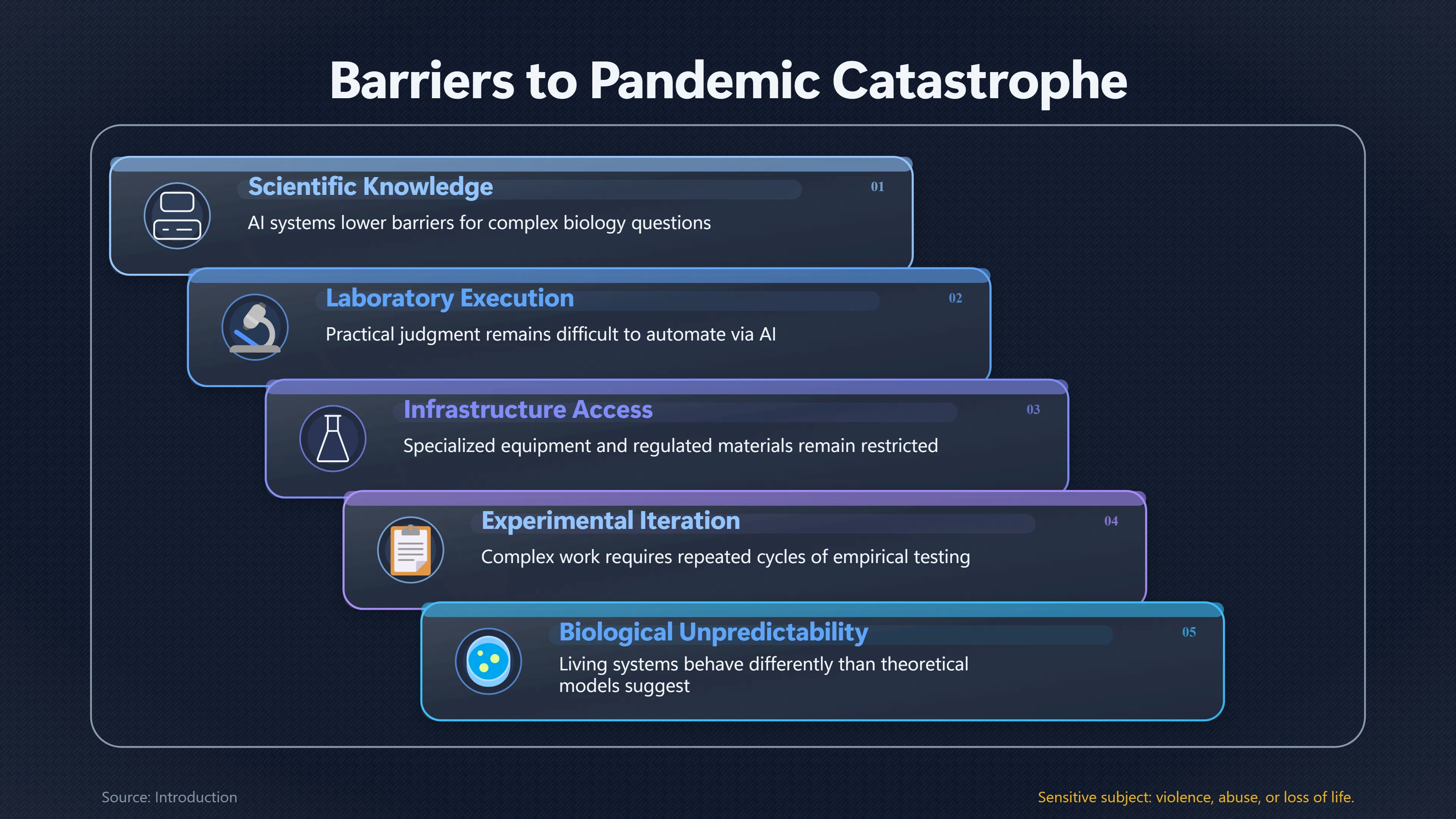
Scientific knowledge is only one ingredient in creating a dangerous biological threat. Even if AI could reliably answer sophisticated biology questions, several other barriers remain difficult to overcome.
The most important include:
- Reliable laboratory execution. Many biological procedures depend on practical judgement acquired through experience rather than written instructions. Experiments frequently fail for mundane reasons such as contamination, equipment variability or subtle handling mistakes. AI-generated advice cannot guarantee successful execution in an unfamiliar laboratory environment.[National Academies]nationalacademies.orgNational AcademiesAI Tools Can Enhance U.S. Biosecurity; Monitoring and Mitigation Will Be Needed to Protect Against MisuseMarch 14, 2025…
- Access to appropriate facilities and materials. Many advanced experiments require specialised equipment, controlled environments, trained personnel or regulated materials. These practical constraints remain independent of how much scientific advice an AI can provide.[National Academies]nationalacademies.orgNational AcademiesAI Tools Can Enhance U.S. Biosecurity; Monitoring and Mitigation Will Be Needed to Protect Against MisuseMarch 14, 2025…
- Repeated experimental iteration. Complex biological work rarely succeeds on the first attempt. Progress often depends on cycles of testing, analysing failures and refining approaches over extended periods. Reducing the knowledge burden does not eliminate the need for repeated empirical work.
- Biological unpredictability. Living systems frequently behave differently from theoretical expectations. Even experienced researchers cannot reliably predict how every genetic change will affect stability, transmissibility or disease severity. The National Academies notes that present AI systems remain limited by incomplete biological knowledge and the available training data needed to design highly concerning pathogens with predictable properties.[National Academies]nationalacademies.orgNational AcademiesAI Tools Can Enhance U.S. Biosecurity; Monitoring and Mitigation Will Be Needed to Protect Against MisuseMarch 14, 2025…
- Scaling from isolated success to widespread impact. Demonstrating a biological effect under controlled conditions is not the same as producing a pathogen capable of sustained real-world spread across diverse populations and environments.
These bottlenecks interact rather than disappear independently. AI may shorten some parts of the process while leaving others largely unchanged.
Why catastrophic misuse is harder than existential misuse
The phrase “pandemic pathogen” can obscure important differences in scale.
Many harmful biological events never become global catastrophes. Outbreaks may remain geographically limited, fail to spread efficiently between people or be contained through surveillance and public-health intervention. An existential scenario requires a much longer chain of successes than simply creating a dangerous organism.
Among the additional hurdles are:
- sustained human-to-human transmission;
- maintaining transmission across different environments and populations;
- avoiding rapid extinction of the outbreak through chance or intervention;
- overwhelming multiple layers of public-health response simultaneously;
- producing consequences severe enough to threaten civilisation rather than causing even a very serious epidemic.
Each stage introduces uncertainty. Historically, even naturally emerging pathogens with advantageous characteristics have varied enormously in their ability to spread globally.
This distinction explains why many biosecurity researchers focus on “high-consequence biological capabilities” rather than assuming every increase in AI capability translates directly into existential risk. The concern is cumulative: if AI progressively reduces multiple independent barriers, the overall level of risk could rise even if no single breakthrough is decisive.[arXiv]arxiv.orgPrioritizing High-Consequence Biological Capabilities in Evaluations of Artificial Intelligence ModelsMay 25, 2024…
Public-health defences remain part of the picture
AI doom discussions sometimes focus almost exclusively on offensive capabilities. However, defensive capacity also affects the probability of catastrophe.
Modern outbreak response includes:
- genomic surveillance to identify emerging pathogens;
- international disease reporting networks;
- diagnostic testing;
- vaccine platform technologies;
- infection-control measures;
- epidemiological modelling;
- medical countermeasure development.
These systems are imperfect, as COVID-19 demonstrated, but they create additional barriers between an initial biological incident and an irreversible global catastrophe. The World Health Organization continues to emphasise rapid investigation, international information sharing and preparedness as critical tools for preventing local outbreaks from becoming worldwide crises.[World Health Organization]who.intWorld Health OrganizationWHO global framework to define and guide studies into the origins of emerging and re-emerging pathogens with epi…
Some researchers also argue that AI itself could strengthen these defences by improving surveillance, accelerating diagnostics and assisting vaccine development. That means advances in AI may simultaneously increase both offensive and defensive capabilities, making the net effect uncertain rather than automatically increasing existential risk.[PubMed]pubmed.ncbi.nlm.nih.govFrom pandemics to preparedness: harnessing AI, CRISPR, and synthetic biology to counter biosecurity threats - PubMedNovember 26, 2025…
Which shrinking barriers would signal rising danger?
Most experts do not expect risk to increase because of one dramatic technological leap. Instead, they watch for several independent barriers beginning to weaken together.
Warning signs that would materially change today’s assessment include:
- AI systems consistently demonstrating reliable laboratory troubleshooting rather than merely answering theoretical questions.
- Wider availability of autonomous laboratory platforms that reduce the need for experienced human operators.
- Biological design tools becoming substantially better at predicting complex pathogen properties rather than isolated molecular functions.
- Easier access to advanced experimental infrastructure through automation or remote services.
- Evidence that non-experts can successfully complete increasingly sophisticated biological projects with AI assistance under realistic conditions rather than paper-based evaluations alone.
- Weakening of safeguards around DNA synthesis, laboratory oversight or model access that currently provide friction against misuse.
No single development would necessarily imply an imminent existential threat. The concern is convergence: multiple barriers shrinking at roughly the same time while AI systems continue improving in planning, reasoning and scientific assistance. This is one reason many recent policy discussions recommend evaluating frontier models specifically for high-consequence biological capabilities before deployment, rather than relying only on general AI benchmarks.[arXiv]arxiv.orgPrioritizing High-Consequence Biological Capabilities in Evaluations of Artificial Intelligence ModelsMay 25, 2024…
Why this matters for AI doom debates
The strongest versions of the AI-enabled pandemic argument do not claim that today’s chatbots allow anyone to create a civilisation-ending pathogen. Instead, they argue that expert-level scientific reasoning is only one obstacle in a larger chain, and that AI may gradually erode several links in that chain over time.
Critics point out that the remaining obstacles are substantial and should not be minimised. Practical laboratory expertise, biological uncertainty, operational complexity and public-health response all continue to limit what hostile actors can achieve. The National Academies concluded that, although AI-enabled biological tools warrant close monitoring, physical implementation remains a significant barrier today.[National Academies]nationalacademies.orgNational AcademiesAI Tools Can Enhance U.S. Biosecurity; Monitoring and Mitigation Will Be Needed to Protect Against MisuseMarch 14, 2025…
Supporters of stronger AI safety measures respond that existential risk depends on future trajectories rather than present capabilities. If frontier AI systems become more capable scientific assistants while laboratory automation, synthetic biology and biological design tools also improve, today’s independent bottlenecks could become progressively less independent. From that perspective, the most important question is not whether AI advice alone can produce a pandemic catastrophe, but whether multiple technological trends could eventually remove enough barriers that such a scenario becomes meaningfully more plausible.
Amazon book picks
Further Reading
Books and field guides related to What Still Stands Between AI Advice and a Pandemic?. Use these as the next step if you want deeper reading beyond the article.
The Coming Wave
"We are approaching a critical threshold in the history of our species. Everything is about to change. Soon you will live surrounded by A...
The Precipice
What existential threats does humanity face? And how can we secure our future?'The Precipice is a powerful book . . . Ord's love for huma...
The End of Epidemics
"Jonathan Quick offers a compelling and intensely readable plan to prevent worldwide infectious outbreaks. The End of Epidemics is essent...
Spillover
A masterpiece of science reporting that tracks the animal origins of emerging human diseases, Spillover is “fascinating and terrifying …...
eBay marketplace picks
Marketplace Samples
Live-tested eBay searches with available results related to this page.
Selected fromvirus model oneBay.co.uk.



Endnotes
1.
Source: arxiv.org
Link:https://arxiv.org/abs/2306.13952
2.
Source: arxiv.org
Link:https://arxiv.org/abs/2407.13059
Source snippet
Prioritizing High-Consequence Biological Capabilities in Evaluations of Artificial Intelligence ModelsMay 25, 2024...
Published: May 25, 2024
3.
Source: nationalacademies.org
Link:https://www.nationalacademies.org/news/ai-tools-can-enhance-u-s-biosecurity-monitoring-and-mitigation-will-be-needed-to-protect-against-misuse
Source snippet
National AcademiesAI Tools Can Enhance U.S. Biosecurity; Monitoring and Mitigation Will Be Needed to Protect Against MisuseMarch 14, 2025...
Published: March 14, 2025
4.
Source: nationalacademies.org
Title: National Academies Biosecurity
Link:https://www.nationalacademies.org/topics/biosecurity
5.
Source: nap.nationalacademies.org
Link:https://nap.nationalacademies.org/initiative/committee-on-assessing-and-navigating-biosecurity-concerns-and-benefits-of-artificial-intelligence-use-in-the-life-sciences
Source snippet
National Academies PressInitiatives|Committee on Assessing and Navigating Biosecurity Concerns and Benefits of Artificial Intelligence Us...
6.
Source: who.int
Link:https://www.who.int/publications/i/item/9789240101470
Source snippet
World Health OrganizationWHO global framework to define and guide studies into the origins of emerging and re-emerging pathogens with epi...
7.
Source: who.int
Title: World Health Organization Synthetic biology technologies
Link:https://www.who.int/news-room/feature-stories/detail/synthetic-biology-technologies
8.
Source: pubmed.ncbi.nlm.nih.gov
Link:https://pubmed.ncbi.nlm.nih.gov/41383331/
Source snippet
From pandemics to preparedness: harnessing AI, CRISPR, and synthetic biology to counter biosecurity threats - PubMedNovember 26, 2025...
Published: November 26, 2025
9.
Source: pubmed.ncbi.nlm.nih.gov
Link:https://pubmed.ncbi.nlm.nih.gov/42305667/
10.
Source: pmc.ncbi.nlm.nih.gov
Link:https://pmc.ncbi.nlm.nih.gov/articles/PMC12689540/
11.
Source: pubmed.ncbi.nlm.nih.gov
Link:https://pubmed.ncbi.nlm.nih.gov/41383331/?fc=None&ff=20251212072228&v=2.18.0.post22+67771e2
12.
Source: ncbi.nlm.nih.gov
Link:https://www.ncbi.nlm.nih.gov/books/NBK614591/
13.
Source: ncbi.nlm.nih.gov
Link:https://www.ncbi.nlm.nih.gov/books/NBK614593/
14.
Source: uwnxt.nationalacademies.org
Link:https://uwnxt.nationalacademies.org/read/28868/chapter/2
15.
Source: uwnxt.nationalacademies.org
Link:https://uwnxt.nationalacademies.org/projects/DELS-BLS-24-04/event/43297
16.
Source: pmc.ncbi.nlm.nih.gov
Link:https://pmc.ncbi.nlm.nih.gov/articles/PMC11116769/
17.
Source: ncbi.nlm.nih.gov
Link:https://www.ncbi.nlm.nih.gov/books/NBK535868/
18.
Source: ncbi.nlm.nih.gov
Link:https://www.ncbi.nlm.nih.gov/books/NBK535887/
19.
Source: who.int
Link:https://www.who.int/publications/i/item/the-independent-advisory-group-on-public-health-implications-of-synthetic-biology-technology-related-to-smallpox
20.
Source: nap.nationalacademies.org
Link:https://nap.nationalacademies.org/collection/69/biosecurity
21.
Source: nationalacademies.org
Link:https://www.nationalacademies.org/read/28868/chapter/2
22.
Source: nationalacademies.org
Link:https://www.nationalacademies.org/read/28868/chapter/5
23.
Source: nationalacademies.org
Link:https://www.nationalacademies.org/projects/DELS-BLS-24-04/publication/28868
24.
Source: nap.nationalacademies.org
Link:https://nap.nationalacademies.org/resource/28868/interactive/
25.
Source: nationalacademies.org
Link:https://www.nationalacademies.org/read/28868/chapter/3
Additional References
26.
Source: axios.com
Link:https://www.axios.com/2024/05/09/ai-superbugs-biosurveillance-fear-biodefense
Source snippet
and China are in competition. Concerns persist about China's biosafety due to past incidents, such as a massive chickenpox lab leak and m...
27.
Source: youtube.com
Link:https://www.youtube.com/watch?v=acnmEQip6Jk
Source snippet
Scaling Laws: Why Data Governance Is the Key to AI Biosecurity, with Jassi Pannu and Doni Bloomfield...
28.
Source: youtube.com
Link:https://www.youtube.com/watch?v=SvPcxRiFauY
Source snippet
The Silent Lab: The Rise of Autonomous Biology & Machine-Led Risks | Code Blue AI...
29.
Source: youtube.com
Link:https://www.youtube.com/watch?v=UUELqwathns
Source snippet
Ep 59 - A New Study Taking Responsible [Innovation]({{ 'false-positives/' | relative_url }}) From Benchmarks to Benchwork...
30.
Source: youtube.com
Title: Bryce Cai
Link:https://www.youtube.com/watch?v=oh4AoiAOwfs
Source snippet
Ep 28 - The Real Risks, and Real Promise, of AI in Biotech from the Perspective of the National A...
31.
Source: nature.com
Link:https://www.nature.com/articles/d41586-024-03815-2
32.
Source: academic.oup.com
Link:https://academic.oup.com/ofid/article/13/7/ofag348/8728458
Source snippet
for the Next Pandemic: Learning From COVID-19 to Build What Comes Next | Open Forum Infectious Diseases | Oxford AcademicJuly 10, 2026 —...
Published: July 10, 2026
33.
Source: frontiersin.org
Link:https://www.frontiersin.org/journals/public-health/articles/10.3389/fpubh.2026.1786846/full
34.
Source: nti.org
Title: Urgent Steps Needed to Safeguard Rapidly Advancing AI-Bioscience Technologies
Link:https://www.nti.org/news/urgent-steps-needed-to-safeguard-rapidly-advancing-ai-bioscience-technologies/
35.
Source: chathamhouse.org
Title: Breaking the deadlock on AI governance | 03 How crises can lead to action
Link:https://www.chathamhouse.org/2026/03/breaking-deadlock-ai-governance/03-how-crises-can-lead-action