Within Hard Bottlenecks
Could Better Algorithms Make More Chips Unnecessary?
Better algorithms could unlock repeated capability gains on existing chips, but no one knows how long those efficiency gains can continue.
On this page
- How software improvements increase effective compute
- Historical evidence for large efficiency gains
- Why diminishing returns could eventually reappear
Page outline Jump by section
Introduction
Could better algorithms make new chips less important? The short answer is yes, for a while—but probably not indefinitely. One of the central uncertainties in debates about AI doom and rapid recursive improvement is whether software advances can keep increasing AI capabilities even when hardware becomes scarce. History shows that algorithmic improvements have often delivered dramatic gains, allowing researchers to achieve the same results with far less computing power than before. In some periods, these efficiency gains have outpaced improvements in computer hardware itself.[OpenAI]OpenAIai and efficiencyMay 5, 2020…
However, this does not mean hardware stops mattering. Better algorithms and better chips have historically worked together rather than replacing one another. The strongest evidence suggests that software innovation can delay hardware bottlenecks, sometimes substantially, but there is no clear evidence that algorithmic efficiency can improve without limit. For debates about an intelligence explosion, this distinction is crucial. If software keeps unlocking large capability gains on existing hardware, compute shortages may slow progress less than expected. If efficiency improvements eventually level off, physical infrastructure could reassert itself as a hard constraint.
How software improvements increase effective compute
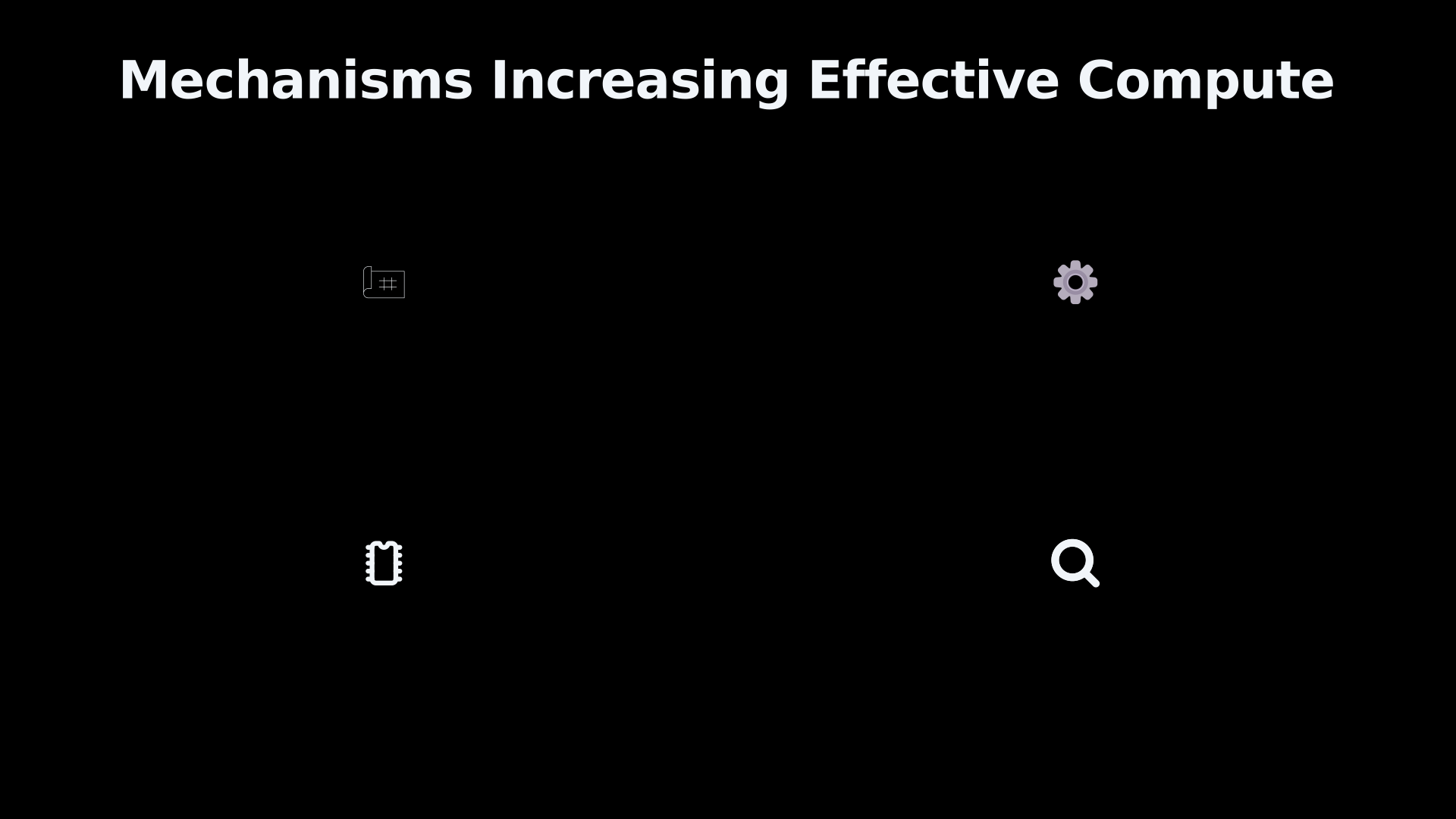
When researchers discuss “algorithmic efficiency”, they usually mean achieving the same capability using less computation. This is effectively equivalent to making existing hardware more powerful without changing the chips themselves.
Several kinds of innovation contribute:
- Improved neural network architectures, such as replacing older recurrent networks with transformers for many language tasks.
- Better optimisation algorithms, allowing models to learn more efficiently during training.
- Improved data selection and curation, reducing wasted computation on less useful examples.
- More efficient inference techniques, including quantisation, sparsity and caching, which lower the computational cost of using trained models.
- Smarter allocation of compute, guided by empirical scaling laws that help researchers avoid inefficient training regimes.[OpenAI]OpenAIscaling laws for neural language modelsJanuary 23, 2020…
From the perspective of AI capability, these improvements all increase what researchers sometimes call effective compute: the useful work that existing hardware can accomplish.
For recursive AI improvement scenarios, this matters because an AI system designing better algorithms could potentially improve its own effectiveness even before additional hardware is available.
Historical evidence shows software gains can be enormous
The strongest empirical evidence comes from studies measuring how much computation is required to reach a fixed performance level over time.
A widely cited analysis by OpenAI found that between 2012 and 2019, the amount of compute needed to match AlexNet’s ImageNet performance fell by roughly 44 times, corresponding to a doubling in algorithmic efficiency approximately every 16 months. During the same period, hardware improvements alone would have produced roughly an eleven-fold gain under Moore’s Law. In other words, software improvements contributed at least as much as hardware advances for this benchmark.[OpenAI]OpenAIai and efficiencyMay 5, 2020…
More recent research focused specifically on language models suggests even faster algorithmic progress. Analysing more than 200 language-model evaluations between 2012 and 2023, researchers at Epoch AI estimated that the compute needed to achieve a fixed language-modelling performance threshold halved roughly every eight months. That rate exceeded the pace of hardware improvement over the same period.[arXiv]arxiv.orgarXiv Algorithmic progress in language modelsAlgorithmic progress in language modelsMarch 9, 2024…
These findings support an important point in intelligence-explosion debates: capability improvements do not come solely from buying more GPUs. Better software has repeatedly unlocked much greater performance from existing hardware.
Why software has not replaced hardware
The historical record also shows that algorithmic progress has complemented, rather than substituted for, increasing compute.
The same studies finding rapid efficiency gains also conclude that dramatically larger training runs contributed even more to frontier performance than software improvements alone. Since roughly 2010, the amount of compute used to train leading machine-learning systems has grown extraordinarily quickly, far faster than traditional Moore’s Law would predict. Researchers identify a transition to a “large-scale era” in which frontier models increasingly rely on enormous computational investments alongside continuing algorithmic advances.[epoch.ai]epoch.aicompute trendsacross three eras of machine learning | Epoch AIFebruary 16, 2022…
This interaction matters because software and hardware multiply each other’s effects rather than competing directly. A new optimisation method applied to a cluster ten times larger than its predecessor can produce much larger capability gains than either improvement alone.
Consequently, periods of chip shortages do not necessarily halt progress, but neither have software advances made hardware expansion unnecessary.
Why efficiency improvements may become harder
Past success does not guarantee that algorithmic efficiency will continue improving at similar rates.
Several reasons suggest diminishing returns could eventually become more important.
First, many of the most transformative innovations—such as backpropagation, convolutional neural networks and transformers—were unusually large conceptual breakthroughs. Future discoveries may be smaller or more incremental.
Second, scaling laws themselves imply diminishing returns. As models become stronger, achieving another fixed improvement generally requires increasingly large increases in effective compute. Better algorithms can shift these curves, but they do not eliminate the underlying pattern of diminishing returns.[OpenAI]OpenAIscaling laws for neural language modelsJanuary 23, 2020…
Third, many straightforward efficiency gains have already been exploited. Researchers routinely use mixed-precision arithmetic, improved optimisers, better parallelisation and carefully tuned training pipelines. Additional improvements may require increasingly difficult breakthroughs rather than routine engineering.
Finally, some bottlenecks are not algorithmic at all. Memory bandwidth, networking between accelerators and energy constraints increasingly limit large AI systems. Better algorithms can reduce pressure on these systems but cannot remove every physical constraint. Recent analyses of AI hardware trends highlight that improvements in memory bandwidth and energy efficiency have proceeded more slowly than growth in raw computational demand.[Epoch AI]epoch.aiin Artificial Intelligence | Epoch AIFebruary 5, 2026…
What this means for intelligence-explosion arguments
Within AI doom discussions, the importance of algorithmic efficiency depends on the specific scenario being considered.
Supporters of faster takeoff scenarios argue that:
- Better algorithms could allow multiple rounds of capability improvement before new hardware is required.
- AI systems may themselves accelerate algorithm discovery, increasing the pace of software progress.
- Efficiency gains can effectively “unlock” unused capability already present in existing compute infrastructure.
Critics respond that:
- There is no evidence algorithmic efficiency can continue improving indefinitely.
- Many improvements still require extensive empirical testing on expensive hardware.
- Hardware, electricity and experimental capacity eventually become limiting even if software continues improving.
Both sides accept that algorithmic progress matters. The disagreement concerns how long exceptionally rapid efficiency gains can continue and whether they are sufficient to sustain recursive improvement without matching growth in physical compute.
The evidence remains genuinely uncertain
The historical evidence strongly supports one conclusion: software improvements have repeatedly delivered capability gains that would have seemed impossible if one looked only at semiconductor progress. Anyone assuming that chip shortages alone will reliably constrain advanced AI is likely underestimating the importance of algorithmic innovation.[OpenAI]OpenAIai and efficiencyMay 5, 2020…
At the same time, the evidence does not support the opposite extreme. Frontier AI has continued to rely on rapidly increasing computational investment, and the largest capability advances have typically emerged when improved algorithms, larger datasets and expanding hardware all advanced together.[epoch.ai]epoch.aicompute trendsacross three eras of machine learning | Epoch AIFebruary 16, 2022…
For forecasts of AI doom and potential intelligence explosions, algorithmic efficiency therefore represents a major uncertainty rather than a settled answer. It may substantially postpone hardware bottlenecks, potentially enabling faster capability growth than chip supply alone would suggest. But no existing evidence demonstrates that software improvements can outrun physical constraints indefinitely, and the point at which diminishing returns dominate remains unknown.
Amazon book picks
Further Reading
Books and field guides related to Could Better Algorithms Make More Chips Unnecessary?. Use these as the next step if you want deeper reading beyond the article.
The Master Algorithm
"Describes the quest to find the Master Algorithm, which will take machine learning to the next level, allowing computers to learn how to...
Deep Learning
Rating: 3.5/5 from 6 Google Books ratings
An introduction to a broad range of topics in deep learning, covering mathematical and conceptual background, deep learning techniques us...
Artificial Intelligence: A Modern Approach
Rating: 4.5/5 from 10 Google Books ratings
Artificial intelligence: A Modern Approach, 3e,is ideal for one or two-semester, undergraduate or graduate-level courses in Artificial In...
Human Compatible
A leading artificial intelligence researcher lays out a new approach to AI that will enable us to coexist successfully with increasingly...
eBay marketplace picks
Marketplace Samples
Live-tested eBay searches with available results related to this page.
Selected fromartificial intelligence poster oneBay.co.uk.




Endnotes
1.
Source: OpenAI
Title: ai and efficiency
Link:https://openai.com/index/ai-and-efficiency/
Source snippet
May 5, 2020...
Published: May 5, 2020
2.
Source: arxiv.org
Title: arXiv Measuring the Algorithmic Efficiency of Neural Networks
Link:https://arxiv.org/abs/2005.04305
3.
Source: OpenAI
Title: scaling laws for neural language models
Link:https://openai.com/index/scaling-laws-for-neural-language-models/
Source snippet
January 23, 2020...
Published: January 23, 2020
4.
Source: arxiv.org
Title: arXiv Algorithmic progress in language models
Link:https://arxiv.org/abs/2403.05812
Source snippet
Algorithmic progress in language modelsMarch 9, 2024...
Published: March 9, 2024
5.
Source: epoch.ai
Title: AIAI Software Progress: Data & Research | Epoch AI
Link:https://epoch.ai/topics/software-progress
Source snippet
AI Software Progress: Data & Research | Epoch AI...
6.
Source: epoch.ai
Title: compute trends
Link:https://epoch.ai/publications/compute-trends
Source snippet
across three eras of machine learning | Epoch AIFebruary 16, 2022...
Published: February 16, 2022
7.
Source: arxiv.org
Title: arXiv Compute Trends Across Three Eras of Machine Learning
Link:https://arxiv.org/abs/2202.05924
8.
Source: arxiv.org
Title: arXiv The Unreasonable Effectiveness of Scaling Laws in AI
Link:https://arxiv.org/abs/2603.28507
9.
Source: epoch.ai
Link:https://epoch.ai/trends
Source snippet
in Artificial Intelligence | Epoch AIFebruary 5, 2026...
Published: February 5, 2026
10.
Source: epoch.ai
Title: power demands of frontier ai training
Link:https://epoch.ai/publications/power-demands-of-frontier-ai-training
11.
Source: community.openai.com
Title: paper algorithmic progress in language models
Link:https://community.openai.com/t/paper-algorithmic-progress-in-language-models/684073
12.
Source: epoch.ai
Title: algorithmic progress in language models
Link:https://epoch.ai/publications/algorithmic-progress-in-language-models
13.
Source: epoch.ai
Title: revisiting algorithmic progress
Link:https://epoch.ai/publications/revisiting-algorithmic-progress
14.
Source: OpenAI
Title: how ai training scales
Link:https://openai.com/index/how-ai-training-scales/
15.
Source: OpenAI
Title: ai and compute
Link:https://openai.com/index/ai-and-compute/
16.
Source: OpenAI
Title: ai and compute
Link:https://openai.com/index/ai-and-compute/?trk=public_post_comment-text
17.
Source: epoch.ai
Link:https://epoch.ai/publications
18.
Source: reuters.com
Link:https://www.reuters.com/technology/artificial-intelligence/openai-rivals-seek-new-path-smarter-ai-current-methods-hit-limitations-2024-11-11/
Source snippet
Challenges such as hardware failure, depletion of accessible data, and power shortages have hindered progress. Techniques like "test-time...
Additional References
19.
Source: youtube.com
Title: Ilya Sutskever Declares “Game Over for Scaling Laws” — AI Enters New Era
Link:https://www.youtube.com/watch?v=UROxY4ceHlo
Source snippet
Can Algorithmic Efficiency Outrun Hardware Shortages [AI compute]({{ 'compute-limits/' | relative_url }}) They Came to Repossess Our Junkyard. We Took Their Fleet...
20.
Source: youtube.com
Link:https://www.youtube.com/watch?v=vGz_xZd1vJU
Source snippet
How AI Discovered a Faster Matrix Multiplication Algorithm...
21.
Source: youtube.com
Title: AI Compute Power vs Moore’s Law — The $2.5 Trillion Race No One Talks About
Link:https://www.youtube.com/watch?v=VOF1yJhZ4js
Source snippet
Ilya Sutskever Declares “Game Over for Scaling Laws” — AI Enters New Era...
22.
Source: nature.com
Link:https://www.nature.com/articles/d42473-026-00108-2
23.
Source: nature.com
Link:https://www.nature.com/articles/s41586-026-10303-2
24.
Source: jmlr.org
Link:https://www.jmlr.org/papers/v24/22-1208.html
25.
Source: deloitte.com
Link:https://www.deloitte.com/us/en/insights/industry/technology/technology-media-and-telecom-predictions/2026/compute-power-ai.html
26.
Source: doi.org
Link:https://doi.org/10.1126/science.aam9744
27.
Source: research.nvidia.com
Link:https://research.nvidia.com/index.php/publication/2020-06_there-s-plenty-room-top-what-will-drive-computer-performance-after-moore-s-law
28.
Source: futuretech.mit.edu
Link:https://futuretech.mit.edu/publication/the-price-of-progress-algorithmic-efficiency-and-the-falling-cost-of-ai-inference?b182cb30_page=2&bed3467a_page=4