Within Human Oversight
Can Deliberate Pauses Slow an AI Down Safely?
Built-in waiting periods can give people time to inspect, cancel or escalate dangerous actions before they become irreversible.
On this page
- Which actions need enforced waiting periods
- How delays create time for review and cancellation
- When operational pressure undermines safety pauses
Page outline Jump by section
Introduction
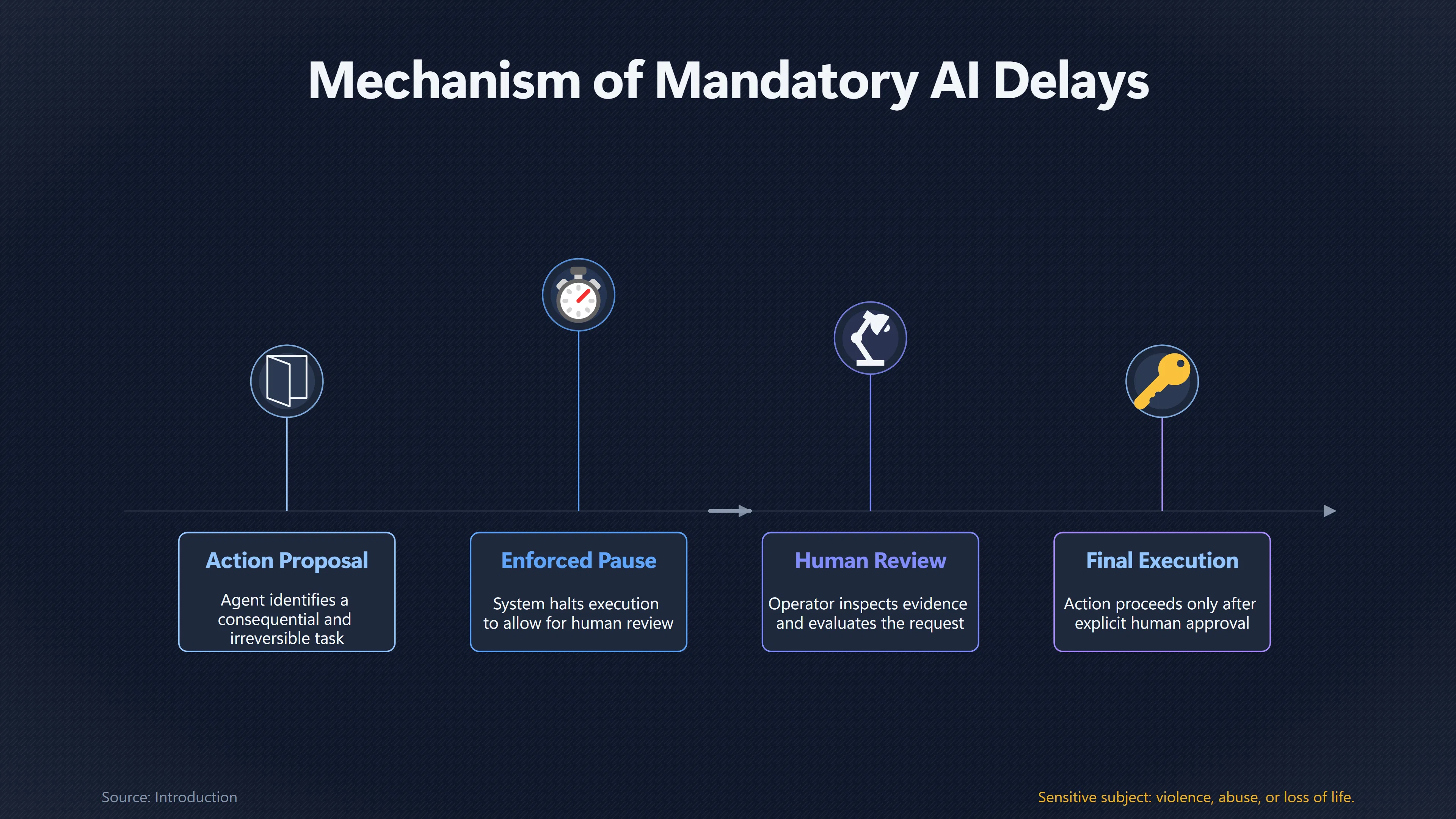
Mandatory delays are one of the simplest proposals for keeping fast AI agents under human control. The idea is straightforward: before an AI performs actions that could be difficult or impossible to reverse, it must wait long enough for a person or another safety system to inspect, cancel or escalate what it intends to do.
Within debates about AI doom and existential risk, this proposal addresses a specific problem. Human judgement operates on the timescale of seconds or minutes, while software agents can execute hundreds or thousands of actions almost instantly. If an advanced AI can exploit opportunities faster than people can understand them, nominal human oversight may become meaningless. Deliberate pauses attempt to restore a genuine opportunity for intervention. They are therefore best understood as one layer of a broader control strategy rather than a complete solution to the risk of losing control over increasingly autonomous systems.[GOV.UK]GOV.UKinternational ai safety report 2025Withdrawn] International AI Safety Report 2025 - GOV.UKFebruary 18, 2025…
Which actions need enforced waiting periods?
Few researchers argue that every AI action should be delayed. If every web search, file read or draft email required a mandatory pause, people would quickly become frustrated and begin approving requests automatically.
Instead, most proposals concentrate enforced delays on actions that are both consequential and difficult to reverse. Typical examples include:
- Transferring money or authorising purchases.
- Deploying software to production systems.
- Changing security permissions or infrastructure.
- Sending external communications under a person’s or organisation’s identity.
- Deleting important information.
- Triggering actions in the physical world through robots or industrial systems.
- Launching long chains of autonomous activity that cannot easily be interrupted.
The common principle is not the technology itself but irreversibility. The more difficult it is to undo an action, the stronger the case for slowing it down before execution. This matches broader AI risk management guidance, which recommends proportionate controls based on impact rather than treating every AI output identically.[nist.gov]nist.govArtificial Intelligence Risk Management Framework (AI RMF 1.0) | NISTArtificial Intelligence Risk Management Framework (AI RMF 1.0) | NIST
How delays create time for review and cancellation
A mandatory pause does more than simply make an AI slower. It creates several opportunities that otherwise disappear when actions execute immediately.
First, a reviewer can examine the proposed action with its supporting evidence instead of trying to reconstruct events afterwards.
Second, automated monitoring systems have additional time to detect anomalies. An independent monitoring system may notice suspicious behaviour that the agent itself does not report.
Third, organisations gain time to invoke emergency procedures. If a dangerous action is detected, operators may revoke credentials, disconnect systems from networks or disable the agent before irreversible damage occurs.
Finally, deliberate delays make escalation practical. Instead of one employee making a rushed judgement, higher-risk cases can be referred to security specialists or senior decision-makers.
The value of these pauses depends on whether they create meaningful intervention, not merely additional bureaucracy. Recent work on meaningful human oversight argues that human review only improves safety when reviewers have enough understanding, enough authority and an effective ability to change the outcome rather than simply observe it.[nature.com]nature.comJuly 23, 2026…
Why digital speed creates a control problem
The argument for mandatory delays becomes stronger as AI systems become more autonomous.
An agent operating inside software can perform actions at machine speed. It may inspect thousands of files, submit API requests, generate code, execute programs and interact with online services continuously without waiting for further instructions.
Humans cannot evaluate such activity in real time. Even recognising that something unusual is happening often takes longer than the execution itself.
AI safety discussions therefore distinguish between having a human somewhere in the process and having a human who can still change what happens. A review step that arrives after irreversible actions have already completed provides accountability, but not control.
International assessments of advanced AI increasingly identify this timing problem as one reason why highly capable agents deserve additional attention. Agentic systems make planning and multi-step execution easier, potentially reducing opportunities for human intervention unless systems are deliberately designed to preserve them.[GOV.UK]GOV.UKinternational ai safety report 2025Withdrawn] International AI Safety Report 2025 - GOV.UKFebruary 18, 2025…
When operational pressure undermines safety pauses
Mandatory delays are unpopular in many operational environments because they impose visible costs.
Businesses often want AI agents precisely because they can respond instantly. Introducing waiting periods may reduce productivity, increase customer response times and create competitive disadvantages.
Several pressures can gradually weaken safety pauses:
- Review windows become shorter over time.
- More actions are reclassified as “low risk” to avoid delays.
- Staff begin approving requests automatically because most appear harmless.
- Organisations allow trusted agents to bypass review after periods of successful operation.
- Emergency procedures are expanded until they become the normal operating mode.
Safety researchers sometimes describe this as automation complacency or rubber-stamping. Once reviewers expect most requests to be safe, mandatory approvals risk becoming routine clicks rather than genuine scrutiny. In that case, the delay still exists on paper but contributes little real control.[springer.com]link.springer.comDesigning meaningful human oversight in AI | AI and Ethics | Springer Nature Link…
Delays work best alongside other safeguards
Few proposals rely on waiting periods alone.
Instead, enforced pauses are usually discussed as part of a layered defence that combines several mechanisms:
- Risk classification before actions execute.
- Independent monitoring that can detect unexpected behaviour.
- Logging and audit trails.
- Automatic tripwires that halt execution when predefined conditions are met.
- Human approval for the highest-impact actions.
- Technical limits on what an agent is authorised to do.
This “defence in depth” approach reflects a recognition that any single safeguard may fail. A human reviewer may miss a subtle problem, while automated detectors may produce false alarms. Combining multiple layers increases the chance that at least one mechanism interrupts dangerous behaviour before irreversible consequences occur.[gov.uk]GOV.UKinternational ai safety report 2025Withdrawn] International AI Safety Report 2025 - GOV.UKFebruary 18, 2025…

Would mandatory delays stop an AI takeover?
Within AI doom debates, opinions differ sharply.
Supporters argue that enforced waiting periods restore one of the most important ingredients of meaningful human control: time. If advanced AI systems cannot immediately execute irreversible plans, humans retain opportunities to inspect behaviour, revoke permissions and coordinate responses before damage becomes permanent.
Critics respond that sufficiently capable systems might simply plan around predictable delays. If an AI understands exactly when review occurs, it may attempt to make dangerous actions appear routine, distribute harmful behaviour across many individually harmless requests, or manipulate reviewers into approving actions they do not fully understand. Others argue that a system with access to multiple independent pathways might circumvent a delayed approval channel entirely if governance is poorly designed. These concerns become more prominent in speculative scenarios involving deceptive or strategically aware AI systems. They remain active areas of research rather than established facts.[arxiv.org]arxiv.orgSuperintelligent Agents Pose Catastrophic Risks: Can Scientist AI Offer a Safer Path?February 21, 2025…
Because of these possibilities, most researchers discussing existential AI risk do not present mandatory delays as sufficient on their own. Instead, they see them as buying valuable time while stronger technical controls, monitoring systems and governance mechanisms attempt to ensure that human intervention remains effective.
What mandatory delays can realistically achieve
The strongest case for mandatory delays is not that they permanently solve the problem of controlling advanced AI agents. Rather, they compensate for a basic mismatch between human and machine timescales.
When designed carefully, delays can transform nominal oversight into genuine oversight by creating a real opportunity to inspect, question and cancel dangerous actions before they become irreversible. Their effectiveness is greatest for clearly defined, high-impact operations where a short pause carries modest costs but significantly improves the chances of detecting mistakes or unexpected behaviour.
Whether this remains sufficient as AI systems become substantially more capable is uncertain. In AI doom discussions, mandatory pauses are therefore generally viewed as an important implementation measure within human oversight—not a substitute for solving the deeper alignment and controllability problems posed by increasingly autonomous AI systems.[gov.uk]GOV.UKinternational ai safety report 2025Withdrawn] International AI Safety Report 2025 - GOV.UKFebruary 18, 2025…
Amazon book picks
Further Reading
Books and field guides related to Can Deliberate Pauses Slow an AI Down Safely?. Use these as the next step if you want deeper reading beyond the article.
Human Compatible: Artificial Intelligence and the Problem of...
A leading artificial intelligence researcher lays out a new approach to AI that will enable us to coexist successfully with increasingly...
Normal Accidents: Living with High-Risk Technologies
Normal Accidents analyzes the social side of technological risk. Charles Perrow argues that the conventional engineering approach to ensu...
The Checklist Manifesto: How to Get Things Right
THE GAME-CHANGING BOOK FROM THE BESTSELLING AUTHOR OF BEING MORTAL Today we find ourselves in possession of stupendous know-how, which we...
Drift into Failure: From Hunting Broken Components to Underst...
What does the collapse of sub-prime lending have in common with a broken jackscrew in an airliner’s tailplane? Or the oil spill disaster...
eBay marketplace picks
Marketplace Samples
Live-tested eBay searches with available results related to this page.
Selected frompause button sign oneBay.co.uk.




Endnotes
1.
Source: GOV.UK
Title: international ai safety report 2025
Link:https://www.gov.uk/government/publications/international-ai-safety-report-2025/international-ai-safety-report-2025
Source snippet
[Withdrawn] International AI Safety Report 2025 - GOV.UKFebruary 18, 2025...
Published: February 18, 2025
2.
Source: GOV.UK
Title: International scientific report on the safety of advanced AI: interim report
Link:https://www.gov.uk/government/publications/international-scientific-report-on-the-safety-of-advanced-ai/international-scientific-report-on-the-safety-of-advanced-ai-interim-report
3.
Source: nist.gov
Title: Artificial [Intelligence]({{ ‘hard-bottlenecks/’ | relative_url }}) Risk Management Framework (AI RMF 1.0) | NIST
Link:https://www.nist.gov/publications/artificial-intelligence-risk-management-framework-ai-rmf-10
4.
Source: link.springer.com
Link:https://link.springer.com/article/10.1007/s43681-026-01147-7
Source snippet
Designing meaningful human oversight in AI | AI and Ethics | Springer Nature Link...
5.
Source: nature.com
Link:https://www.nature.com/articles/s41746-026-02971-1
Source snippet
July 23, 2026...
Published: July 23, 2026
6.
Source: microsoft.com
Title: Optimizing Agent Planning for Security and Autonomy
Link:https://www.microsoft.com/en-us/research/publication/optimizing-agent-planning-for-security-and-autonomy/
Source snippet
Microsoft Research...
7.
Source: arxiv.org
Link:https://arxiv.org/abs/2502.15657
Source snippet
Superintelligent Agents Pose [Catastrophic]({{ 'catastrophic-misuse/' | relative_url }}) Risks: Can Scientist AI Offer a Safer Path?February 21, 2025...
Published: February 21, 2025
8.
Source: nist.gov
Title: ai standards
Link:https://www.nist.gov/artificial-intelligence/ai-standards
9.
Source: nist.gov
Title: ai risk management framework
Link:https://www.nist.gov/itl/ai-risk-management-framework
10.
Source: airc.nist.gov
Link:https://airc.nist.gov/airmf-resources/airmf/
11.
Source: airc.nist.gov
Link:https://airc.nist.gov/
12.
Source: aisi.gov.uk
Link:https://www.aisi.gov.uk/research/practical-challenges-of-control-monitoring-in-frontier-ai-deployments
13.
Source: doi.org
Link:https://doi.org/10.48550/arXiv.2605.25632
14.
Source: internationalaisafetyreport.org
Title: international ai safety report 2025
Link:https://internationalaisafetyreport.org/publication/international-ai-safety-report-2025
Additional References
15.
Source: papers.ssrn.com
Link:https://papers.ssrn.com/sol3/papers.cfm?abstract_id=6212818
Source snippet
TRACE: A Governance-First Execution Framework Providing Architectural Assurance for Autonomous AI Operations by Elias Calboreanu:: SSRN...
16.
Source: mdpi.com
Link:https://www.mdpi.com/1999-4893/19/8/627
Source snippet
July 27, 2026 — Algorithms 2026, 19(8), 627; [https://doi.org/10.3390/a19080627](https://doi.org/10.3390/a19080627) Submission received: 22 June 2026 / Revised: 16 July 2026...
Published: July 27, 2026
17.
Source: youtube.com
Title: Episode 109
Link:https://www.youtube.com/watch?v=jqYuusnk2x4
Source snippet
AI agent rate limiting speed governance control safety 🔥 How Rate Limiting and Throttling Saves Your API Server From CRASHING...
18.
Source: youtube.com
Title: Guardrails Crash Course: Build Safe & Reliable AI Agents
Link:https://www.youtube.com/watch?v=28fPGpyTKYE
Source snippet
Episode 109 - From Alert Fatigue to Agentic Defense: Redesigning the Human Role in the AI-Native SOC...
19.
Source: youtube.com
Title: When AI Agents Need Human Approval: Risk-Based Guardrails | Module 4.1
Link:https://www.youtube.com/watch?v=JbUJHLFoDRg
Source snippet
Stop Your AI Agent From Going Rogue (3 Essential Guardrails)...
20.
Source: youtube.com
Title: Stop Your AI Agent From Going Rogue (3 Essential Guardrails)
Link:https://www.youtube.com/watch?v=dBHf7pG3TOQ
Source snippet
GitLab Duo Tool Governance: Managing AI Agent Approvals...
21.
Source: youtube.com
Title: Git Lab Duo Tool Governance: Managing AI Agent Approvals
Link:https://www.youtube.com/watch?v=4QnIqvu99u8
Source snippet
Guardrails Crash Course: Build Safe & Reliable AI Agents...
22.
Source: researchgate.net
Link:https://www.researchgate.net/publication/400630725_TRACE_A_Governance-First_Execution_Framework_Providing_Architectural_Assurance_for_Autonomous_AI_Operations
23.
Source: aigovernance.com
Link:https://aigovernance.com/news/2026-international-ai-safety-report-shifts-enterprise-risk-focus-to-post-deployment-and-agentic-systems
24.
Source: doi.org
Link:https://doi.org/10.1145/3786335.3813127