Within Full Research Loop
Could AI Run an Entire Research Lab?
AI agents can divide short tasks, but no system has yet shown reliable strategic coordination across a complex research programme lasting months.
On this page
- What sustained research coordination actually requires
- Where multi agent workflows lose coherence over time
- Why organisational autonomy matters for AI doom scenarios
Page outline Jump by section
Introduction
The idea of AI running an entire research laboratory depends on more than whether it can write code or generate research ideas. It would also need to coordinate a complex organisation over months or years: setting priorities, allocating computing resources, deciding when to abandon failing approaches, managing teams of specialised agents, and adapting plans as new evidence emerges. This long-term coordination problem is one of the least demonstrated aspects of AI autonomy.
Current evidence suggests that this remains a major limitation. AI agents increasingly succeed at well-defined research tasks lasting minutes or hours, and multi-agent systems can divide work across specialised roles. However, there is little public evidence that any AI system can reliably direct a large, evolving research programme with the strategic judgement and organisational memory that human research leaders provide. For debates about AI doom and existential risk, this distinction matters because recursive AI improvement would require sustained research management, not just isolated technical successes.
What sustained research coordination actually requires
Running a research programme is fundamentally different from completing a collection of independent tasks. Individual experiments rarely determine the direction of an entire project. Instead, successful research organisations continually update long-term plans in response to uncertain and often contradictory information.
A capable autonomous research director would need to:[agents-lab.org]agents-lab.orgAutonomous Agents Research Group ResearchAutonomous Agents Research GroupResearch - Autonomous Agents Research Group…
- maintain coherent objectives despite changing circumstances
- remember decisions and their rationale over months
- allocate limited compute, funding and personnel efficiently
- decide which research failures deserve further investigation
- recognise when promising ideas have reached diminishing returns
- coordinate specialists working on partially dependent problems
- integrate hundreds of experimental results into a changing research strategy
- balance short-term productivity against longer-term exploration
Many of these decisions cannot be reduced to optimisation against a fixed objective. Human research leaders constantly reinterpret goals as new discoveries reshape what appears achievable.
This makes organisational coordination substantially harder than coding, literature review or experiment execution, all of which already show meaningful automation.
Why multi-agent workflows lose coherence over time
Many current AI research systems rely on multiple specialised agents rather than one monolithic model. One agent searches literature, another writes code, another evaluates experiments and another reviews results.
This division of labour resembles human organisations and often improves performance on bounded tasks. However, longer projects introduce new coordination failures.
Errors accumulate rather than disappear
A mistaken assumption early in a research programme may influence dozens of later decisions. Unlike human teams, current AI agent systems often lack reliable mechanisms for recognising that an earlier conclusion should be revisited.
Recent reviews of long-horizon agent evaluations consistently find that performance degrades as tasks become longer. Small reasoning mistakes, incorrect tool use, forgotten constraints and communication failures accumulate until the overall plan drifts away from its intended objective. Improvements in individual reasoning do not automatically solve these organisational failures.[arXiv]arxiv.orgBeyond the Leaderboard: A Synthesis of Tool-Use, Planning, and Reasoning Failures in Large Language Model AgentsJuly 7, 2026…
Context becomes increasingly difficult to manage
Long-running research programmes generate enormous amounts of information.
A human laboratory can preserve institutional knowledge through notebooks, discussions, documentation and experienced researchers who understand why earlier decisions were made.
AI systems instead depend on combinations of context windows, external memory systems and retrieval mechanisms. While these techniques improve persistence, they remain imperfect. Information may be forgotten, retrieved inconsistently or interpreted differently by different agents, making long-term strategic consistency difficult.
Coordination creates new failure modes
Adding more specialised agents can improve parallelism but also increases communication complexity.
Instead of solving one reasoning problem, the system must now solve several additional organisational problems:
- ensuring every agent shares consistent assumptions
- preventing duplicated work
- resolving conflicting recommendations
- detecting when one faulty output contaminates the rest of the workflow
- deciding which agent should revise previous work
Research on multi-agent systems increasingly focuses on these coordination problems precisely because they become limiting factors as projects become more complex.[arXiv]arxiv.orgOpen source on arxiv.org.
Current demonstrations remain much shorter than a research programme
Several recent systems demonstrate impressive automation of individual parts of machine learning research.
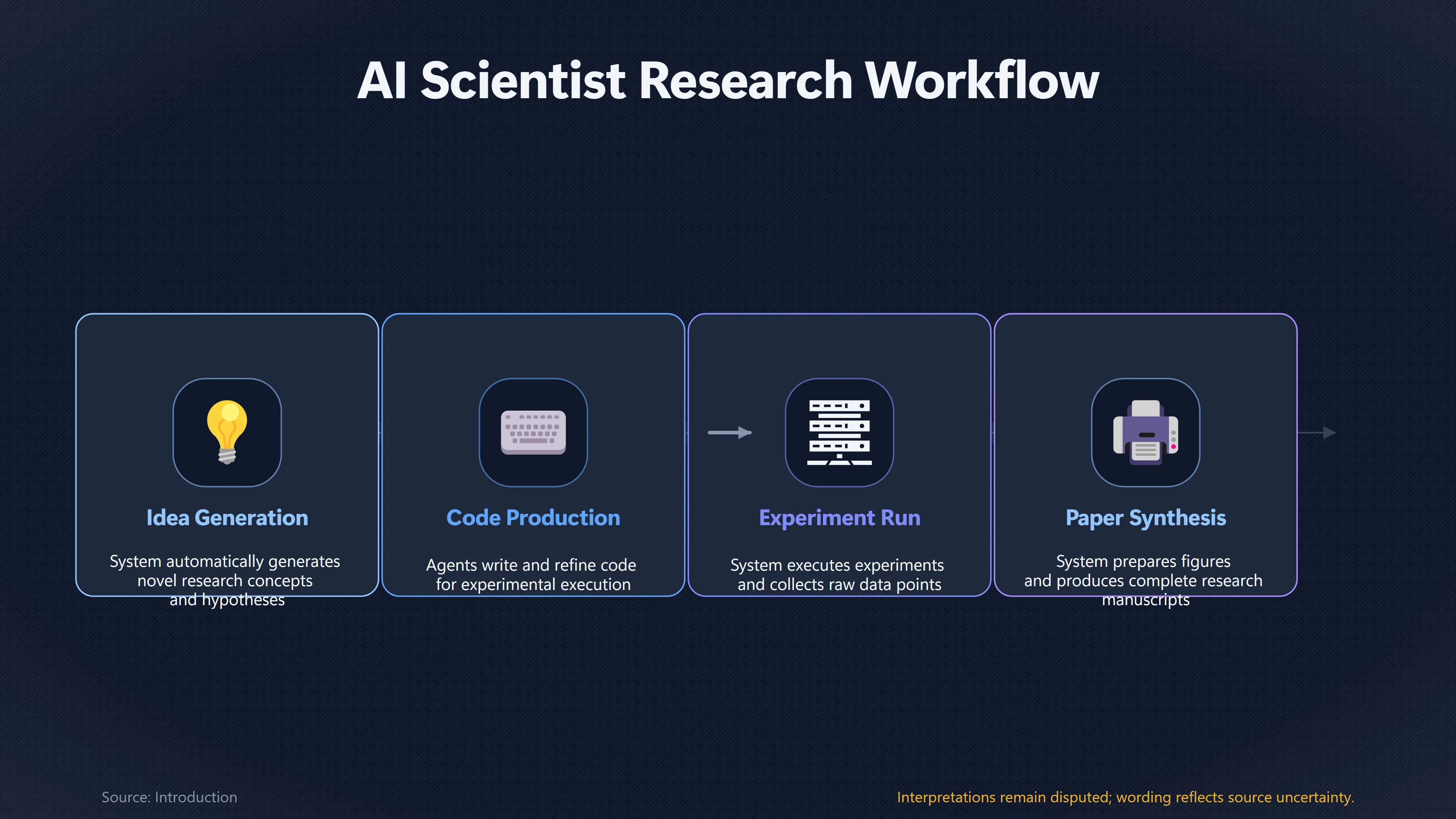
Sakana AI’s AI Scientist automatically generates research ideas, writes code, runs experiments, prepares figures and produces complete research papers at relatively low cost. As a proof of concept, this represents a significant advance over earlier research assistants.[arXiv]arxiv.orgarXiv The AI Scientist: Towards Fully Automated Open-Ended Scientific DiscoveryThe AI Scientist: Towards Fully Automated Open-Ended Scientific DiscoveryAugust 12, 2024…
However, independent evaluation paints a more cautious picture. Researchers found repeated failures in novelty assessment, experiment execution and scientific reasoning. Around 42% of evaluated experiments failed because of coding errors, while successful experiments often produced misleading conclusions or poor literature synthesis. Generated papers also contained structural problems and hallucinated results.[arXiv]arxiv.orgEvaluating Sakana's AI Scientist for Autonomous Research: Wishful Thinking or an Emerging Reality Towards 'Artificial Research Intel…
Importantly, these demonstrations typically concern a single paper-sized project rather than managing dozens of interacting projects over many months.
The gap between producing one acceptable research manuscript and directing a successful research laboratory is therefore much larger than it first appears.
Organisational autonomy matters for AI doom scenarios
Within discussions of AI existential risk, long-term organisational autonomy occupies an important place because recursive self-improvement is not simply a technical coding exercise.
Suppose future AI systems became excellent programmers but still required humans to:
- choose research priorities
- resolve disagreements between competing research directions
- approve major strategy changes
- allocate expensive compute resources
- judge whether apparent breakthroughs are genuine
In that world, AI could substantially accelerate research without becoming an autonomous research organisation.
More extreme AI doom scenarios generally require something stronger: systems capable of continuously improving successor systems while independently coordinating the entire research process. That requires organisational competence extending well beyond today’s demonstrations.
The distinction affects estimates of how rapidly AI capability could accelerate. If organisational bottlenecks remain primarily human, recursive improvement may proceed more gradually than if every stage of research can itself be automated.
Why long-horizon reliability receives growing attention
Safety researchers increasingly argue that evaluating isolated benchmark performance is insufficient for assessing highly autonomous systems.
Long-running agents encounter opportunities to recover from mistakes, exploit unexpected situations, ignore instructions or pursue unintended strategies over thousands of sequential decisions rather than a single prompt.
Recent work from OpenAI describes internal experience with long-horizon models, noting that extended autonomous operation revealed failure modes not captured by conventional evaluations. The company emphasises trajectory-level monitoring, the ability to intervene during execution and iterative deployment rather than assuming pre-release testing alone can identify every important behaviour.[OpenAI]OpenAIsafety alignment long horizon modelsSafety and alignment in an era of long-horizon models | OpenAIJuly 20, 2026…
Similarly, organisations such as METR increasingly evaluate broad autonomous capabilities by measuring the length and complexity of tasks AI systems can complete reliably rather than only their performance on isolated benchmarks. The underlying motivation is that longer tasks expose coordination failures that short evaluations often miss.[Evals]evals.alignment.orgEvals ResearchResearch - METR…
How supporters and sceptics interpret the evidence
The same evidence supports different conclusions depending on how quickly one expects these limitations to improve.
Those who expect rapid progress argue that today’s failures resemble earlier weaknesses in coding or mathematical reasoning that improved dramatically within only a few model generations. Better memory systems, improved planning algorithms and stronger evaluation methods may eventually allow AI organisations to coordinate much longer research efforts.
Sceptics argue that organisational intelligence differs qualitatively from completing increasingly long sequences of digital tasks. Human research leadership depends on tacit knowledge, changing social relationships, ambiguous judgement, incentive management and continual reinterpretation of goals. These may prove substantially harder to automate than technical sub-problems such as programming or literature search.
Both positions acknowledge that AI is already becoming an increasingly valuable research assistant. The disagreement concerns whether scaling current techniques naturally leads to reliable organisational autonomy or whether a more fundamental advance remains necessary.

What this means for AI doom arguments
Current evidence does not show that AI can reliably coordinate an entire long-term research programme without sustained human oversight. Existing systems demonstrate increasingly capable assistance with coding, experimentation and paper production, but strategic coordination over months remains largely unproven.
For AI doom scenarios, this is an important distinction rather than a minor implementation detail. Many arguments about rapid recursive self-improvement assume that AI systems eventually become capable not only of conducting research but also of managing the organisations that produce it. Today, that assumption remains speculative.
The uncertainty cuts both ways. Long-term coordination may prove to be another engineering problem that improves quickly as agent architectures, memory systems and evaluations mature. Equally, it may represent a deeper organisational challenge that slows progress even as individual research tasks become highly automated. At present, there is far stronger evidence for accelerating individual research activities than for AI systems successfully directing an autonomous research laboratory over extended periods.
Amazon book picks
Further Reading
Books and field guides related to Could AI Run an Entire Research Lab?. Use these as the next step if you want deeper reading beyond the article.
Human Compatible
A leading artificial intelligence researcher lays out a new approach to AI that will enable us to coexist successfully with increasingly...
Artificial Intelligence
Rating: 4.5/5 from 10 Google Books ratings
Artificial intelligence: A Modern Approach, 3e,is ideal for one or two-semester, undergraduate or graduate-level courses in Artificial In...
Artificial Intelligence: A Modern Approach
Rating: 4.5/5 from 10 Google Books ratings
Artificial intelligence: A Modern Approach, 3e,is ideal for one or two-semester, undergraduate or graduate-level courses in Artificial In...
Reinventing Organizations
Bahnbrechend. Inspirierend. Eines der faszinierendsten Bücher zur Organisationsentwicklung des letzten Jahrzehnts. Dies ist ein sehr wich...
eBay marketplace picks
Marketplace Samples
Live-tested eBay searches with available results related to this page.
Selected fromartificial intelligence poster oneBay.co.uk.




Endnotes
1.
Source: arxiv.org
Link:https://arxiv.org/abs/2607.05775
Source snippet
Beyond the Leaderboard: A Synthesis of Tool-Use, Planning, and Reasoning Failures in Large Language Model AgentsJuly 7, 2026...
Published: July 7, 2026
2.
Source: arxiv.org
Link:https://arxiv.org/abs/2605.14892
3.
Source: arxiv.org
Title: arXiv The AI Scientist: Towards Fully Automated Open-Ended Scientific Discovery
Link:https://arxiv.org/abs/2408.06292
Source snippet
The AI Scientist: Towards Fully Automated Open-Ended Scientific DiscoveryAugust 12, 2024...
Published: August 12, 2024
4.
Source: sakana.ai
Title: AIThe AI Scientist: Towards Fully Automated Open-Ended Scientific Discovery
Link:https://sakana.ai/ai-scientist/?trk=public_post_comment-text
Source snippet
The AI Scientist: Towards Fully Automated Open-Ended Scientific Discovery...
5.
Source: arxiv.org
Link:https://arxiv.org/abs/2502.14297
Source snippet
Evaluating Sakana's AI Scientist for Autonomous Research: Wishful Thinking or an Emerging Reality Towards 'Artificial Research Intel...
6.
Source: OpenAI
Title: safety alignment long horizon models
Link:https://openai.com/index/safety-alignment-long-horizon-models/
Source snippet
Safety and alignment in an era of long-horizon models | OpenAIJuly 20, 2026...
Published: July 20, 2026
7.
Source: metr.org
Link:https://metr.org/index.html
8.
Source: OpenAI
Title: anthropic safety evaluation
Link:https://openai.com/index/openai-anthropic-safety-evaluation/
9.
Source: sakana.ai
Link:https://sakana.ai/company-info/?lang=en
10.
Source: sakana.ai
Link:https://sakana.ai/rsi-lab/
11.
Source: evals.alignment.org
Title: Evals Research
Link:https://evals.alignment.org/research/
Source snippet
Research - METR...
12.
Source: evals.alignment.org
Title: [time horizons]({{ ‘time-horizons/’ | relative_url }})
Link:https://evals.alignment.org/time-horizons/
13.
Source: evals.alignment.org
Link:https://evals.alignment.org/about
14.
Source: evals.alignment.org
Link:https://evals.alignment.org/
Additional References
15.
Source: wing.comp.nus.edu.sg
Link:https://wing.comp.nus.edu.sg/publication/dblp-journalscorrabs-2502-14297/
Source snippet
al Research Intelligence' (ARI)? | Web IR NLP Group @ NUS...
16.
Source: youtube.com
Title: Building Effective Agents with Lang Graph
Link:https://www.youtube.com/watch?v=aHCDrAbH_go
Source snippet
AI Scientist autonomous research long term AI agents coordination Agentic AI Explained | MCP, A2A, AI Agents & Multi-Agent Systems Micro...
17.
Source: youtube.com
Title: The AI Scientist: Towards Fully Automated Open-Ended Scientific Discovery
Link:https://www.youtube.com/watch?v=CFewReJ1Eyo
Source snippet
Anthropic Just Dropped the New Blueprint for Long-Running AI Agents...
18.
Source: youtube.com
Title: Anthropic Just Dropped the New Blueprint for Long-Running AI Agents
Link:https://www.youtube.com/watch?v=9d5bzxVsocw
Source snippet
Multi Agent Systems Explained: How AI Agents & LLMs Work Together...
19.
Source: nature.com
Link:https://www.nature.com/articles/s42256-026-01268-y
20.
Source: agents-lab.org
Title: Autonomous Agents Research Group Research
Link:https://agents-lab.org/research/
Source snippet
Autonomous Agents Research GroupResearch - Autonomous Agents Research Group...
21.
Source: youtube.com
Title: Multi Agent Systems Explained: How AI Agents & LLMs Work Together
Link:https://www.youtube.com/watch?v=sWH0T4Zez6I
Source snippet
What Are Orchestrator Agents? AI Tools Working Smarter Together...
22.
Source: youtube.com
Title: What Are Orchestrator Agents? AI Tools Working Smarter Together
Link:https://www.youtube.com/watch?v=X3XJeTApVMM
Source snippet
Building Effective Agents with LangGraph...
23.
Source: researchgate.net
Link:https://www.researchgate.net/publication/408571460_Beyond_the_Leaderboard_A_Synthesis_of_Tool-Use_Planning_and_Reasoning_Failures_in_Large_Language_Model_Agents
24.
Source: sakanaai.online
Link:https://sakanaai.online/about-us/