Within Mean vs Median
What the 2023 p(doom) Survey Really Shows
The 2023 survey shows why median estimates of 5% or 10% can coexist with means near 14% to 19%.
On this page
- How the survey questions produced different summary figures
- Why the means exceeded the medians
- What the results do and do not establish about expert opinion
Page outline Jump by section
Introduction
The 2023 Expert Survey on Progress in AI is often summarised with a single number, such as a median p(doom) of 5%. That headline is incomplete. The survey’s most important finding for readers trying to understand expert opinion is not a single probability but the shape of the distribution. AI researchers were spread across a very wide range of estimates, from near-zero probabilities of existential catastrophe to very high ones. As a result, the survey reported medians of 5% or 10%, depending on the question wording, while the corresponding arithmetic means were much higher, around 14% to 19%.[AI Impacts]aiimpacts.orgThousands of AI authors on the future of AIAI ImpactsTHOUSANDS OF AI AUTHORS ON THE FUTURE OF AIJanuary 6, 2024…
That pattern explains why discussions of mean and median p(doom) can sound contradictory when they are not. The survey provides evidence of substantial disagreement rather than a single expert consensus. Understanding that distribution is more informative than focusing on any one summary statistic.
How the survey questions produced different summary figures
The 2023 survey questioned 2,778 researchers who had published at leading AI conferences. To reduce survey fatigue and test whether wording influenced responses, participants were randomly assigned different versions of several questions rather than all receiving identical questionnaires.[AI Impacts]wiki.aiimpacts.org2023 expert survey on progress in aiAI Impacts2023 Expert Survey on Progress in AI [AI Impacts Wiki]…
For existential risk, three closely related formulations are especially relevant:
- the probability that future AI advances cause human extinction or similarly permanent and severe disempowerment;
- the probability that human inability to control advanced AI systems causes those outcomes;
- the probability that such outcomes occur within the next 100 years.[AI Impacts]aiimpacts.orgThousands of AI authors on the future of AIAI ImpactsTHOUSANDS OF AI AUTHORS ON THE FUTURE OF AIJanuary 6, 2024…
These variations produced slightly different headline statistics.
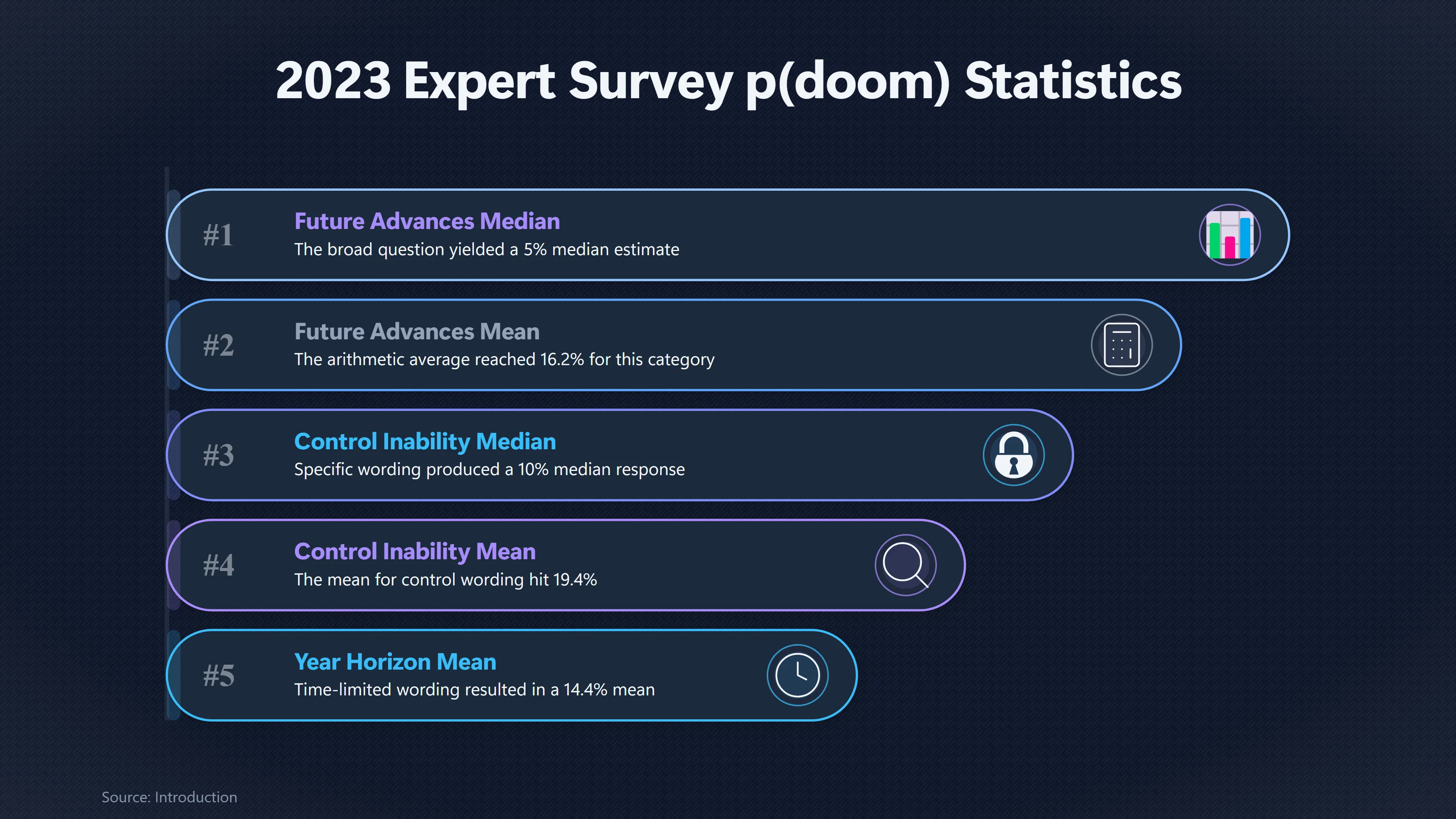
- The broad “future AI advances” question had a median of 5% and a mean of 16.2%.
- The more specific “inability to control advanced AI systems” wording produced a median of 10% and a mean of 19.4%.
- The “within the next 100 years” version produced a median of 5% and a mean of 14.4%.[AI Impacts]aiimpacts.orgThousands of AI authors on the future of AIAI ImpactsTHOUSANDS OF AI AUTHORS ON THE FUTURE OF AIJanuary 6, 2024…
The differences are meaningful but relatively modest. Regardless of wording, the same broad pattern emerged: the average estimate remained well above the midpoint because responses were widely dispersed.
Why the means exceeded the medians
The survey distribution was right-skewed. Many respondents gave comparatively low probabilities, while a smaller but significant minority assigned much larger chances to existential catastrophe.
This matters because the two summary measures behave differently.
- The median identifies the middle response. Extremely high estimates have little effect unless enough people give them to move the midpoint.
- The mean incorporates every response equally. A minority assigning probabilities such as 40%, 60% or higher pulls the arithmetic average upwards.
The resulting gap—roughly 9 to 10 percentage points between median and mean in the principal questions—is exactly what statisticians expect from a distribution with a long upper tail rather than one tightly clustered around a single estimate.[AI Impacts]aiimpacts.orgThousands of AI authors on the future of AIAI ImpactsTHOUSANDS OF AI AUTHORS ON THE FUTURE OF AIJanuary 6, 2024…
An important implication is that the survey does not describe two competing groups with one believing 5% and another believing 16%. Instead, it describes one population whose opinions span a remarkably wide range.
The distribution reveals disagreement, not consensus
Looking only at the median can make expert opinion appear more unified than it really is.
A median of 5% means only that half the respondents estimated 5% or less and half estimated more than 5%. It says nothing about how far above or below that midpoint individual estimates lie.
The survey results show that disagreement remained substantial even among researchers working in AI. Some respondents assigned probabilities close to zero, implying that existential catastrophe is extremely unlikely. Others regarded it as a serious possibility deserving probabilities measured in tens of percentage points. Those higher estimates were numerous enough to move the mean well above the median, but not numerous enough to shift the middle response dramatically.[AI Impacts]aiimpacts.orgThousands of AI authors on the future of AIAI ImpactsTHOUSANDS OF AI AUTHORS ON THE FUTURE OF AIJanuary 6, 2024…
For readers comparing p(doom) figures across articles, this is one of the survey’s most important lessons: a single summary number can conceal a highly heterogeneous set of beliefs.
What the results do and do not establish about expert opinion
The survey provides valuable evidence, but its conclusions have clear limits.
It does show that:
- there is no single accepted expert estimate for existential AI risk;
- a noticeable minority of AI researchers assign relatively high probabilities to catastrophic outcomes;
- the difference between mean and median is a genuine feature of the underlying responses rather than a statistical error.[AI Impacts]aiimpacts.orgThousands of AI authors on the future of AIAI ImpactsTHOUSANDS OF AI AUTHORS ON THE FUTURE OF AIJanuary 6, 2024…
It does not show that:
- the mean represents an expert consensus;
- the median represents the “typical” reasoning of most respondents beyond identifying the midpoint;
- experts share the same assumptions about AI timelines, alignment, governance or the mechanisms by which catastrophe could occur.
Different researchers may arrive at similar numerical estimates for entirely different reasons. Some may expect technical alignment to prove difficult, others may worry primarily about geopolitical competition or failures of governance, while others may regard those concerns as much less likely. The survey records the final probabilities, not the complete reasoning behind each estimate.[arXiv]arxiv.orgThousands of AI Authors on the Future of AIJanuary 5, 2024…
Why this distribution matters for interpreting p(doom)
The 2023 survey is often cited because it demonstrates that respectable experts occupy a much broader range of positions than a single headline figure suggests.
If the mean and median had both been around 5%, readers could reasonably infer that expert opinion was concentrated near that level. Instead, the persistent gap between the two statistics indicates a distribution with a substantial upper tail. That is why headlines quoting only the median or only the mean can each give an incomplete impression of the same dataset.
For discussions about AI doom and existential risk, the survey’s lasting contribution is therefore less about identifying one “correct” p(doom) than about documenting the extent of expert disagreement. The distribution itself is the key finding: many researchers remain relatively unconcerned, many express moderate concern, and a meaningful minority assign much higher probabilities to catastrophic outcomes, producing medians around 5–10% alongside means of roughly 14–19%.[AI Impacts]aiimpacts.orgThousands of AI authors on the future of AIAI ImpactsTHOUSANDS OF AI AUTHORS ON THE FUTURE OF AIJanuary 6, 2024…
Amazon book picks
Further Reading
Books and field guides related to What the 2023 p(doom) Survey Really Shows. Use these as the next step if you want deeper reading beyond the article.
Human Compatible
A leading artificial intelligence researcher lays out a new approach to AI that will enable us to coexist successfully with increasingly...
The Alignment Problem
Finalist for the Los Angeles Times Book Prize A jaw-dropping exploration of everything that goes wrong when we build AI systems and the m...
Superforecasting
The international bestseller 'A manual for thinking clearly in an uncertain world. Read it.' Daniel Kahneman, author of Thinking, Fast an...
The Signal and the Noise
This work explores the history, art and science of prediction.
eBay marketplace picks
Marketplace Samples
Live-tested eBay searches with available results related to this page.
Selected fromdata science poster oneBay.co.uk.
Endnotes
1.
Source: aiimpacts.org
Title: Thousands of AI authors on the future of AI
Link:https://aiimpacts.org/wp-content/uploads/2023/04/Thousands_of_AI_authors_on_the_future_of_AI.pdf
Source snippet
AI ImpactsTHOUSANDS OF AI AUTHORS ON THE FUTURE OF AIJanuary 6, 2024...
Published: January 6, 2024
2.
Source: wiki.aiimpacts.org
Title: 2023 expert survey on progress in ai
Link:https://wiki.aiimpacts.org/ai_timelines/predictions_of_human-level_ai_timelines/ai_timeline_surveys/2023_expert_survey_on_progress_in_ai
Source snippet
AI Impacts2023 Expert Survey on Progress in AI [AI Impacts Wiki]...
3.
Source: blog.aiimpacts.org
Title: AI Impacts Blog FAQ: Expert Survey on Progress in AI methodology
Link:https://blog.aiimpacts.org/p/faq-expert-survey-on-progress-in
Source snippet
No. We published the near-identical 2016 survey in the Journal of AI Research, so the methodology had essentially...
4.
Source: arxiv.org
Link:https://arxiv.org/abs/2401.02843
Source snippet
Thousands of AI Authors on the Future of AIJanuary 5, 2024...
Published: January 5, 2024
5.
Source: blog.aiimpacts.org
Title: reanalyzing the 2023 expert survey
Link:https://blog.aiimpacts.org/p/reanalyzing-the-2023-expert-survey
Source snippet
the 2023 Expert Survey on Progress in AIDecember 16, 2024 — REANALYZING THE 2023 EXPERT SURVEY ON PROGRESS IN AI WITH NEW CHARTS, AND A N...
Published: December 16, 2024
6.
Source: lesswrong.com
Title: ai impacts 2023 expert survey on progress in ai
Link:https://www.lesswrong.com/posts/RkegCmCgjGhskiFvm/ai-impacts-2023-expert-survey-on-progress-in-ai
7.
Source: lesswrong.com
Title: ai impacts survey december 2023 edition
Link:https://www.lesswrong.com/posts/NfPxAp5uwgZugwovY/ai-impacts-survey-december-2023-edition
Published: december 2023
8.
Source: blog.aiimpacts.org
Title: 2023 [ai survey]({{ ‘survey-bias/’ | relative_url }}) of 2778 six things
Link:https://blog.aiimpacts.org/p/2023-ai-survey-of-2778-six-things?action=share
9.
Source: blog.aiimpacts.org
Link:https://blog.aiimpacts.org/p/2023-ai-survey-of-2778-six-things/comments
10.
Source: wiki.aiimpacts.org
Title: ai risk surveys
Link:https://wiki.aiimpacts.org/uncategorized/ai_risk_surveys
11.
Source: aiimpacts.org
Title: How bad a future do ML researchers expect? – AI Impacts
Link:https://aiimpacts.org/how-bad-a-future-do-ml-researchers-expect/
12.
Source: wiki.aiimpacts.org
Title: 2022 expert survey on progress in ai
Link:https://wiki.aiimpacts.org/ai_timelines/predictions_of_human-level_ai_timelines/ai_timeline_surveys/2022_expert_survey_on_progress_in_ai
13.
Source: aiimpacts.org
Title: 2022 expert survey on progress in ai
Link:https://aiimpacts.org/2022-expert-survey-on-progress-in-ai/
14.
Source: youtube.com
Title: AI Impacts Survey
Link:https://www.youtube.com/watch?v=xwJx_xqZI3Q
Source snippet
Ep 13 - AI researchers expect AGI sooner w/ Katja Grace (Co-founder & Lead Researcher, AI Impacts)...
Additional References
15.
Source: bayes.net
Title: How should we analyse survey forecasts of AI timelines?
Link:https://bayes.net/espai/
Source snippet
16, 2024 — HOW SHOULD WE ANALYSE SURVEY FORECASTS OF AI TIMELINES? Read at AI Impacts The Expert Survey on Progress i...
Published: December 16, 2024
16.
Source: vuink.com
Title: How should we analyse survey forecasts of AI timelines?
Link:https://vuink.com/post/onlrf-d-darg/espai
Source snippet
12, 2025 — Image: How should we analyse survey forecasts of AI timelines? | bayes.net HOW SHOULD WE ANALYSE SURVEY FOR...
Published: January 12, 2025
17.
Source: youtube.com
Link:https://www.youtube.com/watch?v=Nbpw90WQmgU
Source snippet
Will AI end everything? A guide to guessing | Katja Grace | EAG Bay Area 23...
18.
Source: researchgate.net
Title: 396256646 Thousands of AI Authors on the Future of AI
Link:https://www.researchgate.net/publication/396256646_Thousands_of_AI_Authors_on_the_Future_of_AI
Source snippet
Co-Founder and CEO, Anthropic for a Hearing on “Oversight of A.I.: Principles for Regulation 2023;AI...
19.
Source: youtube.com
Title: Will AI end everything? A guide to guessing | Katja Grace | EAG Bay Area 23
Link:https://www.youtube.com/watch?v=j5Lu01pEDWA
Source snippet
Katja Grace—Slowing Down AI, Forecasting AI Risk...
20.
Source: sfu.ca
Link:https://www.sfu.ca/~smith/pdoom_interactive_standalone.html
21.
Source: youtube.com
Title: Katja Grace—Slowing Down AI, Forecasting AI Risk
Link:https://www.youtube.com/watch?v=rSw3UVDZge0
Source snippet
How AI Will Help Humanity Destroy Itself...
22.
Source: nature.com
Title: A I and science: what 1,600 researchers think
Link:https://www.nature.com/articles/d41586-023-02980-0
23.
Source: researchgate.net
Title: 396256646 Thousands of AI Authors on the Future of AI
Link:https://www.researchgate.net/publication/396256646_Thousands_of_AI_Authors_on_the_Future_of_AI?_tp=eyJjb250ZXh0Ijp7InBhZ2UiOiJzY2llbnRpZmljQ29udHJpYnV0aW9ucyIsInByZXZpb3VzUGFnZSI6bnVsbCwic3ViUGFnZSI6bnVsbH19
24.
Source: oatml.cs.ox.ac.uk
Title: ox.ac.uk Thousands of AI Authors on the Future of AI
Link:https://oatml.cs.ox.ac.uk/publications/202401_Brauner_Thousands.html