Within AI Race
Does Being First Make Unsafe AI Launches More Likely?
Being first can bring users, investment and influence, giving labs strong incentives to deploy before safety work is complete.
On this page
- Why early market leads can become self reinforcing
- How launch pressure changes testing and deployment choices
- What economic models show and what they cannot prove
Page outline Jump by section
Introduction
The idea that being first can be unusually valuable is central to many AI doom arguments about competitive pressure. The concern is not simply that companies want to release products quickly. It is that frontier AI markets may reward early deployment so strongly that delaying a launch for additional safety work becomes commercially unattractive, even when the delay could reduce serious risks.

In debates about AI existential risk, this mechanism matters because future frontier systems could possess capabilities that are difficult to evaluate before deployment. If organisations believe that a short delay could cost them market leadership, investment, talent or strategic influence, they may accept higher uncertainty about a model’s behaviour than they otherwise would. Whether this dynamic is already occurring remains contested, but economists, AI companies and governance researchers increasingly treat first-mover incentives as a genuine coordination problem rather than a purely theoretical curiosity.[CEPR]cepr.orgDP21454 AI Safety and Competition | CEPRMay 7, 2026…
Why early market leads can become self-reinforcing
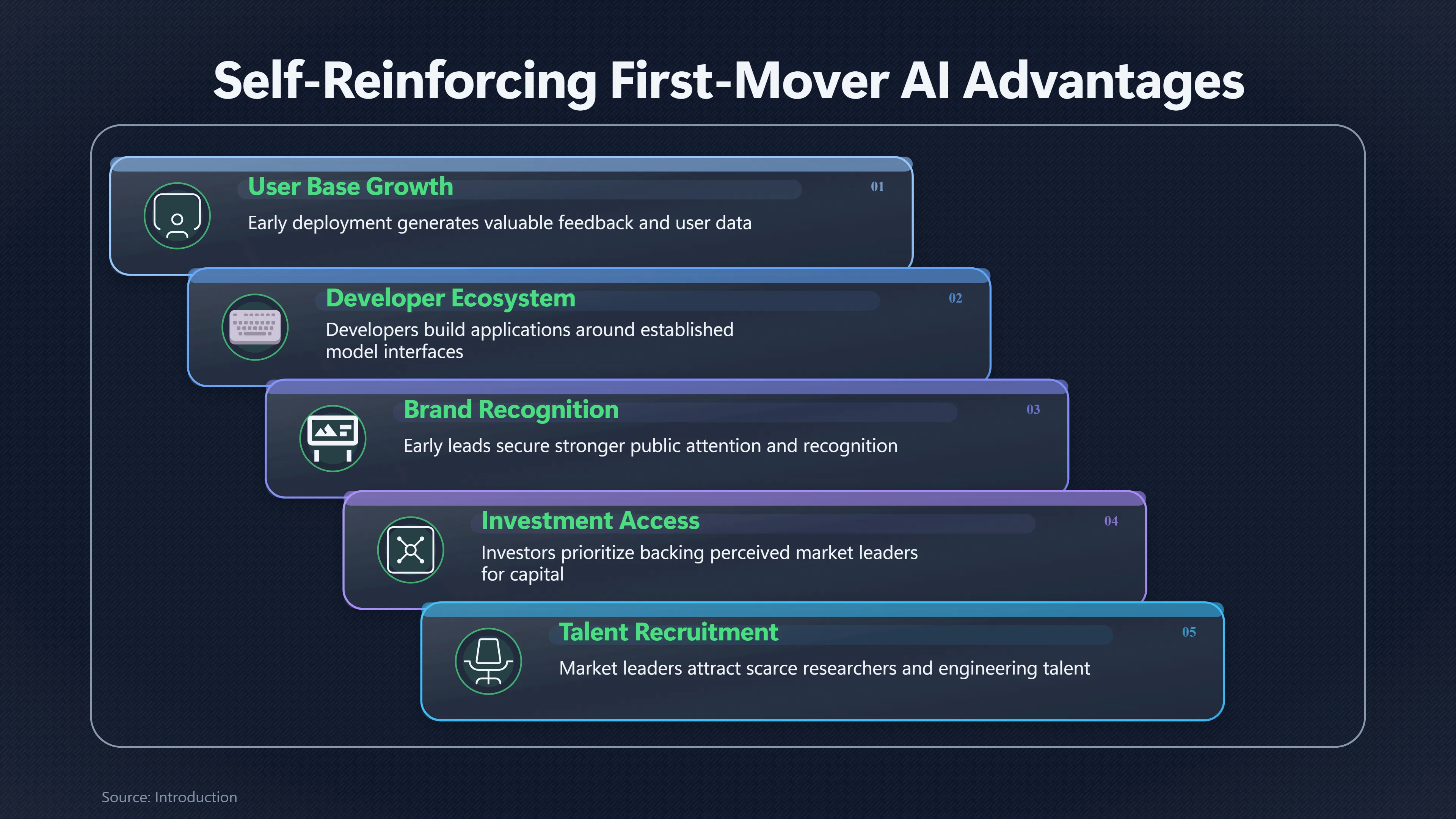
First-mover advantage means that arriving before competitors creates benefits that persist beyond the initial launch. In AI, these advantages can reinforce one another.
An early frontier model may gain:
- A larger user base that generates valuable feedback and data.
- A growing ecosystem of developers building applications around its interfaces.
- Stronger brand recognition and public attention.
- Easier access to investment because investors back perceived leaders.
- Greater ability to recruit scarce researchers and engineers.
- More revenue to purchase computing infrastructure for the next generation of models.
Unlike many traditional software markets, these advantages may accumulate quickly because frontier AI development depends heavily on enormous financial and computing resources. An organisation that establishes an early lead may therefore widen the gap through successive training runs rather than merely enjoying a temporary sales advantage.
This possibility helps explain why AI companies frequently describe competition as occurring over months rather than years. Missing one product cycle could affect access to customers, talent and capital needed for subsequent models.
From an AI doom perspective, the concern is that these cumulative rewards increase the perceived cost of delaying deployment for additional evaluations or safety engineering. A laboratory may conclude that a rival gaining the first major lead would permanently alter the competitive landscape.[OpenAI]OpenAIOpen AIWhy responsible AI development needs cooperation on safety | Open AIWhy responsible AI development needs cooperation on safety | OpenAI…
How launch pressure changes testing and deployment choices
The first-mover mechanism does not require companies to ignore safety completely. Instead, it can change where difficult trade-offs are made.
Additional safety work often takes time. Examples include:
- conducting more extensive capability evaluations;
- running larger red-team exercises to identify unexpected behaviours;
- improving interpretability tools that help researchers understand model reasoning;
- strengthening cybersecurity around model weights;
- testing whether dangerous capabilities emerge when models receive new tools or fine-tuning.
Each extra stage delays commercial release. If executives believe that competitors will launch regardless, every additional week spent on testing can appear increasingly expensive.
Economic theory predicts that this can produce what researchers call premature deployment: releasing a system earlier than would maximise overall social welfare because individual firms face stronger incentives than society does to move first. Importantly, premature does not necessarily mean reckless or negligent. It means that competitive incentives favour an earlier launch than would be chosen if all participants could coordinate around additional safety work.[CEPR]cepr.orgDP21454 AI Safety and Competition | CEPRMay 7, 2026…
For AI doom scenarios, the concern becomes sharper if frontier systems eventually exhibit behaviours that only appear under realistic deployment conditions or at larger scales than laboratory testing can fully reproduce. In that situation, shortening pre-deployment evaluation could increase uncertainty precisely when uncertainty matters most.
What economic models show—and what they cannot prove
Recent economic research has examined these incentives formally rather than relying only on intuition.
A 2026 discussion paper by Jay Pil Choi, Doh-Shin Jeon and Domenico Menicucci models firms deciding when to deploy AI systems under safety risk. Their analysis finds that sufficiently strong first-mover advantages can generate a “race to the bottom”, where competing firms deploy earlier than would maximise joint welfare. The effect becomes stronger when competing systems are technologically similar, making speed more valuable than differentiation. Even when firms acting together would choose a socially desirable deployment date, competition alone can still produce inefficiently early launches.[CEPR]cepr.orgDP21454 AI Safety and Competition | CEPRMay 7, 2026…
These models clarify the mechanism but should not be mistaken for empirical proof that current frontier laboratories are behaving this way.
Several important limitations remain:
- They simplify real business decisions into mathematical assumptions.
- They cannot measure the true size of first-mover advantages in rapidly changing AI markets.
- They cannot predict future capabilities or existential risks.
- Different assumptions about customer behaviour or regulation may produce different outcomes.
The value of these models lies in demonstrating that ordinary market competition does not automatically produce socially optimal deployment timing when safety investments primarily benefit everyone while delays are borne by individual competitors.
Why this mechanism matters more for advanced AI than ordinary software
Most software products improve after release through updates. Bugs are expected, and many failures are reversible.
AI doom arguments claim that frontier AI could eventually differ in several important respects.
If future systems become capable of sophisticated autonomous planning, rapid scientific research, advanced cyber operations or strategically deceptive behaviour, mistakes discovered after deployment could be much harder to reverse. Additional pre-release evaluation might therefore have unusually high value.
This possibility changes the economics of launching first. A company deciding whether to spend another month testing a conventional application may reasonably accept some remaining uncertainty. A company deciding whether to release a system with poorly understood frontier capabilities could face a much steeper trade-off if those capabilities interact unpredictably with real-world environments.
The mechanism therefore depends not only on commercial incentives but also on assumptions about how difficult advanced AI systems will become to evaluate before deployment. That assumption remains one of the central uncertainties in AI doom debates.
Industry recognition of the coordination problem
Major AI developers have publicly acknowledged that competitive pressure can create incentives to move too quickly, although they differ on how serious the problem is and how it should be addressed.
OpenAI has argued that AI development presents a collective-action problem in which companies may underinvest in safety if they expect competitors to prioritise speed. It has proposed greater cooperation, transparency and shared safety norms as ways to reduce those pressures.[OpenAI]OpenAIOpen AIWhy responsible AI development needs cooperation on safety | Open AIWhy responsible AI development needs cooperation on safety | OpenAI…
Anthropic’s Responsible Scaling Policy similarly links deployment decisions to model capability thresholds, requiring progressively stronger safeguards as systems become more capable. The company presents these policies as attempts to prevent commercial incentives from overwhelming risk management.[anthropic.com]anthropic.com’s Responsible Scaling Policy \ AnthropicAnthropic’s Responsible Scaling Policy \ AnthropicJuly 8, 2026…
These public commitments do not demonstrate that competitive pressure has been eliminated. Indeed, debates over revisions to voluntary safety policies illustrate how difficult maintaining unilateral restraint can become when firms compete intensely. Critics argue that commercial realities may eventually weaken voluntary commitments, while supporters respond that transparent policies remain substantially better than having no published deployment criteria at all.[anthropic.com]anthropic.com’s Responsible Scaling Policy \ AnthropicAnthropic’s Responsible Scaling Policy \ AnthropicJuly 8, 2026…
The main objections to the first-mover argument
Not everyone accepts that first-mover advantage necessarily leads to unsafe launches.
Several counterarguments deserve serious consideration.
Being first does not guarantee long-term leadership. Technology markets often reward firms that build better products rather than merely earlier ones. A rushed launch that damages trust could lose customers to a more reliable competitor.
Safety can become a competitive advantage. Enterprise customers increasingly value reliability, security and predictable behaviour. Better safety practices may therefore attract rather than repel buyers.
Rapid deployment can improve safety. Some researchers argue that carefully controlled real-world deployment reveals problems impossible to discover in laboratory settings. Limited releases, staged access and continuous monitoring may therefore improve understanding more quickly than prolonged internal testing.
Regulation may reduce the race. Mandatory evaluations, reporting requirements or common safety standards could reduce incentives for firms to cut corners because competitors would face similar obligations.
These objections mean that first-mover advantage should not be viewed as an automatic path to unsafe deployment. Its effect depends on market structure, regulation, customer preferences and the actual capabilities of future AI systems.
Why this mechanism remains central to AI doom discussions
Within AI existential risk debates, first-mover advantage is important because it connects ordinary commercial incentives to extraordinary long-term risks.
The mechanism does not require malicious actors, irrational executives or deliberate disregard for safety. Instead, it suggests that well-intentioned organisations could collectively make riskier decisions because each fears falling behind if others continue moving faster.
Whether this dynamic ultimately contributes to existential risk depends on several uncertain assumptions: that advanced AI systems become genuinely difficult to control, that additional safety work would materially reduce those risks, and that competitive markets continue rewarding earlier deployment more than greater caution.
Those assumptions remain heavily debated. Nevertheless, first-mover advantage provides one of the clearest explanations for why many AI safety researchers argue that coordination between frontier developers may become increasingly important if future AI systems approach capabilities associated with loss-of-control scenarios.[cepr.org]cepr.orgDP21454 AI Safety and Competition | CEPRMay 7, 2026…
Amazon book picks
Further Reading
Books and field guides related to Does Being First Make Unsafe AI Launches More Likely?. Use these as the next step if you want deeper reading beyond the article.
The Coming Wave
"We are approaching a critical threshold in the history of our species. Everything is about to change. Soon you will live surrounded by A...
The Master Switch
A New Yorker and Fortune Best Book of the Year "A must-read for all Americans who want to remain the ones deciding what they can read, wa...
Zero to One
Rating: 4.5/5 from 5 Google Books ratings
WHAT VALUABLE COMPANY IS NOBODY BUILDING? The next Bill Gates will not build an operating system. The next Larry Page or Sergey Brin won’...
Chip War
***Winner of the 2022 Financial Times Business Book of the Year Award*** ***Selected as one of Barack Obama's Favourite Books of 2023***...
eBay marketplace picks
Marketplace Samples
Live-tested eBay searches with available results related to this page.
Selected fromAI race poster oneBay.co.uk.


Endnotes
1.
Source: cepr.org
Link:https://cepr.org/publications/dp21454
Source snippet
DP21454 AI Safety and Competition | CEPRMay 7, 2026...
Published: May 7, 2026
2.
Source: OpenAI
Title: Open AIWhy responsible AI development needs cooperation on safety | Open AI
Link:https://openai.com/index/cooperation-on-safety/
Source snippet
Why responsible AI development needs cooperation on safety | OpenAI...
3.
Source: anthropic.com
Title: ’s Responsible Scaling Policy \ Anthropic
Link:https://www.anthropic.com/responsible-scaling-policy
Source snippet
Anthropic’s Responsible Scaling Policy \ AnthropicJuly 8, 2026...
Published: July 8, 2026
4.
Source: OpenAI
Title: advancing ai safety through state and federal action
Link:https://openai.com/index/advancing-ai-safety-through-state-and-federal-action/
Source snippet
comThe US is advancing AI safety through state and federal action | OpenAIJuly 15, 2026 — July 15, 2026 Global Affairs THE US IS ADVANCIN...
Published: July 15, 2026
5.
Source: OpenAI
Link:https://openai.com/index/deployment-simulation/
Source snippet
comPredicting model behavior before release by simulating deployment | OpenAIJune 16, 2026 — June 16, 2026 Research PREDICTING MODEL BEHA...
Published: June 16, 2026
6.
Source: anthropic.com
Title: We see the initial glimmers of risks that could become serious in the ne
Link:https://www.anthropic.com/news/the-case-for-targeted-regulation
Source snippet
The case for targeted regulation \ AnthropicOctober 31, 2024 — A YEAR OF ANTHROPIC’S RESPONSIBLE SCALING POLICY Grappling with the catast...
Published: October 31, 2024
7.
Source: anthropic.com
Link:https://www.anthropic.com/policy
Source snippet
We work with governments to ensure that AI policy is built on the best available evidence. POLICY ON THE AI EXPONENTIAL AI...
8.
Source: anthropic.com
Title: We are sharing two policy proposals to prepare for AI progress. The fir
Link:https://www.anthropic.com/policy-on-the-ai-exponential/epf
Source snippet
Policy on the AI Exponential \ AnthropicPOLICY ON THE AI EXPONENTIAL AI is advancing at exponential speed, and the policymaking process w...
9.
Source: youtube.com
Title: Apple’s AI Problem Nobody’s Talking About
Link:https://www.youtube.com/watch?v=YntGcYkE00w
Source snippet
OpenAI vs Anthropic: Which is the Better AI Bet?...
10.
Source: youtube.com
Title: Open AI vs Anthropic: Which is the Better AI Bet?
Link:https://www.youtube.com/watch?v=xmO41X-iEys
Source snippet
Anthropic’s First-Mover IPO Edge Set to Widen Lead Over OpenAI...
Additional References
11.
Source: preprints.org
Title: Optimal Release Timing of AI Systems: A S
Link:https://www.preprints.org/manuscript/202603.2470
Source snippet
trategic Analysis with Safety Externalities[v1] | Preprints.orgMarch 31, 2026 — Version 1 Submitted: 31 March 2026 Posted: 31 March 2026...
Published: March 31, 2026
12.
Source: GOV.UK
Title: www.gov.uk Emerging processes for frontier AI safety
Link:https://www.gov.uk/government/publications/emerging-processes-for-frontier-ai-safety/emerging-processes-for-frontier-ai-safety
Source snippet
Specific technical terms are described within their relevant section. AI (Artificial Intelligence) or AI (Artificia...
13.
Source: openropic.com
Title: Responsible Scaling Policy Updates
Link:https://openropic.com/responsible-scaling-policy
Source snippet
April 2, 2026 — ANTHROPIC'S RESPONSIBLE SCALING POLICY Anticipating and securing against emerging threats that accompany increasingly pow...
Published: April 2, 2026
14.
Source: youtube.com
Title: Anthropic’s First-Mover IPO Edge Set to Widen Lead Over Open AI
Link:https://www.youtube.com/watch?v=R3mpuKNVtLA
Source snippet
First mover advantage [AI race]({{ 'ai-race/' | relative_url }}) launch premature risk safety Undercover Boss Promotes Employee on the Spot...
15.
Source: youtube.com
Title: Anthropic Drops Hallmark Safety Pledge in Race With AI Peers
Link:https://www.youtube.com/watch?v=33lZi_Hfc8M
Source snippet
Why America’s AI Strategy Is Backwards (First-Mover Disadvantage)...
16.
Source: youtube.com
Title: Why America’s AI Strategy Is Backwards (First-Mover Disadvantage)
Link:https://www.youtube.com/watch?v=OpkjcKToCKw
Source snippet
Apple's AI Problem Nobody's Talking About...
17.
Source: tse-fr.eu
Title: A I Safety and Competition | TSE
Link:https://www.tse-fr.eu/publications/ai-safety-and-competition-0