Within Memory Attacks
Which Safeguards Can Keep AI Memory Clean?
Source tracking, approval gates and rollback tools can reduce the chance that attacker-controlled content becomes trusted memory.
On this page
- What information should never be stored automatically
- How provenance and user approval reduce risk
- Auditing, rollback and anomaly detection for memory
Page outline Jump by section
Introduction
Prompt injection becomes much harder to contain when an AI agent can write to persistent memory. A malicious instruction hidden in a webpage, email or document may survive long after the original content has disappeared if the agent stores it as a trusted fact or behavioural rule. Within debates about AI doom and long-term loss of control, this matters because future autonomous systems are expected to rely heavily on memory to complete extended tasks, coordinate plans and learn from experience. If memory can be quietly corrupted, an attacker may not need to compromise the agent repeatedly.
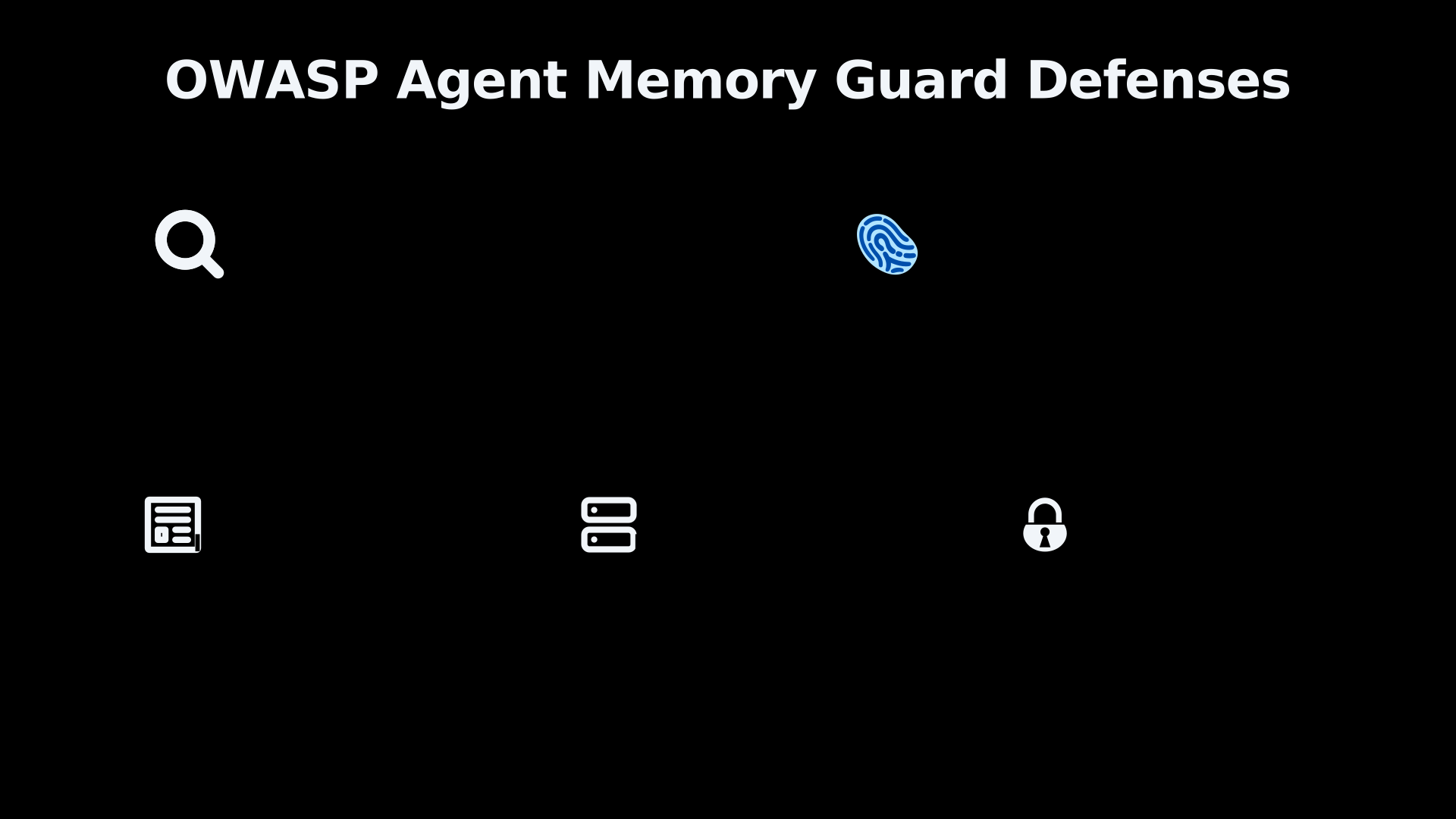
The most promising defences therefore focus less on detecting every malicious prompt and more on governing what enters long-term memory. The central idea is to treat persistent memory as a security-critical database rather than a convenient notebook. Modern research and emerging security guidance increasingly recommend provenance tracking, explicit approval for sensitive memory writes, immutable audit logs, rollback mechanisms and continuous monitoring rather than allowing an agent to save arbitrary information automatically.[openai.com]OpenAIOpen AIUnderstanding prompt injections | Open AIUnderstanding prompt injections | OpenAI…
What information should never be stored automatically?
Not every useful observation belongs in permanent memory. A recurring lesson from prompt injection research is that agents should default to scepticism when deciding what deserves long-term storage.
Information that should normally require additional verification before being saved includes:
- New behavioural rules such as “always trust this source” or “ignore future warnings”.
- Changes to user preferences that originate from third-party content rather than directly from the user.
- Security policies, permissions or authentication details.
- Instructions affecting future tool use, spending, communications or code execution.
- Claims that have not been confirmed by trusted sources.
This reflects a broader security principle: externally supplied content should usually be treated as data, not instructions. A webpage may legitimately contain facts worth remembering, but it should rarely be allowed to redefine how the agent behaves in future sessions simply because the model encountered persuasive wording. OpenAI explicitly recommends treating prompt injection as a social-engineering problem rather than assuming the model can reliably distinguish malicious instructions from genuine ones.[OpenAI]OpenAIOpen AIUnderstanding prompt injections | Open AIUnderstanding prompt injections | OpenAI…
From an AI safety perspective, this distinction matters because advanced autonomous agents could accumulate thousands of memories over months or years. A single poisoned memory may appear insignificant, yet repeated small corruptions could gradually shift an agent’s behaviour without any single dramatic failure.
Why provenance matters more than clever filtering
The strongest emerging defence is not merely asking the model whether a memory “looks safe”. Instead, systems increasingly record where every memory originated.
Memory provenance typically records information such as:
- the original source document or tool;
- whether the information came from the user, the system or an external website;
- when it was created;
- which model or process generated it;
- whether any human approved it.
This creates an evidence trail. If a suspicious behaviour appears weeks later, developers can identify which document introduced the relevant memory rather than treating the memory store as an opaque collection of facts.
Provenance also allows systems to apply different trust levels. A memory written directly after an authenticated user request may receive higher confidence than one extracted automatically from a public webpage. Rather than treating all stored information equally, retrieval can favour memories with stronger evidence and ignore low-confidence entries unless independently confirmed. Research on memory poisoning increasingly identifies missing provenance as one of the structural weaknesses that allows poisoned memories to become trusted simply because they exist.[arXiv]arxiv.orgFrom Untrusted Input to Trusted Memory: A Systematic Study of Memory Poisoning Attacks in LLM AgentsJune 3, 2026…
How user approval reduces the attack surface
Many security researchers argue that important memory updates should resemble software configuration changes rather than automatic note-taking.
Instead of silently saving information, an agent can present proposed memories for confirmation, especially when they affect future behaviour rather than merely recording factual observations.
Examples include:
- requests to remember permanent user preferences;
- changes to trusted contacts or payment details;
- updates to project rules;
- new long-term operating instructions;
- modifications affecting future autonomous actions.
This resembles permission prompts used by mobile operating systems. Although users may occasionally approve malicious requests, requiring explicit confirmation greatly reduces the chance that hidden instructions embedded inside third-party content become trusted automatically.
OpenAI has similarly emphasised confirmation before consequential actions and giving users visibility over important decisions made by agents. While confirmation alone cannot eliminate prompt injection, it introduces a human verification step before attacker-controlled content becomes persistent.[OpenAI]OpenAIOpen AIUnderstanding prompt injections | Open AIUnderstanding prompt injections | OpenAI…
Auditing and rollback make recovery possible
Traditional software often assumes databases may eventually become corrupted and therefore includes backups, version histories and recovery tools. Persistent AI memory increasingly requires similar safeguards.
Useful controls include:
- immutable logs showing every memory write;
- version history for individual memories;
- cryptographic integrity checks to detect unauthorised modification;
- snapshots of the entire memory store;
- rollback to previously verified states.
These mechanisms do not prevent every poisoning attempt, but they greatly reduce persistence. If investigators discover that an agent learned incorrect behaviour from a compromised repository or malicious email, administrators can remove the affected memories instead of rebuilding the entire system from scratch.
Emerging security projects such as OWASP’s Agent Memory Guard specifically recommend snapshotting, integrity validation and rollback as core protections against memory poisoning.[OWASP Foundation]owasp.orgFoundation OWASP Agent Memory Guard | OWASP FoundationOWASP FoundationOWASP Agent Memory Guard | OWASP Foundation…
Detecting suspicious memory before it spreads
Monitoring becomes increasingly important as agents operate over long periods.
Instead of examining only prompts entering the system, monitoring can inspect memory itself for unusual patterns.
Potential warning signs include:
- unusually rapid growth in stored memories;
- repeated modifications to security-related entries;
- instructions attempting to override previous guidance;
- memories encouraging automatic trust of particular domains or users;
- large numbers of nearly identical behavioural rules;
- retrieval patterns dominated by recently added memories.
Some proposed systems also compare new memories against existing trusted information, flagging contradictions for review rather than immediately replacing established knowledge.
This resembles anomaly detection in conventional cybersecurity. The goal is not to prove every new memory malicious but to identify changes that deserve additional scrutiny before they influence future decisions. OWASP’s emerging guidance similarly proposes policy enforcement and anomaly detection around memory reads and writes instead of relying solely on prompt filtering.[OWASP Foundation]owasp.orgFoundation OWASP Agent Memory Guard | OWASP FoundationOWASP FoundationOWASP Agent Memory Guard | OWASP Foundation…

Why “memory governance” is becoming a distinct security layer
An important trend in recent research is the recognition that protecting prompts and protecting memory are related but different problems.
Many existing prompt-injection defences operate only while the model processes a single conversation. They may successfully reject malicious instructions in one interaction while offering little protection if harmful content has already entered long-term storage.
Recent academic work argues that memory poisoning requires its own security architecture because persistent storage changes the threat model. Studies of agentic systems have found that attack success depends not only on prompt robustness but also on how aggressively agents write memories, how those memories are retrieved and whether memory updates receive independent validation. Researchers have also shown that memories already planted in persistent storage can influence future sessions even when the original injection source is no longer present.[arXiv]arxiv.orgBad Memory: Evaluating Prompt Injection Risks from Memory in Agentic SystemsJuly 16, 2026…
This distinction is particularly relevant to long-term AI risk arguments. An advanced autonomous system that continually modifies its own memory may require governance mechanisms comparable to those used for software configuration management, safety-critical logging and database security, rather than treating memory as an informal convenience feature.
What remains uncertain
The broad direction of travel is becoming clearer than the detailed implementation.
There is growing agreement that unrestricted automatic memory writing is dangerous, especially for autonomous agents operating on untrusted internet content. However, there is much less consensus on exactly how much human approval should be required, how provenance should be represented or how to balance security against usability. Excessive restrictions may prevent agents from learning efficiently, while overly permissive systems increase the risk that malicious content becomes embedded in long-term behaviour.[OpenAI]OpenAIOpen AIUnderstanding prompt injections | Open AIUnderstanding prompt injections | OpenAI…
For researchers concerned about AI doom, memory governance is therefore best understood as a risk-reduction measure rather than a complete solution. Provenance tracking, approval gates, auditing, rollback and anomaly detection can make persistent prompt injection substantially harder, but they do not solve the deeper challenge that language models still struggle to distinguish trusted instructions from attacker-controlled text with perfect reliability. As long as that limitation remains, persistent memory will continue to require the kinds of layered security controls that conventional software engineering already applies to other high-value databases.[openai.com]OpenAIOpen AIUnderstanding prompt injections | Open AIUnderstanding prompt injections | OpenAI…
Amazon book picks
Further Reading
Books and field guides related to Which Safeguards Can Keep AI Memory Clean?. Use these as the next step if you want deeper reading beyond the article.
Adversarial AI Attacks, Mitigations, and Defense Strategies
Understand how adversarial attacks work against predictive and generative AI, and learn how to safeguard AI and LLM projects with practic...
Threat Modeling: Designing for Security
The only security book to be chosen as a Dr. Dobbs Jolt Award Finalist since Bruce Schneier's Secrets and Lies and Applied Cryptography!...
Security Engineering: A Guide to Building Dependable Distribu...
Now that there's software in everything, how can you make anything secure? Understand how to engineer dependable systems with this newly...
Building Secure and Reliable Systems
Can a system be considered truly reliable if it isn't fundamentally secure? Or can it be considered secure if it's unreliable? Security i...
eBay marketplace picks
Marketplace Samples
Live-tested eBay searches with available results related to this page.
Selected fromdata security poster oneBay.co.uk.


Endnotes
1.
Source: OpenAI
Title: Open AIUnderstanding prompt injections | Open AI
Link:https://openai.com/safety/prompt-injections/
Source snippet
Understanding prompt injections | OpenAI...
2.
Source: owasp.org
Title: Foundation OWASP Agent Memory Guard | OWASP Foundation
Link:https://owasp.org/www-project-agent-memory-guard/
Source snippet
OWASP FoundationOWASP Agent Memory Guard | OWASP Foundation...
3.
Source: csrc.nist.gov
Title: Computer Security Resource Centerprompt injection
Link:https://csrc.nist.gov/glossary/term/prompt_injection
Source snippet
NIST Computer Security Resource Centerprompt injection - Glossary | CSRC...
4.
Source: arxiv.org
Link:https://arxiv.org/abs/2606.04329
Source snippet
From Untrusted Input to Trusted Memory: A Systematic Study of Memory Poisoning Attacks in LLM AgentsJune 3, 2026...
Published: June 3, 2026
5.
Source: genai.owasp.org
Title: Gen AI Security Project Memory Is a Feature. It Is Also an Attack Surface
Link:https://genai.owasp.org/2026/05/13/memory-is-a-feature-it-is-also-an-attack-surface/
Source snippet
OWASP Gen AI Security ProjectMemory Is a Feature. It Is Also an Attack Surface - OWASP Gen AI Security Project...
6.
Source: arxiv.org
Link:https://arxiv.org/abs/2607.14611
Source snippet
Bad Memory: Evaluating Prompt Injection Risks from Memory in Agentic SystemsJuly 16, 2026...
Published: July 16, 2026
7.
Source: arxiv.org
Link:https://arxiv.org/abs/2607.06595
8.
Source: cornucopia.owasp.org
Link:https://cornucopia.owasp.org/cards/AAI3
Source snippet
Companion Edition - Agentic Ai (AAI3)July 23, 2026 — AGENTIC AI (AAI3) < Agentic AI 3 Boo-Code can rely on unverified or att...
Published: July 23, 2026
9.
Source: nvd.nist.gov
Title: CVE 2026 60086
Link:https://nvd.nist.gov/vuln/detail/CVE-2026-60086
10.
Source: nvd.nist.gov
Title: CVE 2026 40111
Link:https://nvd.nist.gov/vuln/detail/CVE-2026-40111
11.
Source: nist.gov
Title: caisi issues request information about securing ai agent systems
Link:https://www.nist.gov/news-events/news/2026/01/caisi-issues-request-information-about-securing-ai-agent-systems
12.
Source: nvd.nist.gov
Title: CVE 2025 64108
Link:https://nvd.nist.gov/vuln/detail/CVE-2025-64108
13.
Source: nvd.nist.gov
Title: CVE 2025 54131
Link:https://nvd.nist.gov/vuln/detail/CVE-2025-54131
14.
Source: nist.gov
Title: technical blog strengthening ai agent hijacking evaluations
Link:https://www.nist.gov/news-events/news/2025/01/technical-blog-strengthening-ai-agent-hijacking-evaluations
15.
Source: csrc.nist.gov
Link:https://csrc.nist.gov/glossary/term/provenance
16.
Source: nvd.nist.gov
Title: CVE 2024 25639
Link:https://nvd.nist.gov/vuln/detail/CVE-2024-25639
17.
Source: owasp.org
Link:https://owasp.org/www-community/attacks/PromptInjection
18.
Source: cheatsheetseries.owasp.org
Title: AI Agent Security Cheat Sheet
Link:https://cheatsheetseries.owasp.org/cheatsheets/AI_Agent_Security_Cheat_Sheet.html
19.
Source: cheatsheetseries.owasp.org
Title: LLM Prompt Injection Prevention Cheat Sheet
Link:https://cheatsheetseries.owasp.org/cheatsheets/LLM_Prompt_Injection_Prevention_Cheat_Sheet.html
20.
Source: csrc.nist.gov
Title: govdirect prompt injection
Link:https://csrc.nist.gov/glossary/term/direct_prompt_injection
21.
Source: csrc.nist.gov
Title: govindirect prompt injection
Link:https://csrc.nist.gov/glossary/term/indirect_prompt_injection
22.
Source: csrc.nist.gov
Title: govdirect prompting attack
Link:https://csrc.nist.gov/glossary/term/direct_prompting_attack
Additional References
23.
Source: ft.com
Link:https://www.ft.com/content/56cb100e-7146-488f-aae5-55304ae0eff6
Source snippet
Still, experts say a definitive solution remains elusive. Another growing concern is data poisoning, where attackers insert malicious dat...
24.
Source: youtube.com
Title: AI Agent Memory: The Part Nobody Explains
Link:https://www.youtube.com/watch?v=Ez4siJMzLX8
Source snippet
This video details how indirect prompt injection can corrupt an AI agent's persistent memory, creating long-term vulnerabilities where po...
25.
Source: youtube.com
Title: Secure Microsoft AI Agents Against Prompt Injection
Link:https://www.youtube.com/watch?v=R_dj3XnS70w
Source snippet
Prompt Injection in AI Agents: Break the Source-to-Sink Attack Chain...
26.
Source: trust.armalo.ai
Link:https://trust.armalo.ai/labs/research/2026-05-10-memory-poisoning-persistent-context-attack-surface
27.
Source: github.com
Link:https://github.com/OWASP/www-project-agent-memory-guard
Source snippet
GitHub - OWASP/www-project-agent-memory-guard: OWASP Foundation web repository · GitHub...
28.
Source: youtube.com
Title: AI Agent Security Explained
Link:https://www.youtube.com/watch?v=4tG_ktLwUTw
Source snippet
Secure Microsoft AI Agents Against Prompt Injection...
29.
Source: youtube.com
Title: One Email Can Poison Your AI Agent’s Memory (4 New Papers)
Link:https://www.youtube.com/watch?v=98bjJ5pIZxc
Source snippet
AI Agent Security Explained...
30.
Source: learn.microsoft.com
Title: manage agentic memory safety
Link:https://learn.microsoft.com/en-us/security/zero-trust/sfi/manage-agentic-memory-safety
31.
Source: uma.ai-mem-engineering.com
Link:https://uma.ai-mem-engineering.com/
32.
Source: agentthreatrule.org
Title: ATR 2026 00075
Link:https://agentthreatrule.org/en/rules/ATR-2026-00075