Within Nuclear Crises
Could AI Make Nuclear Leaders Act Too Fast?
AI-assisted warnings could compress decision time, amplify automation bias and leave leaders less room to challenge a false alarm.
On this page
- How AI compresses warning and response time
- Why confident outputs can distort human judgement
- How false alarms could become harder to stop
Page outline Jump by section
Introduction
Could AI make nuclear leaders act too fast? Potentially, yes—but not because an AI would independently decide to launch nuclear weapons. The more immediate concern is that AI could compress the time available for human judgement during a crisis. By processing huge volumes of intelligence in seconds, producing rapid recommendations and presenting them with apparent confidence, AI systems could encourage leaders to respond before they have fully tested whether the underlying information is correct. That matters because nuclear crises are already characterised by uncertainty, incomplete information and extreme time pressure. If AI accelerates the pace of decision-making without making the information more reliable, it could increase the risk of miscalculation.[SIPRI]sipri.orgImpact of Military Artificial Intelligence on Nuclear Escalation Risk | SIPRIImpact of Military Artificial Intelligence on Nuclear Escalation Risk | SIPRI…
Within debates about AI doom and existential risk, this is generally treated as a human decision-making problem rather than an AI takeover scenario. The fear is that increasingly capable AI systems could amplify existing weaknesses in nuclear command and crisis management, making accidental escalation more likely at precisely the moments when careful human judgement matters most.
How AI compresses warning and response time
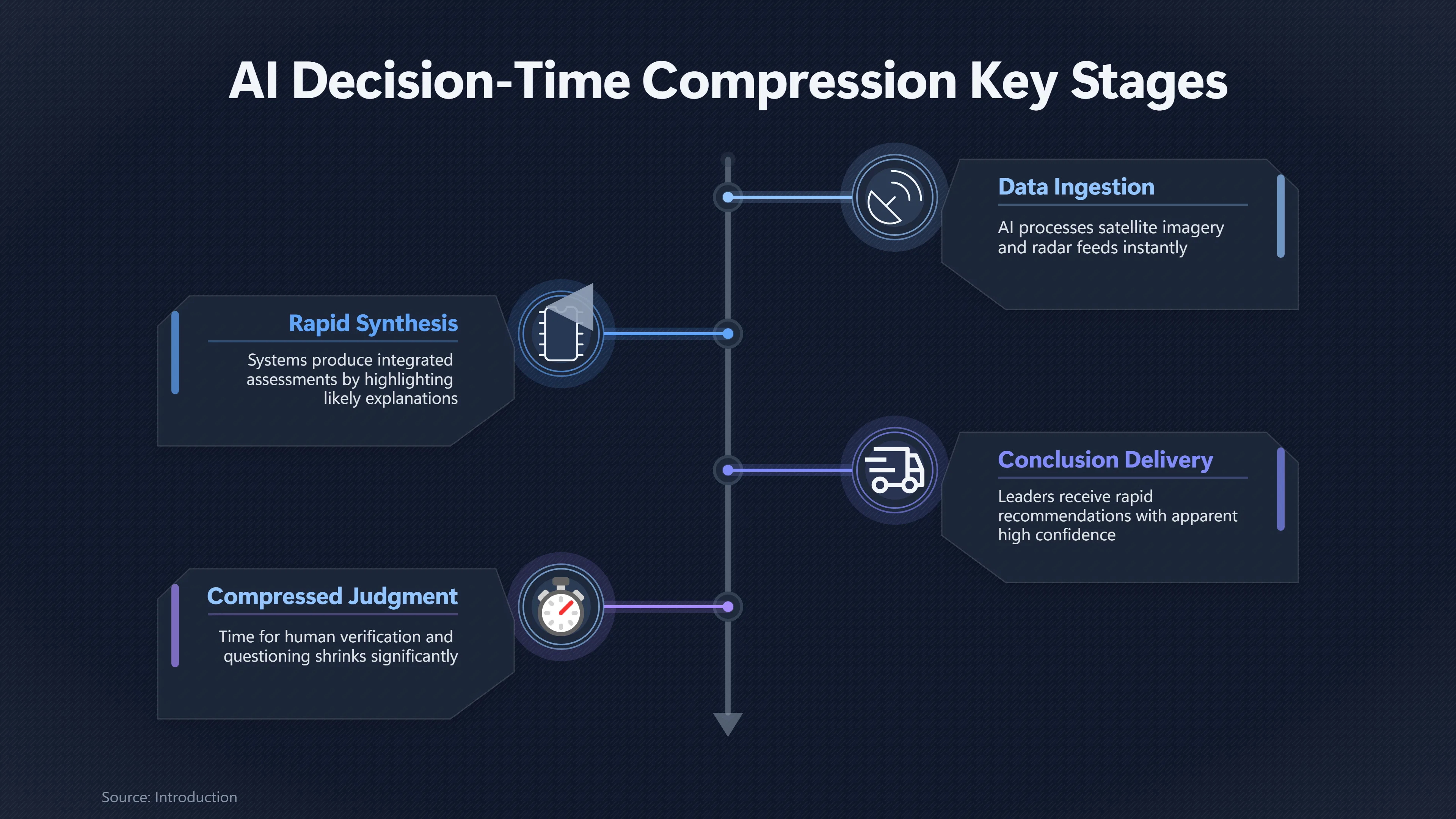
Military organisations increasingly view AI as a way to process satellite imagery, radar feeds, cyber intelligence and communications data faster than human analysts can manage. Faster analysis can improve situational awareness, but it also changes the tempo of decision-making.
Traditionally, a warning of a possible missile launch or military mobilisation passes through multiple stages of analysis before reaching political leaders. Analysts compare different intelligence sources, challenge assumptions and look for signs of technical failure or deception. AI systems may shorten many of these intermediate stages by rapidly producing integrated assessments or highlighting what they judge to be the most likely explanation.[SIPRI]sipri.orgNuclear Weapons and Artificial Intelligence: Technological Promises and Practical Realities | SIPRI…
The result is what researchers describe as decision-time compression. Leaders may receive conclusions more quickly than before, but the time available to question those conclusions may shrink even further.
This creates a difficult trade-off:
- Faster processing may reveal genuine threats earlier.
- Faster recommendations can also create pressure to respond immediately.
- Once one state accelerates its decision cycle, rivals may feel compelled to match that pace rather than risk falling behind.
Researchers at SIPRI argue that this acceleration can increase escalation risks even when AI is used only in conventional military systems rather than directly in nuclear launch systems, because those systems shape leaders’ understanding of unfolding events.[SIPRI]sipri.orgImpact of Military Artificial Intelligence on Nuclear Escalation Risk | SIPRIImpact of Military Artificial Intelligence on Nuclear Escalation Risk | SIPRI…
Why confident outputs can distort human judgement
One of the most discussed risks is not that AI is always wrong, but that it can appear unusually certain even when uncertainty remains high.
Modern AI decision-support systems often produce clear rankings, probabilities or recommended actions. Even if those outputs are statistically well calibrated, they can appear more objective and authoritative than traditional intelligence assessments, which often emphasise uncertainty and competing interpretations.
Psychologists have long documented automation bias: the tendency for people to trust computer-generated recommendations more than they should, especially when operating under stress or severe time pressure. Research on human–AI decision-making suggests that people frequently defer to automated advice even when warning signs indicate that the system may be mistaken.[arXiv]arxiv.orgHuman-AI Interactions in Public Sector Decision-Making: "Automation Bias" and "Selective Adherence" to Algorithmic AdviceMarch 3, 2021…
In a nuclear crisis this tendency could become particularly dangerous because leaders would face:
- enormous political pressure;
- limited time for consultation;
- incomplete intelligence;
- fear of acting too slowly.
An AI assessment that presents one explanation with apparent confidence may therefore crowd out alternative interpretations, even when the evidence is genuinely ambiguous.
Importantly, this concern does not depend on advanced AI becoming autonomous. Even advisory systems can shape human judgement simply because humans naturally place weight on confident-looking recommendations during stressful situations.[SIPRI]sipri.orgImpact of Military Artificial Intelligence on Nuclear Escalation Risk | SIPRIImpact of Military Artificial Intelligence on Nuclear Escalation Risk | SIPRI…

How false alarms could become harder to stop
History shows that false warnings have occurred in nuclear early-warning systems. Human judgement has repeatedly prevented technical errors or misleading sensor readings from escalating into catastrophe.
Supporters of caution argue that those historical episodes illustrate the value of slowing down rather than speeding up decision-making. If AI reduces the opportunities for human operators to question unusual results, future false alarms could become harder to interrupt before political leaders begin considering military responses.[SIPRI]sipri.orgArtificial Intelligence, Strategic Stability and Nuclear RiskArtificial Intelligence, Strategic Stability and Nuclear Risk…
Several mechanisms could contribute:
- AI may combine many imperfect data sources into a single persuasive assessment, making underlying uncertainties less visible.
- Operators may assume the AI has identified patterns they cannot personally verify.
- Rapid machine-generated updates may overwhelm human reviewers, making independent checking increasingly difficult.
- Political leaders may feel that delaying action contradicts the system’s apparent confidence.
None of these mechanisms requires AI to fabricate information deliberately. Ordinary sensor errors, software faults, adversary deception or incomplete intelligence could become more influential simply because decisions are moving faster than verification processes.
Does faster always mean more dangerous?
Not necessarily. Many researchers emphasise that AI could also reduce risk if deployed carefully.
For example, AI might help analysts detect sensor failures, identify contradictory intelligence, prioritise the most reliable information or automate routine monitoring that would otherwise distract human experts. Better warning systems could sometimes give leaders more time to think rather than less.[arXiv]arxiv.orgA Stable Nuclear Future? The Impact of Autonomous Systems and Artificial IntelligenceDecember 11, 2019…
Whether AI increases or decreases danger depends heavily on how organisations use it. Key design choices include:
- whether AI explains its reasoning rather than producing unexplained conclusions;
- whether humans are encouraged to challenge recommendations instead of merely approving them;
- whether procedures deliberately preserve time for verification during crises;
- whether multiple independent intelligence sources remain available for comparison.
For this reason, many specialists argue that the central governance question is not simply whether humans remain “in the loop”, but whether they retain meaningful opportunities to question AI-generated assessments before irreversible decisions are made.[SIPRI]sipri.orgAdvancing Governance at the Nexus of Artificial Intelligence and Nuclear Weapons | SIPRI…
Why this matters for AI doom debates
Within AI doom discussions, compressed nuclear decision-making is usually presented as one possible pathway by which advanced AI could contribute to an existential catastrophe without directly controlling nuclear weapons.
The argument is that AI could subtly alter the structure of crisis decision-making. If competing nuclear powers increasingly rely on fast AI-supported intelligence while simultaneously fearing surprise attack, the incentives to verify information carefully may weaken. Leaders might still make every final decision themselves, yet the practical window for independent human judgement could become progressively smaller.
Whether this mechanism substantially raises the probability of nuclear war remains disputed. There is little direct empirical evidence because no nuclear crisis has yet been managed with highly capable modern AI systems integrated throughout military decision support. Most assessments therefore rely on historical experience with false alarms, established research on automation bias, military simulations and analysis of how increasing operational speed changes strategic stability.[SIPRI]sipri.orgImpact of Military Artificial Intelligence on Nuclear Escalation Risk | SIPRIImpact of Military Artificial Intelligence on Nuclear Escalation Risk | SIPRI…
Amazon book picks
Further Reading
Books and field guides related to Could AI Make Nuclear Leaders Act Too Fast?. Use these as the next step if you want deeper reading beyond the article.
Nuclear War: A Scenario
The INSTANT New York Times bestseller Instant Los Angeles Times bestseller Finalist, Dayton Literary Peace Prize One of NPR's Books We Lo...
Command and Control
Presents a minute-by-minute account of an H-bomb accident that nearly caused a nuclear disaster, examining other near misses and America'...
The Button
The President has the power to end the world in minutes. Right now, no one can stop him. Since the Truman administration, America has bee...
The Limits of Safety
Environmental tragedies such as Chernobyl and the Exxon Valdez remind us that catastrophic accidents are always possible in a world full...
eBay marketplace picks
Marketplace Samples
Live-tested eBay searches with available results related to this page.
Selected fromnuclear warning poster oneBay.co.uk.



Endnotes
1.
Source: sipri.org
Title: Impact of Military Artificial Intelligence on Nuclear Escalation Risk | SIPRI
Link:https://www.sipri.org/publications/2025/sipri-insights-peace-and-security/impact-military-artificial-intelligence-nuclear-escalation-risk
Source snippet
Impact of Military Artificial Intelligence on Nuclear Escalation Risk | SIPRI...
2.
Source: sipri.org
Link:https://www.sipri.org/publications/2024/sipri-background-papers/nuclear-weapons-and-artificial-intelligence-technological-promises-and-practical-realities
Source snippet
Nuclear Weapons and Artificial Intelligence: Technological Promises and Practical Realities | SIPRI...
3.
Source: sipri.org
Title: Artificial Intelligence, Strategic Stability and Nuclear Risk
Link:https://www.sipri.org/sites/default/files/2020-06/artificial_intelligence_strategic_stability_and_nuclear_risk.pdf
Source snippet
Artificial Intelligence, Strategic Stability and Nuclear Risk...
4.
Source: arxiv.org
Link:https://arxiv.org/abs/2103.02381
Source snippet
Human-AI Interactions in Public Sector Decision-Making: "Automation Bias" and "Selective Adherence" to Algorithmic AdviceMarch 3, 2021...
Published: March 3, 2021
5.
Source: arxiv.org
Link:https://arxiv.org/abs/1912.05291
Source snippet
A Stable Nuclear Future? The Impact of Autonomous Systems and Artificial IntelligenceDecember 11, 2019...
Published: December 11, 2019
6.
Source: sipri.org
Link:https://www.sipri.org/publications/2025/sipri-insights-peace-and-security/advancing-governance-nexus-artificial-intelligence-and-nuclear-weapons
Source snippet
Advancing Governance at the Nexus of Artificial Intelligence and Nuclear Weapons | SIPRI...
7.
Source: sipri.org
Link:https://www.sipri.org/publications/2025/other-publications/pragmatic-approaches-governance-artificial-intelligence-nuclear-nexus
Source snippet
Pragmatic Approaches to Governance at the Artificial Intelligence–Nuclear Nexus | SIPRI...
8.
Source: sipri.org
Link:https://www.sipri.org/publications/2025/other-publications/autonomous-weapon-systems-and-ai-enabled-decision-support-systems-military-targeting-comparison-and
9.
Source: sipri.org
Link:https://www.sipri.org/publications/2020/policy-reports/artificial-intelligence-strategic-stability-and-nuclear-risk
10.
Source: sipri.org
Link:https://www.sipri.org/publications/2021/eu-non-proliferation-and-disarmament-papers/explaining-nuclear-challenges-posed-emerging-and-disruptive-technology-primer-european-policymakers
Additional References
11.
Source: cambridge.org
Link:https://www.cambridge.org/core/journals/european-journal-of-[international
Source snippet
GenAI and synthetic foresight at the brink: The future of nuclear crisis decision-making | European Journal of International Security | C...
12.
Source: youtube.com
Title: What does AI warfare look like and why might it favour nuclear escalation?
Link:https://www.youtube.com/watch?v=_zzJRYSD1d8
Source snippet
The Algorithmic Trigger: AI, OODA Loops, and Nuclear Command in South Asia...
13.
Source: fas.org
Link:https://fas.org/publication/risk-assessment-framework-ai-nuclear-weapons/
14.
Source: armscontrol.org
Link:https://www.armscontrol.org/act/2025-12/features/solving-ai-induced-transparency-paradox-nuclear-command-and-control
15.
Source: youtube.com
Title: Decision Time: AI and our Nuclear Arsenal
Link:https://www.youtube.com/watch?v=W3HABFroOBo
Source snippet
How Can AI Increase the Risk from Nuclear Weapons?...
16.
Source: youtube.com
Title: Artificial Escalation
Link:https://www.youtube.com/watch?v=w9npWiTOHX0
Source snippet
What does AI warfare look like and why might it favour nuclear escalation?...
17.
Source: youtube.com
Title: The Algorithmic Trigger: AI, OODA Loops, and Nuclear Command in South Asia
Link:https://www.youtube.com/watch?v=8ttqt9uNdxg
18.
Source: youtube.com
Title: How Can AI Increase the Risk from Nuclear Weapons?
Link:https://www.youtube.com/watch?v=u6IfolCMqrQ
Source snippet
Artificial Escalation...
19.
Source: csis.org
Title: N C3: Challenges Facing the Future System
Link:https://www.csis.org/analysis/nc3-challenges-facing-future-system
20.
Source: europarl.europa.eu
Link:https://www.europarl.europa.eu/doceo/document/E-10-2025-004224_EN.html