Within Intelligence Explosion
What Happens When AI Researchers Work by the Thousand?
Thousands of copied AI researchers working continuously could transform research speed even if each agent remains less capable than a top human scientist.
On this page
- Why digital research labour can scale differently from human teams
- How parallel experiments could compress development timelines
- Coordination costs, duplication and diminishing returns
Page outline Jump by section
Introduction
One of the most important ideas in discussions of recursive AI improvement is not that a single AI suddenly becomes vastly more intelligent, but that AI systems could massively increase the amount of research being done at the same time. If AI researchers can be copied almost without cost, work continuously and operate across thousands of independent experiments, the effective research workforce could become far larger than any human organisation has ever assembled.
This possibility matters because AI research is already heavily digital. Much of the work—reading papers, writing code, debugging systems, analysing results and proposing new experiments—takes place on computers. If capable AI agents can perform a significant fraction of those tasks, progress might speed up through sheer scale even before any individual AI exceeds the world’s best human researchers. Whether this produces gradual acceleration or contributes to an intelligence explosion remains uncertain. The key question is how much useful research output grows once coordination costs, duplicated effort and physical constraints are taken into account.
Why digital research labour scales differently
Human research organisations face unavoidable limits. Hiring takes months, researchers need salaries and office space, expertise varies widely, and people require sleep, holidays and training. Communication also becomes increasingly difficult as teams expand.
Digital AI researchers would have very different properties.
Instead of recruiting another scientist, a laboratory could create another instance of the same capable research agent. Thousands of copies could begin work immediately, each equipped with identical knowledge, access to the same internal tools and the latest model weights. Unlike humans, they could:
- operate around the clock
- start with identical technical knowledge
- switch projects almost instantly
- be paused, duplicated or deleted with little cost
- specialise temporarily before being reassigned elsewhere
This changes the economics of research labour. Rather than searching for scarce experts, an organisation could purchase additional computing resources to run more researchers in parallel. Researchers studying automation of AI R&D frequently identify software engineering, debugging and experiment implementation as especially promising early targets because these activities already occur in digital environments.[Epoch AI]epoch.aiinterviewing ai researchers on automation of ai rndInterviewing AI researchers on automation of AI R&D | Epoch AIAugust 27, 2024…
Importantly, this does not require fully autonomous scientific genius. Even AI systems that perform only parts of the research process may increase overall productivity if enough copies can work simultaneously.
How thousands of parallel experiments could compress timelines
The largest advantage of copied AI researchers is not necessarily making each experiment faster. It is making many more experiments happen simultaneously.
Machine learning research often involves trying numerous variations of an idea:
- different model architectures
- alternative training objectives
- hyperparameter combinations
- evaluation methods
- debugging approaches
- implementation details
Human teams must prioritise because researchers are limited. AI researchers could investigate many of these alternatives at once.
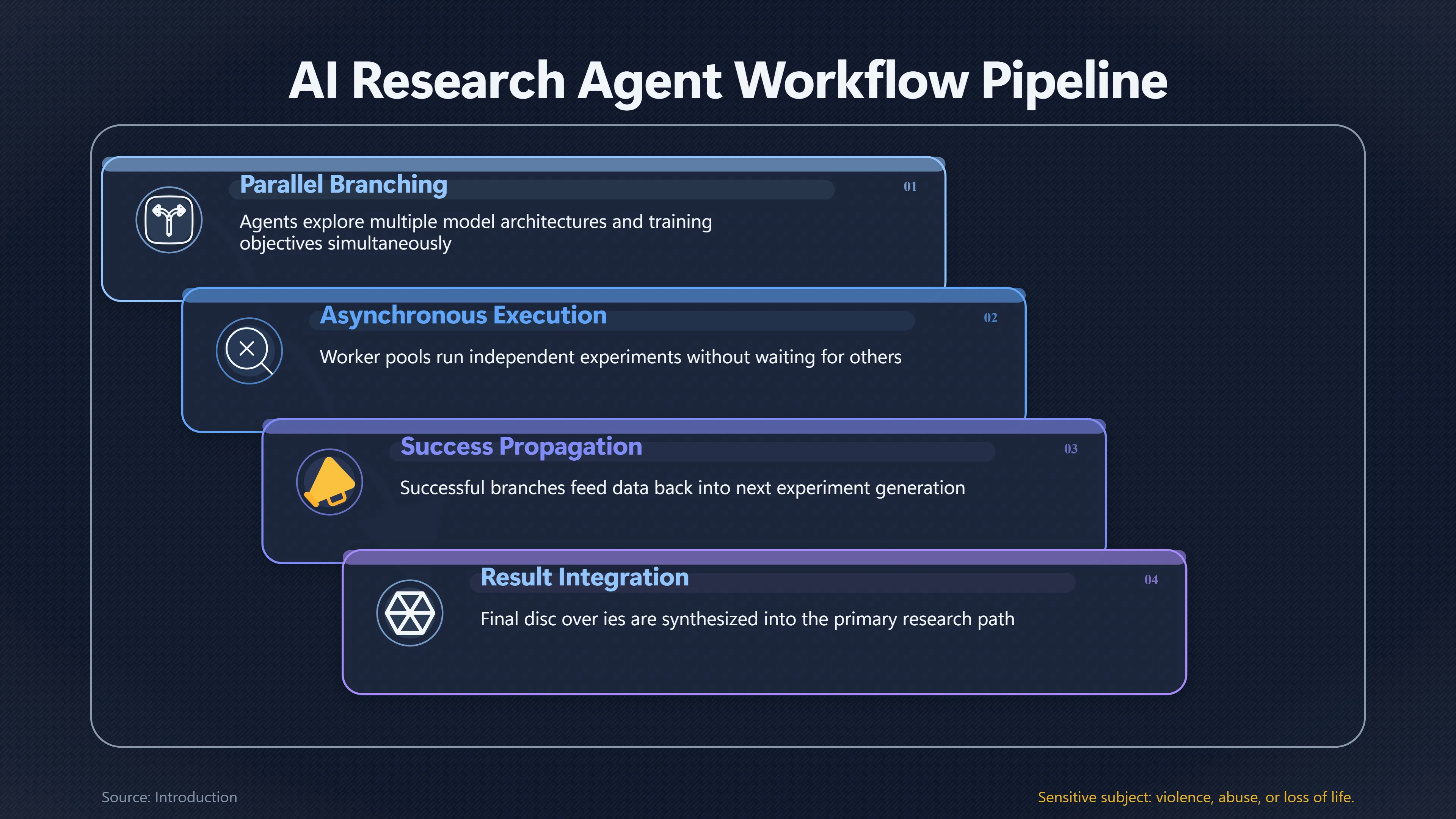
Instead of one engineer exploring ten possible improvements over several weeks, one thousand AI agents might each explore a different branch. Most experiments would fail, but successful branches could immediately be fed back into the next generation of experiments.
This creates a branching search process rather than a single research path. The faster successful results are identified and propagated, the more rapidly the overall search may advance.
Recent research into AI research agents reflects this emphasis on experiment throughput. Systems such as AIRA₂ explicitly use asynchronous worker pools so that many experiments can run concurrently rather than waiting for one another, reporting improved performance as more parallel experimentation becomes possible.[arXiv]arxiv.orgarXiv AIRA_2: Overcoming Bottlenecks in AI Research AgentsAIRA_2: Overcoming Bottlenecks in AI Research AgentsMarch 27, 2026…
Parallelism matters even if each AI is mediocre
A common misunderstanding is that recursive improvement requires an AI researcher individually smarter than the best human scientist.
Many researchers argue this is not necessary.
Suppose an AI researcher performs at the level of a competent junior machine learning engineer rather than a leading expert. If one organisation can deploy 10,000 such researchers simultaneously, the total amount of coding, debugging and experimentation completed each day may still exceed what the world’s top human AI laboratories currently produce.
This resembles the difference between:
- one exceptional scientist working alone
- thousands of competent researchers sharing results continuously
The second organisation may produce more discoveries despite lower average individual ability.
This distinction explains why some AI safety researchers focus heavily on automation levels rather than intelligence measured in isolation. The amount of research labour available can matter almost as much as the capability of each worker. Interviews with AI researchers show many expect engineering automation to be the main driver of early AI R&D acceleration, even while disagreeing sharply about whether this eventually leads to explosive growth.[Epoch AI]epoch.aiinterviewing ai researchers on automation of ai rndInterviewing AI researchers on automation of AI R&D | Epoch AIAugust 27, 2024…
Why AI research may benefit unusually from parallel labour
Not every scientific field scales well through parallel work.
Some disciplines require expensive laboratories, scarce equipment or lengthy biological experiments. Even perfect digital researchers cannot eliminate those physical bottlenecks.
AI research is different because much of the development cycle already consists of software:
- writing training code
- testing algorithms
- evaluating benchmarks
- analysing failures
- searching research literature
- generating implementation variants
Although training frontier models still requires enormous computing infrastructure, much of the intellectual search process can potentially occur in parallel before expensive training runs begin.
This makes AI unusually exposed to labour multiplication through digital workers compared with many other research disciplines.
Coordination becomes the next bottleneck
Running thousands of researchers is not the same as obtaining thousands of independent discoveries.
As organisations grow, coordination becomes increasingly expensive.
Parallel AI researchers may:
- duplicate one another’s work
- pursue identical failed ideas
- interfere with shared codebases
- overwhelm human supervisors with results
- generate more experiments than available computing can execute
The challenge therefore shifts from producing ideas to selecting, coordinating and integrating them.
Current research agents already illustrate this issue. Benchmark results show that AI systems remain much stronger at isolated engineering tasks than at managing complete end-to-end research programmes involving planning, execution and interpretation. Success on entire research workflows remains substantially lower than performance on individual components.[arXiv]arxiv.orgarXiv EXP-Bench: Can AI Conduct AI Research Experiments?arXiv EXP-Bench: Can AI Conduct AI Research Experiments?
Similarly, studies of AI-generated research ideas suggest present systems often concentrate around existing approaches rather than exploring genuinely novel directions, implying that simply adding more agents does not automatically broaden scientific search.[arXiv]arxiv.orgarXiv AI Research Agents Narrow Scientific ExplorationAI Research Agents Narrow Scientific ExplorationMay 27, 2026…
Diminishing returns are a serious objection
One of the strongest criticisms of rapid recursive improvement is that research does not scale linearly with the number of workers.
Several mechanisms may produce diminishing returns.
First, the easiest discoveries are typically made early. Later improvements become progressively harder.
Second, many research tasks depend on one another. A thousand engineers cannot all independently solve the same bottleneck if everyone is waiting for the outcome of one critical experiment.
Third, physical resources eventually dominate. Additional researchers become less useful if:
- GPU clusters are fully occupied
- electrical power is limited
- new chips cannot be manufactured quickly enough
- training runs require weeks regardless of staffing
Economic modelling of recursive self-improvement often identifies these complementarities as a major uncertainty. Some analyses argue that sufficiently strong bottlenecks could prevent runaway acceleration even if AI research becomes highly automated, while others conclude that automation across enough research tasks could overcome diminishing returns under certain assumptions.[epoch.ai]epoch.aimost ai value will come from broad automation not from r dMost AI value will come from broad automation, not from R&D | Epoch AIMarch 21, 2025…
Why this mechanism features prominently in AI doom arguments
Within AI doom scenarios, parallel AI researchers matter because they could shorten the time available for humans to respond.
If every improvement creates more capable research agents, which then produce the next improvement even faster, development cycles may compress dramatically. Human oversight processes that currently operate over months could struggle if major capability advances begin arriving every few days or weeks.
Importantly, this argument does not depend on any single breakthrough. Instead, it relies on cumulative increases in research capacity produced by large populations of copied AI workers.
Supporters of this concern argue that organisations could gradually replace more human research labour with AI labour until AI systems perform most frontier development themselves. Critics counter that coordination problems, hardware limits, evaluation difficulties and diminishing returns may slow the feedback loop enough for progress to remain rapid but manageable.
The available evidence does not yet resolve this disagreement. Current AI systems clearly accelerate parts of software engineering and machine learning research, but they remain far from reliably conducting complete AI research programmes without substantial human involvement. Existing benchmarks find partial success on individual research tasks while full end-to-end autonomous research remains uncommon.[arxiv.org]arxiv.orgarXiv EXP-Bench: Can AI Conduct AI Research Experiments?arXiv EXP-Bench: Can AI Conduct AI Research Experiments?
Amazon book picks
Further Reading
Books and field guides related to What Happens When AI Researchers Work by the Thousand?. Use these as the next step if you want deeper reading beyond the article.
Human Compatible
A leading artificial intelligence researcher lays out a new approach to AI that will enable us to coexist successfully with increasingly...
The Alignment Problem
Finalist for the Los Angeles Times Book Prize A jaw-dropping exploration of everything that goes wrong when we build AI systems and the m...
Superintelligence
This profoundly ambitious and original book picks its way carefully through a vast tract of forbiddingly difficult intellectual terrain.
Life 3.0
'This is the most important conversation of our time, and Tegmark's thought-provoking book will help you join it' Stephen Hawking THE INT...
eBay marketplace picks
Marketplace Samples
Live-tested eBay searches with available results related to this page.
Selected fromartificial intelligence poster oneBay.co.uk.




Endnotes
1.
Source: epoch.ai
Title: interviewing ai researchers on automation of ai rnd
Link:https://epoch.ai/publications/interviewing-ai-researchers-on-automation-of-ai-rnd
Source snippet
Interviewing AI researchers on automation of AI R&D | Epoch AIAugust 27, 2024...
Published: August 27, 2024
2.
Source: arxiv.org
Title: arXiv EXP-Bench: Can AI Conduct AI Research Experiments?
Link:https://arxiv.org/abs/2505.24785
3.
Source: arxiv.org
Title: arXiv AIRA_2: Overcoming Bottlenecks in AI Research Agents
Link:https://arxiv.org/abs/2603.26499
Source snippet
AIRA_2: Overcoming Bottlenecks in AI Research AgentsMarch 27, 2026...
Published: March 27, 2026
4.
Source: arxiv.org
Title: arXiv AI Researchers’ Views on Automating AI R&D and Intelligence Explosions
Link:https://arxiv.org/abs/2603.03338
5.
Source: arxiv.org
Title: arXiv AI Research Agents Narrow Scientific Exploration
Link:https://arxiv.org/abs/2605.27905
Source snippet
AI Research Agents Narrow Scientific ExplorationMay 27, 2026...
Published: May 27, 2026
6.
Source: epoch.ai
Title: most ai value will come from broad automation not from r d
Link:https://epoch.ai/gradient-updates/most-ai-value-will-come-from-broad-automation-not-from-r-d
Source snippet
Most AI value will come from broad automation, not from R&D | Epoch AIMarch 21, 2025...
Published: March 21, 2025
7.
Source: metr.org
Title: The Economics of Recursive Self-Improvement
Link:https://metr.org/notes/2026-07-22-economics-of-recursive-self-improvement/
Source snippet
The Economics of Recursive Self-Improvement - METR...
8.
Source: metr.org
Title: 2026 02 10 simpler ai timelines model
Link:https://metr.org/notes/2026-02-10-simpler-ai-timelines-model/
Source snippet
A simpler AI timelines model predicts 99% AI R&D automation in ~2032 - METR...
9.
Source: metr.org
Link:https://metr.org/blog/2026-07-21-expenditure-horizon/
10.
Source: epoch.ai
Title: the software intelligence explosion debate needs experiments
Link:https://epoch.ai/gradient-updates/the-software-intelligence-explosion-debate-needs-experiments
11.
Source: epoch.ai
Title: announcing gate
Link:https://epoch.ai/publications/announcing-gate
12.
Source: epoch.ai
Title: a compute based framework for thinking about the future of ai
Link:https://epoch.ai/latest/a-compute-based-framework-for-thinking-about-the-future-of-ai
13.
Source: epoch.ai
Link:https://epoch.ai/gate/docs
14.
Source: epoch.ai
Link:https://epoch.ai/gate
15.
Source: epoch.ai
Link:https://epoch.ai/about
16.
Source: epochai.substack.com
Title: the software intelligence explosion
Link:https://epochai.substack.com/p/the-software-intelligence-explosion
Additional References
17.
Source: nature.com
Link:https://www.nature.com/articles/s42256-026-01268-y
Source snippet
July 24, 2026 — Capable language models can outgrow the benefits of collaboration Download PDF Download PDF * Article * Open access *...
Published: July 24, 2026
18.
Source: youtube.com
Link:https://www.youtube.com/watch?v=_kRg-ZP1vQc
Source snippet
Podcast | The Evolution of Long-Running AI Agent Harnesses...
19.
Source: youtube.com
Title: Can AI Automate AI Research? Jerry Tworek on What’s Still Missing
Link:https://www.youtube.com/watch?v=LZfZtqHUpAA
Source snippet
Carl Shulman (Pt 1) — Intelligence explosion, primate evolution, robot doublings, & alignment...
20.
Source: youtube.com
Title: How to Build and Optimize AI Research Agents
Link:https://www.youtube.com/watch?v=cG0kDcXN8Yg
Source snippet
Parallel AI agents acceleration research scaling multi agent R&D The scale of training LLMs 3Blue1Brown...
21.
Source: youtube.com
Title: When AI Builds Itself — Anthropic’s Recursive Self Improvement
Link:https://www.youtube.com/watch?v=fUt5ivlh_78
Source snippet
Can AI Automate AI Research? Jerry Tworek on What's Still Missing...
22.
Source: youtube.com
Title: Podcast | The Evolution of Long-Running AI Agent Harnesses
Link:https://www.youtube.com/watch?v=8PnfxXRJ8DI
Source snippet
How to Build and Optimize AI Research Agents...
23.
Source: research.google
Link:https://research.google/pubs/asap-an-agentic-solution-to-auto-optimize-performance-of-large-scale-llm-training/
24.
Source: linkedin.com
Link:https://www.linkedin.com/posts/epochai_how-close-is-ai-to-automating-ai-rd-right-activity-7473127216894271488-is9V
25.
Source: aclanthology.org
Link:https://aclanthology.org/2025.findings-naacl.448/
26.
Source: doi.org
Link:https://doi.org/10.1145/3731599.3767580