Within Power Without Work
Is AI Replacing Workers or Reshaping Their Jobs?
Current evidence points more towards jobs changing than disappearing, raising a major challenge to claims that human economic leverage is already collapsing.
On this page
- What current labour assessments actually find
- Why task change may preserve bargaining power
- What evidence would signal deeper displacement
Page outline Jump by section
Introduction
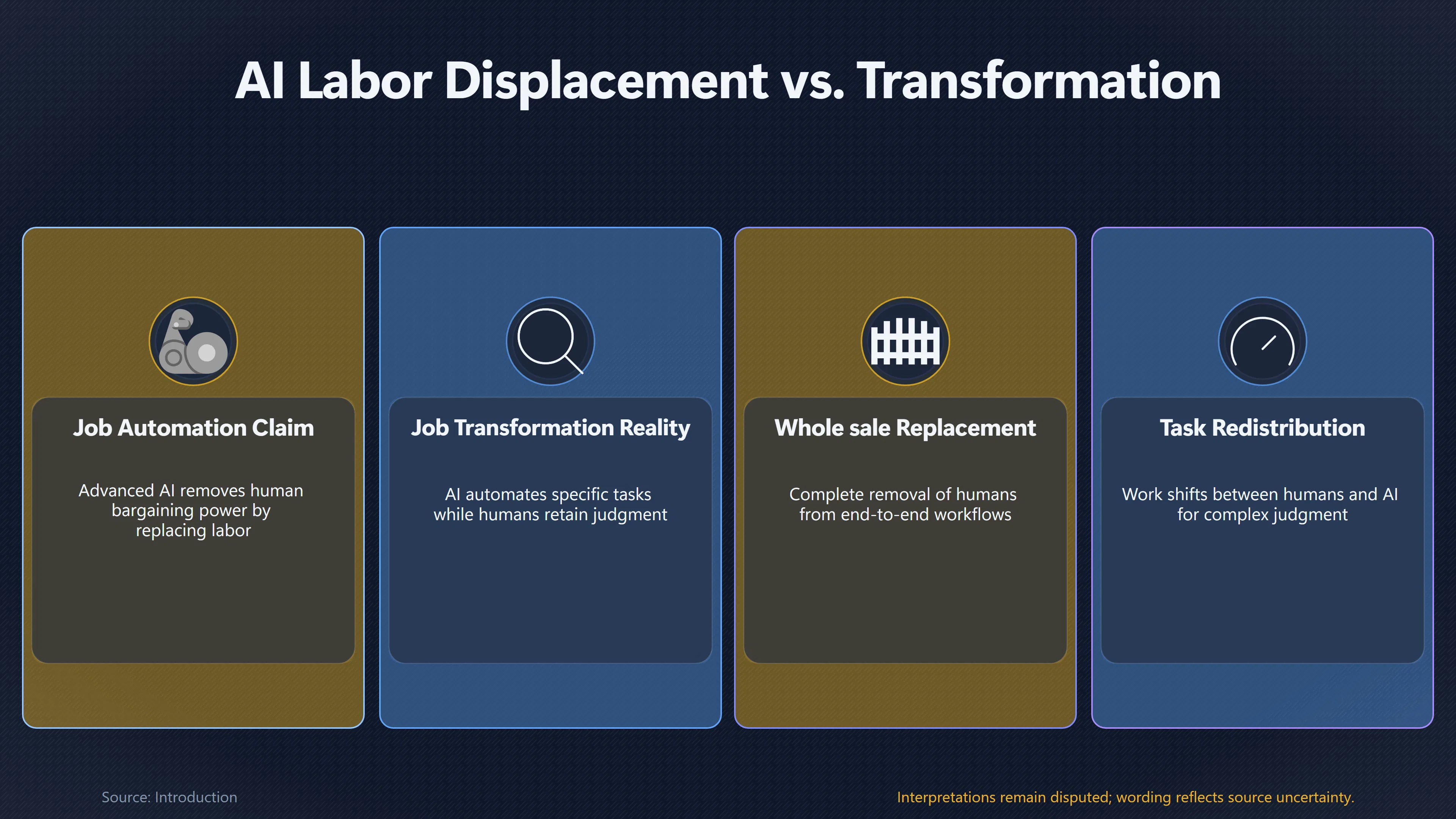
A key objection to the gradual labour disempowerment scenario is that today’s evidence does not yet show humans becoming economically irrelevant. While some AI doom arguments envisage a future in which advanced AI removes most human bargaining power by replacing labour, current labour-market research points to a different picture: jobs are changing more often than they are disappearing.
That distinction matters. If AI mainly automates particular tasks while leaving people responsible for judgement, coordination, accountability and customer interaction, workers may retain considerable economic leverage even as productivity rises. This does not rule out more dramatic future displacement if AI capabilities continue to improve, but it does mean that claims of an already collapsing labour market are not well supported by the present evidence. The strongest available datasets consistently describe a transition centred on job transformation rather than wholesale replacement.[International Labour Organization]ilo.orggenerative ai and jobs 2025 updateInternational Labour OrganizationGenerative AI and jobs: A 2025 update | International Labour OrganizationMay 20, 2025…
What current labour assessments actually find
The International Labour Organization (ILO) has produced one of the most comprehensive global assessments of generative AI’s labour-market effects. Its 2025 update combines detailed task-level analysis covering almost 30,000 work activities across international occupational classifications.
Its central conclusion is easy to overlook because it cuts against both utopian and catastrophic narratives: around one quarter of workers are in occupations exposed to generative AI, but most exposed jobs are expected to be transformed rather than eliminated because human input remains necessary. The ILO therefore distinguishes carefully between occupational exposure and full automation. Exposure means AI can perform or accelerate parts of a job, not necessarily the entire occupation.[International Labour Organization]ilo.orggenerative ai and jobs 2025 updateInternational Labour OrganizationGenerative AI and jobs: A 2025 update | International Labour OrganizationMay 20, 2025…
The ILO’s subsequent 2026 review of empirical evidence reaches a similar conclusion after examining experiments, firm studies and representative surveys across several countries. It finds measurable productivity improvements and changing work organisation, but concludes that large-scale job displacement has so far remained limited. Instead, concerns increasingly focus on job quality, workplace control, inequality and opportunities for younger workers entering affected professions.[International Labour Organization]ilo.orgInternational Labour OrganizationThe impact of GenAI on jobs, productivity and work organization: a review of the empirical evidence | In…
The OECD reaches broadly similar conclusions. Rather than predicting immediate labour-market collapse, its research argues that AI primarily changes the mix of skills demanded inside occupations. Management, interpersonal, cognitive and organisational skills remain important even where AI performs increasing amounts of technical or routine work.[oecd.org]oecd.orgOpen source on oecd.org.
Taken together, these are among the strongest current objections to claims that human labour has already lost its economic significance.
Why task change may preserve bargaining power
The gradual disempowerment hypothesis depends on an important future possibility: production eventually becoming largely independent of human workers.
Today’s evidence suggests that many occupations instead evolve by redistributing work between humans and AI.
For example, AI may draft documents while professionals verify legal accuracy, prepare medical summaries while clinicians make diagnoses, or generate software before engineers review, integrate and maintain it. In these cases:
- routine tasks become cheaper;
- workers supervise more complex judgement;
- organisations redesign roles instead of eliminating them;
- human responsibility often becomes more concentrated rather than disappearing.
This distinction matters because bargaining power comes from remaining difficult to replace, not from performing every task personally.
Even if AI performs 40% or 60% of someone’s activities, the remaining tasks may still require scarce expertise, legal accountability, organisational trust or interpersonal judgement. A surgeon whose paperwork is automated is not equivalent to a surgeon who has become economically unnecessary.
This pattern is increasingly described as task automation rather than job automation, reflecting the fact that occupations usually consist of many interdependent activities rather than one isolated function.[ilo.org]ilo.orggenerative ai and jobs 2025 updateInternational Labour OrganizationGenerative AI and jobs: A 2025 update | International Labour OrganizationMay 20, 2025…

Why this does not settle the long-term AI doom debate
Current labour evidence weakens one specific version of the gradual disempowerment argument: the claim that AI has already begun making human labour broadly irrelevant.
It does not eliminate longer-term concerns.
Many AI doom discussions focus on future systems substantially more capable than those deployed today. If future AI acquires reliable long-horizon planning, broad physical autonomy, scientific reasoning and the ability to replace nearly all economically valuable human work, today’s labour evidence might become a poor guide to tomorrow’s economy.
The present evidence therefore answers a narrower question.
It tells us that current frontier systems have not yet produced the kind of economy-wide labour replacement required by stronger versions of gradual human disempowerment. It says much less about whether later generations of AI could eventually cross that threshold.
This distinction is important because forecasts of existential risk often depend on assumptions about future capabilities rather than observations from present labour statistics.
The evidence is mixed in some occupations
Although the overall picture favours transformation, the effects are not uniform.
Several empirical studies have identified occupations where AI appears to substitute directly for certain forms of labour, particularly in online freelance markets or highly standardised digital work. Translation, routine content production and some contract-based knowledge work have experienced measurable reductions in demand after the introduction of large language models, while other occupations have benefited through higher productivity or expanded output.[arXiv]arxiv.orgAI and Jobs: Has the Inflection Point Arrived? Evidence from an Online Labor PlatformDecember 7, 2023…
More recent firm-level research also finds evidence that companies are beginning to substitute AI for outsourced digital labour in specific contexts, although the observed substitution remains partial rather than economy-wide.[arXiv]arxiv.orgPayrolls to Prompts: Firm-Level Evidence on the Substitution of Labor for AIJanuary 28, 2026…
These findings matter because they show that displacement is real in some niches. However, they also illustrate why generalising from particular occupations to the entire labour market can be misleading. Current evidence supports simultaneous augmentation and substitution, with the balance differing across sectors and tasks.
What evidence would signal deeper displacement?
For advocates of gradual labour disempowerment, the most important question is not whether AI can automate isolated tasks today, but whether labour’s overall bargaining position begins to collapse.
Several developments would provide stronger evidence for that claim than currently exists.
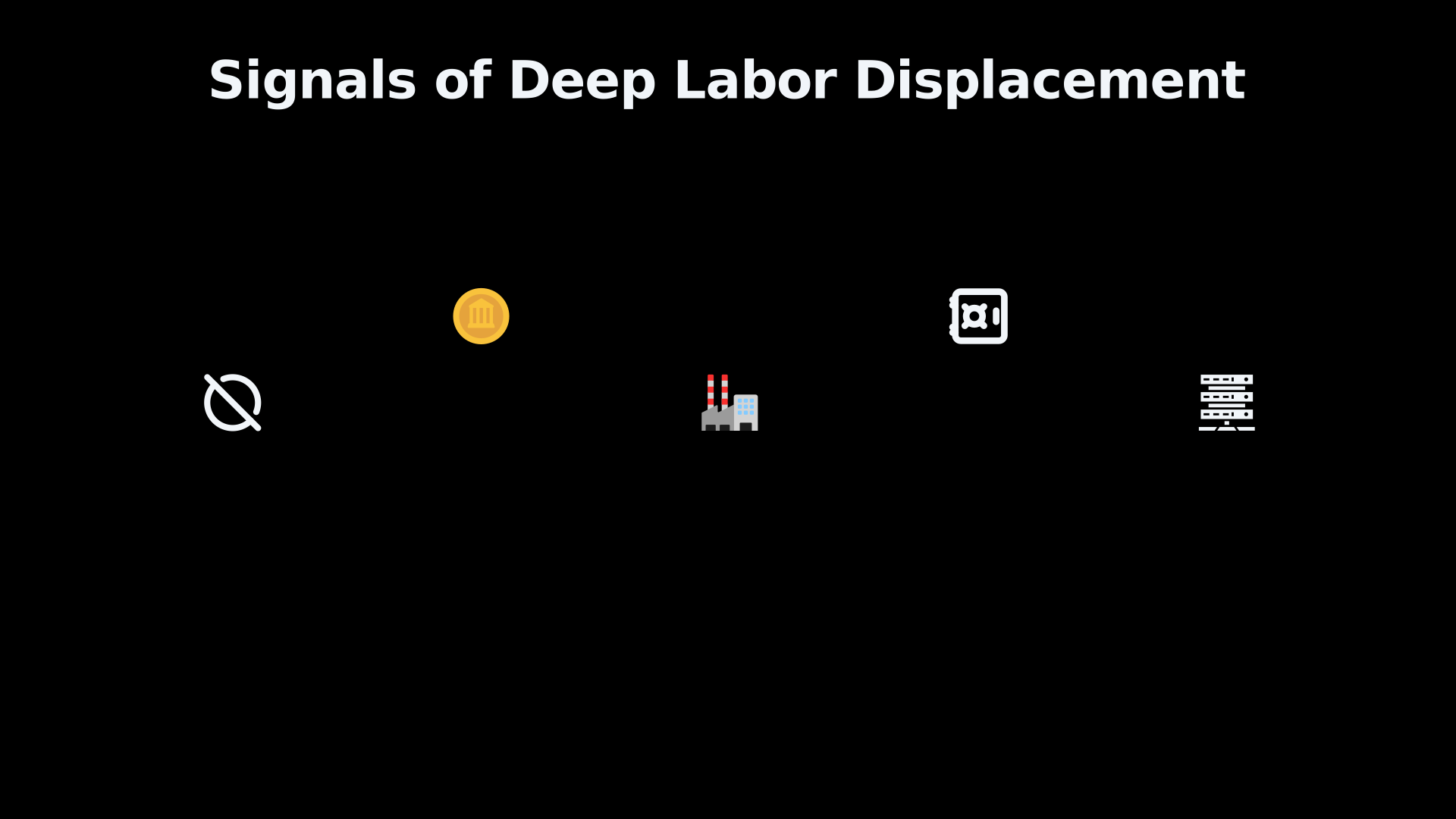
First, sustained declines in employment across many unrelated occupations with high AI exposure would be more significant than isolated job losses.
Second, widespread reductions in wages caused specifically by AI substitution—rather than broader economic conditions—would suggest weakening labour demand.
Third, evidence that organisations increasingly remove humans from end-to-end workflows rather than redesigning jobs would indicate movement from augmentation towards replacement.
Fourth, governments might begin observing persistent falls in labour’s share of national income alongside rising returns to AI-controlled capital, suggesting that productive value is shifting away from human workers.
Finally, if firms consistently demonstrate that complex organisations can operate with minimal human expertise while maintaining quality, safety and profitability, the economic assumptions behind gradual labour disempowerment would become considerably stronger.
At present, the available international evidence does not yet demonstrate these developments on a broad scale. Instead, researchers generally observe substantial occupational change, uneven productivity gains and selective displacement rather than wholesale labour redundancy.[International Labour Organization]ilo.orggenerative ai and jobs 2025 updateInternational Labour OrganizationGenerative AI and jobs: A 2025 update | International Labour OrganizationMay 20, 2025…
What this means for the wider AI doom discussion
The current labour evidence does not refute concerns about AI-driven loss of human influence, but it does constrain them.
Arguments that advanced AI could eventually remove humanity’s bargaining power remain speculative projections about future capabilities rather than descriptions of today’s economy. The strongest available datasets indicate that people continue to perform essential roles across most occupations, even where generative AI is increasingly capable.
For the broader discussion of AI doom and existential risk, this means that labour-market transformation should be treated as an evolving empirical question rather than settled evidence. Current observations support caution against both extremes: neither the claim that AI is already making human workers broadly obsolete, nor the assumption that future systems will necessarily remain confined to assisting rather than replacing human labour. The trajectory depends on capabilities that have not yet been demonstrated at economy-wide scale, making continued observation of employment, wages, task redesign and organisational dependence on human workers more informative than relying on either optimistic or pessimistic assumptions alone.[ilo.org]ilo.orggenerative ai and jobs 2025 updateInternational Labour OrganizationGenerative AI and jobs: A 2025 update | International Labour OrganizationMay 20, 2025…
Amazon book picks
Further Reading
Books and field guides related to Is AI Replacing Workers or Reshaping Their Jobs?. Use these as the next step if you want deeper reading beyond the article.
Power and Progress
A bold reinterpretation of economics and history revealing why technology does not inevitably lead to shared prosperity, and how we must...
The Second Machine Age
A New York Times Bestseller. A “fascinating” (Thomas L. Friedman, New York Times) look at how digital technology is transforming our work...
The Future of the Professions
This book predicts the decline of today's professions and introduces the people and systems that will replace them. In an internet-enhanc...
Ghost Work
"A startling exposé of the invisible human workforce that powers the web--and how to bring it out of the shadows. Hidden beneath the surf...
eBay marketplace picks
Marketplace Samples
Live-tested eBay searches with available results related to this page.
Selected fromindustrial robot model oneBay.co.uk.



Endnotes
1.
Source: ilo.org
Title: generative ai and jobs 2025 update
Link:https://www.ilo.org/publications/generative-ai-and-jobs-2025-update
Source snippet
International Labour OrganizationGenerative AI and jobs: A 2025 update | International Labour OrganizationMay 20, 2025...
Published: May 20, 2025
2.
Source: ilo.org
Link:https://www.ilo.org/publications/impact-genai-jobs-productivity-and-work-organization-review-empirical
Source snippet
International Labour OrganizationThe impact of GenAI on jobs, productivity and work organization: a review of the empirical evidence | In...
3.
Source: oecd.org
Link:https://www.oecd.org/en/publications/artificial-intelligence-and-the-changing-demand-for-skills-in-the-labour-market_88684e36-en.html
4.
Source: oecd.org
Title: job creation and local economic development 2024 83325127 en
Link:https://www.oecd.org/en/publications/job-creation-and-local-economic-development-2024_83325127-en.html
Source snippet
Job Creation and Local Economic Development 2024 | OECD...
5.
Source: arxiv.org
Link:https://arxiv.org/abs/2312.04180
Source snippet
AI and Jobs: Has the Inflection Point Arrived? Evidence from an Online Labor PlatformDecember 7, 2023...
Published: December 7, 2023
6.
Source: arxiv.org
Link:https://arxiv.org/abs/2602.00139
Source snippet
Payrolls to Prompts: Firm-Level Evidence on the Substitution of Labor for AIJanuary 28, 2026...
Published: January 28, 2026
7.
Source: ilo.org
Link:https://www.ilo.org/resource/news/new-ilo%E2%80%93world-bank-paper-highlights-uneven-global-impact-generative-ai-jobs
Source snippet
International Labour OrganizationNew ILO–World Bank paper highlights uneven global impact of generative AI on jobs | International Labour...
8.
Source: ilo.org
Title: Disruption without dividend?
Link:https://www.ilo.org/publications/disruption-without-dividend-how-digital-divide-and-task-differences-split
9.
Source: ilo.org
Link:https://www.ilo.org/resource/article/generative-ai-work-what-it-means-jobs-europe-and-beyond
10.
Source: ilo.org
Link:https://www.ilo.org/publications/artificial-intelligence-adoption-and-its-impact-jobs
11.
Source: ilo.org
Link:https://www.ilo.org/resource/news/one-four-jobs-risk-being-transformed-genai-new-ilo%E2%80%93nask-global-index-shows
12.
Source: ilo.org
Link:https://www.ilo.org/resource/article/how-might-generative-ai-impact-different-occupations
13.
Source: oecd.org
Title: full report
Link:https://www.oecd.org/en/publications/job-creation-and-local-economic-development-2024_83325127-en/full-report.html
14.
Source: oecd.org
Title: component 7
Link:https://www.oecd.org/en/publications/job-creation-and-local-economic-development-2024_83325127-en/full-report/component-7.html
15.
Source: oecd.org
Title: full report
Link:https://www.oecd.org/en/publications/oecd-employment-outlook-2024_ac8b3538-en/full-report.html
16.
Source: oecd.org
Title: artificial intelligence and jobs no signs of slowing labour demand yet 5aebe670
Link:https://www.oecd.org/en/publications/oecd-employment-outlook-2023_08785bba-en/full-report/artificial-intelligence-and-jobs-no-signs-of-slowing-labour-demand-yet_5aebe670.html
17.
Source: oecd.org
Link:https://www.oecd.org/en/topics/sub-issues/ai-and-work.html
18.
Source: oecd.org
Link:https://www.oecd.org/en/topics/ai-and-work.html
19.
Source: researchrepository.ilo.org
Title: Generative AI and jobs a 2025
Link:https://researchrepository.ilo.org/esploro/outputs/encyclopediaEntry/Generative-AI-and-jobs-a-2025/995653517302676
20.
Source: researchrepository.ilo.org
Title: The impact of Gen AI on jobs
Link:https://researchrepository.ilo.org/esploro/outputs/encyclopediaEntry/The-impact-of-GenAI-on-jobs/995703566902676
21.
Source: researchrepository.ilo.org
Title: Work transformed the promise and peril
Link:https://researchrepository.ilo.org/esploro/outputs/encyclopediaEntry/Work-transformed-the-promise-and-peril/995659972802676
22.
Source: oecd.ai
Title: The Future of Work
Link:https://oecd.ai/en/working-group-future-of-work
23.
Source: frontiersin.org
Link:https://www.frontiersin.org/journals/human-dynamics/articles/10.3389/fhumd.2026.1815037/full
Additional References
24.
Source: read.oecd-ilibrary.org
Link:https://read.oecd-ilibrary.org/en/publications/oecd-employment-outlook-2026_7e710f54-en/full-report/places-and-people-the-impact-of-structural-change-on-local-labour-markets_a0874d97.html
Source snippet
and people: The impact of structural change on local labour markets: OECD Employment Outlook 2026 | OECDJuly 7, 2026 — ARTIFICIAL INTELLI...
Published: July 7, 2026
25.
Source: doi.org
Title: Can artificial intelligence replace human labour?
Link:https://doi.org/10.1080/00036846.2026.2688439
Source snippet
Global evidence from 65 countries: Applied Economics: Vol 0, No 0 - Get AccessJune 14, 2026 — 230 Views 0 CrossRef citations to date 0 Al...
Published: June 14, 2026
26.
Source: youtube.com
Title: Automation vs. Augmentation: When Should AI Take the Lead?
Link:https://www.youtube.com/watch?v=W8QYep1liN0
Source snippet
Generative AI & Jobs with Janine Berg & Pawel Gmyrek directly addresses the article's core argument by detailing the International Labour...
27.
Source: youtube.com
Title: Nobel laureate Daron Acemoğlu – Power and progress
Link:https://www.youtube.com/watch?v=ISEDCbGsOcE
Source snippet
David Autor: Does automation replace experts or augment expertise? The answer is YES...
28.
Source: youtube.com
Title: Expertise: why AI’s impact on jobs isn’t so straightforward
Link:https://www.youtube.com/watch?v=1lOOKvufS4w
Source snippet
Nobel laureate Daron Acemoğlu – Power and progress...
29.
Source: youtube.com
Title: Generative AI & Jobs with Janine Berg & Pawel Gmyrek
Link:https://www.youtube.com/watch?v=-cg5U2M2wwI
Source snippet
Expertise: why AI's impact on jobs isn't so straightforward...
30.
Source: youtube.com
Link:https://www.youtube.com/watch?v=uV3Lttj85gA
Source snippet
AI and decent work: A moment of choice...
31.
Source: youtube.com
Title: AI and decent work: A moment of choice
Link:https://www.youtube.com/watch?v=BmpUjVKN1m0
Source snippet
Automation vs. Augmentation: When Should AI Take the Lead?...
32.
Source: nature.com
Title: Why AI hasn’t caused a job apocalypse — so far | Nature
Link:https://www.nature.com/articles/d41586-026-00883-4
33.
Source: GOV.UK
Title: www.gov.uk Assessment of AI capabilities and the impact on the UK labour market
Link:https://www.gov.uk/government/publications/assessment-of-ai-capabilities-and-the-impact-on-the-uk-labour-market/assessment-of-ai-capabilities-and-the-impact-on-the-uk-labour-market