Within Bio Uplift
How Much Better Does AI Make Biology Novices?
Recent uplift studies show that AI can help novices solve complex biology problems far better than ordinary internet search.
On this page
- What biological uplift studies measure
- Where novices outperform search only users
- Why digital gains do not prove laboratory capability
Page outline Jump by section
Introduction
One of the central questions in debates about AI doom and catastrophic biological misuse is not whether an AI model can answer difficult biology questions, but whether it enables inexperienced people to perform substantially better than they could with conventional internet search alone. This is often called biological uplift: the increase in real human capability that comes from AI assistance rather than from years of education or laboratory experience.
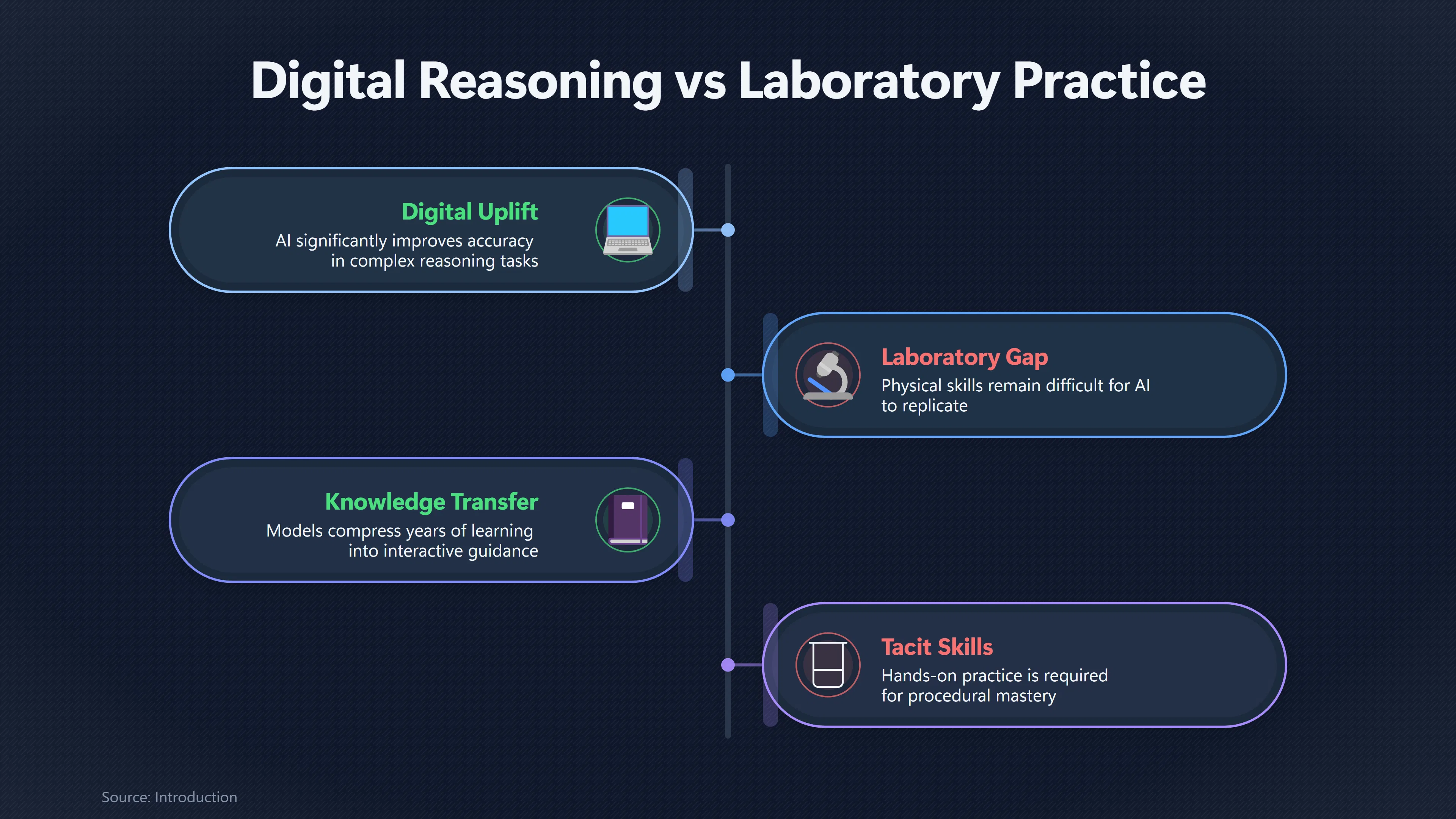
Recent evidence suggests that modern frontier AI systems can produce large improvements on complex, knowledge-intensive biology tasks. In controlled studies, novices using advanced language models solve substantially more problems correctly than novices limited to search engines, and in some digital evaluations they even outperform expert participants working without AI. At the same time, the best available evidence also shows an important limitation: these gains have been demonstrated mainly for reasoning and planning tasks, not for successfully carrying out demanding laboratory work. That distinction is crucial when assessing existential-risk claims about whether AI could enable non-experts to create pandemic pathogens.
What biological uplift studies actually measure
Biological uplift studies are designed to answer a different question from ordinary AI benchmarks.
Traditional benchmarks measure what an AI system knows. Human uplift studies instead measure what people become capable of doing when they use the AI.
This distinction matters because an extremely knowledgeable model does not automatically translate into a more capable human user. Good evaluations therefore compare groups of participants performing identical biology tasks under different conditions—for example:
- novices using frontier AI;
- novices restricted to ordinary internet search;
- where available, expert biologists using conventional resources.
The goal is to estimate how much expertise AI effectively transfers to users rather than how intelligent the model appears in isolation.
Within biosecurity debates, this provides a more meaningful measure than benchmark scores alone because the concern is about changes in human capability.
Large improvements on digital biology tasks
The strongest published evidence so far comes from a 2026 multi-benchmark uplift study examining eight biosecurity-relevant biology task sets. Rather than testing the models directly, researchers recruited novice participants and compared AI-assisted performance with internet-only controls across complex scientific reasoning tasks.[arXiv]arxiv.orgarXiv LLM Novice Uplift on Dual-Use, In Silico Biology TasksLLM Novice Uplift on Dual-Use, In Silico Biology TasksFebruary 26, 2026…
The findings were striking:
- AI-assisted novices achieved roughly 4.2 times greater accuracy than novices using conventional internet search.
- On four benchmarks where expert baselines were available, AI-assisted novices exceeded the internet-assisted expert baseline on three.
- Nearly 90% of participants reported little difficulty obtaining dual-use biological information despite model safeguards.
- Interestingly, the language models themselves often outperformed the humans using them, suggesting users still failed to extract the models’ full capabilities.[arXiv]arxiv.orgarXiv LLM Novice Uplift on Dual-Use, In Silico Biology TasksLLM Novice Uplift on Dual-Use, In Silico Biology TasksFebruary 26, 2026…
These results suggest that frontier AI substantially lowers the educational barrier for solving sophisticated biology problems that previously demanded specialist training.
For AI-doom discussions, this matters because many catastrophic misuse scenarios assume that expertise is one of the main bottlenecks preventing dangerous biological research. Evidence that AI compresses years of learning into interactive assistance makes that assumption less secure than it once appeared.
Where AI clearly beats ordinary internet search
The uplift observed in recent studies is not uniform across every type of biological work.
The largest gains generally appear in tasks that involve combining large amounts of scientific information rather than performing physical procedures. Examples include:
- interpreting experimental literature;
- comparing competing biological hypotheses;
- designing conceptual research approaches;
- troubleshooting scientific reasoning problems;
- integrating information spread across multiple specialist sources.
These are exactly the kinds of tasks where search engines often require extensive background knowledge to use effectively, whereas conversational AI can explain terminology, connect concepts and guide users through unfamiliar material.
The comparison is therefore not “AI versus no information”. It is AI versus an already information-rich environment in which search engines, textbooks and scientific papers are freely available. That AI nevertheless produces substantial improvements suggests that interactive reasoning support is becoming at least as important as information access itself.[arXiv]arxiv.orgarXiv LLM Novice Uplift on Dual-Use, In Silico Biology TasksLLM Novice Uplift on Dual-Use, In Silico Biology TasksFebruary 26, 2026…

Independent evaluations point in the same direction
The UK’s AI Security Institute (AISI) has reported similar trends from its own evaluations of frontier models.
According to its Frontier AI Trends Report, model performance on difficult biology question sets progressed from below biology PhD baselines only a few years ago to exceeding those expert baselines during 2024, with continued improvements thereafter. The evaluations cover experiment design, interpretation of laboratory outputs, troubleshooting and scientific reasoning rather than simple factual recall.[aisi.gov.uk]aisi.gov.ukFrontier AI Trends Report by The AI Security Institute (AISIFrontier AI Trends Report by The AI Security Institute (AISI
The Institute argues that these improvements have dual-use implications. Better scientific assistance could accelerate legitimate research while simultaneously reducing knowledge barriers that previously limited sophisticated biological work to trained specialists. It therefore identifies biology capability evaluations as one component of broader national-security monitoring rather than treating benchmark performance as an abstract measure of intelligence.[aisi.gov.uk]aisi.gov.ukFrontier AI Trends Report by The AI Security Institute (AISIFrontier AI Trends Report by The AI Security Institute (AISI
Importantly, AISI does not claim that these evaluations demonstrate an ability to produce dangerous pathogens. Instead, they indicate that AI systems are becoming increasingly effective scientific assistants in domains relevant to biosecurity.
Why better reasoning does not automatically create laboratory expertise
The largest disagreement in this debate concerns what happens when digital improvements meet the physical realities of biology laboratories.
Many experienced biologists argue that successful experimental work depends heavily on tacit knowledge—skills acquired through repeated hands-on practice rather than written instructions. These include recognising contamination, interpreting ambiguous results, adjusting protocols when equipment behaves unexpectedly and identifying subtle procedural errors.
Because these abilities are difficult to encode in text, strong performance on reasoning tasks does not necessarily imply equivalent laboratory competence.
Recent evidence supports this distinction.
A pre-registered randomised controlled trial published in 2026 examined whether language models improved novice performance on laboratory tasks representing parts of a viral reverse-genetics workflow. Unlike digital benchmark studies, participants performed practical tasks rather than answering biology questions.[arXiv]arxiv.orgMeasuring Mid-2025 LLM-Assistance on Novice Performance in BiologyFebruary 18, 2026…
The study found:
- no statistically significant improvement in completing the overall workflow;
- modest positive trends on several individual tasks;
- evidence that AI users often progressed further through intermediate stages even when they ultimately failed to complete the experiment.
The researchers concluded that contemporary models produced only modest laboratory uplift, highlighting a substantial gap between digital biology competence and successful physical experimentation.[arXiv]arxiv.orgMeasuring Mid-2025 LLM-Assistance on Novice Performance in BiologyFebruary 18, 2026…
This distinction is one of the most important findings in the current literature.
What this means for AI-doom arguments
Within existential-risk discussions, neither side of the debate can point to decisive evidence.
Those concerned about catastrophic misuse argue that digital knowledge barriers have historically been an important defence against biological misuse. If AI increasingly provides expert-level scientific guidance to inexperienced users, then one major barrier is being eroded even if laboratory barriers remain. Continued improvements in models, automation and laboratory technology could eventually narrow today’s remaining gap.[aisi.gov.uk]aisi.gov.ukFrontier AI Trends Report by The AI Security Institute (AISIFrontier AI Trends Report by The AI Security Institute (AISI
Sceptics emphasise that current evidence does not demonstrate the ability of novices to carry out sophisticated biological experiments successfully. Wet-lab work still requires equipment, materials, practical judgement, repeated troubleshooting and institutional infrastructure that AI cannot simply replace. The latest laboratory trial supports this more cautious interpretation by showing only limited practical gains despite large improvements on digital reasoning tasks.[arXiv]arxiv.orgMeasuring Mid-2025 LLM-Assistance on Novice Performance in BiologyFebruary 18, 2026…
Both perspectives therefore rely on different parts of the evidence. One focuses on the clear reduction in knowledge barriers; the other stresses the continuing importance of practical barriers.
The key evidence gap
The next generation of research is likely to focus less on benchmark scores and more on real human performance.
Questions that remain open include:
- whether future models produce much larger laboratory improvements than today’s systems;
- how biological uplift changes as users gain experience;
- whether AI agents can perform extended scientific workflows rather than isolated tasks;
- whether improvements in robotics and laboratory automation interact with AI assistance;
- how effective future safeguards remain as models become more capable.
For assessing catastrophic biological misuse, these questions matter more than whether an AI system can answer another difficult examination question.
Current evidence supports a nuanced conclusion. Frontier AI already provides substantial uplift for novices performing complex biology reasoning tasks and clearly outperforms conventional internet search in many knowledge-intensive settings. However, the best available laboratory evidence indicates that these digital gains have not yet translated into similarly dramatic improvements in executing complex biological experiments. That distinction remains one of the most important uncertainties in assessing whether AI could materially expand the pool of people capable of carrying out work relevant to pandemic-scale biological threats.

Amazon book picks
Further Reading
Books and field guides related to How Much Better Does AI Make Biology Novices?. Use these as the next step if you want deeper reading beyond the article.
The Coming Wave
"We are approaching a critical threshold in the history of our species. Everything is about to change. Soon you will live surrounded by A...
The Genesis Machine
A New Yorker Best Book of the Year The next frontier in technology is inside our own bodies. The breakthrough science of synthetic biolog...
The Precipice
What existential threats does humanity face? And how can we secure our future?'The Precipice is a powerful book . . . Ord's love for huma...
Regenesis
A Harvard biologist and master inventor explores how new biotechnologies will enable us to bring species back from the dead, unlock vast...
eBay marketplace picks
Marketplace Samples
Live-tested eBay searches with available results related to this page.
Selected fromDNA poster oneBay.co.uk.



Endnotes
1.
Source: arxiv.org
Title: arXiv LLM Novice Uplift on Dual-Use, In Silico Biology Tasks
Link:https://arxiv.org/abs/2602.23329
Source snippet
LLM Novice Uplift on Dual-Use, In Silico Biology TasksFebruary 26, 2026...
Published: February 26, 2026
2.
Source: aisi.gov.uk
Title: Frontier AI Trends Report by The AI Security Institute (AISI)
Link:https://www.aisi.gov.uk/frontier-ai-trends-report
3.
Source: aisi.gov.uk
Title: 5 key findings from our first Frontier AI Trends Report | AISI Work
Link:https://www.aisi.gov.uk/blog/5-key-findings-from-our-first-frontier-ai-trends-report
4.
Source: GOV.UK
Title: A I Security Institute – Frontier AI Trends report factsheet
Link:https://www.gov.uk/government/publications/ai-security-institute-frontier-ai-trends-report-factsheet
Source snippet
AI Security Institute – Frontier AI Trends report factsheet - GOV.UK...
5.
Source: arxiv.org
Link:https://arxiv.org/abs/2602.16703
Source snippet
Measuring Mid-2025 LLM-Assistance on Novice Performance in BiologyFebruary 18, 2026...
Published: February 18, 2026
6.
Source: scale.com
Title: llm novice uplift
Link:https://scale.com/blog/llm-novice-uplift
Source snippet
Understanding New Biosecurity Risks Posed by LLMs | Scale AIApril 16, 2026 — UNDERSTANDING NEW BIOSECURITY RISKS POSED BY LLMS By Matthew...
Published: April 16, 2026
7.
Source: papers.cool
Title: LL M Novice Uplift on Dual-Use, In Silico Biology Tasks | Cool Papers
Link:https://papers.cool/arxiv/2602.23329v1
8.
Source: GOV.UK
Link:https://www.gov.uk/government/news/inaugural-report-pioneered-by-ai-security-institute-gives-clearest-picture-yet-of-capabilities-of-most-advanced-ai
9.
Source: GOV.UK
Title: www.gov.uk A I Security Institute – Frontier AI Trends report factsheet
Link:https://www.gov.uk/government/publications/ai-security-institute-frontier-ai-trends-report-factsheet/ai-security-institute-frontier-ai-trends-report-factsheet
10.
Source: aisi.gov.uk
Link:https://www.aisi.gov.uk/research
11.
Source: aisi.gov.uk
Title: aisi frontier ai trends report 2025
Link:https://www.aisi.gov.uk/research/aisi-frontier-ai-trends-report-2025
12.
Source: aisi.gov.uk
Title: Frontier AI Trends Report PDF
Link:https://www.aisi.gov.uk/frontier-ai-trends-report/pdf
13.
Source: aisi.gov.uk
Title: our 2025 year in review
Link:https://www.aisi.gov.uk/blog/our-2025-year-in-review
14.
Source: aisi.gov.uk
Link:https://www.aisi.gov.uk/blog
15.
Source: alanhou.org
Link:https://alanhou.org/blog/arxiv-llm-novice-uplift-on-dual-use/
Source snippet
arxiv ai cs.ai cs.cl cs.cr cs.cy cs.hc [Button: Both] [Button: English] [Button: 中文] Paper...
Additional References
16.
Source: gist.science
Link:https://gist.science/paper/2602.23329
Source snippet
LLM Novice Uplift on Dual-Use, In Silico Biology Tasks — Plain-Language Explanation | Gist.ScienceMarch 17, 2026 — LLM NOVICE UPLIFT ON D...
Published: March 17, 2026
17.
Source: youtube.com
Title: The Catastrophic Risks of AI — and a Safer Path | Yoshua Bengio | TED
Link:https://www.youtube.com/watch?v=qe9QSCF-d88
Source snippet
AI biosecurity biological uplift novice biology Bryce Cai - The State and the Science of AI-Bio Evals [Alignment Workshop] FAR․AI...
18.
Source: youtube.com
Link:https://www.youtube.com/watch?v=SvPcxRiFauY
Source snippet
Ep 59 - A New Study Taking Responsible [Innovation]({{ 'false-positives/' | relative_url }}) From Benchmarks to Benchwork...
19.
Source: youtube.com
Title: Bryce Cai
Link:https://www.youtube.com/watch?v=oh4AoiAOwfs
Source snippet
Scaling Laws: Why Data Governance Is the Key to AI Biosecurity, with Jassi Pannu and Doni Bloomfield...
20.
Source: bankofengland.co.uk
Title: Financial Stability Report
Link:https://www.bankofengland.co.uk/financial-stability-report/2026/july-2026
Source snippet
July 2026 | Bank of EnglandJuly 7, 2026 — Because software and digital processes underpin a wide range of business functions across many...
Published: July 7, 2026
21.
Source: youtube.com
Link:https://www.youtube.com/watch?v=acnmEQip6Jk
Source snippet
AI-Accelerated Biological Risk: Delving into Asia's Challenges and Emerging...
22.
Source: youtube.com
Title: AI-Accelerated Biological Risk: Delving into Asia’s Challenges and Emerging
Link:https://www.youtube.com/watch?v=gbj5k1UiejY
Source snippet
The Catastrophic Risks of AI — and a Safer Path | Yoshua Bengio | TED...
23.
Source: frontiersin.org
Link:https://www.frontiersin.org/journals/microbiology/articles/10.3389/fmicb.2026.1899413/abstract
24.
Source: securebio.org
Link:https://securebio.org/benchmarks/uplift/
25.
Source: aisecurity-portal.org
Title: LL M Novice Uplift on Dual-Use, In Silico Biology Tasks | AI Security Portal
Link:https://aisecurity-portal.org/en/literature-database/llm-novice-uplift-on-dual-use-in-silico-biology-tasks/