Within Parallel Researchers
Could Hardware Bottlenecks Stop an AI Speed Up?
More AI researchers may stop adding much value when scarce chips, power and sequential experiments become the true limits on progress.
On this page
- Why research output does not scale linearly with worker count
- How GPU capacity and long training runs constrain parallelism
- When physical bottlenecks could prevent runaway acceleration
Page outline Jump by section
Introduction
One argument for rapid AI progress is that digital researchers could be copied almost without cost, allowing thousands or even millions of AI agents to work on AI research simultaneously. However, that argument depends on a crucial assumption: that adding more researchers continues to produce proportionally more useful research.
Many researchers question that assumption. Even if AI labour becomes effectively unlimited, the pace of frontier AI development may still be constrained by scarce graphics processing units (GPUs), electricity, networking capacity, memory bandwidth, fabrication limits, and the simple fact that some experiments must finish before the next generation of ideas can be tested. These physical and sequential bottlenecks mean that research output may show diminishing returns rather than runaway acceleration. This does not rule out rapid progress, but it weakens one of the stronger versions of the “parallel AI researchers” argument by suggesting that digital labour is only one ingredient in the research process.
Why adding more researchers does not produce unlimited progress
The intuition behind parallel AI researchers is straightforward: if one capable AI researcher is useful, then 10,000 identical copies should be vastly more useful.
In practice, research rarely scales so cleanly.
Machine learning development combines activities that parallelise well with activities that do not. Thousands of researchers can simultaneously propose architectures, write code, analyse literature or inspect model behaviour. However, many important steps remain dependent on shared resources or sequential feedback.
For example:
- only a limited number of large training runs can occupy a GPU cluster at once
- promising ideas often cannot be evaluated until previous experiments finish
- researchers must compare results against common benchmarks before deciding what to try next
- successful discoveries frequently become inputs into later experiments rather than independent pieces of work.
Computer scientists have long recognised this phenomenon through Amdahl’s Law, which shows that the speed-up obtainable from parallel workers is limited by the fraction of work that must still occur sequentially. Although AI research is more complicated than the classic formulation, the same intuition applies: if some critical stages cannot be parallelised, adding ever more researchers eventually produces progressively smaller gains.[sciencedirect.com]sciencedirect.comAmdahl's Lawan overview | ScienceDirect Topics…
This does not imply that parallel AI research is ineffective. It suggests that the relationship is unlikely to remain linear indefinitely.
How GPU capacity and long training runs constrain parallelism
The most obvious physical bottleneck is computing hardware.
Frontier AI systems are trained on clusters containing thousands or tens of thousands of specialised accelerators connected by extremely fast networking. These machines are expensive, consume enormous amounts of electricity and are produced through highly constrained semiconductor supply chains.
If an organisation possesses one million AI researchers but only enough compute for twenty frontier training runs, the additional researchers cannot all execute their most valuable experiments. Instead, they compete for scarce hardware.
This creates several forms of congestion.
First, large training runs occupy hardware for weeks or months. New ideas often cannot be fully tested until previous jobs complete.
Second, the most valuable experiments generally require the largest compute budgets. Small exploratory tests are useful, but eventually the decisive evidence comes from expensive full-scale training runs.
Third, frontier research depends on scarce infrastructure beyond GPUs alone, including high-bandwidth networking, memory systems, storage and datacentre power. Adding researchers does not instantly create additional physical capacity.[epoch.ai]epoch.aidata movement bottlenecks scaling past 1e28 flopData movement bottlenecks to large-scale model training: Scaling past 1e28 FLOP | Epoch AINovember 2, 2024…
The consequence is that AI labour and compute become complements rather than substitutes. More researchers are valuable only if sufficient hardware exists to execute the experiments they propose.
Long training cycles create unavoidable waiting time
Even unlimited digital labour cannot eliminate the passage of time.
Many frontier models require extended training periods before researchers know whether an idea succeeded. While smaller proxy experiments can reject obviously poor approaches, some questions can only be answered after completing an expensive full-scale run.
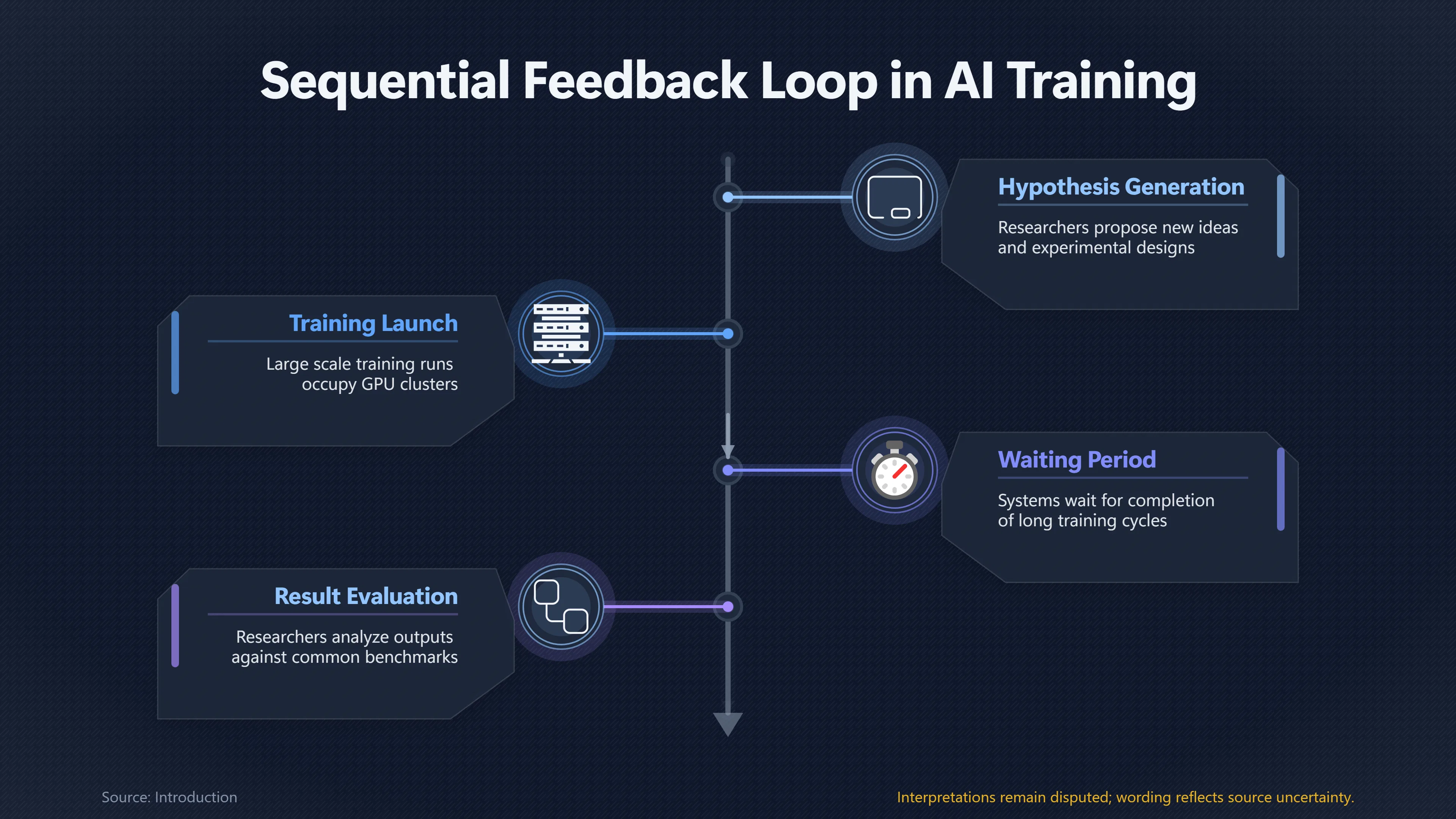
This introduces a sequential feedback loop:
- generate a hypothesis
- launch training
- wait for completion
- evaluate results
- design the next experiment.
Thousands of AI researchers can prepare future experiments during the waiting period, but they cannot observe results before the training process finishes.
This resembles pharmaceutical development more than software compilation. Many scientists can propose candidate drugs simultaneously, yet everyone still waits for clinical trial outcomes before deciding what genuinely works.
As training runs become larger, these waiting periods may themselves become an important constraint on how quickly frontier capabilities improve. Research on distributed training also finds that adding ever more hardware eventually yields diminishing improvements because communication overhead grows alongside cluster size.[arXiv]arxiv.orgOpen source on arxiv.org.

More GPUs do not always mean proportionally faster research
A common assumption is that organisations can simply keep adding GPUs until hardware ceases to be a bottleneck.
Unfortunately, distributed computing also exhibits diminishing returns.
When training spans many thousands of accelerators, increasing communication between machines consumes a growing share of total computation. GPUs spend more time exchanging parameters and synchronising intermediate results rather than performing useful calculations.
This is a well-known challenge in high-performance computing, and recent work on large-scale language-model training finds that optimal parallelisation strategies change as clusters grow. Beyond certain scales, communication overhead and data movement reduce the benefit of additional accelerators, lowering the marginal value of every extra GPU-hour.[arXiv]arxiv.orgOpen source on arxiv.org.
In other words, scaling hardware itself becomes increasingly difficult. Unlimited AI researchers would therefore inherit the same systems-engineering constraints that already affect today’s frontier laboratories.
Physical infrastructure can become the real bottleneck
Even if algorithms continue improving, physical infrastructure expands much more slowly.
Frontier AI depends on:
- semiconductor fabrication capacity
- advanced packaging technologies
- high-bandwidth memory production
- electricity generation
- cooling systems
- datacentre construction
- networking equipment.
Each requires substantial capital investment and long construction times.
Recent industry reporting has highlighted shortages of high-bandwidth memory, power availability and specialised AI infrastructure as important constraints on scaling advanced systems. Even where funding is abundant, expanding physical capacity can take years rather than weeks.[techradar.com]techradar.comIt uniquely supports open standards like PyTorch and Kubernetes, promoting ease of adoption without proprietary lock-in. Existing deploym…
From the perspective of AI acceleration, this matters because software can usually be copied almost instantly, whereas physical infrastructure cannot.
Could AI researchers help remove these bottlenecks?
Supporters of rapid acceleration argue that capable AI systems might themselves improve hardware engineering.
For example, AI researchers could contribute to:
- better chip layouts
- improved compiler optimisation
- more efficient distributed training algorithms
- faster debugging of networking systems
- higher hardware utilisation
- improved experiment scheduling.
If successful, AI labour would indirectly expand effective compute rather than merely competing for existing resources.
History provides some support for this possibility. Better algorithms, larger batch training, improved parallelisation techniques and specialised hardware have repeatedly relaxed limits that once appeared fundamental. OpenAI’s analysis of historical compute trends notes that advances in algorithms and engineering have repeatedly enabled larger effective training runs despite earlier concerns about data-parallel limitations.[OpenAI]OpenAIai and computeMay 16, 2018…
Nevertheless, removing bottlenecks is not the same as eliminating them. Every improvement eventually encounters new physical constraints, whether in networking, memory movement, fabrication or energy supply.

What this means for AI doom arguments
Within debates about AI doom and existential risk, compute bottlenecks play an important moderating role.
The strongest versions of recursive self-improvement sometimes imagine millions of AI researchers rapidly generating overwhelming capability gains simply by working in parallel. Compute constraints suggest that this picture may be incomplete.
If frontier research remains limited by scarce hardware, long experimental cycles and infrastructure expansion, then additional AI researchers eventually contribute less than earlier ones. Progress may still be extremely fast by historical standards, but not necessarily explosive.
At the same time, these bottlenecks should not be treated as permanent safeguards. AI systems may improve hardware efficiency, algorithms may reduce required compute, and continued investment can expand global chip production over time. The question is therefore not whether compute matters—it clearly does—but whether hardware constraints slow progress enough to materially delay dangerous capabilities.
This remains an active area of disagreement. Some researchers view compute as one of the strongest practical brakes on runaway AI development, while others argue that engineering improvements, algorithmic advances and sustained infrastructure investment will repeatedly shift those limits outward. The evidence so far suggests that physical constraints are real and economically significant, but not obviously sufficient on their own to prevent very rapid advances if multiple bottlenecks are reduced together.
Amazon book picks
Further Reading
Books and field guides related to Could Hardware Bottlenecks Stop an AI Speed Up?. Use these as the next step if you want deeper reading beyond the article.

Atlas of AI: Power, Politics, and the Planetary Costs of Arti...
First published 2021. Subjects: Science, Artificial intelligence, Sociological aspects, Political aspects, COMPUTERS / Intelligence (AI)...
Superintelligence: Paths, Dangers, Strategies
This profoundly ambitious and original book picks its way carefully through a vast tract of forbiddingly difficult intellectual terrain.
The Coming Wave: Technology, Power, and the Twenty-first Cent...
"We are approaching a critical threshold in the history of our species. Everything is about to change. Soon you will live surrounded by A...
Chip War: The Fight for the World's Most Critical Technology
***Winner of the 2022 Financial Times Business Book of the Year Award*** ***Selected as one of Barack Obama's Favourite Books of 2023***...
eBay marketplace picks
Marketplace Samples
Live-tested eBay searches with available results related to this page.
Selected fromgraphics card backplate oneBay.co.uk.



Endnotes
1.
Source: sciencedirect.com
Title: Amdahl’s Law
Link:https://www.sciencedirect.com/topics/computer-science/amdahls-law
Source snippet
an overview | ScienceDirect Topics...
2.
Source: techtarget.com
Title: Tech Target What is Amdahl’s law? | Definition from Tech Target
Link:https://www.techtarget.com/whatis/definition/Amdahls-law
3.
Source: epoch.ai
Title: data movement bottlenecks scaling past 1e28 flop
Link:https://epoch.ai/publications/data-movement-bottlenecks-scaling-past-1e28-flop
Source snippet
Data movement bottlenecks to large-scale model training: Scaling past 1e28 FLOP | Epoch AINovember 2, 2024...
Published: November 2, 2024
4.
Source: arxiv.org
Link:https://arxiv.org/abs/2411.13055
5.
Source: techradar.com
Link:https://www.techradar.com/pro/those-two-jobs-need-different-physics-rebellions-ceo-says-training-and-inference-need-different-chips
Source snippet
It uniquely supports open standards like PyTorch and Kubernetes, promoting ease of adoption without proprietary lock-in. Existing deploym...
6.
Source: reuters.com
Link:https://www.reuters.com/technology/artificial-[intelligence
Source snippet
Challenges such as hardware failure, depletion of accessible data, and power shortages have hindered progress. Techniques like "test-time...
7.
Source: OpenAI
Title: ai and compute
Link:https://openai.com/index/ai-and-compute/
Source snippet
May 16, 2018...
Published: May 16, 2018
8.
Source: sciencedirect.com
Link:https://www.sciencedirect.com/science/article/abs/pii/S0167819126000141
Source snippet
June 1, 2026 — PARALLEL COMPUTING Volume 128, June 2026, 103196 Review A survey of parallel computing frameworks and optimiz...
Published: June 1, 2026
9.
Source: epoch.ai
Title: could decentralized training solve ais power problem
Link:https://epoch.ai/publications/could-decentralized-training-solve-ais-power-problem
10.
Source: epoch.ai
Title: power demands of frontier ai training
Link:https://epoch.ai/publications/power-demands-of-frontier-ai-training
11.
Source: epoch.ai
Title: can ai scaling continue through 2030
Link:https://epoch.ai/publications/can-ai-scaling-continue-through-2030
12.
Source: epoch.ai
Title: trading off compute in training and inference
Link:https://epoch.ai/publications/trading-off-compute-in-training-and-inference
13.
Source: OpenAI
Title: techniques for training large neural networks
Link:https://openai.com/index/techniques-for-training-large-neural-networks/
14.
Source: OpenAI
Title: ai and efficiency
Link:https://openai.com/index/ai-and-efficiency/
15.
Source: OpenAI
Title: scaling laws for neural language models
Link:https://openai.com/index/scaling-laws-for-neural-language-models/
16.
Source: OpenAI
Title: how ai training scales
Link:https://openai.com/index/how-ai-training-scales/
17.
Source: OpenAI
Title: ai and compute
Link:https://openai.com/index/ai-and-compute/?trk=public_post_comment-text
18.
Source: epoch.ai
Link:https://epoch.ai/gate
19.
Source: sciencedirect.com
Title: On extending Amdahl’s law to learn computer performance
Link:https://www.sciencedirect.com/science/article/pii/S0141933122002745
20.
Source: sciencedirect.com
Title: Parallel Solution
Link:https://www.sciencedirect.com/topics/computer-science/parallel-solution
21.
Source: sciencedirect.com
Title: Parallel Application
Link:https://www.sciencedirect.com/topics/computer-science/parallel-application
22.
Source: cis.temple.edu
Link:https://cis.temple.edu/~shi/wwwroot/shi/public_html/docs/amdahl/amdahl.html
Additional References
23.
Source: pmc.ncbi.nlm.nih.gov
Link:https://pmc.ncbi.nlm.nih.gov/articles/PMC6458202/
Source snippet
PubMed Central (PMC)How Amdahl’s Law limits the performance of large artificial neural networks: why the functionality of full-scale brai...
24.
Source: nature.com
Link:https://www.nature.com/articles/s43247-026-03537-5
25.
Source: youtube.com
Link:https://www.youtube.com/watch?v=7LVZZxPo4rY
Source snippet
AI compute bottleneck scaling laws diminishing returns AI can't cross this line and we don't know why...
26.
Source: mcs.anl.gov
Link:https://www.mcs.anl.gov/~itf/dbpp/text/node28.html
27.
Source: jmlr.org
Link:https://www.jmlr.org/papers/v24/22-1208.html
28.
Source: linkedin.com
Link:https://www.linkedin.com/posts/epochai_how-does-data-movement-constrain-the-size-activity-7260666774197518337-SHz1
29.
Source: jmlr.org
Link:https://jmlr.org/papers/v26/24-1000.html
30.
Source: cir.nii.ac.jp
Link:https://cir.nii.ac.jp/crid/1364233268541106688
31.
Source: youtube.com
Title: AI can’t cross this line and we don’t know why
Link:https://www.youtube.com/watch?v=5eqRuVp65eY
Source snippet
The AI Bottleneck Nobody Is Prepared For...
32.
Source: youtube.com
Title: Why LLMs Will Hit a Wall (MIT Proved It)
Link:https://www.youtube.com/watch?v=GFeGowKupMo
Source snippet
AI can't cross this line and we don't know why...