Within Intelligence Explosion
Can Smarter Algorithms Outpace Bigger AI Hardware?
Improved architectures, training methods and inference techniques could raise AI capability without waiting for proportionally larger computing clusters.
On this page
- How algorithmic efficiency increases capability per unit of compute
- Why research tools can compound gains across later model generations
- Limits to software led progress without new hardware
Page outline Jump by section
Introduction
A common assumption is that frontier AI can only become much more capable if companies build much larger data centres filled with more advanced chips. Researchers working on recursive AI improvement argue that this assumption may be too simple. Smarter algorithms, better model architectures and more efficient training methods can sometimes produce large capability gains using roughly the same hardware. If that happens repeatedly, AI progress could accelerate even during periods when chip production, electricity supply or data-centre construction become bottlenecks.
This possibility matters because many AI doom scenarios do not depend on unlimited hardware growth. Instead, they assume that software improvements allow each generation of AI to extract more useful work from existing computing resources, while also helping researchers discover the next round of improvements. Whether this process could continue long enough to create an intelligence explosion remains uncertain, but algorithmic progress is one of the central mechanisms discussed by both AI-risk advocates and many mainstream machine learning researchers.[openai.com]OpenAIai and efficiencyMay 5, 2020…
How algorithmic efficiency increases capability per unit of compute
Hardware determines how many calculations a computer can perform. Algorithms determine how effectively those calculations are used. A better algorithm can therefore achieve higher performance without requiring proportionally more computing power.
Machine learning has repeatedly demonstrated this effect. Researchers have improved optimisation methods, neural network architectures, attention mechanisms, training procedures and data selection, reducing the amount of computation needed to reach a given level of performance. OpenAI estimated that between 2012 and 2019 the compute required to achieve AlexNet-level image classification performance fell by roughly a factor of 44, corresponding to algorithmic efficiency doubling about every 16 months—faster than hardware improvements alone over the same period.[OpenAI]OpenAIai and efficiencyMay 5, 2020…
For AI-doom discussions, the important point is not any single efficiency gain but the cumulative effect. If hardware becomes twice as powerful while algorithms simultaneously halve the computation needed for the same result, the combined improvement is roughly fourfold. Over several generations, software and hardware gains multiply rather than compete.
This means that slowing hardware progress would not necessarily slow capability growth by the same amount. AI systems might continue improving because researchers discover more efficient ways to use existing chips.
Which software improvements matter most?
Not every algorithmic improvement produces a dramatic jump in intelligence. Many only improve speed or reduce costs. However, several classes of advances could substantially increase capability without requiring proportionally larger computing clusters.
Better architectures. Modern transformer models differ significantly from earlier neural networks. Architectural innovations sometimes improve learning efficiency enough that smaller models outperform much larger predecessors trained using older methods. Scaling-law research also shows that choosing the right balance between model size, training data and computation matters as much as simply increasing parameter counts. The Chinchilla work from DeepMind demonstrated that many large language models had been undertrained rather than fundamentally too small.[arXiv]arxiv.orgarXiv Training Compute-Optimal Large Language ModelsarXiv Training Compute-Optimal Large Language Models
More efficient attention mechanisms. Standard transformer attention becomes increasingly expensive as context length grows. Techniques such as FlashAttention reorganise computation to reduce memory movement and improve hardware utilisation, allowing longer contexts or faster training without fundamentally changing the underlying hardware. Although these improvements do not create new intelligence on their own, they allow existing chips to solve larger problems.[arXiv]arxiv.orgarXiv Compute-Efficient Deep Learning: Algorithmic Trends and OpportunitiesCompute-Efficient Deep Learning: Algorithmic Trends and OpportunitiesOctober 13, 2022…
Sparse computation and Mixture-of-Experts (MoE). Dense models activate every parameter for every token. MoE models instead activate only a small subset of specialised components, allowing total model capacity to increase without proportional growth in computation. Recent scaling-law research suggests that carefully designed MoE systems can achieve better performance under fixed compute or memory budgets than dense models.[mlr.press]proceedings.mlr.pressProceedings of Machine Learning ResearchJoint MoE Scaling Laws: Mixture of Experts Can Be Memory EfficientOctober 6, 2025…
Improved data use. Better filtering, curriculum learning, synthetic data generation and more efficient training objectives may allow models to learn more from the same amount of computation. In some cases, selecting higher-quality data provides larger gains than simply increasing dataset size.[arXiv]arxiv.orgarXiv Training Compute-Optimal Large Language ModelsarXiv Training Compute-Optimal Large Language Models
These advances are individually incremental, but together they illustrate how software progress can substantially increase capability without requiring each generation to wait for new semiconductor manufacturing breakthroughs.
Why research tools can compound gains across later model generations
Within recursive AI improvement, algorithmic advances matter because they can become permanent improvements to the research process itself.
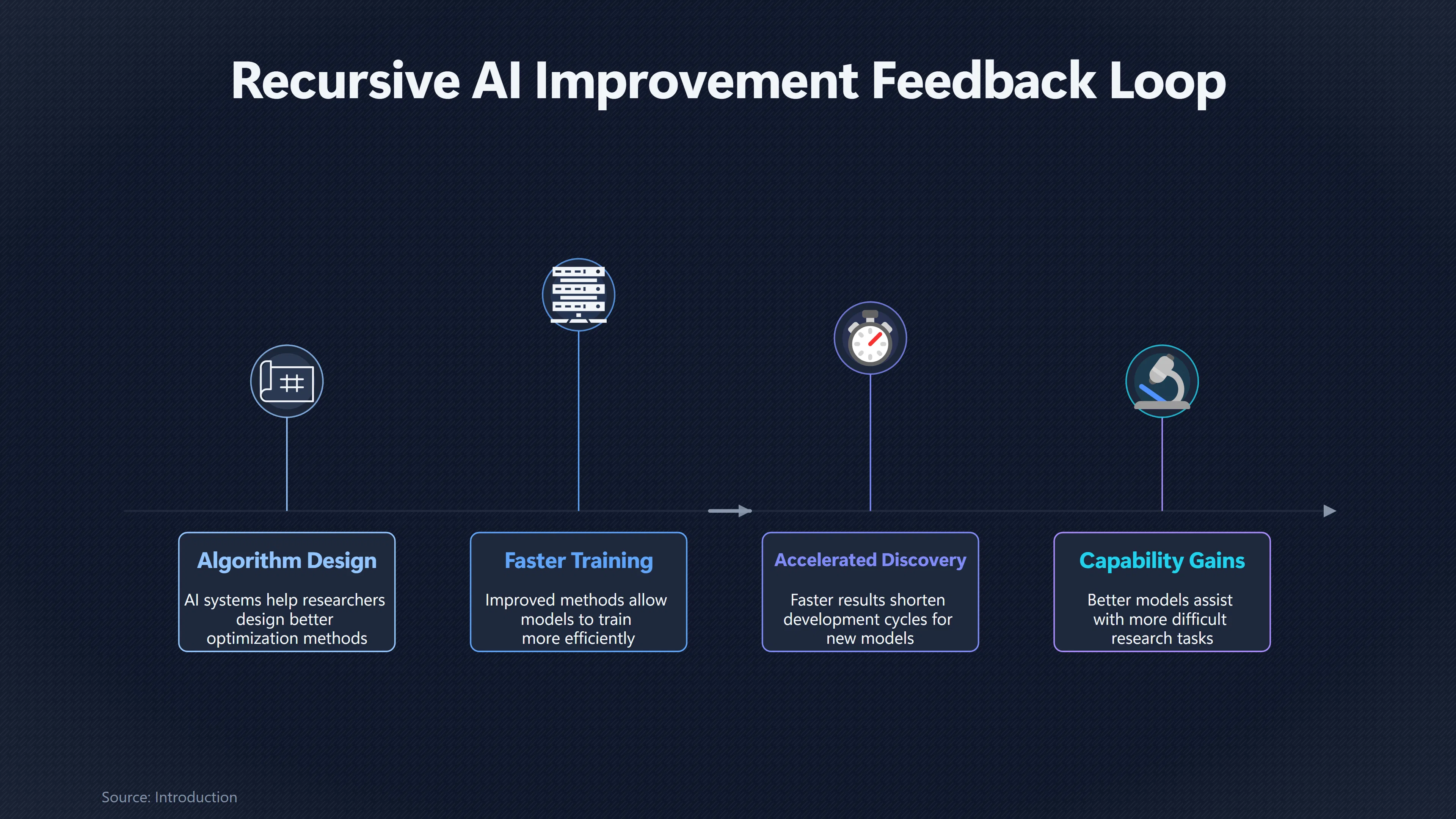
Imagine an AI system that helps researchers design better optimisation algorithms. Once that optimisation method exists, every later model can train faster or more efficiently. The improved model then participates in discovering further improvements.
This creates several reinforcing effects:
- More experiments can be run with the same computing budget.
- Researchers receive results sooner, shortening development cycles.
- Better models assist with more difficult research tasks.
- Those models help discover still more efficient algorithms.[businessinsider.com]businessinsider.comSource details in endnotes.
Unlike buying additional hardware, algorithmic improvements are often reusable. Once incorporated into training software or model architectures, they can benefit every future training run using compatible methods.
From an AI-doom perspective, this raises the possibility that progress becomes self-reinforcing even if hardware expansion slows. The feedback loop depends not only on faster chips but also on increasingly productive research methods.

Why hardware limits may be less restrictive than they appear
Discussions of AI often focus on semiconductor shortages, electricity demand or data-centre construction. These constraints are real, but they are not absolute ceilings on capability.
A hardware bottleneck usually limits raw computation rather than useful computation. Better algorithms effectively increase the amount of useful work performed by each floating-point operation.
An analogy is software optimisation in conventional computing. A faster sorting algorithm can dramatically reduce runtime without changing the processor. Similarly, an improved neural-network architecture may produce substantially better reasoning ability using approximately the same computational budget.
Recent developments in inference also illustrate this principle. Companies increasingly distinguish between expensive model training and much cheaper deployment techniques, using architectural improvements and inference optimisation to reduce practical compute costs rather than relying solely on larger hardware installations.[techradar.com]techradar.comIt uniquely supports open standards like PyTorch and Kubernetes, promoting ease of adoption without proprietary lock-in. Existing deploym…
This does not eliminate hardware constraints altogether. If algorithms become dramatically more efficient, organisations may simply use the savings to train even larger models. Historically, software improvements have often increased demand for computation rather than reducing it permanently.
Why software-led progress may still have limits
The possibility of algorithmic acceleration should not be confused with unlimited improvement.
Several constraints could reduce or eventually halt software-driven gains.
First, many obvious algorithmic improvements may already have been discovered. Early advances often capture the largest available efficiencies, leaving increasingly difficult problems for future researchers.
Second, empirical scaling laws suggest that performance improvements become progressively harder to obtain as models improve. Better algorithms can shift the curve, but they may not eliminate diminishing returns altogether.[arXiv]arxiv.orgarXiv Scaling Laws for Neural Language ModelsarXiv Scaling Laws for Neural Language Models
Third, validating new algorithms remains expensive. A promising idea usually requires large-scale experiments before researchers know whether it genuinely improves capability. Even AI-assisted research cannot avoid every experimental cost.
Fourth, software improvements eventually interact with physical constraints such as memory bandwidth, communication latency, electricity consumption and manufacturing capacity. Better algorithms cannot completely remove these engineering realities.
For these reasons, many researchers expect algorithmic progress to complement hardware growth rather than replace it entirely.
Why this mechanism matters in AI doom debates
Algorithmic gains occupy an important place in arguments about intelligence explosions because they weaken a common objection: that AI progress must slow once hardware growth slows.
Supporters of fast-takeoff scenarios argue that sufficiently capable AI systems could continually improve research efficiency, making existing compute increasingly productive and accelerating future discoveries. Software improvements therefore become part of the feedback loop driving recursive capability growth.
Critics respond that algorithmic breakthroughs are historically unpredictable, difficult to automate and may become increasingly rare as the easiest ideas are exhausted. They also argue that many advances require extensive empirical testing, human judgement and engineering effort rather than simply discovering clever mathematical insights.
At present, the evidence supports neither extreme position. Machine learning has repeatedly demonstrated that algorithmic innovation can produce surprisingly large efficiency gains, sometimes outpacing hardware improvements over multi-year periods. At the same time, there is no established evidence that such gains can continue indefinitely or produce runaway recursive self-improvement without eventually encountering scientific, engineering or physical limits.[openai.com]OpenAIai and efficiencyMay 5, 2020…
Amazon book picks
Further Reading
Books and field guides related to Can Smarter Algorithms Outpace Bigger AI Hardware?. Use these as the next step if you want deeper reading beyond the article.
Human Compatible
A leading artificial intelligence researcher lays out a new approach to AI that will enable us to coexist successfully with increasingly...
The Master Algorithm
"Describes the quest to find the Master Algorithm, which will take machine learning to the next level, allowing computers to learn how to...
Artificial Intelligence: A Modern Approach
Rating: 4.5/5 from 10 Google Books ratings
Artificial intelligence: A Modern Approach, 3e,is ideal for one or two-semester, undergraduate or graduate-level courses in Artificial In...
Algorithms to Live By
A fascinating exploration of how computer algorithms can be applied to our everyday lives. In this dazzlingly interdisciplinary work, acc...
eBay marketplace picks
Marketplace Samples
Live-tested eBay searches with available results related to this page.
Selected fromcomputer chip wall art oneBay.co.uk.




Endnotes
1.
Source: OpenAI
Title: ai and efficiency
Link:https://openai.com/index/ai-and-efficiency/
Source snippet
May 5, 2020...
Published: May 5, 2020
2.
Source: arxiv.org
Title: arXiv Measuring the Algorithmic Efficiency of Neural Networks
Link:https://arxiv.org/abs/2005.04305
3.
Source: arxiv.org
Title: arXiv Training Compute-Optimal Large Language Models
Link:https://arxiv.org/abs/2203.15556
4.
Source: arxiv.org
Title: arXiv Scaling Laws for Neural Language Models
Link:https://arxiv.org/abs/2001.08361
5.
Source: arxiv.org
Title: arXiv Compute-Efficient Deep Learning: Algorithmic Trends and Opportunities
Link:https://arxiv.org/abs/2210.06640
Source snippet
Compute-Efficient Deep Learning: Algorithmic Trends and OpportunitiesOctober 13, 2022...
Published: October 13, 2022
6.
Source: techradar.com
Link:https://www.techradar.com/pro/those-two-jobs-need-different-physics-rebellions-ceo-says-training-and-inference-need-different-chips
Source snippet
It uniquely supports open standards like PyTorch and Kubernetes, promoting ease of adoption without proprietary lock-in. Existing deploym...
7.
Source: proceedings.mlr.press
Link:https://proceedings.mlr.press/v267/ludziejewski25a.html
Source snippet
Proceedings of Machine Learning ResearchJoint MoE Scaling Laws: Mixture of Experts Can Be Memory EfficientOctober 6, 2025...
Published: October 6, 2025
8.
Source: huggingface.co
Title: Hugging Face Paper page
Link:https://huggingface.co/papers/2507.17702
Source snippet
Hugging FacePaper page - Towards Greater Leverage: Scaling Laws for Efficient Mixture-of-Experts Language Models...
9.
Source: huggingface.co
Title: Scaling Laws of AI: What Happens When You Make Models Bigger?
Link:https://huggingface.co/blog/ChaoticEconomist/scalinglawsofai
10.
Source: arxiv.deeppaper.ai
Link:https://arxiv.deeppaper.ai/papers/2507.17702v1?locale=en
11.
Source: proceedings.mlr.press
Link:https://proceedings.mlr.press/v267/abnar25a.html
12.
Source: huggingface.co
Title: Paper page
Link:https://huggingface.co/papers/2502.05172
Additional References
13.
Source: reddit.com
Link:https://www.reddit.com/r/MachineLearning/comments/1r1pr3c/r_i_am_looking_for_good_research_papers_on/
Source snippet
Reddit[R] I am looking for good research papers on compute optimization during model training, ways to reduce FLOPs, memory usage, and tr...
14.
Source: aclanthology.org
Link:https://aclanthology.org/2026.acl-industry.98/
Source snippet
ACL AnthologyOptimal Expert-Attention Allocation in Mixture-of-Experts: A Scalable Law for Dynamic Model Design - ACL Anthology...
15.
Source: youtube.com
Title: Optimize Your AI
Link:https://www.youtube.com/watch?v=K75j8MkwgJ0
Source snippet
Algorithmic efficiency bypass hardware limits [AI compute]({{ 'compute-limits/' | relative_url }}) AI can't cross this line and we don't know why...
16.
Source: youtube.com
Title: How AI Discovered a Faster Matrix Multiplication Algorithm
Link:https://www.youtube.com/watch?v=fDAPJ7rvcUw
Source snippet
Optimizing attention for modern hardware - Tri Dao (Princeton & Together AI)...
17.
Source: youtube.com
Title: Quantization vs Pruning vs Distillation: Optimizing NNs for Inference
Link:https://www.youtube.com/watch?v=UcwDgsMgTu4
Source snippet
How AI Discovered a Faster Matrix Multiplication Algorithm...
18.
Source: youtube.com
Title: Optimizing attention for modern hardware
Link:https://www.youtube.com/watch?v=cPwt1Y10gjI
Source snippet
AI can't cross this line and we don't know why...
19.
Source: businessinsider.com
Link:https://www.businessinsider.com/ai-chinchilla-openai-google-anthropic-compute-demand-capex-scaling-laws
20.
Source: doi.org
Link:https://doi.org/10.1145/3794845
21.
Source: amazon.science
Link:https://www.amazon.science/blog/making-llms-faster-without-sacrificing-accuracy?tag=searcht-20
22.
Source: zeroentropy.dev
Link:https://zeroentropy.dev/concepts/scaling-laws/