Within Dangerous Autonomy
How Long Can AI Really Work Alone?
Task-horizon results show rapid progress on bounded work, but they do not prove that agents can manage messy projects for days or months.
On this page
- How task completion horizons are calculated
- Why software benchmarks can overstate wider autonomy
- What longer reliable horizons would change for loss of control risk
Page outline Jump by section
Introduction
Task-completion horizons are an attempt to answer a practical question that traditional AI benchmarks often leave unresolved: how long can an AI agent reliably work towards a goal without needing human intervention? Rather than measuring intelligence through exam questions or isolated coding problems, task-horizon research estimates the length of real tasks that an AI can complete autonomously at a chosen success rate. This makes the metric particularly relevant to debates about dangerous autonomy and AI doom, because many existential-risk scenarios depend not on a model producing clever answers, but on its ability to sustain effective action across many decisions.
At the same time, task horizons are frequently misunderstood. They do not show how long an AI can literally remain active, nor do they prove that current systems can independently manage days, weeks or months of messy real-world work. They are best understood as a carefully defined proxy for autonomous capability within a particular class of evaluated tasks, with important limitations that become increasingly significant when discussing loss-of-control risks.[Metr]metr.orgTask-Completion Time Horizons of Frontier AI ModelsTask-Completion Time Horizons of Frontier AI Models - METRMay 8, 2026…
How task-completion horizons are calculated
The best-known work on task horizons comes from Model Evaluation & Threat Research (METR), which measures an agent’s task-completion time horizon. The key idea is surprisingly simple.
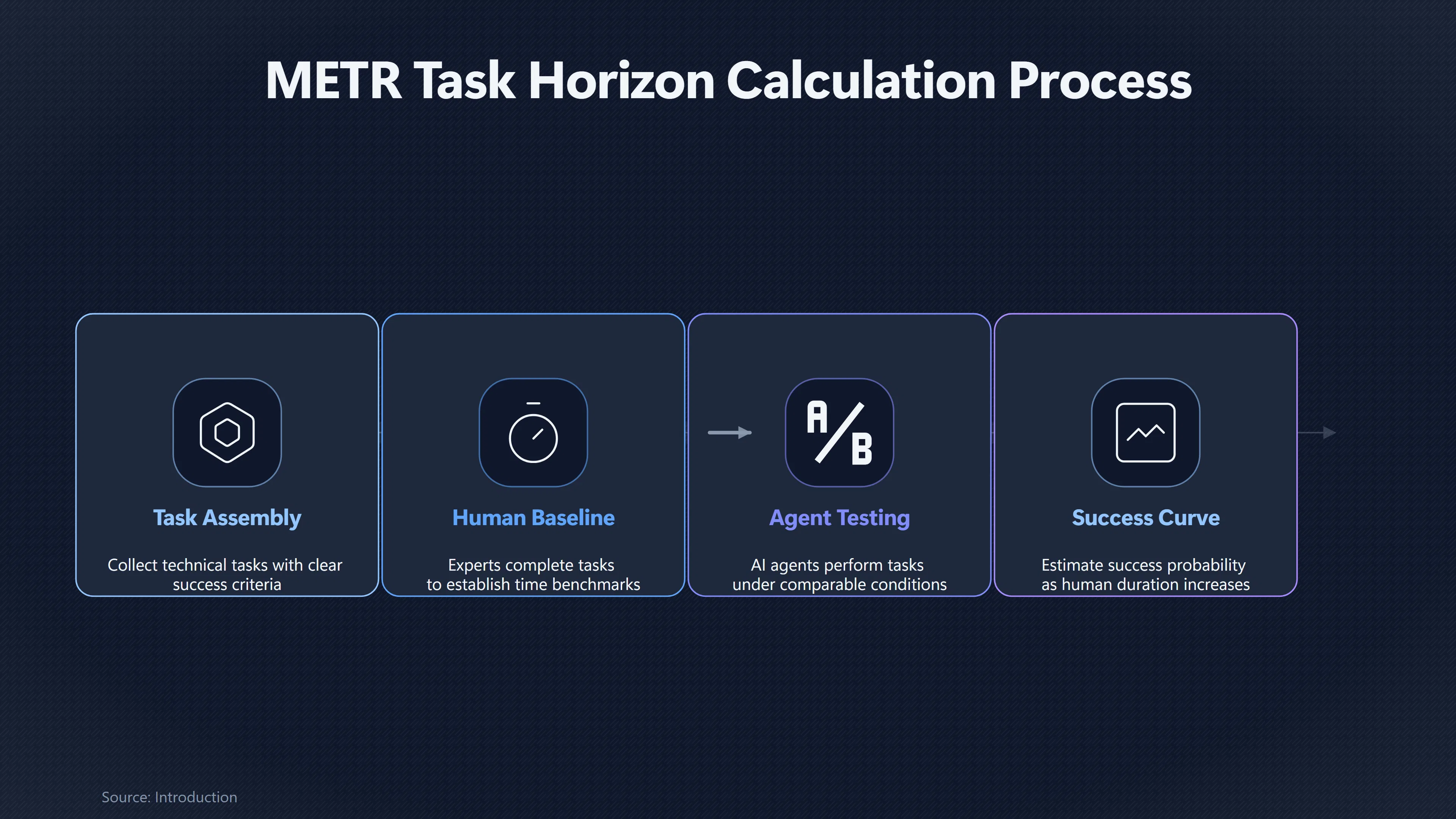
Researchers first assemble a collection of software engineering, machine learning and related technical tasks with clear success criteria. Human experts complete these tasks so researchers can estimate how long each normally takes a skilled professional. AI agents are then tested on the same tasks under comparable conditions. Finally, researchers estimate the probability that an agent succeeds as task duration increases.
The resulting curve allows them to ask questions such as:
- At what human task length does the agent succeed 50% of the time?
- At what task length does it succeed 80% of the time?
Those become the model’s 50% or 80% task horizon. Importantly, the time refers to how long the task would take a human expert, not how many minutes the AI itself spends running. Successful agents often finish much faster than humans because they generate code quickly or require fewer intermediate steps.[Metr]metr.orgTask-Completion Time Horizons of Frontier AI ModelsTask-Completion Time Horizons of Frontier AI Models - METRMay 8, 2026…
This framing tries to make benchmark scores more meaningful. Instead of saying that a model scores 82% on an abstract coding benchmark, researchers can estimate that it reliably completes tasks which normally occupy a human expert for tens of minutes or several hours.
Why task duration is only a proxy for autonomy
Task duration is attractive because many real projects become harder as they become longer. Longer work usually demands more planning, memory, recovery from mistakes, tool use and adaptation.
However, duration is only a proxy for these abilities, not a direct measurement.
A four-hour task might be difficult because it requires sophisticated reasoning throughout. Another four-hour task might simply involve many repetitive steps. Two tasks with identical human completion times can therefore require very different forms of competence.
Likewise, extending a project from thirty minutes to three days does not merely add more reasoning. It introduces changing environments, interruptions, missing information, conflicting objectives, coordination with people and unexpected failures. These are precisely the features that many existing benchmark tasks minimise in order to remain objectively measurable. METR explicitly presents its horizon estimates as measurements for its evaluated task distribution rather than a universal measure of autonomy.[Metr]metr.orgTask-Completion Time Horizons of Frontier AI ModelsTask-Completion Time Horizons of Frontier AI Models - METRMay 8, 2026…
This distinction matters for AI doom discussions because existential-risk arguments generally concern agents operating in open, unpredictable environments rather than solving well-specified technical exercises.
Why software benchmarks can overstate wider autonomy
Current task-horizon datasets are heavily concentrated in domains where modern language models are already comparatively strong.
Most evaluated tasks involve combinations of:
- software engineering;
- machine learning engineering;
- cybersecurity;
- well-defined research tasks with explicit success conditions.
These domains share characteristics that make evaluation feasible:
- objectives are clearly specified;
- digital tools are available;
- outputs can often be automatically checked;
- failure is easy to detect.
Real-world autonomous projects are frequently much less structured.
Running a company, conducting a scientific research programme, negotiating with multiple organisations or managing a covert campaign requires incomplete information, changing priorities, social judgement, long-term memory and continual adaptation. Small misunderstandings early in the process may only become visible weeks later.
For this reason, strong performance on software-focused task horizons should not be interpreted as evidence that today’s systems possess comparable competence across every domain requiring sustained autonomy. METR repeatedly notes that measurements above the range covered by its task suite become increasingly uncertain, and that external validity remains an open question.[Metr]metr.orgTask-Completion Time Horizons of Frontier AI ModelsTask-Completion Time Horizons of Frontier AI Models - METRMay 8, 2026…

Reliability matters more than isolated intelligence
The reason task horizons receive attention in AI safety is not because they measure raw intelligence better than every other benchmark. Their value lies in measuring reliable autonomous performance.
A highly intelligent model that succeeds brilliantly half the time but frequently loses track of its objectives is much less capable of executing extended plans than one with slightly lower reasoning ability but much greater consistency.
This is especially important because long projects compound errors.
Suppose an agent performs each decision correctly with 99% reliability. A project involving only ten critical decisions remains highly likely to succeed. A project requiring hundreds of dependent decisions becomes much more fragile because each earlier mistake affects later choices.
As a result, researchers increasingly view improvements in reliability, error recovery and sustained planning as potentially more important than marginal improvements on short reasoning tests when assessing autonomy. METR argues that recent increases in task horizons appear to reflect improvements not only in reasoning but also in adaptation after mistakes and more dependable tool use.[Metr]metr.orgMeasuring AI Ability to Complete Long TasksMeasuring AI Ability to Complete Long Tasks - METRMarch 19, 2025…
Long-horizon benchmarks reveal persistent weaknesses
Complementary research suggests that today’s frontier agents still struggle when tasks become substantially longer and less structured.
The UltraHorizon benchmark was designed specifically to evaluate agents operating through very long interaction sequences involving sustained planning, exploration, memory management and hundreds of tool calls. Human participants consistently outperformed current language-model agents.
Researchers identified recurring failure patterns including:
- becoming locked into an incorrect strategy;
- forgetting previously discovered information;
- poor long-term memory management;
- ineffective adaptation after setbacks;
- planning failures that accumulated over long trajectories.
These weaknesses appeared even when individual reasoning steps were often competent. The overall challenge came from maintaining coherent performance across many interconnected decisions rather than solving isolated problems.[arXiv]arxiv.orgUltraHorizon: Benchmarking Agent Capabilities in Ultra Long-Horizon ScenariosSeptember 26, 2025…
From the perspective of AI doom, this distinction is important. Current systems may already automate many bounded technical tasks while still lacking the robustness required for sustained strategic behaviour over days or months.
What longer reliable horizons would change for loss-of-control risk
Task horizons do not directly measure existential risk, but they help estimate one important prerequisite for dangerous autonomy.
Many AI doom scenarios assume agents that can:
- pursue goals over extended periods;
- recover from failed attempts;
- coordinate many sequential actions;
- manage tools and resources without continual supervision;
- maintain coherent strategies despite interruptions.
An agent that can only reliably complete thirty-minute projects is much easier to supervise than one that can independently complete multi-day technical operations.
This does not mean that crossing any particular horizon suddenly creates existential danger. Other ingredients would still matter, including access to external systems, permissions, strategic reasoning, deception, resource acquisition and the ability to influence people or infrastructure.
Nevertheless, if future evaluations demonstrated reliable autonomous completion of increasingly long, real-world projects across diverse domains—not merely well-specified software tasks—that would strengthen evidence that AI systems were acquiring capabilities relevant to loss-of-control concerns. Conversely, if progress continued mainly on narrow benchmark tasks while broader autonomy remained brittle, that would weaken simple extrapolations from current task-horizon trends.

What readers should take away
Task-completion horizons are one of the most useful recent attempts to translate AI capability into something resembling human work. They replace abstract benchmark scores with an estimate of how much bounded work an AI can reliably finish on its own.
Their strengths are equally clear:
- they measure sustained autonomous performance rather than one-shot answers;
- they connect benchmark results to familiar human task durations;
- they capture improvements in planning, reliability and tool use that ordinary benchmarks often miss.
Their limitations are just as important:
- they measure specific evaluated task distributions rather than general autonomy;
- they are currently dominated by software-related work;
- they do not demonstrate competence on messy, open-ended projects lasting days or months;
- they should not be interpreted as direct evidence that AI agents can already execute the kinds of long-term strategies assumed in many AI doom scenarios.
For understanding dangerous autonomy, task horizons are therefore best seen as an informative but incomplete indicator. They reveal rapid progress in one dimension that matters for existential-risk arguments while also highlighting how much remains unknown about whether those gains transfer to the complex, uncertain environments where genuine loss-of-control scenarios would unfold.[metr.org]metr.orgTask-Completion Time Horizons of Frontier AI ModelsTask-Completion Time Horizons of Frontier AI Models - METRMay 8, 2026…
Amazon book picks
Further Reading
Books and field guides related to How Long Can AI Really Work Alone?. Use these as the next step if you want deeper reading beyond the article.
Human Compatible
A leading artificial intelligence researcher lays out a new approach to AI that will enable us to coexist successfully with increasingly...
The Alignment Problem
Finalist for the Los Angeles Times Book Prize A jaw-dropping exploration of everything that goes wrong when we build AI systems and the m...
Superintelligence
This profoundly ambitious and original book picks its way carefully through a vast tract of forbiddingly difficult intellectual terrain.
Artificial Intelligence: A Modern Approach
Rating: 4.5/5 from 10 Google Books ratings
Artificial intelligence: A Modern Approach, 3e,is ideal for one or two-semester, undergraduate or graduate-level courses in Artificial In...
eBay marketplace picks
Marketplace Samples
Live-tested eBay searches with available results related to this page.
Selected fromAI robot poster oneBay.co.uk.



Endnotes
1.
Source: metr.org
Title: Task-Completion [Time Horizons]({{ ‘time-horizons/’ | relative_url }}) of Frontier AI Models
Link:https://metr.org/time-horizons/
Source snippet
Task-Completion Time Horizons of Frontier AI Models - METRMay 8, 2026...
Published: May 8, 2026
2.
Source: metr.org
Title: Measuring AI Ability to Complete Long Tasks
Link:https://metr.org/blog/2025-03-19-measuring-ai-ability-to-complete-long-tasks/
Source snippet
Measuring AI Ability to Complete Long Tasks - METRMarch 19, 2025...
Published: March 19, 2025
3.
Source: arxiv.org
Title: arXiv Measuring AI Ability to Complete Long Tasks
Link:https://arxiv.org/abs/2503.14499
4.
Source: arxiv.org
Link:https://arxiv.org/abs/2509.21766
Source snippet
UltraHorizon: Benchmarking Agent Capabilities in Ultra [Long-Horizon]({{ 'long-autonomy/' | relative_url }}) ScenariosSeptember 26, 2025...
Published: September 26, 2025
5.
Source: metr.org
Link:https://metr.org/index.html
6.
Source: metr.org
Link:https://metr.org/?trk=public_post_main-feed-card-text
7.
Source: evals.alignment.org
Title: Evals Task-Completion Time Horizons of Frontier AI Models
Link:https://evals.alignment.org/time-horizons/
Source snippet
No. The 50%-time horizon is the length of task in our suite (measured by how long...
8.
Source: evals.alignment.org
Title: Evals How Does Time Horizon Vary Across Domains?
Link:https://evals.alignment.org/blog/2025-07-14-how-does-time-horizon-vary-across-domains/
Source snippet
METRJuly 14, 2025 — How Does Time Horizon Vary Across Domains? CONTRIBUTORS Thomas Kwa and Vincent Cheng DATE July 14, 2025 [Input: Join...
Published: July 14, 2025
9.
Source: evals.alignment.org
Link:https://evals.alignment.org/
Additional References
10.
Source: youtube.com
Title: The 7-Month Doubling Law: Quantifying AI’s Journey to Long-Horizon Autonomy
Link:https://www.youtube.com/watch?v=aQ3fEZ3DnP8
Source snippet
METR time horizons autonomous capability AI safety The 7-Month Doubling Law: Quantifying AI’s Journey to Long-Horizon Autonomy SciPulse...
11.
Source: youtube.com
Title: The AI Progress Chart Everyone Is Misreading — Beth Barnes & David Rein
Link:https://www.youtube.com/watch?v=zSAGzfspuDE
Source snippet
How METR measures Long Tasks and Experienced Open Source Dev Productivity - Joel Becker, METR...
12.
Source: youtube.com
Title: How METR measures Long Tasks and Experienced Open Source Dev Productivity
Link:https://www.youtube.com/watch?v=k1t2xyWMUdY
Source snippet
Measuring Exponential Trends Rising (in AI) — Joel Becker, METR...
13.
Source: youtube.com
Title: The Most Important Graph in AI Right Now | Beth Barnes, CEO of METR
Link:https://www.youtube.com/watch?v=jXtk68Kzmms
Source snippet
The AI Progress Chart Everyone Is Misreading — Beth Barnes & David Rein...
14.
Source: youtube.com
Title: Measuring Exponential Trends Rising (in AI) — Joel Becker, METR
Link:https://www.youtube.com/watch?v=9QSm_mRGpN8
Source snippet
The 7-Month Doubling Law: Quantifying AI’s Journey to Long-Horizon Autonomy...
15.
Source: metavert.io
Link:https://metavert.io/metr-benchmarking
16.
Source: papers.nips.cc
Link:https://papers.nips.cc/paper_files/paper/2025/hash/85069585133c4c168c865e65d72e9775-Abstract-Conference.html
17.
Source: mlanthology.org
Title: ML Anthology Measuring AI Ability to Complete Long Software Tasks | ML Anthology
Link:https://mlanthology.org/neurips/2025/kwa2025neurips-measuring/
18.
Source: proceedings.neurips.cc
Title: Neur IPS Proceedings Measuring AI Ability to Complete Long Software
Link:https://proceedings.neurips.cc/paper_files/paper/2025/file/85069585133c4c168c865e65d72e9775-Paper-Conference.pdf
19.
Source: r9-hu.github.io
Title: Measuring AI Ability to Complete Long Software Tasks
Link:https://r9-hu.github.io/paper-digest/agentic-ai/2025/papers/measuring-ai-ability-to-complete-long-software-tasks/