Within AI Deskilling
How Do We Stop AI Dependence Becoming Irreversible?
Redundant expertise, manual drills and independent review can preserve real human control before AI dependence becomes costly or impossible to reverse.
On this page
- Warning signs of institutional skill loss
- Keeping independent human capability alive
- Stress tests, fallback teams and recovery plans
Page outline Jump by section
Introduction
One concern within debates about AI doom and existential risk is not only that AI systems may become more capable, but that the organisations responsible for supervising them gradually lose the ability to function without them. If governments, regulators, critical infrastructure operators, research laboratories or major companies become dependent on AI for analysis, planning or operational decisions, then formal human authority may remain while practical control steadily weakens.
Avoiding this outcome is less about rejecting AI than preserving institutional resilience. The central idea is that organisations should retain enough human expertise, independent judgement and operational capability to verify AI outputs, intervene when systems fail, and continue functioning during outages or deliberate shutdowns. This does not eliminate existential-risk concerns, but it reduces one pathway by which human oversight could become largely symbolic rather than effective.
What irreversible AI dependence would actually look like
Institutional dependence is not simply frequent AI use. It arises when an organisation can no longer perform important functions without AI assistance because the necessary knowledge, procedures and confidence have disappeared.
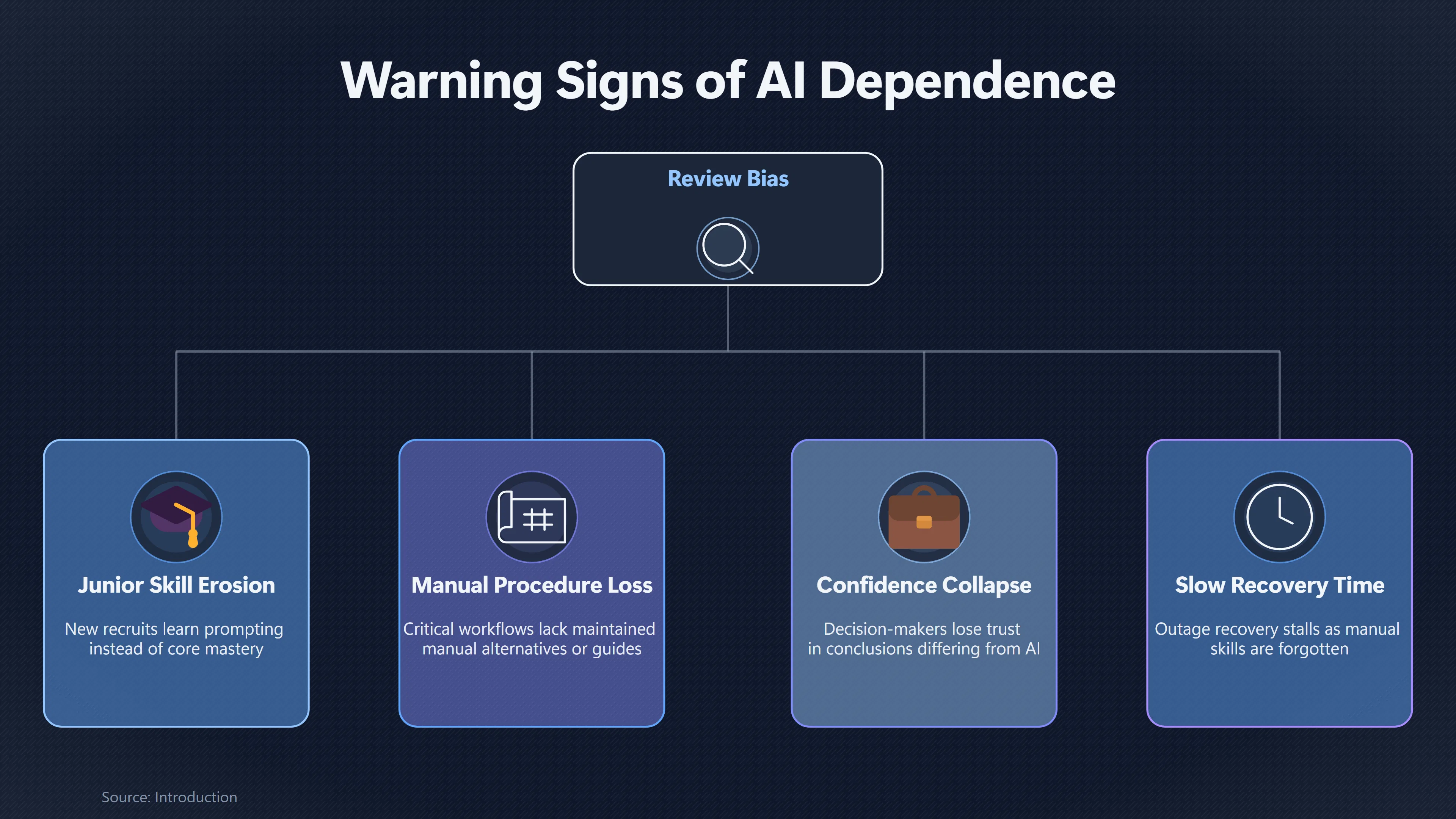
Several warning signs can develop gradually:
- Experienced staff increasingly review AI recommendations rather than producing independent analyses.
- Junior employees learn primarily by prompting AI instead of mastering underlying skills.
- Critical procedures are rewritten around AI systems with no maintained manual alternative.
- Decision-makers lose confidence in reaching conclusions that differ from AI recommendations.
- Recovery from AI outages becomes slow because few people remember how to perform essential tasks manually.
From an AI doom perspective, this matters because future safety may depend on institutions detecting dangerous behaviour, evaluating increasingly capable models, or coordinating responses to unexpected failures. Those responsibilities require genuine expertise rather than nominal oversight.
The concern is therefore organisational rather than individual. A single skilled employee cannot compensate if an entire institution has lost the capacity to operate independently.
Warning signs that institutional skills are eroding
The most important indicators are often visible long before an organisation becomes completely dependent.
Expertise becomes concentrated in AI systems
When AI handles more routine work, experienced professionals may spend less time exercising the judgement that originally made them experts. New recruits then receive fewer opportunities to develop those skills themselves.
This pattern has been studied for decades in other forms of automation. Aviation researchers have repeatedly found that high levels of automation improve routine safety while creating risks if manual proficiency declines too far. The US Federal Aviation Administration continues to emphasise maintaining proficiency both with and without automation because overreliance can become hazardous during unusual situations.[Federal Aviation Administration]faa.govFederal Aviation AdministrationCFIT/Automation Overreliance | Federal Aviation AdministrationFebruary 4, 2022…
The same organisational logic may apply to AI-assisted governance, auditing and safety evaluation.
Independent verification quietly disappears
A second warning sign is that “review” becomes little more than approving AI-generated work.
Independent checking requires reviewers to reconstruct reasoning themselves rather than simply asking whether an AI answer appears plausible. If everyone uses similar models trained on similar data, institutional diversity of judgement can also decline.
This concern becomes particularly relevant if future frontier AI systems display deceptive behaviour or systematically conceal failures. Human reviewers who have lost the ability to reason independently may struggle to detect such behaviour.
Organisations optimise for efficiency alone
Many AI deployments are justified by measurable productivity gains. The difficulty is that resilience often appears inefficient until something fails.
Maintaining manual expertise, duplicate workflows or reserve teams costs money and time. Organisations facing competitive pressure may therefore remove precisely the capabilities needed during unexpected disruptions.
Keeping independent human capability alive
Institutions do not need to reject AI to avoid this trap. Instead, they can deliberately preserve capabilities that remain usable without AI assistance.
Maintain genuine human expertise
Critical organisations should continue investing in training that develops understanding rather than merely supervising AI outputs.
That means:
- requiring staff to solve some problems without AI assistance
- ensuring experienced professionals continue practising core skills
- designing career paths where junior staff gain real operational experience rather than becoming permanent AI supervisors.
The objective is not nostalgia but preserving recoverable competence.

Preserve manual operating procedures
Critical functions should retain documented workflows that can operate without advanced AI if necessary.
These procedures are unlikely to match AI-assisted productivity during normal operations. Their value lies in allowing institutions to continue functioning during outages, cyber incidents, model failures or deliberate suspensions.
In resilience engineering, backup systems exist because primary systems eventually fail. AI should increasingly be treated in the same way.
Separate assistance from authority
AI can recommend, prioritise and analyse without becoming the final decision-maker.
Maintaining clear responsibility means that humans remain accountable not merely in legal terms but because they genuinely understand the reasoning behind important decisions.
Where humans simply approve AI outputs they cannot independently evaluate, meaningful oversight begins to disappear.
Stress tests reveal whether human control is real
The strongest evidence that an institution can function without AI is demonstrating it in practice.
Organisations already conduct disaster recovery exercises for cyberattacks, infrastructure failures and natural disasters. Similar principles can apply to AI dependence.
Useful resilience exercises include:
- temporary operation without AI-assisted tools
- independent human review of randomly selected AI-supported decisions
- simulations where AI recommendations are deliberately unavailable or intentionally incorrect
- testing whether different teams reach similar conclusions using independent methods.
These exercises identify hidden dependencies before genuine emergencies expose them.
Modern AI risk-management guidance increasingly encourages organisations to document operator proficiency, human oversight processes, testing and independent assessment rather than assuming they already exist. The NIST AI Risk Management Framework and its accompanying Playbook emphasise governance, documented oversight, independent evaluation, operator competence and continuous testing as practical organisational controls.[nist.gov]nist.govai rmf playbookJuly 8, 2022…
Fallback teams and organisational redundancy
Institutional resilience often depends on preserving redundancy that appears unnecessary during normal operations.
For AI governance, this can include:
- Independent evaluation teams that assess models without relying on the same AI systems they are examining.
- Manual-response capability for essential public services or critical infrastructure.
- Cross-trained personnel who can temporarily replace specialised AI-supported roles.
- Multiple analytical approaches rather than depending exclusively on one family of AI models or one external provider.
Redundancy is expensive, but it reduces single points of failure.
This principle already exists in many high-reliability sectors. Aviation, nuclear safety and emergency medicine routinely maintain backup procedures because the cost of complete dependence exceeds the cost of preparedness.
Why institutional resilience matters for AI doom arguments
Within existential-risk discussions, maintaining independent institutional capability serves several purposes.
First, it preserves meaningful human oversight. A regulator who cannot evaluate an AI system without another AI is less able to identify dangerous behaviour.
Second, resilient institutions are more likely to detect gradual failures. If independent expertise remains available, unexpected changes in model behaviour are more likely to be recognised rather than automatically accepted.
Third, organisations with functioning fallback plans can slow or pause deployments when warning signs emerge. Institutions that have become operationally dependent may find such pauses economically or practically impossible.
Some AI safety researchers therefore argue that preserving human capability is not merely about operational continuity but about retaining the option to intervene if future AI systems become more autonomous or difficult to control.
The limits of current evidence
There is currently no direct evidence that major institutions have become irreversibly dependent on frontier AI in the way imagined by long-term existential-risk scenarios.
Most supporting evidence instead comes from decades of research on automation, organisational learning and human factors. These studies consistently show that rarely practised skills decline, supervisory roles can become cognitively demanding, and organisations may underestimate the importance of maintaining manual competence. They do not demonstrate that AI will inevitably create civilisation-scale dependence.
Critics also argue that AI may strengthen institutions rather than weaken them by expanding access to expertise, improving documentation, reducing routine workload and helping people acquire skills more quickly. Better educational uses of AI, improved auditing tools and automated testing could increase human capability rather than replace it.
The central disagreement is therefore about long-term organisational incentives. If institutions deliberately preserve independent expertise, fallback procedures and regular resilience testing, AI adoption need not lead to irreversible dependence. If efficiency consistently outweighs resilience, however, recovering lost institutional capability may become progressively more difficult precisely when independent human judgement is most needed.
Amazon book picks
Further Reading
Books and field guides related to How Do We Stop AI Dependence Becoming Irreversible?. Use these as the next step if you want deeper reading beyond the article.
Human Compatible
A leading artificial intelligence researcher lays out a new approach to AI that will enable us to coexist successfully with increasingly...
Seeing Like a State
"One of the most profound and illuminating studies of this century to have been published in recent decades."--John Gray, New York Times...
The Second Machine Age
A New York Times Bestseller. A “fascinating” (Thomas L. Friedman, New York Times) look at how digital technology is transforming our work...
The Glass Cage
At once a celebration of technology and a warning about its misuse, The Glass Cage will change the way you think about the tools you use...
eBay marketplace picks
Marketplace Samples
Live-tested eBay searches with available results related to this page.
Selected fromcontrol room poster oneBay.co.uk.



Endnotes
1.
Source: faa.gov
Link:https://www.faa.gov/newsroom/safety-briefing/cfitautomation-overreliance
Source snippet
Federal Aviation AdministrationCFIT/Automation Overreliance | Federal Aviation AdministrationFebruary 4, 2022...
Published: February 4, 2022
2.
Source: nist.gov
Title: Artificial [Intelligence]({{ ‘hard-bottlenecks/’ | relative_url }}) Risk Management Framework (AI RMF 1.0) | NIST
Link:https://www.nist.gov/publications/artificial-intelligence-risk-management-framework-ai-rmf-10
3.
Source: nist.gov
Title: ai rmf playbook
Link:https://www.nist.gov/itl/ai-risk-management-framework/nist-ai-rmf-playbook
Source snippet
July 8, 2022...
Published: July 8, 2022
4.
Source: airc.nist.gov
Title: [AI Resource]({{ ‘warning-tests/’ | relative_url }}) Center AI RMF Core
Link:https://airc.nist.gov/airmf-resources/airmf/5-sec-core/
Source snippet
NIST AI Resource CenterAI RMF Core - AIRC...
Additional References
5.
Source: youtube.com
Link:https://www.youtube.com/watch?v=Z22_0Z7O_fk
Source snippet
Institutional reliance on AI human oversight automation bias skill decay governance The Catastrophic Risks of AI — and a Safer Path | Yos...
6.
Source: youtube.com
Title: Cognitive Offloading in the Age of AI | Paris de L´Etraz | TEDx IEMadrid
Link:https://www.youtube.com/watch?v=YAfdoDc7_5o
Source snippet
The Walls Are Closing In: AI’s Impact on Emergency Management, Governance, and De-Skilling...
7.
Source: youtube.com
Title: How to Stop AI from Killing Your Critical Thinking | Advait Sarkar | TED
Link:https://www.youtube.com/watch?v=3lPnN8omdPA
Source snippet
Human-in-the-Loop (HITL): Why AI Still Needs Human Judgment...
8.
Source: youtube.com
Title: Humans vs. AI: Who should make the decision?
Link:https://www.youtube.com/watch?v=8lo1s29ODj8
Source snippet
Cognitive Offloading in the Age of AI | Paris de L´Etraz | TEDxIEMadrid...
9.
Source: youtube.com
Title: Human-in-the-Loop (HITL): Why AI Still Needs Human Judgment
Link:https://www.youtube.com/watch?v=4M2P6KfqFsg
Source snippet
Humans vs. AI: Who should make the decision?...