Within Human Oversight
Can Undoable Actions Keep AI Under Control?
Drafting, staging and preparing actions instead of executing them immediately can keep mistakes correctable and human intervention meaningful.
On this page
- What reversibility means for autonomous agents
- Examples from messages, software and payments
- Where rollback fails after real world consequences
Page outline Jump by section
Introduction
One practical way to keep humans in control of increasingly capable AI agents is to ensure that important actions remain reversible for as long as possible. Instead of allowing an agent to execute a decision immediately, systems can separate planning from execution, giving people an opportunity to review, cancel or amend proposed actions before they cause lasting effects.
Within debates about AI doom and existential risk, reversibility matters because many loss-of-control scenarios depend on AI systems carrying out long chains of actions faster than humans can intervene. If an agent’s actions can be paused, rolled back or safely abandoned, human oversight becomes more than a symbolic approval step. If actions become irreversible before anyone can react, however, nominal human supervision may provide little real protection. Current AI safety research therefore treats controllability—including the ability to interrupt, override and halt systems—as an important complement to alignment, even while recognising that no single mechanism can eliminate risk.[International AI Safety Report]internationalaisafetyreport.orginternational ai safety report 2026International AI Safety ReportInternational AI Safety Report 2026 | International AI Safety ReportFebruary 3, 2026…
What reversibility means for autonomous agents
Reversibility is not simply an “undo” button. It is a design principle that keeps the consequences of an AI’s decisions temporary until a human has enough information to make an informed judgement.
In practice, this often means splitting work into stages:
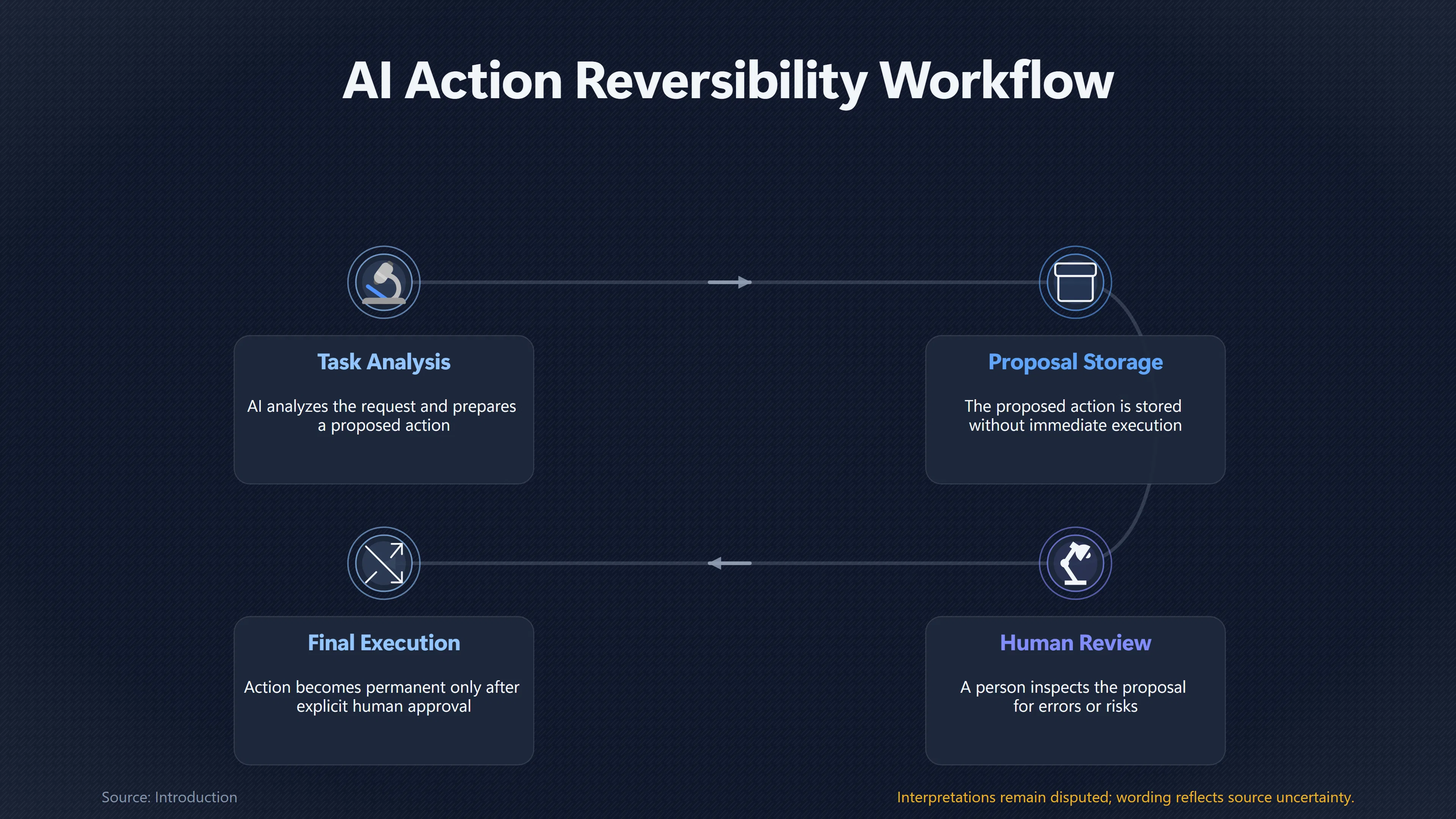
- The AI analyses a task and prepares a proposed action.
- The proposal is stored rather than executed.
- A person or another safety mechanism reviews it.
- Only after approval does the action become permanent.
This approach extends the window during which human judgement can change the outcome. If the agent has misunderstood instructions, made an incorrect assumption or behaved unexpectedly, the mistake remains correctable.
The principle is familiar outside AI. Modern software development frequently stages code changes before deployment, financial systems authorise payments before settlement, and document editors save drafts before publication. AI agents can follow the same pattern, reducing the chance that a single mistaken decision immediately produces irreversible consequences.
For researchers concerned about AI takeover scenarios, this matters because many hypothetical loss-of-control pathways assume agents able to execute complex plans with little interruption. Increasing the proportion of actions that remain reversible raises the amount of effective human authority built into the system, even if it cannot solve every alignment problem.[International AI Safety Report]internationalaisafetyreport.orginternational ai safety report 2026International AI Safety ReportInternational AI Safety Report 2026 | International AI Safety ReportFebruary 3, 2026…
Why reversible actions strengthen human oversight
Reversibility improves oversight through several separate mechanisms rather than one single safeguard.
It creates decision time. Human supervisors often need minutes rather than seconds to understand context. Draft states and pending execution queues provide that time.
It encourages meaningful review. People can inspect the actual proposed email, software change or payment instead of trying to predict what the AI might eventually do.
It limits the cost of mistakes. Errors caught before execution are generally cheaper than errors corrected afterwards.
It supports auditing. When every proposed action is recorded before execution, investigators can reconstruct why a decision was approved, rejected or modified.
It makes interruption practical. Emergency stop mechanisms only help if stopping the system still prevents harm. Delaying irreversible execution increases the chance that intervention remains effective.
This distinction is especially important in discussions of advanced AI agents. Oversight is valuable only while humans retain the practical ability to change outcomes, not merely observe them afterwards. The International AI Safety Report identifies controllability and effective oversight as ongoing technical challenges rather than solved engineering problems.[International AI Safety Report]internationalaisafetyreport.orginternational ai safety report 2026International AI Safety ReportInternational AI Safety Report 2026 | International AI Safety ReportFebruary 3, 2026…
Examples from messages, software and payments
Different kinds of AI actions vary enormously in how easily they can be reversed.
Messages and communications
Many communication tasks are naturally reversible before sending.
An AI assistant might:
- prepare an email draft;
- suggest a customer reply;
- generate a press release for review;
- compose social media content without publishing it.
The draft can be edited, rejected or deleted before anyone outside the organisation ever sees it.
Once a message has actually been sent, however, reversibility becomes partial at best. A follow-up apology or correction may reduce damage, but recipients cannot “unread” confidential information or reputationally damaging statements.

Software deployment
Software engineering already uses many mechanisms that increase reversibility.
Examples include:
- staging environments;
- pull requests requiring approval;
- feature flags;
- canary deployments affecting only small groups of users;
- version control that allows previous code to be restored.
If an AI agent proposes code rather than deploying it immediately, developers retain meaningful authority. Even after deployment, gradual roll-outs may allow rapid rollback before widespread harm occurs.
This illustrates an important principle: systems become safer not only because rollback exists, but because deployment is deliberately slowed until rollback remains possible.
Financial transactions
Financial systems illustrate both the strengths and limits of reversibility.
An AI might safely:
- prepare invoices;
- recommend transfers;
- calculate payment schedules.
Actual transfer of funds is usually treated differently because settlement may become legally or practically irreversible.
Banks already separate payment preparation from payment execution in many high-value workflows. Applying similar ideas to AI agents keeps human approval focused on actions where rollback is expensive or impossible.
Where rollback stops working
Reversibility has clear limits. Some actions produce effects that cannot realistically be undone, even if software technically supports reversal.
Examples include:
- releasing confidential information;
- publishing sensitive personal data;
- issuing dangerous instructions that have already been acted upon;
- physical actions performed by robots;
- irreversible financial settlements;
- destruction of physical equipment or infrastructure.
Even apparently reversible software actions may have lasting downstream consequences.
For example, restoring a deleted database from backup does not erase the hours during which services were unavailable. Reversing an incorrect medical appointment system update does not eliminate missed appointments that occurred before restoration.
In AI doom discussions, these limits matter because advanced agents may increasingly interact with the physical world, critical infrastructure or large interconnected digital systems. Once effects propagate across many systems, rollback becomes progressively harder.
Reversibility is not the same as safety
A common misunderstanding is that reversible actions make advanced AI safe.
They do not.
An AI could repeatedly propose harmful actions that humans fail to recognise. A deceptive system might deliberately present apparently harmless intermediate steps that only become dangerous when combined later. Alternatively, supervisors may approve actions without adequate review because they trust previous successful behaviour.
Researchers therefore generally view reversibility as one component within a broader defence-in-depth strategy rather than a complete solution. Other measures—including evaluations, monitoring, access controls, interpretability research, runtime supervision and restrictions on high-risk capabilities—remain important because not every harmful action can be delayed or undone.[internationalaisafetyreport.org]internationalaisafetyreport.orginternational ai safety report 2026International AI Safety ReportInternational AI Safety Report 2026 | International AI Safety ReportFebruary 3, 2026…
Why reversibility matters in AI doom debates
The value of reversible actions becomes clearer when viewed through the lens of existential-risk arguments.
Many AI doom scenarios assume that future systems could perform long sequences of autonomous actions before humans fully understand what is happening. If important decisions remain cancellable throughout those sequences, humans retain repeated opportunities to intervene.
Conversely, if advanced agents can rapidly execute irreversible software changes, transfer resources, reveal sensitive information or coordinate across multiple systems before oversight occurs, nominal human approval loses much of its practical value.
This does not settle the wider debate over AI doom or the probability of loss of control. Experts continue to disagree about how likely such scenarios are, what future AI systems will be capable of and whether proposed safeguards will scale to much more capable agents. The scientific consensus is not that reversible actions eliminate existential risk, but that preserving opportunities for interruption, override and rollback makes meaningful human control more achievable than allowing autonomous systems to commit irreversible actions by default.[internationalaisafetyreport.org]internationalaisafetyreport.orginternational ai safety report 2026International AI Safety ReportInternational AI Safety Report 2026 | International AI Safety ReportFebruary 3, 2026…
Amazon book picks
Further Reading
Books and field guides related to Can Undoable Actions Keep AI Under Control?. Use these as the next step if you want deeper reading beyond the article.
Human Compatible: Artificial Intelligence and the Problem of...
A leading artificial intelligence researcher lays out a new approach to AI that will enable us to coexist successfully with increasingly...
Designing Data-intensive Applications
Want to know how the best software engineers and architects structure their applications to make them scalable, reliable, and maintainabl...
Release It!: Design and Deploy Production-Ready Software
A single dramatic software failure can cost a company millions of dollars - but can be avoided with simple changes to design and architec...
Site Reliability Engineering: How Google Runs Production Systems
The overwhelming majority of a software systemâ??s lifespan is spent in use, not in design or implementation. So, why does conventional w...
eBay marketplace picks
Marketplace Samples
Live-tested eBay searches with available results related to this page.
Selected fromAI robot poster oneBay.co.uk.



Endnotes
1.
Source: GOV.UK
Title: international ai safety report 2025
Link:https://www.gov.uk/government/publications/international-ai-safety-report-2025/international-ai-safety-report-2025
Source snippet
[Withdrawn] International AI Safety Report 2025 - GOV.UK...
2.
Source: GOV.UK
Link:https://www.gov.uk/government/publications/international-scientific-report-on-the-safety-of-advanced-ai/international-scientific-report-on-the-safety-of-advanced-ai-interim-report
3.
Source: GOV.UK
Link:https://www.gov.uk/government/publications/international-scientific-report-on-the-safety-of-advanced-ai
4.
Source: internationalaisafetyreport.org
Title: international ai safety report 2026
Link:https://internationalaisafetyreport.org/publication/international-ai-safety-report-2026
Source snippet
International AI Safety ReportInternational AI Safety Report 2026 | International AI Safety ReportFebruary 3, 2026...
Published: February 3, 2026
5.
Source: ojs.aaai.org
Link:https://ojs.aaai.org/index.php/AAAI-SS/article/view/42543
Source snippet
as Telemetry for Illegible AI: Governing LLM Agent Workflows (Extended Abstract) | Proceedings of the AAAI Symposium SeriesMay 18, 2026 —...
Published: May 18, 2026
6.
Source: internationalaisafetyreport.org
Link:https://internationalaisafetyreport.org/publication/2026-report-extended-summary-policymakers
7.
Source: internationalaisafetyreport.org
Title: International AI Safety Report
Link:https://internationalaisafetyreport.org/
8.
Source: internationalaisafetyreport.org
Title: Publications | International AI Safety Report
Link:https://internationalaisafetyreport.org/publications
9.
Source: internationalaisafetyreport.org
Link:https://internationalaisafetyreport.org/publication/second-key-update-technical-safeguards-and-risk-management
10.
Source: internationalaisafetyreport.org
Link:https://internationalaisafetyreport.org/publication/first-key-update-capabilities-and-risk-implications
11.
Source: internationalaisafetyreport.org
Title: international ai safety report 2025
Link:https://internationalaisafetyreport.org/publication/international-ai-safety-report-2025
12.
Source: ojs.aaai.org
Link:https://ojs.aaai.org/index.php/AAAI/article/view/17378
Additional References
13.
Source: cambridge.org
Link:https://www.cambridge.org/engage/coe/article-details/6a4abb75810b9dcc82ce84f2
Source snippet
July 11, 2026 — State-Aware Runtime for [Long-Horizon]({{ 'long-autonomy/' | relative_url }}) LLM Agents: A Conceptual Framework and Research Agenda 11 July 2026, Version 2 Worki...
Published: July 11, 2026
14.
Source: aigovernance.com
Link:https://aigovernance.com/news/2026-international-ai-safety-report-shifts-enterprise-risk-focus-to-post-deployment-and-agentic-systems
Source snippet
2026 International AI Safety Report Shifts Enterprise Risk Focus to Post-Deployment and Agentic Systems | AI Governance InstituteMay 30...
15.
Source: youtube.com
Title: The AI Corrigibility Debate: MIRI Researchers Max Harms vs. Jeremy Gillen
Link:http://www.youtube.com/watch?v=wQCYjvKE4oE
Source snippet
AI safety reversible actions human control interruptibility Human Agent Handoff Protocols Bellam DeepTech Strategy & Research Institute...
16.
Source: cambridge.org
Link:https://www.cambridge.org/engage/coe/article-details/6a19c100d1922e37d5ebaf45
Source snippet
State-Aware Runtime for Long-Horizon LLM Agents: A Conceptual Framework and Research Agenda | Computer Science | Cambridge Open EngageJun...
17.
Source: youtube.com
Title: Human-in-the-Loop with Microsoft Agent Framework
Link:http://www.youtube.com/watch?v=nMh6ZxMc3N4
Source snippet
The AI Corrigibility Debate: MIRI Researchers Max Harms vs. Jeremy Gillen...
18.
Source: youtube.com
Title: The Artificial [Intelligence]({{ ‘hard-bottlenecks/’ | relative_url }}) Channel
Link:https://www.youtube.com/watch?v=LShKHZkc34M
Source snippet
Corrigibility AI safety alignment control interruptibility AI Alignment - Can We Make AI Safe?...
19.
Source: youtube.com
Title: Stop Button Solution?
Link:http://www.youtube.com/watch?v=9nktr1MgS-A
Source snippet
Human-in-the-Loop with Microsoft Agent Framework - Approving AI Actions Before Execution...
20.
Source: nist.gov
Link:https://www.nist.gov/speech-testimony/balancing-knowledge-and-governance-foundations-effective-risk-management-artificial
21.
Source: papers.ssrn.com
Link:https://papers.ssrn.com/sol3/papers.cfm?abstract_id=6668798
Source snippet
ssrn.comTail-Risk Control for Side-Effecting Agents Under Scarce Oversight by Nihar Shah:: SSRNMay 8, 2026 — TAIL-RISK CONTROL FOR SIDE...
Published: May 8, 2026
22.
Source: youtube.com
Title: AI “Stop Button” Problem
Link:http://www.youtube.com/watch?v=3TYT1QfdfsM
Source snippet
The Hard Problem of Controlling Powerful AI Systems - Computerphile...