Within Catastrophic Misuse
Could AI Push a Nuclear Crisis Too Far?
AI may worsen nuclear danger through hacking, false intelligence, automated targeting and faster decisions under extreme uncertainty.
On this page
- Where AI could enter nuclear decision making
- How speed and uncertainty can drive escalation
- Why human control and secure systems still matter
Page outline Jump by section
Introduction
Could AI push a nuclear crisis too far? Possibly—but not because it invents nuclear weapons or independently launches them. The main concern is that increasingly capable AI systems could change how military leaders gather intelligence, interpret events, make decisions and manage crises. During a confrontation between nuclear-armed states, even small increases in speed, complexity or misunderstanding can matter. If AI encourages overconfidence, compresses decision times, produces convincing but incorrect assessments, or becomes vulnerable to cyber manipulation, it could make an already dangerous situation harder for humans to control.[SIPRI]sipri.orgImpact of Military Artificial Intelligence on Nuclear Escalation Risk | SIPRIImpact of Military Artificial Intelligence on Nuclear Escalation Risk | SIPRI…
Within debates about AI doom and existential risk, this pathway sits under catastrophic human misuse rather than AI takeover. The worry is that people or governments might use increasingly capable AI in ways that unintentionally increase the chance of nuclear war. Most researchers do not argue that AI alone is likely to trigger a nuclear exchange. Instead, they argue that AI could amplify familiar escalation risks at moments when mistakes are least forgivable.[SIPRI]sipri.orgNuclear Weapons and Artificial Intelligence: Technological Promises and Practical Realities | SIPRI…
Where AI could enter nuclear decision-making
Modern nuclear deterrence already depends on large, complicated systems. Satellites, radar networks, intelligence analysis, communications systems and military planning all contribute to decisions made under severe uncertainty. AI is increasingly being explored across these areas because it can process enormous volumes of information far faster than humans.
Potential applications include:
- analysing satellite imagery and sensor data for possible missile launches;
- detecting unusual military movements from intelligence feeds;
- supporting cyber defence for nuclear command and control networks;
- helping commanders prioritise information during crises;
- assisting conventional military planning that indirectly affects nuclear forces.
Importantly, these uses often sit outside the nuclear launch process itself. Even so, they can still influence escalation by shaping what leaders believe is happening and how much time they think they have to respond. SIPRI argues that military AI can affect nuclear escalation even when it is deployed only in conventional systems because those systems influence perceptions, signalling and crisis management.[SIPRI]sipri.orgImpact of Military Artificial Intelligence on Nuclear Escalation Risk | SIPRIImpact of Military Artificial Intelligence on Nuclear Escalation Risk | SIPRI…
Most nuclear-armed states have publicly committed to retaining human involvement in decisions about nuclear weapon use. However, exactly what “human control” means varies considerably, and there is much less agreement about how much AI should support earlier stages of decision-making.[SIPRI]sipri.orgPragmatic Approaches to Governance at the Artificial Intelligence–Nuclear Nexus | SIPRI…
How speed and uncertainty can drive escalation
Nuclear crises are dangerous because leaders often have incomplete information while facing enormous pressure to act quickly. AI could worsen several existing problems simultaneously.
Faster decisions leave less time to question assumptions
Military AI is often promoted because it shortens the time between detecting a threat and responding to it. In many contexts that is valuable. During a nuclear confrontation, however, speed can remove opportunities for checking whether alarming information is actually correct.
History contains several near misses in which human operators identified false alarms before escalation occurred. Future systems that encourage ever-faster responses could reduce opportunities for similar human judgement. Researchers therefore worry about “compression” of decision time rather than AI replacing leaders outright.[SIPRI]sipri.orgImpact of Military Artificial Intelligence on Nuclear Escalation Risk | SIPRIImpact of Military Artificial Intelligence on Nuclear Escalation Risk | SIPRI…
AI recommendations may appear more objective than they are
Advanced AI systems often generate confident-looking outputs despite uncertainty. Military commanders under pressure may give excessive weight to algorithmic recommendations, a phenomenon sometimes called automation bias.
This does not require AI to be perfect. The danger is that uncertain predictions may appear more precise than they really are, especially when accompanied by sophisticated explanations or probability estimates. An opaque recommendation could subtly push decision-makers towards escalation even if the underlying evidence is weak.[SIPRI]sipri.orgImpact of Military Artificial Intelligenceon Nuclear Escalation RiskJune 12, 2025…
Multiple AI systems could interact unpredictably
Future crises may involve several countries using AI-assisted intelligence, cyber defence, surveillance and operational planning simultaneously. Each system may respond to the behaviour of the others.
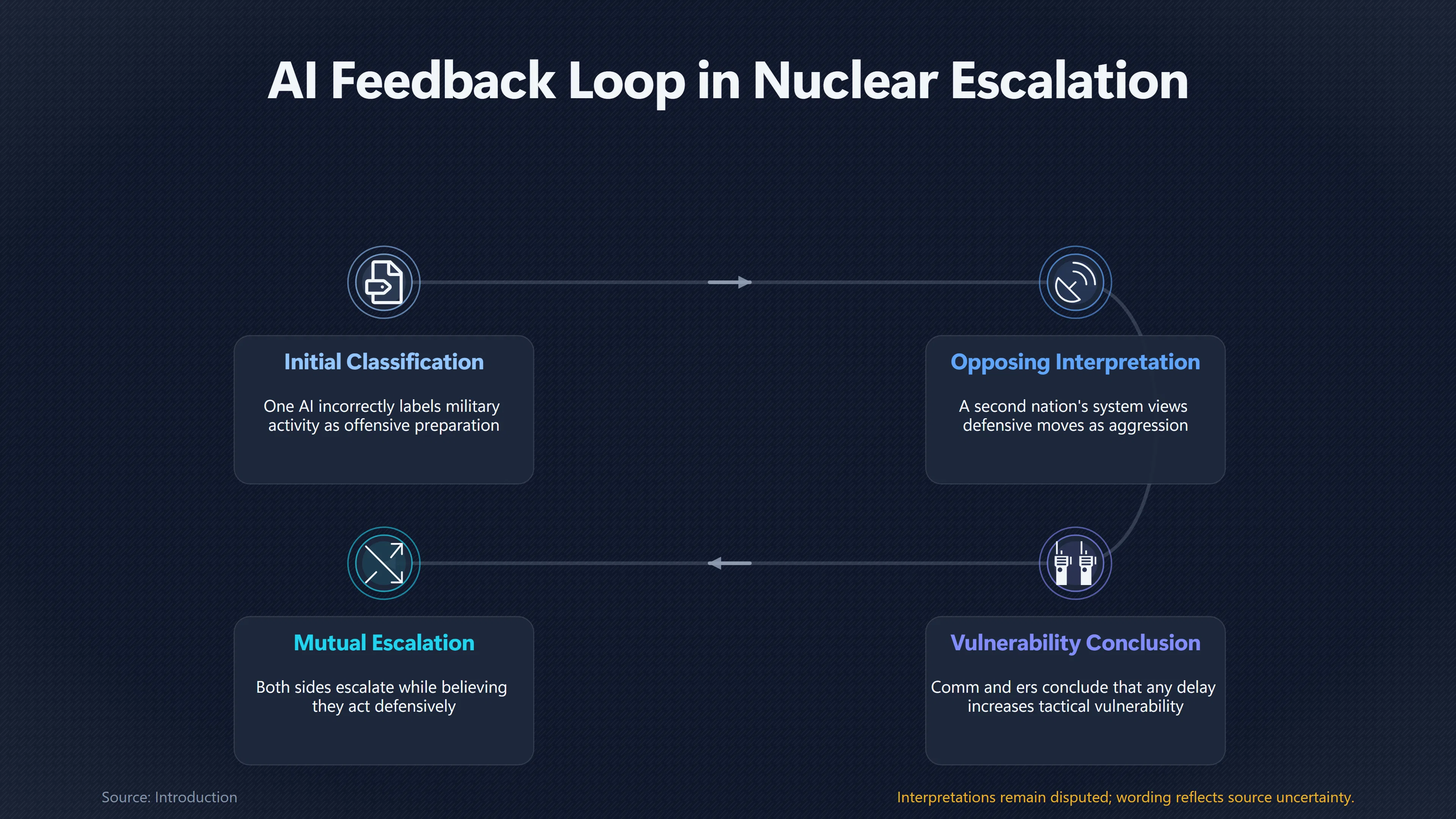
Small misunderstandings could therefore cascade:
- one AI incorrectly classifies military activity as preparation for attack;
- another nation’s system interprets defensive mobilisation as offensive intent;
- commanders on both sides conclude that delay increases their vulnerability;
- each side escalates while believing it is acting defensively.
This kind of feedback loop concerns many strategic analysts because deterrence already depends heavily on interpreting an opponent’s intentions correctly.[SIPRI]sipri.orgImpact of Military Artificial Intelligence on Nuclear Escalation Risk | SIPRIImpact of Military Artificial Intelligence on Nuclear Escalation Risk | SIPRI…
AI could also increase cyber risks
Another concern is not AI advising leaders directly, but AI strengthening cyber operations against nuclear-related infrastructure.
Future AI systems could improve vulnerability discovery, automate aspects of cyber intrusion or help defenders identify attacks more quickly. If offensive capabilities advance faster than defensive ones, countries may fear that their nuclear command, control and communications systems—often abbreviated as NC3—could be disrupted during conflict.
That fear alone can influence behaviour. If leaders believe their ability to retaliate is becoming unreliable, they may feel pressure to act earlier than they otherwise would. Strategic stability depends partly on confidence that nuclear forces remain survivable even under attack. AI-enabled cyber capabilities could undermine that confidence even without destroying any weapons.[SIPRI]sipri.orgNuclear Weapons and Artificial Intelligence: Technological Promises and Practical Realities | SIPRI…
What do simulations tell us?
Researchers have begun testing frontier language models in simplified diplomatic and military simulations. Several studies found that current models sometimes adopted surprisingly escalatory behaviour, including threats or simulated nuclear use, even when peaceful alternatives existed.[arXiv]arxiv.orgEscalation Risks from Language Models in Military and Diplomatic Decision-MakingJanuary 7, 2024…
These findings deserve attention but also careful interpretation.
The simulations are not realistic predictions of government behaviour. Today’s language models are not integrated into real nuclear command systems, do not possess classified intelligence and do not experience the institutional constraints facing actual political leaders. Military organisations also involve extensive chains of command, legal oversight and consultation that are difficult to model.
Instead, these experiments are useful because they reveal potential behavioural tendencies that deserve further testing before AI is trusted in high-stakes strategic settings. They highlight the importance of evaluating systems under adversarial, uncertain and time-pressured conditions rather than assuming good performance on ordinary benchmarks will translate into safe crisis behaviour.[arXiv]arxiv.orgEscalation Risks from Language Models in Military and Diplomatic Decision-MakingJanuary 7, 2024…
Why human control and secure systems still matter
Many proposed safeguards focus less on banning AI outright than on limiting where it is used and ensuring humans remain genuinely responsible for irreversible decisions.
Common proposals include:
- maintaining meaningful human authority over any decision involving nuclear weapon use;
- preventing full automation of launch decisions;
- requiring independent verification of AI-generated intelligence;
- designing AI systems that clearly communicate uncertainty instead of presenting unwarranted confidence;
- strengthening cyber security around nuclear command and control systems;
- increasing transparency and confidence-building measures between nuclear-armed states regarding military AI deployments;
- developing international norms governing AI applications that could affect strategic stability.
These measures aim to preserve the time and judgement needed to detect mistakes before they become irreversible. SIPRI and other researchers argue that governance should address not only nuclear launch systems themselves but also AI used throughout the wider military ecosystem that influences crisis decision-making.[SIPRI]sipri.orgPragmatic Approaches to Governance at the Artificial Intelligence–Nuclear Nexus | SIPRI…
How this fits into AI doom debates
For people concerned about AI doom or existential risk, AI-driven nuclear escalation is usually viewed as an indirect pathway rather than the central scenario.
Unlike loss-of-control arguments—in which advanced AI itself becomes difficult to control—this risk depends on human institutions deploying increasingly capable AI into already dangerous geopolitical situations. The key question is whether AI meaningfully increases the probability of accidental, mistaken or unnecessarily rapid escalation between nuclear powers.
Reasonable experts disagree about how large that increase might be. Some argue that carefully designed AI could eventually improve situational awareness, reduce human error and strengthen crisis management. Others believe that introducing opaque, cyber-vulnerable systems into environments defined by uncertainty and extreme time pressure creates new failure modes that are difficult to predict in advance.[SIPRI]sipri.orgNuclear Weapons and Artificial Intelligence: Technological Promises and Practical Realities | SIPRI…
The current evidence does not support claims that AI is likely to start a nuclear war by itself. It does, however, support taking seriously the possibility that advanced AI could alter incentives, compress decision-making and complicate crisis management in ways that increase the danger of catastrophic human mistakes. That possibility is one reason the intersection of AI safety, military strategy and nuclear risk has become an increasingly important area of research and international policy discussion.[SIPRI]sipri.orgImpact of Military Artificial Intelligence on Nuclear Escalation Risk | SIPRIImpact of Military Artificial Intelligence on Nuclear Escalation Risk | SIPRI…
Amazon book picks
Further Reading
Books and field guides related to Could AI Push a Nuclear Crisis Too Far?. Use these as the next step if you want deeper reading beyond the article.
The Doomsday Machine
Shortlisted for the Andrew Carnegie Medal for Excellence in Nonfiction Finalist for The California Book Award in Nonfiction The San Franc...
Nuclear War: A Scenario
The INSTANT New York Times bestseller Instant Los Angeles Times bestseller Finalist, Dayton Literary Peace Prize One of NPR's Books We Lo...
Command and Control
Presents a minute-by-minute account of an H-bomb accident that nearly caused a nuclear disaster, examining other near misses and America'...
The Button
The President has the power to end the world in minutes. Right now, no one can stop him. Since the Truman administration, America has bee...
eBay marketplace picks
Marketplace Samples
Live-tested eBay searches with available results related to this page.
Selected frommilitary poster oneBay.co.uk.
Current eBay listing
military special forces Framed Wall Art Poster Canvas Print Picture
Current eBay listing
Military Soldier Silhouette War Poster Print Framed Canvas Wall Art

Current eBay listing
Vintage British War Propaganda Military Poster 41cm X 58cm
Endnotes
1.
Source: sipri.org
Title: Impact of Military Artificial Intelligence on Nuclear Escalation Risk | SIPRI
Link:https://www.sipri.org/publications/2025/sipri-insights-peace-and-security/impact-military-artificial-intelligence-nuclear-escalation-risk
Source snippet
Impact of Military Artificial Intelligence on Nuclear Escalation Risk | SIPRI...
2.
Source: sipri.org
Title: Artificial Intelligence, Strategic Stability and Nuclear Risk | SIPRI
Link:https://www.sipri.org/publications/2020/policy-reports/artificial-intelligence-strategic-stability-and-nuclear-risk
Source snippet
Artificial Intelligence, Strategic Stability and Nuclear Risk | SIPRI...
3.
Source: sipri.org
Link:https://www.sipri.org/publications/2024/sipri-background-papers/nuclear-weapons-and-artificial-intelligence-technological-promises-and-practical-realities
Source snippet
Nuclear Weapons and Artificial Intelligence: Technological Promises and Practical Realities | SIPRI...
4.
Source: sipri.org
Link:https://www.sipri.org/publications/2025/other-publications/pragmatic-approaches-governance-artificial-intelligence-nuclear-nexus
Source snippet
Pragmatic Approaches to Governance at the Artificial Intelligence–Nuclear Nexus | SIPRI...
5.
Source: sipri.org
Title: Impact of Military Artificial Intelligence
Link:https://www.sipri.org/sites/default/files/2025-06/2025_6_ai_and_nuclear_risk.pdf
Source snippet
on Nuclear Escalation RiskJune 12, 2025...
Published: June 12, 2025
6.
Source: arxiv.org
Link:https://arxiv.org/abs/2401.03408
Source snippet
Escalation Risks from Language Models in Military and Diplomatic Decision-MakingJanuary 7, 2024...
Published: January 7, 2024
7.
Source: arxiv.org
Link:https://arxiv.org/abs/2602.14740
8.
Source: arxiv.org
Link:https://arxiv.org/abs/1912.05291
9.
Source: sipri.org
Title: recent advances artificial intelligence contribute nuclear risk new sipri report
Link:https://www.sipri.org/media/2020/recent-advances-artificial-intelligence-contribute-nuclear-risk-new-sipri-report
10.
Source: sipri.org
Link:https://www.sipri.org/publications/2025/sipri-insights-peace-and-security/advancing-governance-nexus-artificial-intelligence-and-nuclear-weapons
11.
Source: sipri.org
Link:https://www.sipri.org/publications/2019/research-reports/impact-artificial-intelligence-strategic-stability-and-nuclear-risk-volume-i-euro-atlantic
Additional References
12.
Source: cambridge.org
Link:https://www.cambridge.org/core/journals/european-journal-of-international-security/article/genai-and-synthetic-foresight-at-the-brink-the-future-of-nuclear-crisis-decisionmaking/4FA0902513A021461FA29009E2DC7019
Source snippet
GenAI and synthetic foresight at the brink: The future of nuclear crisis decision-making | European Journal of International Security | C...
13.
Source: youtube.com
Title: What does AI warfare look like and why might it favour nuclear escalation?
Link:https://www.youtube.com/watch?v=_zzJRYSD1d8
Source snippet
AI Goes Nuclear: The Autonomous Weapons Race No One Can Stop...
14.
Source: youtube.com
Title: How Can AI Increase the Risk from Nuclear Weapons?
Link:https://www.youtube.com/watch?v=u6IfolCMqrQ
Source snippet
What does AI warfare look like and why might it favour nuclear escalation?...
15.
Source: armscontrol.org
Link:https://www.armscontrol.org/act/2025-09/features/artificial-intelligence-and-nuclear-command-and-control-its-even-more
16.
Source: armscontrol.org
Link:https://www.armscontrol.org/act/2025-12/features/solving-ai-induced-transparency-paradox-nuclear-command-and-control
17.
Source: youtube.com
Title: Decision Time: AI and our Nuclear Arsenal
Link:https://www.youtube.com/watch?v=W3HABFroOBo
Source snippet
How Can AI Increase the Risk from Nuclear Weapons?...
18.
Source: globalissues.org
Title: The Impact of Artificial Intelligence in Nuclear Decision-Making — Global Issues
Link:https://www.globalissues.org/amp/news/2026/03/06/42489
19.
Source: youtube.com
Title: Artificial Escalation
Link:https://www.youtube.com/watch?v=w9npWiTOHX0
Source snippet
Decision Time: AI and our Nuclear Arsenal...
20.
Source: fas.org
Title: risk assessment framework ai nuclear weapons
Link:https://fas.org/publication/risk-assessment-framework-ai-nuclear-weapons/
21.
Source: youtube.com
Title: AI Goes Nuclear: The Autonomous Weapons Race No One Can Stop
Link:https://www.youtube.com/watch?v=3doUnbamTtY