Within Catastrophic Misuse
Can AI Turn Novices Into Bioweapon Developers?
AI can lower scientific knowledge barriers, but laboratory skill, materials, containment and delivery still separate advice from catastrophe.
On this page
- What biology uplift studies actually measure
- Why digital success may not transfer to laboratories
- Which remaining barriers matter most for extinction risk
Page outline Jump by section
Introduction
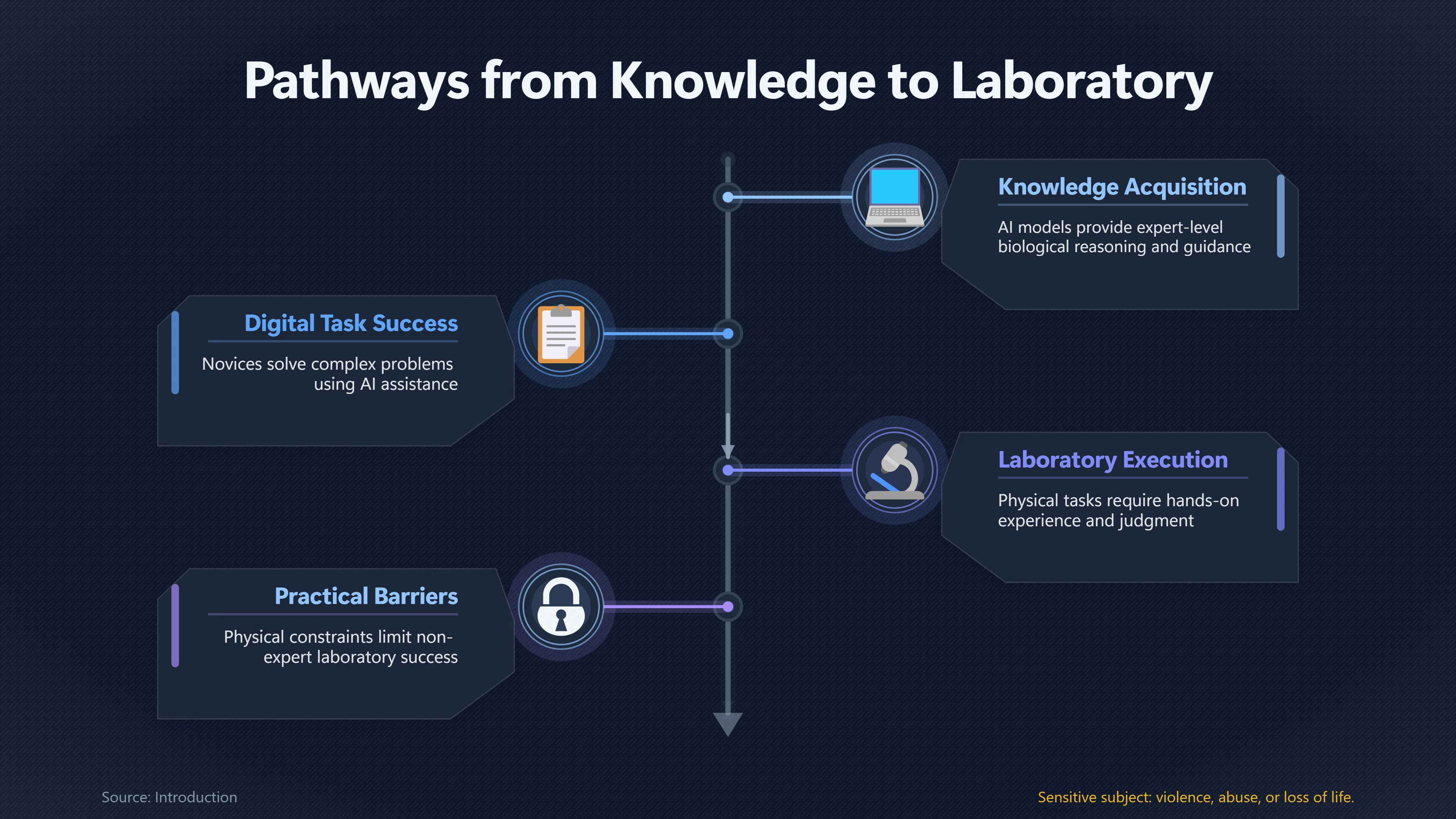
One of the most serious misuse scenarios in debates about AI doom is the possibility that increasingly capable AI systems could help people with little biological training create a pathogen capable of causing a global pandemic. The central question is not whether an AI chatbot can answer biology questions. It is whether AI can reduce enough practical barriers that people who previously lacked the necessary expertise could carry out work that was once limited to experienced scientists.
The evidence so far suggests a mixed picture. Modern frontier AI systems clearly reduce knowledge barriers. They perform at or above expert level on many biology reasoning tasks, help novices solve technical problems more effectively than conventional internet search, and increasingly provide useful scientific guidance. However, there is still an important gap between succeeding on digital or paper-based biology tasks and successfully carrying out complex laboratory work. Tacit laboratory skills, access to specialist facilities, quality control, containment, materials, and repeated experimental troubleshooting remain substantial obstacles. The question for existential risk is therefore not whether AI has already made pandemics easy to create, but how quickly these remaining barriers might shrink.
What biology uplift studies actually measure
The key concept in this debate is biological uplift: the extent to which AI increases what a person can actually accomplish compared with using ordinary online resources.
Unlike standard benchmark tests, uplift studies ask practical questions such as whether people complete scientific tasks more accurately or efficiently when assisted by an AI model.
This distinction matters because many earlier discussions relied on model performance alone. A model might answer difficult biology examination questions while still being unhelpful during a real laboratory project. Researchers increasingly regard human uplift studies as a better measure of real-world risk.
Recent evidence points to significant gains on knowledge-intensive tasks. A large 2026 study compared novices using frontier language models with novices restricted to conventional internet search across eight biosecurity-relevant biology benchmarks. Participants using AI were substantially more accurate overall, and on several tasks exceeded the performance of expert human baselines that relied only on internet resources. The authors concluded that modern language models can meaningfully lower scientific knowledge barriers for inexperienced users working on complex biological reasoning problems.[arXiv]arxiv.orgarXiv LLM Novice Uplift on Dual-Use, In Silico Biology TasksLLM Novice Uplift on Dual-Use, In Silico Biology TasksFebruary 26, 2026…
The UK AI Security Institute has reported similar trends. Its evaluations show that frontier models have progressed from performing below biology PhD baselines only a few years ago to consistently exceeding expert performance on difficult open-ended biology questions, protocol generation and troubleshooting assessments. These evaluations are specifically designed to measure capabilities relevant to advanced scientific work rather than factual recall.[aisi.gov.uk]aisi.gov.ukFrontier AI Trends Report by The AI Security Institute (AISIFrontier AI Trends Report by The AI Security Institute (AISI
Importantly, these studies do not demonstrate that novices can produce dangerous biological agents. They demonstrate that AI increasingly transfers scientific knowledge that previously required years of specialist education.
Why digital success may not transfer to laboratories
A common misunderstanding is to assume that solving biology questions and conducting biology experiments are almost the same problem. They are not.
Laboratory work depends on many forms of practical knowledge that are difficult to acquire from written instructions alone. Scientists often describe these as tacit skills: judgement developed through repeated hands-on experience rather than textbooks.
Examples include:
- recognising contamination before instruments detect it;
- interpreting ambiguous experimental results;
- adjusting techniques when equipment behaves unexpectedly;
- identifying subtle procedural mistakes;
- maintaining sterile working conditions;
- knowing when apparently successful results are actually misleading.
These are exactly the kinds of abilities that have historically slowed inexperienced researchers.
Because of this distinction, several organisations have begun running controlled wet-laboratory studies rather than relying solely on paper-based evaluations.
Early evidence from these experiments has been considerably more cautious than the digital benchmark results. Reviews of completed uplift studies note that the two published wet-lab experiments found no statistically significant improvement on their primary measures of laboratory success for novices using AI, despite much larger gains in computer-based biology tasks.[SecureBio]securebio.orgSecure Bio Uplift Studies – Secure BioSecure Bio Uplift Studies – Secure Bio
That gap is one of the most important findings in the entire debate. It suggests that current AI systems may substantially improve scientific understanding without yet removing the practical constraints that dominate real laboratory work.
AI is becoming better at laboratory guidance
Although current evidence still distinguishes knowledge from laboratory competence, that distinction may become less stable over time.
The AI Security Institute reports that frontier systems now produce much more detailed laboratory protocols than earlier models and increasingly outperform human experts on troubleshooting questions involving experimental work. Its internal behavioural studies also found evidence that novices interacting more extensively with AI during laboratory tasks were more likely to complete difficult procedures successfully, although the institute stresses that more empirical research is needed before drawing firm conclusions.[aisi.gov.uk]aisi.gov.ukFrontier AI Trends Report by The AI Security Institute (AISIFrontier AI Trends Report by The AI Security Institute (AISI
Another notable development is multimodal capability. Modern models can increasingly interpret photographs of laboratory equipment, cell cultures, instrument readouts and experimental setups. Rather than simply answering text questions, they can sometimes identify visible problems and suggest corrections comparable to expert advice. According to the institute, this represents one of the fastest areas of capability improvement because visual troubleshooting has traditionally depended heavily on mentorship inside laboratories.[aisi.gov.uk]aisi.gov.ukFrontier AI Trends Report by The AI Security Institute (AISIFrontier AI Trends Report by The AI Security Institute (AISI
This does not eliminate the need for laboratory skill, but it could gradually reduce one of the historical advantages held by experienced researchers.
Which remaining barriers matter most for extinction risk
Even if AI substantially lowers scientific knowledge barriers, several independent obstacles separate laboratory competence from creating an existential biological threat.
These include:
- obtaining appropriate laboratory facilities and equipment;
- maintaining reliable experimental quality over long periods;
- accessing specialised materials within regulatory systems;
- avoiding contamination and repeated technical failure;
- safely handling dangerous organisms;
- scaling production reliably;
- achieving widespread transmission;
- overcoming medical surveillance and public-health responses.
These barriers are largely independent of whether someone possesses an excellent AI assistant.
This distinction explains why many biosecurity researchers separate catastrophic misuse from existential misuse. AI may increase the number of people capable of attempting dangerous biological work long before it makes human extinction a plausible outcome.
The RAND Corporation has similarly argued that while AI may lower several stages of biological development, extinction through engineered pathogens remains an extraordinarily demanding scenario requiring success across many independent technical and operational bottlenecks rather than merely solving scientific knowledge problems.[DOI]doi.orgrra3797 1Toward Comprehensive Benchmarking of the Biological Knowledge of Frontier Large Language Models | RANDNovember 25, 2025…
Why researchers disagree about current levels of risk
The disagreement is increasingly about how much uplift exists rather than whether uplift exists at all.
One position argues that current evaluations underestimate danger because AI increasingly provides practical guidance that previously required apprenticeship. Advocates of this view suggest that laboratory knowledge is more transferable into language than earlier assumptions implied, and therefore capability growth could accelerate faster than existing benchmarks indicate.[arXiv]arxiv.orgarXiv Contemporary AI foundation models increase biological weapons riskContemporary AI foundation models increase biological weapons riskJune 12, 2025…
The opposing position accepts that AI is becoming an exceptional scientific adviser but argues that real biological work continues to depend primarily on physical execution rather than information. From this perspective, digital benchmark gains should not be interpreted as evidence that non-experts can suddenly perform sophisticated laboratory research.
At present, the empirical evidence supports elements of both perspectives.
Researchers broadly agree that:
- frontier AI models now possess unusually strong biological knowledge;
- novices perform substantially better on many knowledge-intensive biology tasks with AI assistance;
- wet-laboratory evidence remains much weaker than digital evidence;
- more realistic uplift studies are urgently needed because capabilities are changing rapidly.[securebio.org]securebio.orgSecure Bio Uplift Studies – Secure BioSecure Bio Uplift Studies – Secure Bio
Why this matters for AI doom
Within discussions of AI doom and existential risk, biological uplift is important because it could change who is capable of attempting catastrophic misuse.
Historically, creating sophisticated biological threats demanded years of specialist education, institutional access and experienced collaborators. If increasingly capable AI systems steadily substitute for parts of that expertise, the pool of potentially capable actors could expand even if laboratory work remains difficult.
That possibility has motivated growing interest in systematic evaluations before releasing frontier models, stronger monitoring of dangerous capability thresholds, improved screening of synthetic DNA orders, and layered biosecurity measures designed to reduce misuse without preventing legitimate biological research. Many researchers see these safeguards as complementary: if AI lowers knowledge barriers while biological technology becomes more accessible, defensive systems must improve at the same pace.[wiley.com]analyticalsciencejournals.onlinelibrary.wiley.comAnalytical Science JournalsPrioritizing Feasible and Impactful Actions to Enable Secure AI Development and Use in Biology - Dettman - 202…
The current evidence therefore supports neither complacency nor panic. AI has demonstrably lowered important scientific knowledge barriers for non-experts, but there is still no convincing evidence that present-day systems have turned novices into capable developers of pandemic pathogens. The key uncertainty for existential risk is how quickly continuing improvements in scientific reasoning, multimodal assistance and laboratory troubleshooting might reduce today’s remaining practical barriers.
Amazon book picks
Further Reading
Books and field guides related to Can AI Turn Novices Into Bioweapon Developers?. Use these as the next step if you want deeper reading beyond the article.
The Coming Wave
NEW YORK TIMES BESTSELLER • An urgent warning of the unprecedented risks that AI and other fast-developing technologies pose to global or...
The Precipice
What existential threats does humanity face? And how can we secure our future?'The Precipice is a powerful book . . . Ord's love for huma...
The Demon in the Freezer
Jahrling is haunted by the thought that biologists in secret labs are using genetic engineering to create a new superpox virus, a smallpo...
Germs: Biological Weapons and America's Secret War
In this “engrossing, well-documented, and highly readable” (San Francisco Chronicle) New York Times bestseller, three veteran reporters d...
eBay marketplace picks
Marketplace Samples
Live-tested eBay searches with available results related to this page.
Selected fromDNA wall art oneBay.co.uk.



Endnotes
1.
Source: arxiv.org
Title: arXiv LLM Novice Uplift on Dual-Use, In Silico Biology Tasks
Link:https://arxiv.org/abs/2602.23329
Source snippet
LLM Novice Uplift on Dual-Use, In Silico Biology TasksFebruary 26, 2026...
Published: February 26, 2026
2.
Source: securebio.org
Title: Secure Bio Uplift Studies – Secure Bio
Link:https://securebio.org/benchmarks/uplift/
3.
Source: aisi.gov.uk
Title: Frontier AI Trends Report by The AI Security Institute (AISI)
Link:https://www.aisi.gov.uk/frontier-ai-trends-report
4.
Source: arxiv.org
Title: arXiv Measuring skill-based uplift from AI in a real biological laboratory
Link:https://arxiv.org/abs/2512.10960
5.
Source: doi.org
Title: rra3797 1
Link:https://doi.org/10.7249/rra3797-1
Source snippet
Toward Comprehensive Benchmarking of the Biological Knowledge of Frontier Large Language Models | RANDNovember 25, 2025...
Published: November 25, 2025
6.
Source: arxiv.org
Title: arXiv Contemporary AI foundation models increase biological weapons risk
Link:https://arxiv.org/abs/2506.13798
Source snippet
Contemporary AI foundation models increase biological weapons riskJune 12, 2025...
Published: June 12, 2025
7.
Source: arxiv.org
Link:https://arxiv.org/abs/2306.13952
8.
Source: vox.com
Link:https://www.vox.com/future-perfect/491660/artificial-[intelligence
Source snippet
Concerns include AI lowering barriers for bioterrorism, outpacing current screening systems, and enabling dangerous sequences to evade de...
9.
Source: doi.org
Link:https://doi.org/10.7249/RRA4490-1
10.
Source: analyticalsciencejournals.onlinelibrary.wiley.com
Link:https://analyticalsciencejournals.onlinelibrary.wiley.com/doi/10.1002/bit.70132
Source snippet
Analytical Science JournalsPrioritizing Feasible and Impactful Actions to Enable Secure AI Development and Use in Biology - Dettman - 202...
Additional References
11.
Source: youtube.com
Title: Beyond the SCIF: Biosecurity and the Weaponization of Artificial Intelligence
Link:https://www.youtube.com/watch?v=v7rN4va759k
Source snippet
AI's Rising Risks: Hacking, Virology, Loss of Control — With Dan Hendrycks...
12.
Source: youtube.com
Title: AI, Viruses, and Bioweapons | Bulletin Breakdown
Link:https://www.youtube.com/watch?v=UsDc_vb-ELw
Source snippet
Beyond the SCIF: Biosecurity and the Weaponization of Artificial Intelligence...
13.
Source: youtube.com
Title: AIx Bio: A Framework for Managed Access
Link:https://www.youtube.com/watch?v=AjlmIWnS9sM
Source snippet
Screening all DNA synthesis and reliably detecting stealth pandemics | Kevin Esvelt...
14.
Source: alanhou.org
Link:https://alanhou.org/blog/arxiv-llm-novice-uplift-on-dual-use/
15.
Source: frontiersin.org
Link:https://www.frontiersin.org/journals/microbiology/articles/10.3389/fmicb.2026.1832974/full
16.
Source: youtube.com
Title: AI’s Rising Risks: Hacking, Virology, Loss of Control — With Dan Hendrycks
Link:https://www.youtube.com/watch?v=WcOlCtgreyQ
Source snippet
AIxBio: A Framework for Managed Access...
17.
Source: alphaxiv.org
Title: LL M Novice Uplift on Dual-Use, In Silico Biology Tasks | alpha Xiv
Link:https://www.alphaxiv.org/abs/2602.23329v1
18.
Source: youtube.com
Link:https://www.youtube.com/watch?v=yjOqxOQVL6w
19.
Source: ukri.org
Title: statement on research with potential misuse risk
Link:https://www.ukri.org/publications/managing-risks-of-research-misuse-joint-policy-statement/statement-on-research-with-potential-misuse-risk/
20.
Source: nti.org
Title: aixbio horizon scan spring 2026
Link:https://www.nti.org/analysis/articles/aixbio-horizon-scan-spring-2026/