Within Parallel Researchers
Can Thousands of AI Experiments Compress Progress?
Copied AI researchers could explore thousands of competing ideas at once, turning machine learning progress into a rapidly branching search.
On this page
- How parallel experiment branches multiply the search space
- How successful results feed the next round of trials
- Why experiment throughput may matter more than individual brilliance
Page outline Jump by section
Introduction
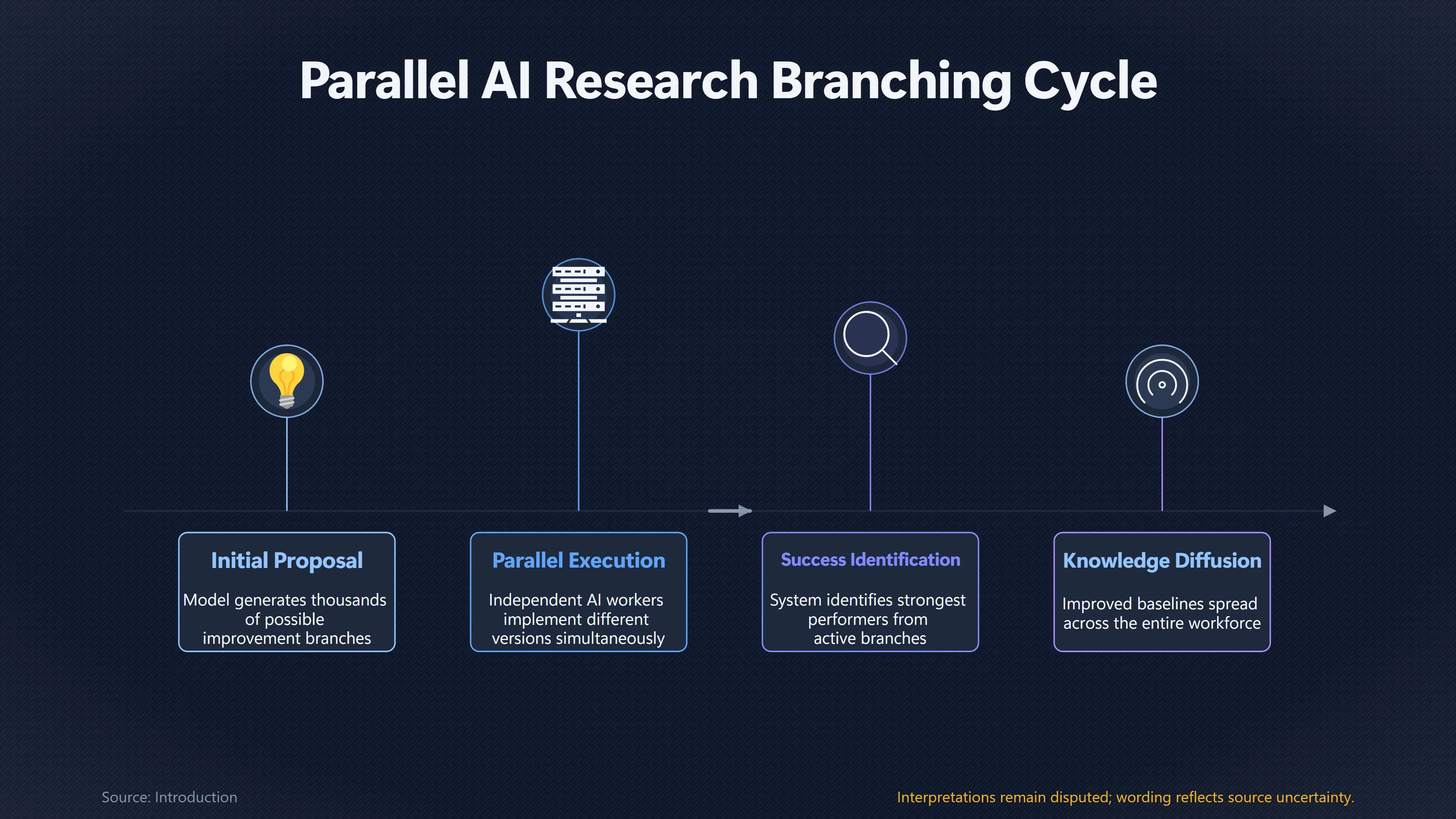
A common picture of AI progress is a single brilliant breakthrough that suddenly changes everything. The mechanism discussed in AI doom debates is often different. Instead of one extraordinary insight, the concern is that advanced AI systems could make far more research happen at the same time. If capable AI researchers can be copied cheaply and assigned to independent tasks, thousands of experiment branches could run in parallel, with successful ideas feeding directly into the next wave of experiments. The result is a rapidly branching search through possible improvements rather than a single line of investigation.
This possibility matters because modern machine learning research is unusually well suited to parallel digital work. Writing code, launching training jobs, analysing results and testing variations can often be divided into independent tasks. If AI systems automate much of this workflow, the pace of improvement may depend less on finding one exceptional discovery and more on dramatically increasing the number of useful experiments completed per day. Whether this would merely speed existing trends or contribute to much faster capability gains remains an open question, but it is one reason why parallel AI researchers receive attention in discussions of AI existential risk.[arXiv]arxiv.orgarXiv Measuring AI R&D AutomationMeasuring AI R&D AutomationMarch 4, 2026…
How parallel experiment branches multiply the search space
Machine learning research already resembles a search through an enormous landscape of possible designs. Researchers rarely know in advance which combination of architecture, training method, dataset, optimisation strategy or evaluation procedure will work best. Progress usually comes from trying many alternatives and discarding most of them.
Human teams are constrained by limited staff and time. Even well-funded laboratories cannot test every plausible variation. AI researchers that can be duplicated remove part of that constraint. Instead of choosing between ten promising ideas, thousands of digital workers could each investigate a different branch simultaneously.
The branching process can look something like this:
- An initial model proposes hundreds or thousands of possible improvements.
- Independent AI workers implement different versions.
- Each branch runs experiments in parallel.
- The most successful branches become starting points for another round of variation.
- Less successful branches are abandoned without slowing the rest of the search.
Rather than following one research path, the system continually expands and prunes a large tree of competing ideas. This resembles search methods used throughout computer science, but applied to AI research itself. The critical difference is that the search may be limited primarily by available computing resources rather than by the number of human scientists.[arXiv]arxiv.orgarXiv AIRA_2: Overcoming Bottlenecks in AI Research AgentsarXiv AIRA_2: Overcoming Bottlenecks in AI Research Agents
How successful results feed the next round of trials
Parallel experimentation becomes more powerful when successful discoveries spread immediately across all active workers.
A human research organisation often experiences delays. Results must be written up, meetings held, code reviewed and new priorities agreed before everyone benefits from a promising discovery. Even highly efficient laboratories lose time through communication and coordination.
Digital AI researchers could shorten many of these delays. Once one branch discovers a useful optimisation, improved debugging method or better training configuration, every future worker could begin from that improved baseline almost immediately.
This creates a repeated cycle:
- explore many independent possibilities
- identify the strongest performers
- copy those improvements across the workforce
- generate another wave of variations from the improved starting point
Each cycle increases the average quality of subsequent experiments. Even if most branches fail, failures mainly consume computation rather than scarce expert attention.
Recent research into autonomous AI research agents reflects this emphasis on throughput. The AIRA₂ system, for example, replaces sequential execution with an asynchronous pool of workers so experiments no longer wait for one another. The authors report that increasing available GPUs increases experiment throughput roughly linearly within their architecture, allowing more candidate ideas to be explored over the same period. This does not prove explosive progress, but it illustrates how engineering changes that increase parallel experimentation can improve research performance.[arXiv]arxiv.orgarXiv AIRA_2: Overcoming Bottlenecks in AI Research AgentsarXiv AIRA_2: Overcoming Bottlenecks in AI Research Agents
Why experiment throughput may matter more than individual brilliance
A common misconception is that accelerating AI progress requires each AI researcher to become dramatically more intelligent than today’s best human experts.
Many researchers instead distinguish between individual capability and collective throughput.
Imagine two research organisations:
- The first employs ten exceptional scientists.
- The second employs ten good scientists but somehow completes one thousand carefully designed experiments every day.
In many scientific fields, especially empirical ones, the second organisation may discover useful improvements more quickly simply because it explores much more of the available design space.
Machine learning has several properties that make this argument particularly relevant:
- many hypotheses can be tested independently
- experiments produce quantitative feedback relatively quickly
- software changes can often be evaluated automatically
- failed experiments still provide information about what does not work
- successful implementations can be copied perfectly
From this perspective, increasing the number of useful experimental attempts may produce larger gains than making each individual researcher modestly smarter. AI doom arguments that emphasise recursive improvement often rely on this possibility rather than assuming the sudden appearance of scientific supergeniuses.
Why branching search may compress research timelines
Suppose a laboratory would normally investigate one hundred promising ideas over a year because of staffing limits.
If ten thousand AI workers can each execute independent research tasks around the clock, the laboratory may be able to evaluate a comparable number of branches in days or weeks instead of months. The relationship is unlikely to be perfectly linear because experiments compete for computing resources, some require long training runs and many depend on earlier discoveries. Nevertheless, reducing wall-clock time while maintaining high experimental quality could significantly shorten development cycles.[arXiv]arxiv.orgarXiv AIRA_2: Overcoming Bottlenecks in AI Research AgentsarXiv AIRA_2: Overcoming Bottlenecks in AI Research Agents
Shorter cycles matter because each completed round creates opportunities for another. Compressing the time between proposing an idea, testing it and incorporating the result allows improvements to accumulate more rapidly than in traditional research organisations.
In AI doom discussions, this mechanism is sometimes viewed as a potential contributor to recursive capability gains. Faster experimentation can produce better systems, which may automate more research work, increasing experiment throughput again. Whether such feedback remains modest or becomes much stronger is one of the central uncertainties in the debate.
What limits a massively parallel search?
The branching-search picture is not universally accepted as a recipe for extremely rapid progress. Several important constraints could limit its impact.
Not every experiment is independent. Some research questions require long sequential investigations rather than thousands of isolated tests.
Computing resources remain scarce. Running many capable AI researchers simultaneously demands substantial hardware, energy and infrastructure. Digital workers are easier to copy than humans, but they are not free.
Evaluation becomes a bottleneck. A search process is only as good as its ability to identify genuinely better solutions. Noisy benchmarks or poorly designed evaluations can cause systems to optimise misleading signals rather than real improvements. Recent work on AI research agents has highlighted reliable evaluation as a major technical challenge alongside experiment throughput.[arXiv]arxiv.orgarXiv AIRA_2: Overcoming Bottlenecks in AI Research AgentsarXiv AIRA_2: Overcoming Bottlenecks in AI Research Agents
Coordination still matters. Large numbers of workers can duplicate effort, pursue unproductive directions or overwhelm shared infrastructure unless the overall search is carefully organised.
These limitations mean that more parallelism does not automatically translate into proportionally faster scientific progress.
Why this mechanism matters in AI doom arguments
Within existential risk discussions, branching experiment search is significant because it offers a route to accelerating AI progress that does not depend on speculative assumptions about instant superintelligence.
If AI systems become capable enough to automate substantial parts of AI research, then simply increasing the number of concurrent experiments could compress development timelines. Faster iteration could reduce the amount of calendar time available for safety evaluations, governance responses and international coordination before increasingly capable systems are deployed.
This mechanism does not show that catastrophic outcomes are inevitable. It identifies one plausible way in which AI capabilities might advance more quickly than many observers intuitively expect. The key uncertainty is not whether parallel digital work is possible—it already exists in many forms—but how much additional useful research output increasingly capable AI researchers could generate once experiment throughput, coordination and evaluation all improve together. Current proposals to measure AI R&D automation therefore emphasise tracking not only benchmark performance but also how much real research labour AI systems replace and whether safety oversight keeps pace with accelerating capability development.[arXiv]arxiv.orgarXiv Measuring AI R&D AutomationMeasuring AI R&D AutomationMarch 4, 2026…
Amazon book picks
Further Reading
Books and field guides related to Can Thousands of AI Experiments Compress Progress?. Use these as the next step if you want deeper reading beyond the article.
The Alignment Problem: Machine Learning and Human Values
Finalist for the Los Angeles Times Book Prize A jaw-dropping exploration of everything that goes wrong when we build AI systems and the m...
Superintelligence: Paths, Dangers, Strategies
This profoundly ambitious and original book picks its way carefully through a vast tract of forbiddingly difficult intellectual terrain.
The Coming Wave: Technology, Power, and the Twenty-first Cent...
"We are approaching a critical threshold in the history of our species. Everything is about to change. Soon you will live surrounded by A...
The Master Algorithm: How the Quest for the Ultimate Learning...
Computer scientist Pedro Domingos, one of the field's leading lights, lifts the veil to give us a peek inside the learning machines that...
eBay marketplace picks
Marketplace Samples
Live-tested eBay searches with available results related to this page.
Selected fromartificial intelligence poster oneBay.co.uk.

Current eBay listing
A. I. Artificial Intelligence. Jude Law. Original UK Video Poster.



Current eBay listing
A.I. Artificial Intelligence - Jude Law - One Sheet Cinema Poster
Endnotes
1.
Source: arxiv.org
Title: arXiv Measuring AI R&D Automation
Link:https://arxiv.org/abs/2603.03992
Source snippet
Measuring AI R&D AutomationMarch 4, 2026...
Published: March 4, 2026
2.
Source: arxiv.org
Title: arXiv AIRA_2: Overcoming Bottlenecks in AI Research Agents
Link:https://arxiv.org/abs/2603.26499
3.
Source: arxiv.org
Title: arXiv Adaptive Parallel Iterative Deepening Search
Link:https://arxiv.org/abs/1105.5447
4.
Source: arxiv-troller.com
Title: AIR A_2: Overcoming Bottlenecks in AI Research Age…
Link:https://arxiv-troller.com/paper/3127731/
Additional References
5.
Source: alphaxiv.org
Title: alpha Xiv AIRA_2: Overcoming Bottlenecks in AI Research Agents | alpha Xiv
Link:https://www.alphaxiv.org/abs/2603.26499v1
Source snippet
AIRA_2: Overcoming Bottlenecks in AI Research Agents | alphaXivMarch 27, 2026 — AIRA_2: OVERCOMING BOTTLENECKS IN AI RESEARCH AGENTS Kare...
Published: March 27, 2026
6.
Source: researchtrend.ai
Title: AIR A_2: Overcoming Bottlenecks in AI Research Agents | Research Trend.AI
Link:https://researchtrend.ai/papers/2603.26499
Source snippet
AIRA_2: Overcoming Bottlenecks in AI Research Agents | ResearchTrend.AIMarch 30, 2026 — AIRA_2: OVERCOMING BOTTLENECKS IN AI RESEARCH AGE...
Published: March 30, 2026
7.
Source: alphaxiv.org
Title: AIR A_2: Overcoming Bottlenecks in AI Research Agents | alpha Xiv
Link:https://www.alphaxiv.org/overview/2603.26499v2
Source snippet
AIRA_2: Overcoming Bottlenecks in AI Research Agents | alphaXivApril 13, 2026 — AIRA_2: Overcoming Bottlenecks in AI Research Agents Apri...
Published: April 13, 2026
8.
Source: paperity.org
Title: aira 2 overcoming bottlenecks in ai research agents
Link:https://paperity.org/p/374083132/aira-2-overcoming-bottlenecks-in-ai-research-agents
Source snippet
AIRA_2: Overcoming Bottlenecks in AI Research Agents (pdf) | PaperityApril 13, 2026 — AIRA_2: OVERCOMING BOTTLENECKS IN AI RESEARCH AGENT...
Published: April 13, 2026
9.
Source: youtube.com
Title: Chain-of-Thought Is Not Enough — Your LLM Demands Tree of Thoughts
Link:https://www.youtube.com/watch?v=nz054BhDIzI
Source snippet
Enhancing Reasoning of Large Language Models through Reward-Guided Search and Self-Training...
10.
Source: youtube.com
Link:https://www.youtube.com/watch?v=bPaYQ3W31dI
Source snippet
Tree of Thoughts: Deliberate Problem Solving with Large Language Models (Full Paper Review)...
11.
Source: youtube.com
Link:https://www.youtube.com/watch?v=1DcZGAAF1CA
Source snippet
AI Automates Scientific Discovery with Agentic Tree Search...
12.
Source: asi-research.com
Link:https://asi-research.com/library/meta-aira2/
Source snippet
AIRA2: Overcoming Bottlenecks in AI Research Agents | ASI ResearchApril 16, 2026 — ASI-LIB-035 16 Apr 2026 technical AI research agents A...
Published: April 16, 2026
13.
Source: youtube.com
Title: AI Automates Scientific Discovery with Agentic Tree Search
Link:https://www.youtube.com/watch?v=EB0P3eNl0eU
Source snippet
Chain-of-Thought Is Not Enough — Your LLM Demands Tree of Thoughts...
14.
Source: youtube.com
Link:https://www.youtube.com/watch?v=ut5kp56wW_4