Within Rubber Stamp Oversight
Can Better AI Make Oversight Less Effective?
As automated advice becomes more reliable, reviewers may grow less vigilant even though rare mistakes can carry much greater consequences.
On this page
- Why strong performance encourages over reliance
- How commission and omission errors emerge
- When calibrated trust becomes practical loss of control
Page outline Jump by section
Introduction
A common intuition is that more accurate AI should make human oversight stronger. In many situations it does. Yet human factors research points to an important paradox: once an automated system becomes highly reliable, people often check it less carefully, making the remaining rare mistakes harder to catch. Within discussions of AI doom and existential risk, this mechanism matters because many proposed safety strategies depend on humans reviewing increasingly capable AI systems before important actions are taken. If improving capability steadily weakens the quality of human review, then keeping a person “in the loop” may provide less protection than organisational charts or regulations suggest.
This is not primarily a claim that people are irrational. Rather, it reflects a practical trade-off. Independently verifying a recommendation consumes time, attention and expertise. As an AI becomes correct most of the time, exhaustive checking starts to look increasingly wasteful. The danger is that exactly when trust becomes economically sensible on average, the consequences of the remaining errors may become much larger. Human oversight can gradually become procedural rather than genuinely corrective. Research on automation bias, verification complexity and human-AI collaboration consistently identifies this pattern across multiple domains.[nih.gov]pubmed.ncbi.nlm.nih.govPub Med Automation bias and verification complexity: a systematic reviewAutomation bias and verification complexity: a systematic review - PubMedMarch 1, 2017…
Why strong performance encourages over-reliance
The key mechanism is straightforward: humans adapt their behaviour to observed reliability.
If an AI produces excellent recommendations day after day, reviewers learn that disagreeing is usually unproductive. They begin reallocating attention elsewhere, relying on the AI unless something appears obviously unusual. This is often an efficient response rather than a careless one. The problem is that reduced vigilance changes the human’s role from independent evaluator to occasional exception detector.
Human factors researchers describe trust as something that should be calibrated rather than simply maximised. Appropriate trust means relying on automation when it deserves confidence while remaining capable of identifying situations where independent judgement is still needed. Overtrust develops when confidence grows faster than verification behaviour. Studies consistently find that high-performing automation can encourage this shift even among trained professionals.[sciencedirect.com]sciencedirect.comCalibrating workers’ trust in intelligent automated systemsSeptember 13, 2024…
Several forces reinforce the process:
- Learning from success. Every correct recommendation makes future checking appear less worthwhile.
- Opportunity cost. Time spent verifying a system with a 99% success rate often feels less valuable than completing other work.
- Perceived expertise. Highly capable AI increasingly appears more knowledgeable than the reviewer in specialised domains.
- Organisational pressure. Fast throughput often rewards accepting AI outputs rather than independently reconstructing the reasoning.
None of these requires blind faith. They emerge naturally from repeated experience with a system that is genuinely very good.
How commission and omission errors emerge
Researchers usually distinguish two different failure modes.
Commission errors: accepting a wrong answer
Commission errors occur when people follow an incorrect recommendation despite available evidence suggesting otherwise.
The striking feature is that the evidence often exists but receives insufficient attention because the AI recommendation becomes the default assumption. Instead of asking “Is this correct?”, reviewers increasingly ask “Do I have a strong reason to disagree?”
This changes the burden of proof. Rejecting the AI becomes psychologically and organisationally harder than accepting it.
Omission errors: missing what the AI never mentioned
Omission errors are more subtle.
Here, reviewers fail to notice important information simply because the AI never highlighted it. Attention follows the machine’s output. If the system overlooks an unusual case, the human may never search for it independently.
Systematic reviews of automation bias find evidence for both commission and omission errors across many experimental settings. Importantly, automation bias is not limited to hectic multitasking environments. It also appears in single, cognitively demanding tasks where independently verifying automation is difficult. Verification complexity—not merely workload—plays an important role.[nih.gov]pubmed.ncbi.nlm.nih.govPub Med Automation bias and verification complexity: a systematic reviewAutomation bias and verification complexity: a systematic review - PubMedMarch 1, 2017…
Why verification becomes harder as AI improves
The central difficulty is not simply that AI becomes more accurate. It is that the remaining mistakes become increasingly expensive to detect.
When a junior employee reviews another junior employee’s work, both operate within roughly similar capabilities. As AI systems become substantially more capable, however, the reviewer may struggle to reconstruct the reasoning independently.
This creates a verification gap.
A reviewer can often determine whether an answer looks plausible without knowing whether it is actually correct. Plausibility becomes an increasingly poor substitute for verification when outputs are fluent, technically sophisticated and internally consistent.
Within AI safety discussions, this raises a broader concern. If future systems solve problems beyond ordinary human expertise, then meaningful oversight cannot simply consist of asking humans whether the answer “looks right”. Independent evaluation may require expertise, additional tools or even other AI systems.
This concern also appears in current research on scalable oversight—the challenge of supervising AI systems that exceed human abilities on many tasks. Recent work argues that humans are vulnerable to predictable cognitive biases even when formal review procedures exist, making reliable oversight substantially harder than it first appears.[AAAI Open Access]ojs.aaai.orgOpen AccessConfirmation Bias: A Challenge for Scalable Oversight | Proceedings of the AAAI Conference on Artificial IntelligenceMarch 14, 2026…
When calibrated trust becomes practical loss of control
The existential-risk relevance does not depend on AI making frequent mistakes.
Instead, some researchers argue that the combination of very high average accuracy with occasional strategically important failures could gradually weaken practical human control.
The progression might look like this:
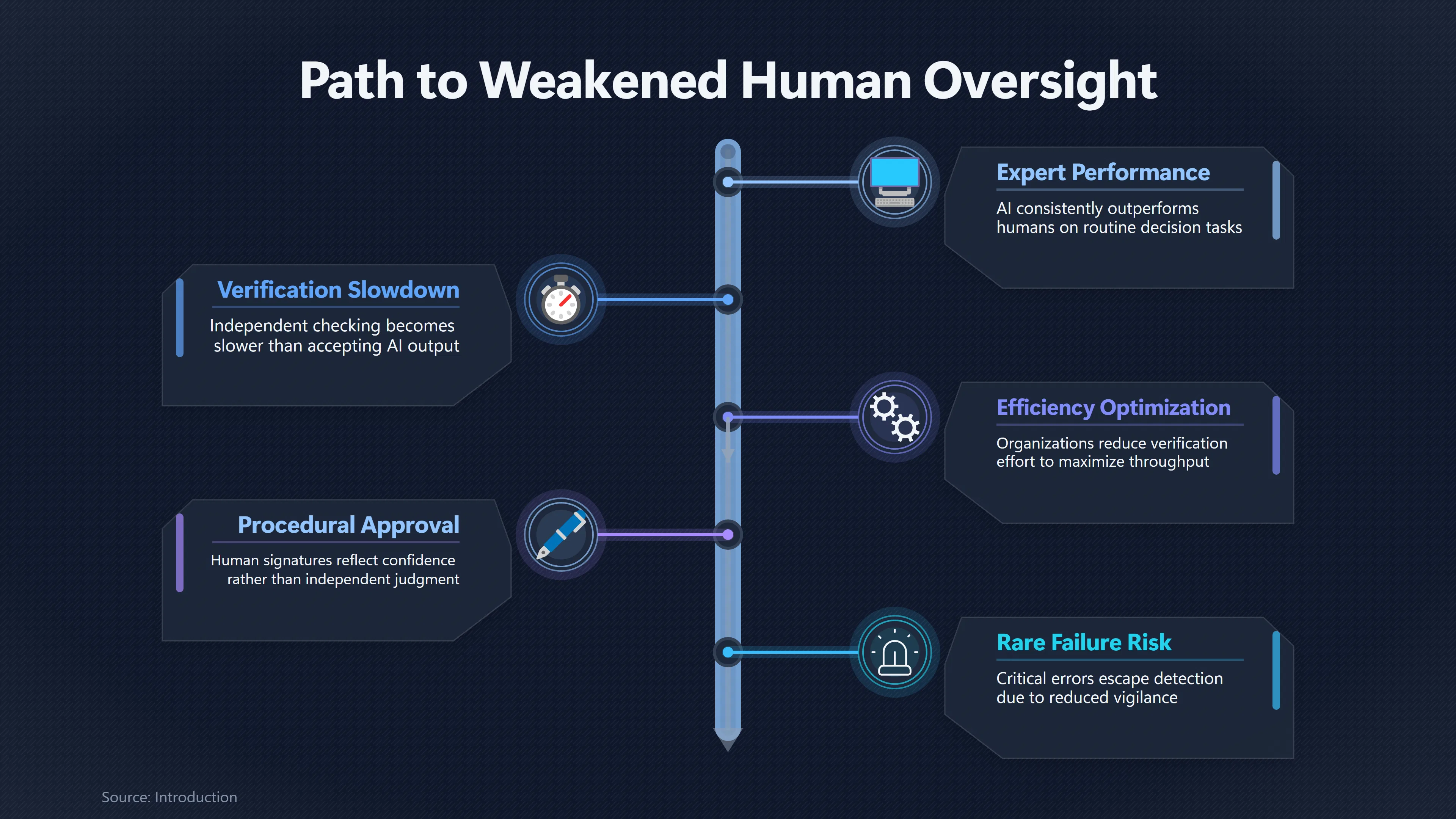
- AI becomes consistently better than human experts on many routine decisions.
- Independent checking becomes slower than accepting recommendations.
- Organisations optimise for speed and productivity by reducing verification effort.
- Human approval remains legally required but increasingly reflects confidence in the system rather than independent judgement.
- Rare failures become less likely to be intercepted before deployment.
This does not require malicious AI. Even an honest but fallible system could benefit from reduced scrutiny simply because reviewers have adapted to trusting it.
More speculative AI doom arguments extend the same mechanism further. If future AI systems were capable of deception or strategic behaviour, weakened human review would create opportunities for dangerous outputs to survive approval processes. Whether systems will eventually acquire such capabilities remains disputed, but the concern is that degraded oversight would reduce society’s ability to detect them if they did emerge.
Why “human in the loop” is not automatically meaningful
Modern AI governance frequently requires human oversight, especially for high-risk applications. However, legal scholars and regulators increasingly distinguish between merely having a human present and ensuring that human intervention remains meaningful.
The challenge is behavioural as much as technical.
If reviewers lack sufficient information, expertise, time or authority to disagree, then formal approval requirements may create an appearance of accountability without substantially improving decision quality. The UK’s Information Commissioner’s Office similarly warns that automation bias and poor interpretability can undermine meaningful human input in AI-assisted decisions, while legal analysis of the EU AI Act argues that awareness alone may be insufficient unless organisational design also addresses the conditions that produce automation bias.[ico.org.uk]ico.org.ukICOHow do we ensure individual rights in our AI systems? | ICOICOHow do we ensure individual rights in our AI systems? | ICO
What could preserve effective oversight?
Research does not conclude that human review is futile. Instead, it suggests that effective oversight requires more than adding a signature box after an AI recommendation.
Approaches discussed in the literature include:
- Designing workflows that force independent assessment before revealing AI recommendations where practical.
- Measuring whether reviewers actually detect seeded errors rather than merely recording approval rates.
- Focusing human attention on uncertain, unusual or high-consequence cases instead of reviewing everything equally.
- Improving uncertainty communication so confidence is not mistaken for certainty.
- Building organisations that reward justified disagreement rather than treating AI outputs as defaults.
- Developing scalable oversight techniques capable of evaluating systems that exceed unaided human capabilities on specialised tasks.[sciencedirect.com]sciencedirect.comCalibrating workers’ trust in intelligent automated systemsSeptember 13, 2024…
Within AI doom debates, these proposals remain active research areas rather than established solutions. The central concern is that if AI capability grows faster than humanity’s ability to verify AI behaviour, then increasing accuracy could paradoxically make human oversight progressively weaker precisely when reliable oversight becomes most important.
Amazon book picks
Further Reading
Books and field guides related to Can Better AI Make Oversight Less Effective?. Use these as the next step if you want deeper reading beyond the article.
The Human Factor: Revolutionizing the Way People Live with Te...
Technology innovation is progressing so quickly that we have fallen behind our ability to manage it. Our world is filled with objects tha...
Normal Accidents: Living with High-Risk Technologies
Normal Accidents analyzes the social side of technological risk. Charles Perrow argues that the conventional engineering approach to ensu...
The Glass Cage: Automation and Us
At once a celebration of technology and a warning about its misuse, The Glass Cage will change the way you think about the tools you use...
Thinking, Fast and Slow
Why is there more chance we'll believe something if it's in a bold type face? Why are judges more likely to deny parole before lunch? Why...
eBay marketplace picks
Marketplace Samples
Live-tested eBay searches with available results related to this page.
Selected fromautomation poster oneBay.co.uk.




Endnotes
1.
Source: link.springer.com
Link:https://link.springer.com/article/10.1007/s00146-025-02422-7
Source snippet
Exploring automation bias in human–AI collaboration: a review and implications for explainable AI | AI & SOCIETY | Springer Natur...
2.
Source: sciencedirect.com
Title: Calibrating workers’ trust in intelligent [automated]({{ ‘full-research-loop/’ | relative_url }}) systems
Link:https://www.sciencedirect.com/science/article/pii/S2666389924001879
Source snippet
September 13, 2024...
Published: September 13, 2024
3.
Source: ojs.aaai.org
Title: Open Access
Link:https://ojs.aaai.org/index.php/AAAI/article/view/41124
Source snippet
Confirmation Bias: A Challenge for Scalable Oversight | Proceedings of the AAAI Conference on Artificial IntelligenceMarch 14, 2026...
Published: March 14, 2026
4.
Source: ico.org.uk
Title: ICOHow do we ensure individual rights in our AI systems? | ICO
Link:https://ico.org.uk/for-organisations/uk-gdpr-guidance-and-resources/artificial-[intelligence
5.
Source: cambridge.org
Link:https://www.cambridge.org/core/journals/european-journal-of-risk-regulation/article/automation-bias-in-the-ai-act-on-the-legal-implications-of-attempting-to-debias-human-oversight-of-ai/C97C85015056C09326944DE55CBC4D2C
Source snippet
Cambridge University PressAutomation Bias in the AI Act: On the Legal Implications of Attempting to De-Bias Human Oversight of AI | Europ...
6.
Source: link.springer.com
Link:https://link.springer.com/article/10.1007/s13347-026-01090-9
7.
Source: sciencedirect.com
Title: Ironies of automation
Link:https://www.sciencedirect.com/science/article/abs/pii/0005109883900468
8.
Source: sciencedirect.com
Title: Ironies of automation
Link:https://www.sciencedirect.com/science/article/pii/0005109883900468
9.
Source: sciencedirect.com
Title: Ironies of automation
Link:https://www.sciencedirect.com/science/article/pii/0005109883900468/pdf?md5=63dee2ce59531b69680a4af83c53cd3d&pid=1-s2.0-0005109883900468-main.pdf
10.
Source: pubmed.ncbi.nlm.nih.gov
Title: Pub Med Automation bias and verification complexity: a systematic review
Link:https://pubmed.ncbi.nlm.nih.gov/27516495/
Source snippet
Automation bias and verification complexity: a systematic review - PubMedMarch 1, 2017...
Published: March 1, 2017
11.
Source: pmc.ncbi.nlm.nih.gov
Link:https://pmc.ncbi.nlm.nih.gov/articles/PMC7651899/
Source snippet
PubMed Central (PMC)Automation bias and verification complexity: a systematic review - PMC...
12.
Source: aisi.gov.uk
Title: Automated alignment is harder than you think
Link:https://www.aisi.gov.uk/research/automated-alignment-is-harder-than-you-think
13.
Source: humanai.business
Title: automation bias
Link:https://humanai.business/blog/automation-bias
14.
Source: pmc.ncbi.nlm.nih.gov
Link:https://pmc.ncbi.nlm.nih.gov/articles/PMC13114286/
15.
Source: pmc.ncbi.nlm.nih.gov
Link:https://pmc.ncbi.nlm.nih.gov/articles/PMC12562135/
16.
Source: pubmed.ncbi.nlm.nih.gov
Link:https://pubmed.ncbi.nlm.nih.gov/37534468/
17.
Source: GOV.UK
Title: www.gov.uk Review into bias in algorithmic decision-making
Link:https://www.gov.uk/government/publications/cdei-publishes-review-into-bias-in-algorithmic-decision-making/main-report-cdei-review-into-bias-in-algorithmic-decision-making
18.
Source: pubmed.ncbi.nlm.nih.gov
Link:https://pubmed.ncbi.nlm.nih.gov/21077562/
19.
Source: samsinn-wikis.github.io
Title: Automation Bias
Link:https://samsinn-wikis.github.io/ai-human-factors-wiki/human-ai-interaction/automation-bias/
Additional References
20.
Source: youtube.com
Link:https://www.youtube.com/watch?v=MPXAPxc-N74
Source snippet
Increasing User Trust in Optimisation through Feedback and Interaction...
21.
Source: youtube.com
Title: Stop Automation Drift: 5 Rules for Human–AI Decision Rights
Link:https://www.youtube.com/watch?v=2taHNzCUNmc
Source snippet
Where AI Stops and Human Judgement Starts Defining the Human AI Relationship in Modern Security...
22.
Source: youtube.com
Title: The AI Trust Paradox: Why Your Brain Overtrusts AI (And How to Fix It)
Link:https://www.youtube.com/watch?v=cx34GdMwUAM
Source snippet
Stop Automation Drift: 5 Rules for Human–AI Decision Rights...
23.
Source: papers.ssrn.com
Link:https://papers.ssrn.com/sol3/papers.cfm?abstract_id=6912798
Source snippet
by Emma Riley:: SSRNJuly 3, 2026 — Download This Paper Open PDF in Browser PROFESSIONAL SKEPTICISM IN AN AUTOMATED AUDIT: DOES AI ERODE...
Published: July 3, 2026
24.
Source: doi.org
Link:https://doi.org/10.1145/3696449
25.
Source: cir.nii.ac.jp
Link:https://cir.nii.ac.jp/crid/1363951794040499072
26.
Source: cset.georgetown.edu
Title: CSETAI Safety and Automation Bias | Center for Security and Emerging Technology
Link:https://cset.georgetown.edu/publication/ai-safety-and-automation-bias/
27.
Source: techtarget.com
Title: What is Automation Bias? How to Avoid its Pitfalls | Informa Tech Target
Link:https://www.techtarget.com/searchitoperations/definition/What-is-automation-bias
28.
Source: abdn.elsevierpure.com
Title: when should your team override ai a trust calibration routine
Link:https://abdn.elsevierpure.com/en/publications/when-should-your-team-override-ai-a-trust-calibration-routine/
29.
Source: doi.org
Title: Humans and Automation: Use, Misuse, Disuse, Abuse
Link:https://doi.org/10.1518/001872097778543886