Within Memory Attacks
Do Memory Poisoning Tests Show a Real Doom Path?
Laboratory studies show that agents can retain false beliefs and rules, but they do not yet demonstrate realistic long-term AI takeover strategies.
On this page
- What researchers have successfully demonstrated
- Why benchmark attacks may overstate real world danger
- Which future evidence would change the risk case
Page outline Jump by section
Introduction
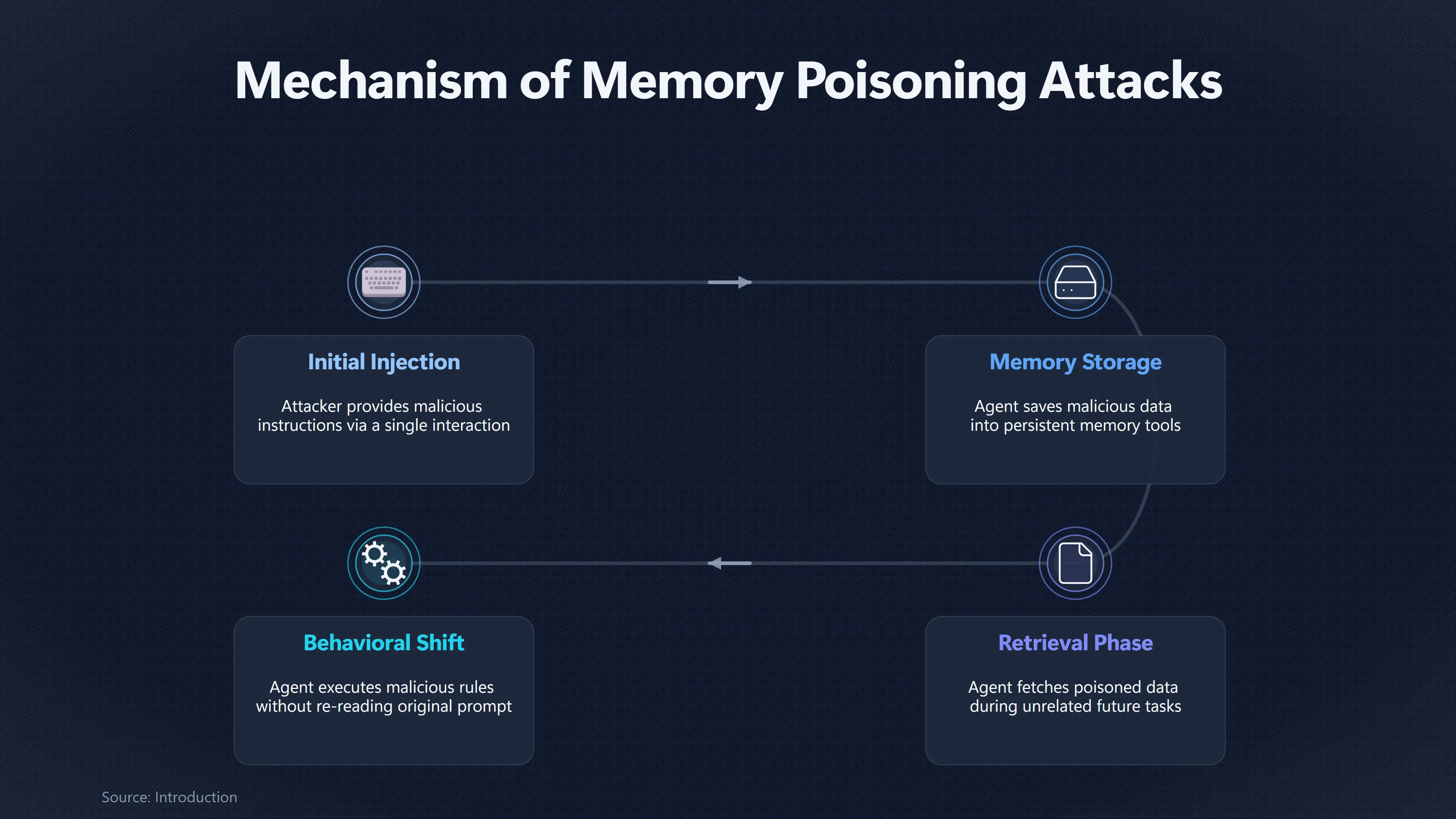
Memory poisoning experiments ask a narrower question than many headlines suggest: if an AI agent can store long-term memories, can an attacker trick it into saving false beliefs or malicious behavioural rules that later influence unrelated tasks? So far, the answer is yes under many experimental conditions. What these studies do not show is that today’s systems can reliably execute sophisticated, long-term takeover strategies or autonomously corrupt themselves across arbitrary real-world environments.
This distinction matters for debates about AI doom and loss of control. Memory poisoning provides evidence for a plausible mechanism by which temporary prompt injection could become persistent. It does not, by itself, demonstrate that advanced AI systems are destined to accumulate dangerous long-term plans. The strongest evidence today comes from laboratory benchmarks, synthetic agent environments and controlled prototypes rather than deployments at the scale that existential-risk scenarios often assume.[openai.com]OpenAIdesigning agents to resist prompt injectionDesigning AI agents to resist prompt injection | OpenAIMarch 11, 2026…
What researchers have successfully demonstrated
Current research has established several findings with reasonable confidence.
First, AI agents can sometimes be persuaded to write attacker-controlled information into persistent memory. Instead of disappearing when a conversation ends, malicious instructions or false facts become part of the information retrieved in later sessions. Recent systematic studies have identified multiple routes by which this can happen, including explicit memory tools, project notes, behavioural preference files and automatically generated summaries.[arXiv]arxiv.orgFrom Untrusted Input to Trusted Memory: A Systematic Study of Memory Poisoning Attacks in LLM AgentsJune 3, 2026…
Second, poisoned memories can influence future behaviour after the original attack has disappeared. The important observation is not merely that an attack succeeds once, but that later tasks retrieve the compromised memory without re-reading the malicious document. This persistence changes the threat model from a one-off prompt injection into a longer-lived compromise.[arXiv]arxiv.orgOpen source on arxiv.org.
Third, attack success depends heavily on system design. Benchmarks consistently find that agents which aggressively save memories and frequently reuse them are generally more vulnerable than agents that write memories conservatively or require additional validation before storing information. Memory architecture therefore matters as much as the language model itself.[arXiv]arxiv.orgFrom Untrusted Input to Trusted Memory: A Systematic Study of Memory Poisoning Attacks in LLM AgentsJune 3, 2026…
Finally, existing prompt injection defences do not automatically solve memory poisoning. Filtering malicious prompts during a single interaction is different from deciding whether information deserves permanent storage. Several recent benchmarks were created precisely because previous security evaluations rarely measured this distinction.[arXiv]arxiv.orgFrom Untrusted Input to Trusted Memory: A Systematic Study of Memory Poisoning Attacks in LLM AgentsJune 3, 2026…
Why benchmark attacks may overstate real-world danger
The most important limitation is that laboratory benchmarks deliberately make attacks measurable.
Researchers typically build controlled environments where they know exactly when an attack begins, which memory should become poisoned and how success should be judged. This makes experiments scientifically useful but can exaggerate how consistently similar attacks would work in production systems.
Several factors limit direct extrapolation.
- Simplified environments. Most experiments use synthetic workspaces, predefined tasks or isolated coding agents rather than complex organisations with multiple security controls.
- Known attack objectives. Researchers usually test attacks designed in advance, whereas real attackers face uncertainty about memory architecture, retrieval policies and available tools.
- Repeated evaluation. Benchmarks often optimise attacks through many experimental runs. A successful benchmark payload does not imply similar reliability against every deployed agent.
- Limited time horizons. Although some studies span multiple sessions, they generally observe days or weeks rather than the months or years relevant to many AI doom scenarios.[arXiv]arxiv.orgOpen source on arxiv.org.
There is another important caveat. Many experiments intentionally evaluate memory poisoning after assuming that an agent already possesses persistent memory with relatively permissive write access. That is useful for understanding worst-case behaviour, but many commercial systems increasingly restrict what can be written into long-term memory or require explicit user approval for sensitive actions. OpenAI argues that practical defences should treat prompt injection more like social engineering: rather than assuming every manipulation attempt can be detected perfectly, systems should limit what compromised agents are allowed to do.[OpenAI]OpenAIdesigning agents to resist prompt injectionDesigning AI agents to resist prompt injection | OpenAIMarch 11, 2026…
For readers interested in AI doom, this means laboratory success rates should not be interpreted as probabilities that future advanced systems will inevitably become persistently corrupted.

What memory poisoning does and does not imply for existential risk
Within the broader AI doom debate, memory poisoning occupies an intermediate position.
Supporters of higher existential-risk estimates argue that increasingly autonomous agents will depend on persistent memory to manage long-running projects. If memory can be corrupted, temporary manipulation could evolve into durable behavioural change. A compromised agent might repeatedly retrieve false assumptions, trust malicious sources or apply incorrect operating procedures without revisiting the original attack.
Current experiments make this mechanism appear technically plausible. They demonstrate that persistence creates a qualitatively different security problem from ordinary prompt injection.[arXiv]arxiv.orgOpen source on arxiv.org.
However, these experiments stop well short of demonstrating realistic AI takeover pathways.
They do not show agents independently constructing multi-stage deception campaigns over months or years. They do not establish that poisoned memories naturally evolve into coherent long-term strategic plans. Nor do they show that memory poisoning bypasses all other safety mechanisms, organisational oversight or human intervention.
Instead, the experiments establish a narrower claim: persistent memory creates an additional attack surface that deserves dedicated security engineering because successful compromises can survive across future interactions.
That conclusion supports caution but not certainty about much larger existential-risk arguments.
Which future evidence would change the risk case
The debate would shift substantially if future research demonstrated capabilities beyond today’s benchmarks.
Evidence that would strengthen concern includes:
- successful memory poisoning against production-quality autonomous agents operating in realistic workflows;
- attacks that remain effective despite strong memory validation, provenance tracking and user confirmation;
- long-duration studies showing poisoned memories surviving many months while resisting correction;
- demonstrations that independently acquired false memories combine into increasingly capable deceptive behaviour rather than isolated mistakes;
- evidence that agents can intentionally preserve, conceal or reinforce poisoned memories despite attempts to remove them.[arxiv.org]arxiv.orgOpen source on arxiv.org.
Evidence pointing the other way would also be important.
If robust memory governance consistently prevented untrusted information from becoming durable knowledge, or if retrieval systems reliably downgraded low-confidence memories while preserving useful personalisation, then persistent memory might become a manageable engineering problem rather than a major contributor to existential risk.

The present evidence supports caution, not certainty
The strongest conclusion available today is deliberately modest.
Memory poisoning research has established a genuine technical failure mode: AI agents can sometimes retain false information or behavioural rules introduced through prompt injection, allowing mistakes to persist beyond the original interaction. That is an important advance over earlier prompt injection research because it demonstrates how temporary attacks can become durable.
At the same time, the evidence remains primarily experimental. Existing studies rely on controlled benchmarks, prototype agents and synthetic environments designed to expose vulnerabilities. They demonstrate plausible mechanisms, not inevitable futures.
For discussions of AI doom, memory poisoning is therefore best understood as evidence that persistent autonomy introduces new security challenges whose long-term consequences remain uncertain. It strengthens the argument that advanced agents will require careful memory management and evaluation, but it does not yet prove that memory poisoning alone provides a realistic route to existential catastrophe.[arxiv.org]arxiv.orgFrom Untrusted Input to Trusted Memory: A Systematic Study of Memory Poisoning Attacks in LLM AgentsJune 3, 2026…
Amazon book picks
Further Reading
Books and field guides related to Do Memory Poisoning Tests Show a Real Doom Path?. Use these as the next step if you want deeper reading beyond the article.
Adversarial AI Attacks, Mitigations, and Defense Strategies
Understand how adversarial attacks work against predictive and generative AI, and learn how to safeguard AI and LLM projects with practic...
The Alignment Problem: Machine Learning and Human Values
Finalist for the Los Angeles Times Book Prize A jaw-dropping exploration of everything that goes wrong when we build AI systems and the m...
Weapons of Math Destruction
'A manual for the 21st-century citizen... accessible, refreshingly critical, relevant and urgent' - Financial Times 'Fascinating and deep...
Calling Bullshit: The Art of Skepticism in a Data-Driven World
Bullshit isn’t what it used to be. Now, two science professors give us the tools to dismantle misinformation and think clearly in a world...
eBay marketplace picks
Marketplace Samples
Live-tested eBay searches with available results related to this page.
Selected fromcybersecurity wall art oneBay.co.uk.




Endnotes
1.
Source: OpenAI
Title: designing agents to resist prompt injection
Link:https://openai.com/index/designing-agents-to-resist-prompt-injection/
Source snippet
Designing AI agents to resist prompt injection | OpenAIMarch 11, 2026...
Published: March 11, 2026
2.
Source: arxiv.org
Link:https://arxiv.org/abs/2403.02691
3.
Source: arxiv.org
Link:https://arxiv.org/abs/2606.04329
Source snippet
From Untrusted Input to Trusted Memory: A Systematic Study of Memory Poisoning Attacks in LLM AgentsJune 3, 2026...
Published: June 3, 2026
4.
Source: arxiv.org
Link:https://arxiv.org/abs/2607.14611
5.
Source: arxiv.org
Link:https://arxiv.org/abs/2607.27080
6.
Source: OpenAI
Title: hardening atlas against prompt injection
Link:https://openai.com/index/hardening-atlas-against-prompt-injection/
7.
Source: aclanthology.org
Link:https://aclanthology.org/2024.findings-acl.624/
Source snippet
ACL AnthologyInjecAgent: Benchmarking Indirect Prompt Injections in Tool-Integrated Large Language Model Agents - ACL Anthology...
8.
Source: publicnow.com
Title: Open A I Inc. (via Public) / Designing AI agents to resist prompt injection
Link:https://www.publicnow.com/view/492A9257B7114367877C26A89353F044924C9F90
Additional References
9.
Source: alphaxiv.org
Link:https://www.alphaxiv.org/abs/2606.04329
Source snippet
From Untrusted Input to Trusted Memory: A Systematic Study of Memory Poisoning Attacks in LLM Agents | alphaXivJune 18, 2026 — FROM UNTRU...
Published: June 18, 2026
10.
Source: alphaxiv.org
Link:https://www.alphaxiv.org/overview/2606.04329
Source snippet
From Untrusted Input to Trusted Memory: A Systematic Study of Memory Poisoning Attacks in LLM Agents | alphaXivJune 18, 2026 — FROM UNTRU...
Published: June 18, 2026
11.
Source: alphaxiv.org
Link:https://www.alphaxiv.org/abs/2607.14611
Source snippet
Bad Memory: Evaluating Prompt Injection Risks from Memory in Agentic Systems | alphaXivJuly 16, 2026 — BAD MEMORY: EVALUATING PROMPT INJE...
Published: July 16, 2026
12.
Source: youtube.com
Title: AI Agent Hijack Explained: How to Prevent Prompt Injection Attacks
Link:https://www.youtube.com/watch?v=EIUAN_twbus
Source snippet
How Your AI Agent Gets Hijacked: Prompt Injection Explained...
13.
Source: youtube.com
Title: How Your AI Agent Gets Hijacked: Prompt Injection Explained
Link:https://www.youtube.com/watch?v=Uz8CfV4SkdY
Source snippet
Agentic AI Security: Why Traditional Defenses Are Failing...
14.
Source: researchgate.net
Link:https://www.researchgate.net/publication/405923299_From_Untrusted_Input_to_Trusted_Memory_A_Systematic_Study_of_Memory_Poisoning_Attacks_in_LLM_Agents/download
15.
Source: mlanthology.org
Link:https://mlanthology.org/iclr/2025/zhang2025iclr-agent/
16.
Source: alphaxiv.org
Link:https://www.alphaxiv.org/abs/2410.02644
17.
Source: catalyzex.com
Link:https://www.catalyzex.com/paper/from-untrusted-input-to-trusted-memory-a
18.
Source: emergentmind.com
Link:https://www.emergentmind.com/papers/2606.04329