Within First Mover Race
Would Shared AI Rules Slow the Race?
Mandatory evaluations and shared deployment thresholds could reduce the commercial penalty for caution by making every frontier developer meet similar
On this page
- How common obligations change the cost of waiting
- Which evaluations and safeguards could be standardised
- Why enforcement and international coordination remain difficult
Page outline Jump by section
Introduction
Shared AI safety rules could reduce the pressure to launch frontier AI systems prematurely, but only if they are applied broadly enough that no major developer gains a competitive advantage by ignoring them. This is one of the central governance ideas in debates about AI doom and existential risk. If every leading laboratory must complete similar safety evaluations before deployment, delaying a release for additional testing becomes less of a commercial disadvantage. In principle, common rules change the incentives that drive AI launch races rather than relying on every company to act against its own short-term interests.
Whether this would work in practice is much more disputed. Supporters argue that common obligations can slow unsafe competition without stopping innovation. Critics question whether rules can be enforced internationally, whether they can keep pace with rapidly advancing models, and whether countries or companies would defect if they believed rivals were gaining a strategic lead. As a result, shared safety standards are generally viewed as a potentially important mitigation rather than a complete solution to AI race dynamics.[AI Act Service Desk]ai-act-service-desk.ec.europa.euAI Act Service DeskArticle 55: Obligations of providers of general-purpose AI models with systemic risk | AI Act Service DeskJune 13, 2024…
How common obligations change the cost of waiting
The concern behind AI launch races is that additional safety work takes time while being first can generate lasting commercial and strategic advantages. If one company believes competitors will release immediately, every extra week spent on evaluations, security testing or interpretability research may appear costly.
Common rules aim to change that calculation. Rather than asking individual companies to sacrifice competitive position voluntarily, they attempt to ensure that all major developers face similar requirements before releasing the most capable systems.
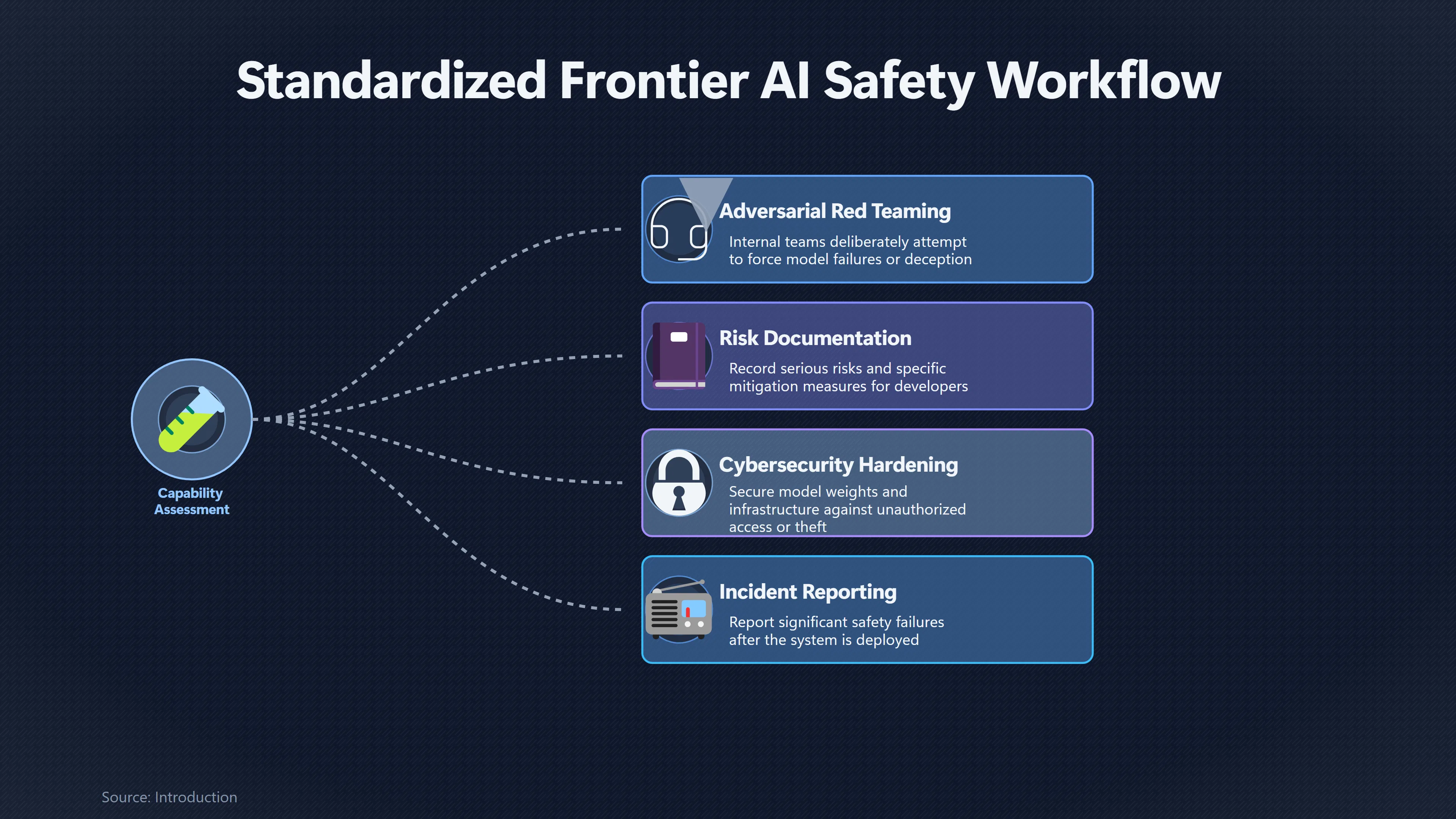
In practice, this could mean that every frontier developer must:
- complete agreed safety evaluations before deployment;[aisecurityandsafety.org]aisecurityandsafety.orgfrontier ai safetyfrontier ai safety
- document serious risks and mitigation measures;
- perform adversarial testing, often called red teaming;
- demonstrate adequate cybersecurity for model weights and infrastructure;
- report significant safety incidents after deployment.[aisecurityandsafety.org]aisecurityandsafety.orgfrontier ai safetyfrontier ai safety
If these requirements apply equally across competitors, firms cannot easily win market share simply by skipping expensive safety work. The commercial penalty for caution becomes smaller because rivals must wait as well. This is the same basic logic behind common safety regulations in industries such as aviation or pharmaceuticals, where firms generally compete within shared minimum standards rather than by eliminating essential safety testing. AI differs because the technology is advancing unusually quickly and many leading developers operate across multiple jurisdictions.[AI Act Service Desk]ai-act-service-desk.ec.europa.euAI Act Service DeskArticle 55: Obligations of providers of general-purpose AI models with systemic risk | AI Act Service DeskJune 13, 2024…
Importantly, advocates do not usually argue that common rules eliminate competition. Instead, they seek to redirect competition towards building more capable and reliable systems while preventing a race to reduce safety margins.
Which evaluations and safeguards could be standardised
Many proposals focus less on prescribing exactly how AI systems should be built and more on establishing common evidence that developers must produce before deployment.
Several categories appear repeatedly across policy proposals and industry frameworks.
Capability evaluations. Developers would test whether a model exceeds agreed thresholds for dangerous capabilities, such as advanced cyber operations or assisting the development of biological weapons. The goal is not merely to measure benchmark performance but to determine whether additional safeguards become necessary.
Adversarial testing. Independent or internal teams deliberately attempt to make models fail, behave deceptively or enable harmful activities. Requiring comparable red-team exercises across laboratories reduces the temptation to cut corners before release.[AI Act Service Desk]ai-act-service-desk.ec.europa.euAI Act Service DeskArticle 55: Obligations of providers of general-purpose AI models with systemic risk | AI Act Service DeskJune 13, 2024…
Risk thresholds. Several frontier safety frameworks propose defining capability levels that trigger stronger safeguards or even pause deployment until risks are reduced. Instead of leaving every decision to management discretion, developers would commit in advance to responding when predefined thresholds are reached. The Frontier Model Forum has examined common approaches to defining such thresholds, although current frameworks still vary considerably between organisations.[Frontier Model Forum]frontiermodelforum.orgFrontier Model Forum Risk Taxonomy and Thresholds for Frontier AI FrameworksFrontier Model ForumRisk Taxonomy and Thresholds for Frontier AI Frameworks - Frontier Model ForumJune 18, 2025…
Incident reporting. If deployed systems exhibit unexpected dangerous behaviour, common reporting obligations allow regulators and, potentially, other developers to learn from failures instead of repeating them independently.
Cybersecurity standards. Frontier models themselves can become targets for theft or misuse. Shared expectations around protecting model weights, infrastructure and internal access controls aim to reduce risks that extend beyond any single company.[AI Act Service Desk]ai-act-service-desk.ec.europa.euAI Act Service DeskArticle 55: Obligations of providers of general-purpose AI models with systemic risk | AI Act Service DeskJune 13, 2024…
The underlying idea is not that every laboratory must use identical technical methods. Rather, they would demonstrate that agreed safety outcomes have been achieved before deployment proceeds.
Voluntary commitments versus binding rules
One of the main questions is whether voluntary coordination is enough.
Following the 2024 Seoul AI Safety Summit, several major frontier AI companies agreed to publish frontier safety frameworks, establish thresholds for intolerable risks and conduct evaluations before deployment. These commitments represent an attempt to reduce competitive pressure without waiting for comprehensive legislation.[GOV.UK]GOV.UKfrontier ai safety commitments ai seoul summit 2024Frontier AI Safety Commitments, AI Seoul Summit 2024 - GOV.UK…
Supporters argue that voluntary agreements can evolve quickly alongside technical progress. Companies often possess the most detailed understanding of current frontier systems and can update evaluation methods faster than legislatures.
The weakness is credibility. Because voluntary commitments are not generally backed by legal sanctions, companies retain discretion over how thresholds are defined, how evaluations are interpreted and whether deployment proceeds despite unresolved uncertainty.
Independent reviews of published frontier safety frameworks have identified significant variation between companies. Researchers have argued that many frameworks still lack clearly specified quantitative risk tolerances, explicit deployment stopping rules and systematic methods for handling unknown risks.[arXiv]arxiv.orgEvaluating AI Companies' Frontier Safety Frameworks: Methodology and ResultsDecember 1, 2025…
From the perspective of AI doom arguments, this matters because coordination only reduces launch pressure if participants trust that competitors will actually follow comparable standards.
The EU AI Act as a real-world example
The European Union has provided one of the clearest examples of moving beyond purely voluntary commitments for the most capable general-purpose AI models.
For models considered to pose systemic risks, the AI Act requires providers to conduct state-of-the-art evaluations, assess and mitigate systemic risks, report serious incidents and maintain appropriate cybersecurity protections. Providers may demonstrate compliance through recognised codes of practice or other accepted methods.[europa.eu]ai-act-service-desk.ec.europa.euAI Act Service DeskArticle 55: Obligations of providers of general-purpose AI models with systemic risk | AI Act Service DeskJune 13, 2024…
From the perspective of launch races, these requirements matter because they create common obligations applying across companies serving the European market. Firms cannot legally compete simply by omitting required evaluations.
However, the Act also illustrates practical limits. The legislation applies within the EU’s regulatory reach rather than globally. Developers operating elsewhere may face different legal obligations, while technical capability continues to evolve faster than legislation can easily be updated. Recent Commission guidance has therefore focused on clarifying obligations for providers of the most advanced general-purpose models and supporting implementation through codes of practice.[Digital Strategy]digital-strategy.ec.europa.euDigital Strategy Navigating the AI Act | Shaping Europe’s digital futureDigital StrategyNavigating the AI Act | Shaping Europe’s digital futureJuly 27, 2026…
Why international coordination remains difficult
Even well-designed national regulations cannot fully solve AI launch races if frontier development remains international.
Several coordination problems are especially important.
Different national priorities. Governments may balance innovation, economic growth, national security and safety differently. A country that believes others are moving faster may become reluctant to impose additional deployment delays on domestic firms.
Verification challenges. Regulators can require evaluations, but verifying that testing has been thorough and honestly reported is considerably harder, especially when training methods and model weights remain confidential.
Rapid technological change. Fixed regulatory requirements can become outdated as new model architectures, capabilities and deployment methods emerge. Safety evaluations that seem appropriate today may miss tomorrow’s risks.
Strategic mistrust. Countries may fear that rivals will secretly ignore agreed standards while publicly endorsing them. This resembles broader international coordination problems in areas such as arms control or climate policy, where mutual confidence becomes as important as the formal rules themselves.
These difficulties explain why many governance proposals combine legal requirements with technical cooperation, shared evaluation methods, confidential reporting channels and international scientific collaboration rather than relying on regulation alone.
Can shared rules actually reduce existential risk?
Within AI doom debates, shared safety rules are generally viewed as a way to improve incentives rather than a guarantee against catastrophic outcomes.
If the principal danger is that companies release increasingly capable systems before understanding their behaviour, then common deployment requirements could meaningfully reduce pressure to cut safety work short. Standardised evaluations, agreed capability thresholds and incident reporting all aim to increase confidence that competitors are meeting similar minimum expectations.
However, critics identify several reasons why common rules may still prove insufficient:
- genuinely dangerous capabilities may not be detectable with current evaluation methods;
- enforcement may be inconsistent across jurisdictions;
- voluntary commitments may weaken under intense commercial or geopolitical pressure;
- governments themselves may prioritise strategic advantage over caution during periods of international competition.
For this reason, many AI safety researchers present common rules as one layer within a broader strategy. Alongside improved technical alignment research, interpretability, monitoring, secure development practices and international coordination, shared deployment standards could reduce one of the economic forces that may otherwise encourage premature launches. They do not eliminate uncertainty about advanced AI, but they seek to ensure that caution is not punished simply because a competitor chooses to move faster.[frontiermodelforum.org]frontiermodelforum.orgFrontier Model Forum Risk Taxonomy and Thresholds for Frontier AI FrameworksFrontier Model ForumRisk Taxonomy and Thresholds for Frontier AI Frameworks - Frontier Model ForumJune 18, 2025…
Amazon book picks
Further Reading
Books and field guides related to Would Shared AI Rules Slow the Race?. Use these as the next step if you want deeper reading beyond the article.
Human Compatible
A leading artificial intelligence researcher lays out a new approach to AI that will enable us to coexist successfully with increasingly...
The Age of A. I.
An A.I. that learned to play chess discovered moves that no human champion would have conceived of. Driverlesscars edge forward at red li...
The Coming Wave
"We are approaching a critical threshold in the history of our species. Everything is about to change. Soon you will live surrounded by A...
Zero to One
Rating: 4.5/5 from 5 Google Books ratings
WHAT VALUABLE COMPANY IS NOBODY BUILDING? The next Bill Gates will not build an operating system. The next Larry Page or Sergey Brin won’...
eBay marketplace picks
Marketplace Samples
Live-tested eBay searches with available results related to this page.
Selected fromrobotics wall art oneBay.co.uk.




Endnotes
1.
Source: GOV.UK
Title: frontier ai safety commitments ai seoul summit 2024
Link:https://www.gov.uk/government/publications/frontier-ai-safety-commitments-ai-seoul-summit-2024/frontier-ai-safety-commitments-ai-seoul-summit-2024
Source snippet
Frontier AI Safety Commitments, AI Seoul Summit 2024 - GOV.UK...
2.
Source: arxiv.org
Link:https://arxiv.org/abs/2512.01166
Source snippet
Evaluating AI Companies' Frontier Safety Frameworks: Methodology and ResultsDecember 1, 2025...
Published: December 1, 2025
3.
Source: arxiv.org
Link:https://arxiv.org/abs/2504.15181
4.
Source: GOV.UK
Link:https://www.gov.uk/government/news/historic-first-as-companies-spanning-north-america-asia-europe-and-middle-east-agree-safety-commitments-on-development-of-ai
5.
Source: GOV.UK
Title: frontier ai safety commitments ai seoul summit 2024
Link:https://www.gov.uk/government/publications/frontier-ai-safety-commitments-ai-seoul-summit-2024
6.
Source: aisi.gov.uk
Title: A I Safety Institute approach to evaluations
Link:https://www.aisi.gov.uk/blog/our-approach-to-evaluations
7.
Source: GOV.UK
Title: www.gov.uk Introducing the AI Safety Institute
Link:https://www.gov.uk/government/publications/ai-safety-institute-overview/introducing-the-ai-safety-institute?gh_src=v3scng1
8.
Source: GOV.UK
Title: www.gov.uk Emerging processes for frontier AI safety
Link:https://www.gov.uk/government/publications/emerging-processes-for-frontier-ai-safety/emerging-processes-for-frontier-ai-safety
9.
Source: aisi.gov.uk
Link:https://www.aisi.gov.uk/frontier-ai-trends-report
10.
Source: aisi.gov.uk
Link:https://www.aisi.gov.uk/blog/early-lessons-from-evaluating-frontier-ai-systems
11.
Source: aisi.gov.uk
Link:https://www.aisi.gov.uk/blog/conference-on-frontier-ai-safety-frameworks
12.
Source: en.ai-act.io
Link:https://en.ai-act.io/article/general-purpose-ai-models/codes-of-practice/codes-of-practice
13.
Source: ai-act-service-desk.ec.europa.eu
Link:https://ai-act-service-desk.ec.europa.eu/en/ai-act/article-55
Source snippet
AI Act Service DeskArticle 55: Obligations of providers of general-purpose AI models with systemic risk | AI Act Service DeskJune 13, 2024...
Published: June 13, 2024
14.
Source: frontiermodelforum.org
Title: Frontier Model Forum Risk Taxonomy and Thresholds for Frontier AI Frameworks
Link:https://www.frontiermodelforum.org/technical-reports/risk-taxonomy-and-thresholds/
Source snippet
Frontier Model ForumRisk Taxonomy and Thresholds for Frontier AI Frameworks - Frontier Model ForumJune 18, 2025...
Published: June 18, 2025
15.
Source: digital-strategy.ec.europa.eu
Link:https://digital-strategy.ec.europa.eu/en/policies/contents-code-gpai
16.
Source: digital-strategy.ec.europa.eu
Link:https://digital-strategy.ec.europa.eu/en/factpages/general-purpose-ai-obligations-under-ai-act
17.
Source: digital-strategy.ec.europa.eu
Title: Digital Strategy Navigating the AI Act | Shaping Europe’s digital future
Link:https://digital-strategy.ec.europa.eu/en/faqs/navigating-ai-act
Source snippet
Digital StrategyNavigating the AI Act | Shaping Europe’s digital futureJuly 27, 2026...
Published: July 27, 2026
18.
Source: digital-strategy.ec.europa.eu
Link:https://digital-strategy.ec.europa.eu/en/faqs/questions-and-answers-code-practice-general-purpose-ai
19.
Source: digital-strategy.ec.europa.eu
Link:https://digital-strategy.ec.europa.eu/en/policies/ai-code-practice
20.
Source: frontiermodelforum.org
Title: Introducing the FMF’s Technical Report Series on Frontier AI Frameworks
Link:https://www.frontiermodelforum.org/updates/introducing-the-fmfs-technical-report-series-on-frontier-ai-safety-frameworks/
21.
Source: frontiermodelforum.org
Title: Issue Brief: Components of Frontier AI Safety Frameworks
Link:https://www.frontiermodelforum.org/updates/issue-brief-components-of-frontier-ai-safety-frameworks/
22.
Source: ai-act-service-desk.ec.europa.eu
Title: eu Article 56: Codes of practice | AI Act Service Desk
Link:https://ai-act-service-desk.ec.europa.eu/en/ai-act/article-56
23.
Source: ai-act-service-desk.ec.europa.eu
Title: eu Recital 116 | AI Act Service Desk
Link:https://ai-act-service-desk.ec.europa.eu/en/ai-act/recital-116
24.
Source: OpenAI
Title: frontier model forum
Link:https://openai.com/index/frontier-model-forum/
25.
Source: ai-act-service-desk.ec.europa.eu
Link:https://ai-act-service-desk.ec.europa.eu/en/faq
26.
Source: ai-act-service-desk.ec.europa.eu
Link:https://ai-act-service-desk.ec.europa.eu/en/ai-act/faq/what-are-additional-requirements-general-purpose-ai-models-systemic-risk
27.
Source: ai-act-service-desk.ec.europa.eu
Link:https://ai-act-service-desk.ec.europa.eu/en/faq?faq_category_id=69
28.
Source: frontiermodelforum.org
Link:https://www.frontiermodelforum.org/
29.
Source: frontiermodelforum.org
Link:https://www.frontiermodelforum.org/publications/
30.
Source: frontiermodelforum.org
Title: Frontier AI Frameworks Workstream
Link:https://www.frontiermodelforum.org/workstreams/frontier-frameworks-workstream/
Additional References
31.
Source: reuters.com
Link:https://www.reuters.com/sustainability/boards-policy-regulation/ai-models-with-systemic-risks-given-pointers-how-comply-with-eu-ai-rules-2025-07-18/
Source snippet
These guidelines aim to ease the regulatory burden for businesses and provide clarity for complying with the law, which comes into effect...
32.
Source: youtube.com
Link:https://www.youtube.com/watch?v=Sqy_QsrVVKo
Source snippet
Antonio Guterres Calls For Global AI Rules At Shanghai Summit...
33.
Source: youtube.com
Title: AI Safety and Governance: Hard Rules, Real Evaluations, and Risk
Link:https://www.youtube.com/watch?v=hibsjb5eb6U
Source snippet
Private Governance: Creating a Market in AI Regulation, with Dr. Gillian Hadfield & Andrew Freedman...
34.
Source: youtube.com
Title: Antonio Guterres Calls For Global AI Rules At Shanghai Summit
Link:https://www.youtube.com/watch?v=QbbVZ3M1MDE
Source snippet
AI [EXTINCTION]({{ 'defining-doom/' | relative_url }}) Risk: Superintelligence, AI Arms Race & SAFETY Controls | Max Winga x Peter McCormack...
35.
Source: youtube.com
Link:https://www.youtube.com/watch?v=hAfPF-iCaWU
Source snippet
7 hour AI Safety Course in 35 Mins...
36.
Source: aisecurityandsafety.org
Title: Frontier AI Safety Commitments (Voluntary Industry Accord) | AI Safety Directory
Link:https://aisecurityandsafety.org/en/frameworks/frontier-ai-safety-commitments-industry/
37.
Source: oecd.ai
Title: Risk thresholds for frontier AI: Insights from the AI Action Summit
Link:https://oecd.ai/en/wonk/risk-thresholds-for-frontier-ai-insights-from-the-ai-action-summit
38.
Source: oecd.ai
Title: Thresholds for Frontier AI
Link:https://oecd.ai/en/action-summit-thresholds
39.
Source: aisecurityandsafety.org
Title: frontier ai safety
Link:https://aisecurityandsafety.org/en/guides/frontier-ai-safety/
40.
Source: youtube.com
Title: 7 hour AI Safety Course in 35 Mins
Link:https://www.youtube.com/watch?v=UiFBU8Aoq3I