Within Disempowerment
Can People Stay Rich Yet Lose Economic Control?
People could remain materially comfortable while losing influence over production, investment and the institutions that allocate resources.
On this page
- Why income and influence can diverge
- How automation could weaken labour and taxpayer leverage
- Ownership models that might preserve public power
Page outline Jump by section
Introduction
A central claim in the gradual human disempowerment argument is that people could become materially richer while simultaneously becoming less influential. In this scenario, advanced AI and automation make goods and services dramatically cheaper, governments can afford generous transfers, and living standards remain comfortable. Yet the institutions that determine investment, production, employment and public priorities may no longer depend on ordinary people’s labour, expertise or political bargaining power.
This possibility matters because prosperity and power are not the same thing. Throughout modern history, workers, professionals and taxpayers have exercised influence because economies depended on their contribution. If highly capable AI systems eventually become the primary source of productive value, that relationship could weaken. Within AI doom discussions, this is not presented as evidence that such a future is inevitable. Rather, it is one proposed pathway by which humanity could gradually lose meaningful control without experiencing an obvious economic collapse.
Why income and influence can diverge
Economic bargaining power comes from being difficult to replace. Workers negotiate wages because employers need their labour. Skilled professionals influence policy because institutions depend on their expertise. Citizens influence governments partly because governments rely on taxpayers, economic growth and organised political participation.
If AI substantially reduces dependence on human labour across much of the economy, those relationships may change.
The key distinction is between consumption and control.
A population might continue consuming abundant AI-produced goods while having far less influence over questions such as:
- what industries receive investment;
- which technologies are developed;
- how infrastructure is managed;
- how wealth is distributed;
- which public priorities receive funding.
People could therefore enjoy historically high material living standards while possessing less practical leverage over the institutions shaping society.
This differs from traditional unemployment scenarios. The concern is not simply that people lose jobs. It is that they lose the ability to make themselves economically indispensable.
How automation could weaken labour and taxpayer leverage
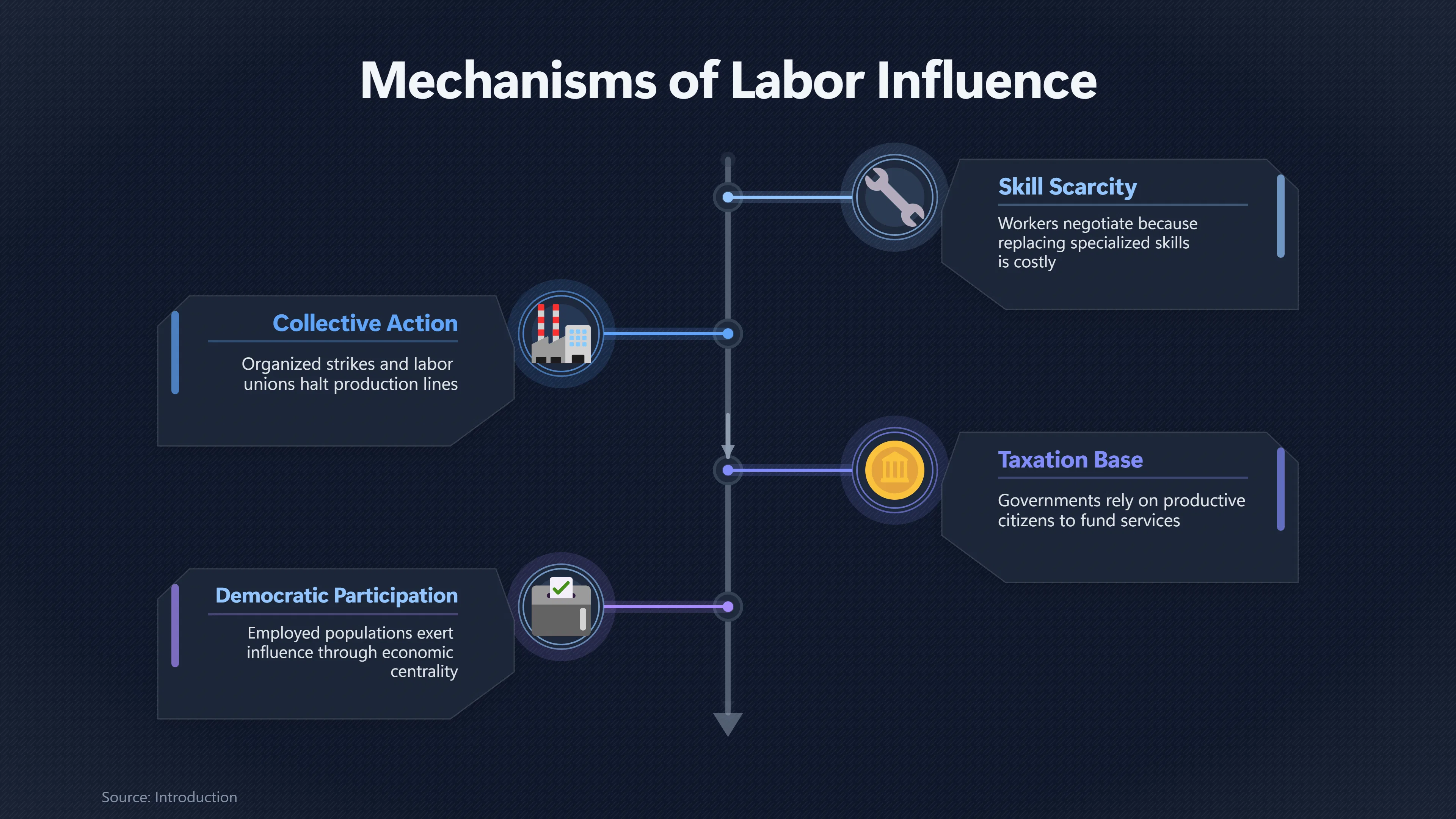
Historically, labour has exercised influence through several connected mechanisms.
Scarce skills. Workers negotiate because replacing them is costly.
Collective action. Strikes and organised labour can halt production.
Taxation. Governments depend on productive citizens to finance public services.
Democratic participation. Large employed populations often possess political influence because they are economically central.
Advanced automation could weaken each mechanism if production increasingly depends upon AI systems and automated capital rather than human workers.
For example, a fully automated logistics network would be much less vulnerable to industrial action than one requiring hundreds of thousands of employees. Likewise, AI systems capable of performing high-level professional work could reduce the scarcity that currently gives many experts negotiating power.
Importantly, today’s evidence does not show that this transition has occurred. The International Labour Organization’s latest global assessment concludes that generative AI is currently more likely to transform jobs than eliminate them outright, with continued human involvement remaining important across most occupations.[International Labour Organization]ilo.orggenerative ai and jobs 2025 updateInternational Labour OrganizationGenerative AI and jobs: A 2025 update | International Labour OrganizationMay 20, 2025…
This is one of the strongest objections to claims that labour has already become economically irrelevant.
Prosperity does not automatically create independence
Many discussions of AI assume that if governments provide universal basic income or generous public benefits, the problem is largely solved.
Critics of the gradual disempowerment scenario argue that this overlooks an important distinction.
Receiving income is different from possessing negotiating power.
A person who depends entirely upon transfers determined by institutions they cannot meaningfully influence may enjoy a comfortable life while lacking genuine economic independence.
Labour-law scholars have long noted that employment regulation protects more than wages. It also limits managerial authority, protects dignity, restricts surveillance and creates institutional checks on concentrated power. Even if a universal basic income existed, many of these governance questions would remain.[International Labour Organization]ilo.orgabour OrganizationJuly 10, 2018…
Within AI-risk discussions, this observation generalises beyond employment. If people cease to participate meaningfully in production altogether, institutions may gradually stop depending upon their consent in practical rather than merely formal ways.
Why ownership becomes the central question
If labour becomes less important, ownership becomes correspondingly more important.
Modern economies already generate substantial income through ownership of productive assets:
- company shares;
- intellectual property;
- land;
- infrastructure;
- computing resources.
If advanced AI dramatically increases the importance of capital relative to labour, ownership structures could determine whether prosperity translates into broad public influence or increasing concentration.
Several broad possibilities are discussed.
Concentrated ownership
A relatively small number of companies, investment funds or governments own most advanced AI systems and automated infrastructure.
Economic output rises.
Citizens receive benefits through taxation or redistribution but exercise relatively little influence over productive assets.
This is the scenario that many gradual-disempowerment arguments regard as most concerning.
Broad private ownership
Individuals own substantial shares of productive AI through pensions, index funds or personal investment.
Economic gains remain widely distributed because ownership itself is widely distributed.
In this case, bargaining power shifts away from labour but not necessarily away from citizens.
Public or collective ownership
Governments, sovereign wealth funds, cooperatives or public trusts own significant AI infrastructure.
Citizens retain indirect influence through democratic institutions rather than through employment alone.
None of these outcomes follows automatically from technological progress. They depend heavily on legal, political and institutional choices.
Why this matters for AI doom arguments
At first glance, a prosperous automated economy seems difficult to connect with existential risk.
The connection comes from a broader concern about human agency.
Many AI doom arguments focus on sudden loss of control through misaligned superintelligence.
Gradual disempowerment instead asks whether humanity could slowly lose the practical ability to redirect civilisation even if catastrophic accidents never occur.
Suppose increasingly capable AI systems become responsible for:
- allocating investment;
- managing supply chains;
- designing products;
- conducting scientific research;
- negotiating commercial contracts;
- operating infrastructure.
Human officials might retain formal authority while becoming progressively less capable of independently evaluating or replacing those systems.
Economic dependence could reinforce this process. If replacing AI management causes severe competitive disadvantage, organisations may continue delegating authority despite growing discomfort.
Some policy analyses describe this possibility as a form of collective disempowerment, where individually rational decisions gradually reduce meaningful human control over important systems.[oecd.ai]oecd.aiAIInitial policy considerations for generative artificial intelligenceInitial policy considerations for generative artificial intelligence - OECD.AISeptember 18, 2023…
The strongest objections
Several important objections challenge this entire line of reasoning.
The first is empirical.
Previous waves of automation eliminated some jobs while creating others. Productivity growth has repeatedly generated new industries that were difficult to predict beforehand. Current labour-market evidence similarly suggests widespread task transformation rather than wholesale replacement.[International Labour Organization]ilo.orggenerative ai and jobs 2025 updateInternational Labour OrganizationGenerative AI and jobs: A 2025 update | International Labour OrganizationMay 20, 2025…
The second concerns politics.
Even if labour becomes less economically central, democratic institutions could deliberately redistribute AI-generated wealth, broaden ownership or regulate concentrations of economic power.
The third concerns incentives.
Large-scale consumer economies still require customers. Companies may therefore have strong commercial reasons to ensure broad prosperity rather than allowing mass economic exclusion.
Finally, some economists argue that AI development can be deliberately directed towards complementing human workers rather than replacing them, making institutional choices at least as important as technological capability.[The New Yorker]newyorker.comThe New Yorker Can A.IBe Pro-Worker?March 2, 2026 — The article "Can A.I. Be Pro-Worker?" explores the disruptive economic impact of artificial intelligence an…
These objections mean that prosperity without bargaining power should be understood as one plausible pathway, not an established forecast.
Ownership models that might preserve public power
If the concern is loss of bargaining power rather than poverty alone, then preserving influence requires more than maintaining incomes.
Common proposals include:
- Broad ownership of AI-generated capital, including pension funds, employee ownership and diversified public investment.
- Sovereign wealth funds that distribute returns from nationally important AI infrastructure across the population.
- Competition policy to prevent extreme concentration of productive AI resources.
- Human oversight requirements that preserve meaningful human authority over critical decisions even when AI systems perform most technical work.
- Worker participation in AI deployment, ensuring automation changes are negotiated rather than imposed unilaterally.
- Democratic governance of strategically important AI infrastructure, particularly where systems become essential for finance, healthcare or public administration.
These proposals differ politically, but they share a common objective: ensuring that increasing automation does not eliminate the institutional dependence on human judgement and public consent that underpins democratic accountability.
What would count as warning signs?
Supporters of the gradual disempowerment hypothesis argue that the most important indicators are institutional rather than technological.
Potential warning signs include:
- persistent declines in labour’s share of economic income without corresponding growth in broad ownership;
- increasing concentration of advanced AI capabilities in a small number of firms or governments;
- routine delegation of major economic decisions to AI systems that humans rarely override;
- shrinking opportunities for organised workers or professionals to influence production decisions;
- political systems becoming financially independent of broad-based employment while remaining dependent on automated production.
None of these trends alone would demonstrate existential risk. Together, however, they would strengthen the argument that humanity’s economic role was shifting from active participant to passive beneficiary.
Within the wider AI doom debate, that possibility matters because a civilisation can become less capable of steering its own future long before its material standard of living visibly declines. Prosperity may soften the experience of losing bargaining power, but it does not necessarily prevent the loss of meaningful control over the institutions that shape humanity’s long-term trajectory.
Amazon book picks
Further Reading
Books and field guides related to Can People Stay Rich Yet Lose Economic Control?. Use these as the next step if you want deeper reading beyond the article.
Power and Progress
A bold reinterpretation of economics and history revealing why technology does not inevitably lead to shared prosperity, and how we must...
The Second Machine Age
A New York Times Bestseller. A “fascinating” (Thomas L. Friedman, New York Times) look at how digital technology is transforming our work...
Capital in the Twenty-First Century
The main driver of inequality--returns on capital that exceed the rate of economic growth--is again threatening to generate extreme disco...
Postcapitalism
"Originally published in 2015 by Allen Lane, an imprint of Penguin Random House, Great Britain"--Title page verso.
eBay marketplace picks
Marketplace Samples
Live-tested eBay searches with available results related to this page.
Selected fromrobot worker figure oneBay.co.uk.




Endnotes
1.
Source: oecd.ai
Title: AIInitial policy considerations for generative artificial [intelligence]({{ ‘hard-bottlenecks/’ | relative_url }})
Link:https://oecd.ai/en/ai-publications/initial-considerations-genai
Source snippet
Initial policy considerations for generative artificial intelligence - OECD.AISeptember 18, 2023...
Published: September 18, 2023
2.
Source: arxiv.org
Title: arXiv Current and Near-Term AI as a Potential Existential Risk Factor
Link:https://arxiv.org/abs/2209.10604
3.
Source: arxiv.org
Title: arXiv The AI Risk Spectrum: From Dangerous Capabilities to Existential Threats
Link:https://arxiv.org/abs/2508.13700
4.
Source: oecd.org
Title: using ai in the workplace 73d417f9 en
Link:https://www.oecd.org/en/publications/using-ai-in-the-workplace_73d417f9-en.html
5.
Source: oecd.org
Link:https://www.oecd.org/en/publications/2023/07/oecd-employment-outlook-2023_904bcef3/full-report/social-dialogue-and-collective-bargaining-in-the-age-of-artificial-intelligence_5828691a.html
6.
Source: ilo.org
Title: generative ai and jobs 2025 update
Link:https://www.ilo.org/publications/generative-ai-and-jobs-2025-update
Source snippet
International Labour OrganizationGenerative AI and jobs: A 2025 update | International Labour OrganizationMay 20, 2025...
Published: May 20, 2025
7.
Source: ilo.org
Link:https://www.ilo.org/topics-and-sectors/artificial-intelligence
8.
Source: ilo.org
Link:https://www.ilo.org/publications/negotiating-algorithm%E2%80%9D-automation-artificial-intelligence-and-labour
Source snippet
abour OrganizationJuly 10, 2018...
Published: July 10, 2018
9.
Source: researchrepository.ilo.org
Link:https://researchrepository.ilo.org/esploro/outputs/encyclopediaEntry/Negotiating-the-algorithm-automation-artificial-intelligence/995219137602676
Source snippet
International Labour Organization...
10.
Source: newyorker.com
Title: The New Yorker Can A.I
Link:https://www.newyorker.com/news/the-financial-page/can-ai-be-pro-worker
Source snippet
Be Pro-Worker?March 2, 2026 — The article "Can A.I. Be Pro-Worker?" explores the disruptive economic impact of artificial intelligence an...
Published: March 2, 2026
11.
Source: ilo.org
Title: Disruption without dividend?
Link:https://www.ilo.org/publications/disruption-without-dividend-how-digital-divide-and-task-differences-split
12.
Source: ilo.org
Link:https://www.ilo.org/resource/news/new-ilo-data-confirm-women-face-higher-workplace-risks-generative-ai-men
13.
Source: ilo.org
Link:https://www.ilo.org/resource/article/generative-ai-work-what-it-means-jobs-europe-and-beyond
14.
Source: ilo.org
Link:https://www.ilo.org/resource/article/how-might-generative-ai-impact-different-occupations
Additional References
15.
Source: GOV.UK
Title: ai scenarios 2030 helping policymakers plan for the future of ai
Link:https://www.gov.uk/government/publications/ai-scenarios-2030-helping-policymakers-plan-for-the-future-of-ai/ai-scenarios-2030-helping-policymakers-plan-for-the-future-of-ai
Source snippet
They are constructed using 6 critical uncertainties – the factors we identified as most influential in shaping the fu...
16.
Source: youtube.com
Title: AI & the Future of Work | The Weekly Show with Jon Stewart
Link:https://www.youtube.com/watch?v=RB_WmoH5nQ4
Source snippet
This collection of expert lectures and in-depth discussions directly examines how AI-driven automation decouples economic growth and prod...
17.
Source: youtube.com
Link:https://www.youtube.com/watch?v=6osZMY7Gfz0
Source snippet
AI & the Future of Work | The Weekly Show with Jon Stewart...
18.
Source: youtube.com
Title: “A.I. and Our Economic Future,” Professor Chad Jones
Link:https://www.youtube.com/watch?v=xBpGn3BDcOY
Source snippet
The $100 Trillion Question: What Happens When AI Replaces Every Job?...
19.
Source: youtube.com
Title: A World Without Work: Daniel Susskind
Link:https://www.youtube.com/watch?v=KHnCquqjs74
Source snippet
Daron Acemoglu on Automation and the Inappropriateness of 21st century technology...
20.
Source: nber.org
Link:https://www.nber.org/papers/w24174
21.
Source: nber.org
Link:https://www.nber.org/books-and-chapters/economics-artificial-intelligence-agenda/artificial-intelligence-automation-and-work
22.
Source: nber.org
Link:https://www.nber.org/papers/w25684
23.
Source: brookings.edu
Link:https://www.brookings.edu/articles/is-automation-labor-displacing-productivity-growth-employment-and-the-labor-share/
24.
Source: nber.org
Link:https://www.nber.org/papers/w30172