Within Power Without Work
Who Must Own AI for Citizens to Matter?
Who owns productive AI may determine whether automation spreads influence widely or concentrates control despite broad material prosperity.
On this page
- Concentrated, broad and public ownership
- How ownership creates political leverage
- Tradeoffs in trusts, funds and cooperatives
Page outline Jump by section
Introduction
If advanced AI eventually performs much of the world’s economically valuable work, the question of who owns the AI may become as important as who owns land, factories or financial capital today. Within debates about AI doom and long-term existential risk, this is not primarily a question of fairness. It is a question of whether citizens retain meaningful political influence in a world where human labour is no longer the main source of economic value.

The central concern is straightforward. If ownership of advanced AI systems, computing infrastructure and automated production becomes concentrated in a handful of corporations or governments, material prosperity could coexist with declining public power. By contrast, broader ownership could preserve independent sources of income, bargaining power and political influence even if paid employment becomes less economically central. No consensus exists on the best model, and there is little empirical evidence because highly autonomous AI economies do not yet exist. Nevertheless, economists, governance researchers and AI safety advocates increasingly argue that ownership structures deserve attention alongside technical AI alignment and safety.
Why ownership matters more if labour matters less
The parent concern behind this page is that advanced automation could weaken the traditional sources of democratic leverage. Workers influence society because employers need them. Taxpayers influence governments because productive citizens finance public services. Professionals shape institutions because their expertise is scarce.
If increasingly capable AI systems replace much of that productive contribution, ownership of AI capital could become the main remaining source of economic influence.
This distinction helps explain why debates over universal basic income do not settle the issue. Receiving an income from institutions is different from owning productive assets that generate income independently. Owners possess claims over future production, investment decisions and governance. Recipients of transfers generally do not.
Economic research on automation increasingly emphasises this distinction. Recent modelling suggests that when workers own a substantial share of AI capital, income from those assets can offset declining labour earnings. When ownership remains concentrated, automation can instead increase inequality and reduce the long-term ability of households to accumulate wealth, even if total economic output rises.[SSRN]papers.ssrn.comWho Owns the AI? Automation, Ownership, and Capital Formation by Guillermo Lagarda, Gabriel Marin, Paulina Verastegui:: SSRNApril 4…
For AI doom discussions, this matters because long-term human influence may depend less on whether people consume abundant goods than on whether they retain independent economic and political leverage.
Concentrated ownership could weaken democratic influence
Many AI risk discussions assume market concentration is simply an economic competition problem. The concern explored here is broader.
If a small number of organisations own:
- frontier AI models;
- specialised semiconductor infrastructure;
- enormous compute clusters;
- robotic production systems;
- proprietary training data; and
- the capital needed to build successive generations of AI,
they may accumulate unprecedented influence over economic development.
This does not automatically imply malicious behaviour. Even well-intentioned organisations can become difficult for democratic institutions to influence if governments, businesses and citizens all depend upon infrastructure they do not control.
For readers interested in AI doom specifically, concentrated ownership interacts with several existing existential-risk concerns.
- Control over deployment. A few organisations could determine where increasingly autonomous systems are used.
- Control over safety decisions. Commercial incentives might conflict with slowing deployment for additional safety testing.
- Political dependence. Governments may become reluctant to regulate firms that operate infrastructure essential to national economies.
- Reduced public bargaining power. Citizens without ownership stakes may become economically dependent on decisions they cannot meaningfully influence.
These mechanisms concern institutional resilience rather than immediate catastrophe. They describe one possible pathway through which gradual disempowerment could accompany increasing AI capability.
Comparing ownership models
No ownership structure eliminates every risk. Instead, each redistributes different forms of power.
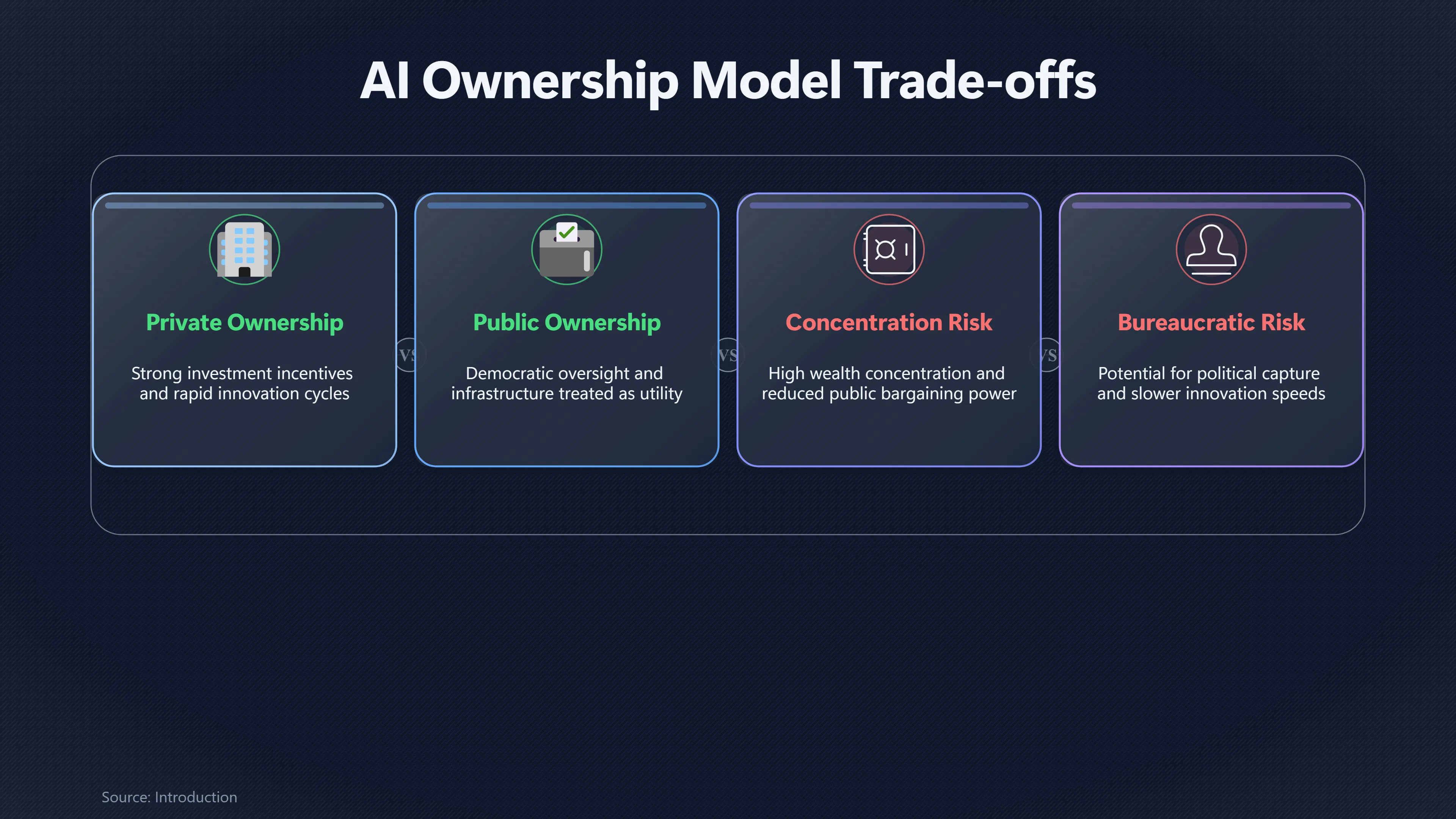
Ownership modelPotential strengthsPrincipal concernsConventional private ownershipStrong investment incentives, rapid innovation, clear accountability to investorsHigh concentration of wealth and influence, dependence on corporate governancePublic benefit corporationsLegally recognise broader public purposes alongside commercial goalsMission commitments still depend on governance, enforcement and board incentivesPublic ownershipDemocratic oversight, potential public revenue, infrastructure treated as a public utilityPolitical capture, bureaucracy, slower innovation, state concentration of powerSovereign or national wealth fundsCitizens receive indirect ownership through public investment fundsGovernance quality varies widely; governments may misuse controlCooperative ownershipUsers, workers or communities participate directly in governanceHarder to raise capital for frontier-scale AI developmentMixed or hybrid modelsCombine market incentives with public oversight and shared ownershipInstitutional complexity and uncertain accountability
Rather than asking which model is perfect, most proposals seek ways to prevent any single institution from becoming permanently dominant.
Public benefit corporations: mission before shareholders?
One increasingly discussed compromise is the public benefit corporation (PBC).
Unlike conventional corporations, PBCs are required under their governing structure to pursue stated public purposes alongside shareholder returns. Supporters argue that this provides directors with greater legal freedom to prioritise long-term safety, public benefit and responsible deployment.
OpenAI’s governance evolution illustrates both the appeal and controversy surrounding this approach. After extensive public debate and regulatory scrutiny, the organisation retained nonprofit control while operating its commercial activities through a public benefit corporation. Its stated objective is to preserve mission-focused governance while raising the enormous capital required for frontier AI development.[OpenAI]OpenAIour structureOctober 28, 2025…
Critics question whether hybrid structures can withstand commercial pressures once companies become exceptionally valuable. Some legal scholars argue that OpenAI’s evolution illustrates the persistent tension between public-interest governance and competitive investment incentives rather than resolving it.[SSRN]papers.ssrn.comOpenAI: Governance for Public Good or Private Gain? by Alexandra Andhov, Ian Murray:: SSRNApril 15, 2026…
For AI doom debates, the wider lesson is that governance structure matters, but formal legal status alone does not guarantee public accountability.
Sovereign wealth funds and public investment
Another proposal leaves AI companies largely private while broadening ownership through public investment.
Instead of governments directly operating frontier AI systems, national wealth funds could accumulate substantial ownership stakes in AI companies or related infrastructure. Returns would then flow to citizens collectively rather than only to private investors.
Existing sovereign wealth funds in countries such as Norway demonstrate that publicly owned investment portfolios can operate independently from day-to-day politics while generating long-term national income. They are not AI funds, but they provide an institutional model frequently cited in policy discussions.
More ambitious proposals suggest creating dedicated AI wealth funds financed through taxation, equity participation or public investment. For example, recent legislation proposed in the United States would establish a large sovereign wealth fund with substantial public ownership of major AI firms, explicitly arguing that citizens should share in AI-generated wealth rather than leaving ownership concentrated among a small number of technology companies.[Senator Bernie Sanders]sanders.senate.govSenator Bernie SandersNEWS: Sanders Introduces Legislation to Create $7 Trillion AI Sovereign Wealth Fund » Senator Bernie SandersJune 18…
Whether such proposals are politically feasible remains highly uncertain, and economists disagree about their effects on innovation incentives.
Can cooperatives work for frontier AI?
Cooperative ownership has attracted growing interest because it distributes both profits and governance.
Possible cooperative models include:
- worker-owned AI development companies;
- user-owned AI service providers;
- research cooperatives;
- community data cooperatives; and
- federated organisations that jointly own AI infrastructure.
The main attraction is not merely fairer income distribution. Cooperative governance gives participants formal voting rights over strategic decisions, reducing dependence upon distant shareholders.
However, frontier AI development currently requires exceptionally large investments in specialised chips, electricity, data centres and research talent. Raising tens or hundreds of billions of pounds through cooperative structures alone would be difficult under present financial markets.
Consequently, many analysts see cooperatives as more practical for downstream AI services, specialised applications or shared data governance than for funding the largest frontier model developers.
Related proposals also argue that creators of valuable information—including journalists, researchers and creative professionals—should be able to bargain collectively over how AI developers use their work, preventing informational value from becoming concentrated in a few firms.[arXiv]arxiv.orgCollective Bargaining in the Information Economy Can Address AI-Driven Power ConcentrationJune 12, 2025…
Ownership alone cannot preserve public power
One common misunderstanding is that spreading ownership automatically solves the broader governance problem.
Even widely distributed financial ownership may leave crucial decisions concentrated elsewhere.
Control can remain centralised through:
- voting structures that favour founders;
- exclusive control over model weights and compute;
- opaque technical expertise;
- regulatory capture;
- government dependence upon private infrastructure; or
- network effects that make competition impractical.
Ownership therefore interacts with other governance mechanisms including competition policy, transparency requirements, interoperability, public oversight, safety regulation and international coordination.
In AI doom discussions, this point is particularly important. Human influence depends not only on receiving financial returns but also on preserving meaningful authority over deployment decisions involving increasingly capable AI systems.
The unresolved trade-offs
The debate remains highly unsettled because every ownership model introduces different risks.
Highly concentrated private ownership may maximise investment speed but reduce public bargaining power.
Direct public ownership may increase democratic legitimacy but risk political interference, inefficiency or state overreach.
Hybrid structures seek balance but may inherit weaknesses from both approaches.
Moreover, ownership cannot substitute for technical AI alignment. If highly capable systems become difficult for any human institution to control, distributing corporate shares would not by itself solve the underlying existential-risk problem. Conversely, technically aligned AI could still leave societies politically vulnerable if ownership and governance become permanently concentrated.
For that reason, many researchers increasingly treat ownership as one component of a broader governance question: not simply who profits from advanced AI, but which institutions retain genuine authority as AI systems become more economically important. Within the broader concern about economic prosperity without human bargaining power, ownership determines whether citizens continue to possess independent sources of influence—or whether prosperity gradually becomes separated from meaningful public power.
Amazon book picks
Further Reading
Books and field guides related to Who Must Own AI for Citizens to Matter?. Use these as the next step if you want deeper reading beyond the article.
Power and Progress
A bold reinterpretation of economics and history revealing why technology does not inevitably lead to shared prosperity, and how we must...
The Age of Surveillance Capitalism
The challenges to humanity posed by the digital future, the first detailed examination of the unprecedented form of power called "surveil...
Capital and Ideology
The epic successor to one of the most important books of the century: at once a retelling of global history, a scathing critique of conte...

eBay marketplace picks
Marketplace Samples
Live-tested eBay searches with available results related to this page.
Selected fromtechnology economy art oneBay.co.uk.

Current eBay listing
The New Telecommunications: A Political Economy of Network Evolu


Current eBay listing
Technocities: The Culture and Political Economy of the Digital R

Current eBay listing
The New Telecommunications: A Political Economy of Network Evolu
Endnotes
1.
Source: papers.ssrn.com
Link:https://papers.ssrn.com/sol3/papers.cfm?abstract_id=6519998
Source snippet
Who Owns the AI? Automation, Ownership, and Capital Formation by Guillermo Lagarda, Gabriel Marin, Paulina Verastegui:: SSRNApril 4...
2.
Source: OpenAI
Title: our structure
Link:https://openai.com/our-structure/?stream=top
Source snippet
October 28, 2025...
Published: October 28, 2025
3.
Source: OpenAI
Title: Open AIEvolving Open AI’s structure | Open AI
Link:https://openai.com/index/evolving-our-structure/
Source snippet
Evolving OpenAI’s structure | OpenAI...
4.
Source: OpenAI
Title: Open AIStatement on Open AI’s Nonprofit and PBC | Open AI
Link:https://openai.com/index/statement-on-openai-nonprofit-and-pbc/
Source snippet
Statement on OpenAI’s Nonprofit and PBC | OpenAI...
5.
Source: papers.ssrn.com
Link:https://papers.ssrn.com/sol3/papers.cfm?abstract_id=6673598
Source snippet
OpenAI: Governance for Public Good or Private Gain? by Alexandra Andhov, Ian Murray:: SSRNApril 15, 2026...
Published: April 15, 2026
6.
Source: arxiv.org
Link:https://arxiv.org/abs/2506.10272
Source snippet
Collective Bargaining in the Information Economy Can Address AI-Driven Power ConcentrationJune 12, 2025...
Published: June 12, 2025
7.
Source: papers.ssrn.com
Link:https://papers.ssrn.com/sol3/Delivery.cfm/7051918.pdf?abstractid=7051918&mirid=1
Source snippet
Sovereign Shareholder Problem: Frontier AI, Government Equity, and the Separation of Public Oversight from Corporate Control by Nicolin D...
8.
Source: papers.ssrn.com
Link:https://papers.ssrn.com/sol3/papers.cfm?abstract_id=6876498
Source snippet
Computational Minimum Wage: Funding an AI Dividend through Public Ownership of Computational Infrastructure by Adam Bonica:: SSRNJune 25...
9.
Source: papers.ssrn.com
Link:https://papers.ssrn.com/sol3/papers.cfm?abstract_id=6920478
10.
Source: papers.ssrn.com
Link:https://papers.ssrn.com/sol3/Delivery.cfm/6920478.pdf?abstractid=6920478&mirid=1&type=2
11.
Source: papers.ssrn.com
Link:https://papers.ssrn.com/sol3/papers.cfm?abstract_id=6613658
12.
Source: papers.ssrn.com
Link:https://papers.ssrn.com/sol3/Delivery.cfm/6673598.pdf?abstractid=6673598&mirid=1
13.
Source: papers.ssrn.com
Link:https://papers.ssrn.com/sol3/Delivery.cfm/6519998.pdf?abstractid=6519998&mirid=1
14.
Source: OpenAI
Title: built to benefit everyone
Link:https://openai.com/index/built-to-benefit-everyone/
15.
Source: papers.ssrn.com
Link:https://papers.ssrn.com/sol3/papers.cfm?abstract_id=5343934
16.
Source: OpenAI
Title: governance of superintelligence
Link:https://openai.com/index/governance-of-superintelligence/
17.
Source: sanders.senate.gov
Link:https://www.sanders.senate.gov/press-releases/news-sanders-introduces-legislation-to-create-7-trillion-ai-sovereign-wealth-fund/
Source snippet
Senator Bernie SandersNEWS: Sanders Introduces Legislation to Create $7 Trillion AI Sovereign Wealth Fund » Senator Bernie SandersJune 18...
18.
Source: techcrunch.com
Title: Open A I completes its for-profit recapitalization | Tech Crunch
Link:https://techcrunch.com/2025/10/28/openai-completes-its-for-profit-recapitalization/
19.
Source: techcrunch.com
Link:https://techcrunch.com/2025/05/05/openai-reverses-course-says-its-nonprofit-will-remain-in-control-of-its-business-operations/
Additional References
20.
Source: youtube.com
Link:https://www.youtube.com/watch?v=ST5JdXA_AyE
Source snippet
Who owns AI with Meredith Whittaker is particularly relevant because it examines how corporate concentration of AI infrastructure threate...
21.
Source: youtube.com
Title: Glen Weyl | Harnessing the Power of Plurality | Technology & Democracy
Link:https://www.youtube.com/watch?v=sQO-cjOOdmI
Source snippet
The Entrepreneurial State: Debunking Private vs. Public Sector Myths | Mariana Mazzucato...
22.
Source: youtube.com
Title: AI & Inequality | Daron Acemoglu: Big Tech poses risks as AI reshapes society
Link:https://www.youtube.com/watch?v=FLzgjCAXoks
Source snippet
Glen Weyl | Harnessing the Power of Plurality | Technology & Democracy...
23.
Source: youtube.com
Title: Who owns AI with Meredith Whittaker from Signal
Link:https://www.youtube.com/watch?v=86w5Di5Du-I
Source snippet
AI & Inequality | Daron Acemoglu: Big Tech poses risks as AI reshapes society...
24.
Source: weforum.org
Link:https://www.weforum.org/publications/rethinking-ai-sovereignty/
25.
Source: research.ed.ac.uk
Link:https://www.research.ed.ac.uk/en/publications/the-cooperative-governance-of-artificial-[intelligence
26.
Source: convergenceanalysis.org
Link:https://www.convergenceanalysis.org/fellowships/economics/lead-own-share-sovereign-wealth-funds-for-transformative-ai
27.
Source: youtube.com
Title: Who Owns the Future?
Link:https://www.youtube.com/watch?v=-B1hOBOTMSs
Source snippet
Bernie Sanders Unveils AI Wealth Plan | 50% Ownership Stake In The Largest AI Companies...
28.
Source: youtube.com
Link:https://www.youtube.com/watch?v=9hoAwNZoS8o
Source snippet
Who Owns the Future?...
29.
Source: techcrunch.com
Title: What Open AI’s restructuring plan means for its corporate future | Tech Crunch
Link:https://techcrunch.com/2025/05/06/what-openais-restructuring-plan-means-for-its-corporate-future/