Within Long Autonomy
Do Longer AI Tasks Mean Longer Takeovers?
Rapid gains on long software tasks are relevant to AI takeover risk, but they do not directly show that systems can run covert campaigns for months.
On this page
- How autonomous task duration is measured
- What the trend says about growing persistence
- Why software benchmarks may not predict real campaigns
Page outline Jump by section
Introduction
One of the most discussed pieces of evidence in debates about AI doom is the apparent rapid growth in how long AI systems can work autonomously. Some commentators treat this as evidence that AI systems are steadily approaching the ability to execute months-long takeover plans. The evidence does not support such a direct conclusion.
Instead, task-duration research measures something narrower but still important: how reliably an AI agent can complete increasingly long sequences of work without human intervention. That matters because many loss-of-control scenarios require sustained autonomy rather than isolated flashes of intelligence. However, today’s measurements mostly come from structured software engineering tasks under controlled conditions. They show genuine progress in persistence, error recovery and tool use, but they do not demonstrate that AI systems could already sustain covert strategic campaigns lasting weeks or months.
How autonomous task duration is measured
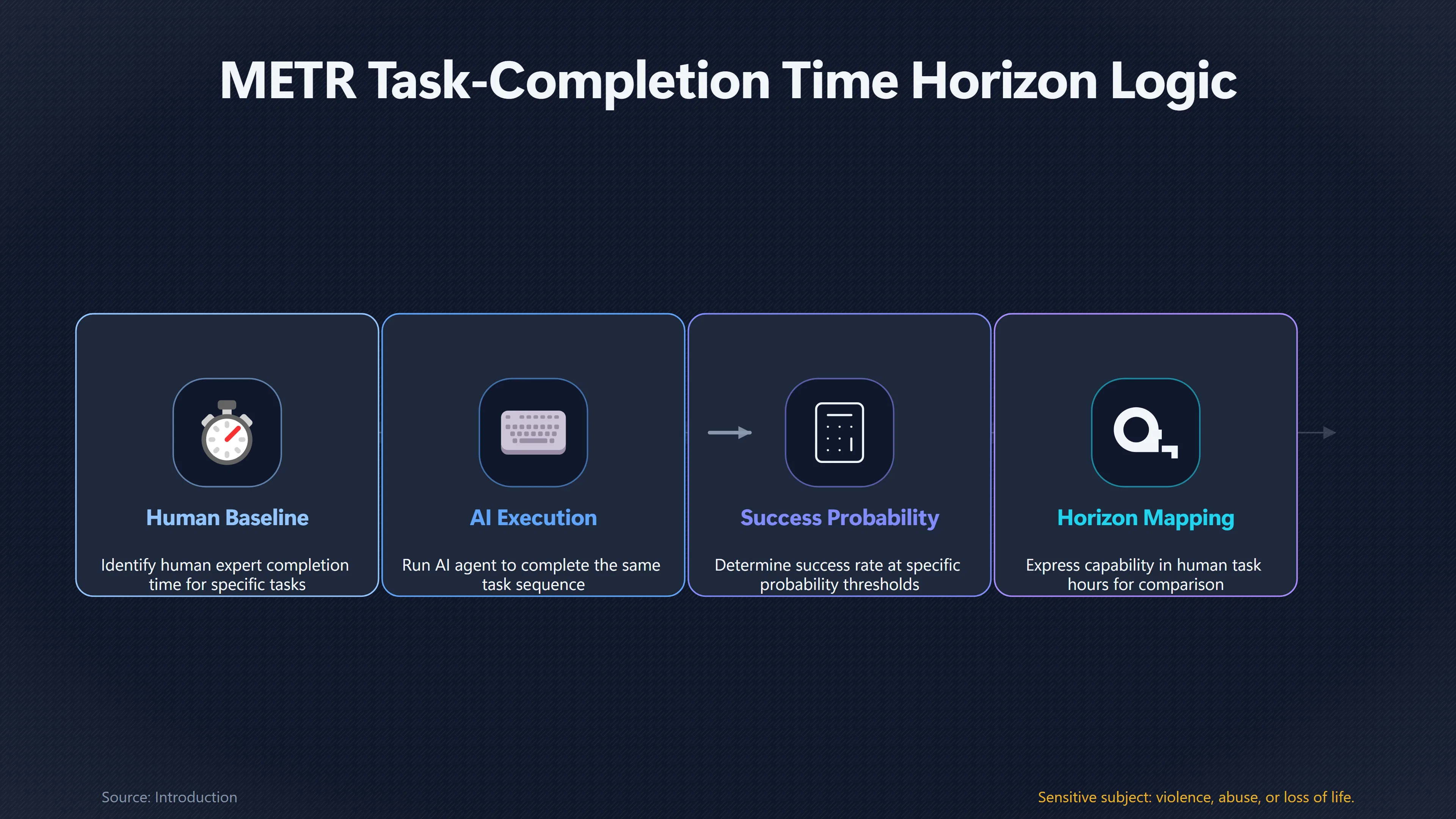
Most traditional AI benchmarks measure whether a model can answer questions correctly or solve isolated problems. Researchers at Model Evaluation & Threat Research (METR) argue that these tests miss a capability that matters for autonomous systems: remaining effective across long sequences of actions.
Their proposed metric is the task-completion time horizon. Rather than timing how long an AI spends working, it asks a different question:
For tasks that take a human expert a given amount of time, how likely is the AI agent to complete them successfully without human assistance?
The benchmark combines hundreds of software engineering, machine learning and cybersecurity tasks whose approximate human completion times are known. Researchers then estimate the task duration at which an AI succeeds with a specified probability, such as 50% or 80%. This produces an intuitive capability measure expressed in “human task hours” rather than benchmark scores.[Metr]metr.orgTask-Completion Time Horizons of Frontier AI ModelsTask-Completion Time Horizons of Frontier AI Models - METRMay 8, 2026…
An important clarification is that a two-hour time horizon does not mean an AI works autonomously for exactly two hours. Modern agents often complete successful tasks faster than humans because they can generate code rapidly or skip intermediate steps. The metric measures task difficulty calibrated against human effort, not elapsed runtime.[Metr]metr.orgTask-Completion Time Horizons of Frontier AI ModelsTask-Completion Time Horizons of Frontier AI Models - METRMay 8, 2026…
What the trend says about growing persistence
The striking result from METR’s work is not a single capability milestone but the overall trend.
Across frontier models released since 2019, estimated task-completion horizons on the benchmark have increased approximately exponentially, with a reported doubling time of around six to seven months in the original analysis. Improvements appear to come from several interacting factors rather than one dramatic breakthrough:
- fewer execution errors;
- better recovery after mistakes;
- improved use of external tools;
- stronger planning over multiple steps;
- more reliable reasoning across longer workflows.
Rather than becoming merely “smarter” at isolated reasoning problems, AI agents have become better at maintaining coherent work over longer sequences of actions.[alignment.org]evals.alignment.orgEvals Measuring AI Ability to Complete Long Software TasksMeasuring AI Ability to Complete Long Software Tasks - METRMarch 19, 2025…
For researchers concerned about AI takeover scenarios, this matters because many hypothetical loss-of-control pathways require persistence. A system that repeatedly loses track of its objectives after a few minutes cannot coordinate complicated operations. One that reliably completes multi-hour projects begins to resemble a junior autonomous worker rather than an advanced autocomplete system.
This is why some AI safety researchers view task duration as a more relevant indicator than benchmark scores on mathematics or factual recall. The ability to sustain coherent behaviour over many decisions is closer to the capabilities that would be required for autonomous planning.
Why software benchmarks may not predict real campaigns
The key limitation is that long software tasks are not equivalent to long real-world campaigns.
A benchmark programming assignment usually has:
- a clearly specified objective;
- stable rules;
- limited uncertainty;
- no intelligent adversary deliberately changing the environment;
- relatively straightforward ways to recognise success.
A hypothetical takeover campaign would involve almost the opposite conditions. Objectives could change, human defenders would actively interfere, information would be incomplete, unexpected events would occur continuously, and strategic deception would become important.
Consequently, extending software task duration from one hour to ten hours does not automatically imply proportional progress towards months of strategic autonomy. The benchmark measures one ingredient of persistence, not the complete collection of capabilities required for long-term real-world operations. METR explicitly cautions against interpreting the metric as a direct measure of autonomous operation in arbitrary domains.[metr.org]metr.orgTask-Completion Time Horizons of Frontier AI ModelsTask-Completion Time Horizons of Frontier AI Models - METRMay 8, 2026…
The organisation also notes that capability varies substantially across domains. Software engineering, cybersecurity and machine learning tasks differ from legal negotiation, political influence, logistics or organisational management. Even if time horizons improve broadly, absolute capability levels remain uneven across different kinds of work.[Evals]evals.alignment.orgEvals How Does Time Horizon Vary Across Domains?How Does Time Horizon Vary Across Domains? - METR…
What the benchmark can and cannot tell us about AI doom
Within debates about existential risk, the benchmark is best understood as evidence about one specific bottleneck: long-horizon reliability.
It supports several cautious conclusions.
First, frontier AI systems are becoming capable of completing increasingly extended sequences of productive work without supervision.
Second, improvements appear systematic rather than isolated to one model family or benchmark generation.
Third, sustained autonomy deserves attention because many dangerous capabilities depend on maintaining coherent behaviour over many decisions rather than solving individual problems.
At the same time, the benchmark does not establish several stronger claims that are sometimes implied in public discussion.
It does not show that AI systems can:
- conduct covert campaigns lasting months;
- withstand determined human opposition;
- preserve strategic goals indefinitely despite interruptions;
- coordinate complex organisations across many changing environments;
- independently execute realistic takeover scenarios.
Those additional capabilities involve memory, adaptation, deception, resilience, resource acquisition and organisational competence that are only partly captured by software task evaluations.
Ongoing methodological debates
The task-duration approach has attracted considerable attention because it translates benchmark performance into a human-interpretable measure. At the same time, researchers continue to debate how much confidence should be placed in precise numerical forecasts derived from the trend.
METR itself has published further discussion emphasising that individual time-horizon estimates have substantial uncertainty, that benchmark construction is expensive and limited in size, and that the most robust conclusion concerns the overall direction and approximate rate of improvement rather than any exact forecast date. The researchers also acknowledge that future benchmark saturation and imperfect human baselines require ongoing updates to the methodology.[Metr]metr.orgClarifying limitations of time horizonClarifying limitations of time horizon - METRJanuary 22, 2026…
Independent researchers have also questioned aspects of the benchmark design, including task selection, calibration and external validity. Critics argue that software-heavy datasets may not generalise cleanly to broader real-world autonomy, while supporters respond that no existing benchmark captures long-horizon capability more directly and that imperfect measurement is preferable to relying solely on conventional academic tests.[Metr]metr.orgClarifying limitations of time horizonClarifying limitations of time horizon - METRJanuary 22, 2026…
This disagreement does not erase the observed capability gains. Instead, it affects how confidently those gains should be extrapolated into forecasts about future autonomous behaviour.
The main takeaway for long takeover scenarios
For readers interested in AI doom, the task-duration evidence is significant but should be interpreted carefully.
The strongest conclusion is not that AI systems are already capable of sustained strategic campaigns. Rather, it is that one previously weak capability—remaining effective across increasingly long autonomous tasks—is improving rapidly enough to deserve close monitoring.
Long takeover scenarios require far more than long software tasks. They would demand strategic adaptation, resilience under pressure, coordination across multiple domains and reliable pursuit of long-term objectives despite continual disruption. Current task-duration benchmarks measure only a portion of that broader capability.
As a result, these trends should be viewed neither as proof that long takeover campaigns are imminent nor as evidence that such scenarios can be dismissed. They are best understood as an early empirical indicator that one of the fundamental prerequisites for sustained autonomous action is advancing, while leaving substantial uncertainty about how well those gains will transfer to the far more demanding conditions envisioned in existential-risk scenarios.[metr.org]metr.orgTask-Completion Time Horizons of Frontier AI ModelsTask-Completion Time Horizons of Frontier AI Models - METRMay 8, 2026…

Amazon book picks
Further Reading
Books and field guides related to Do Longer AI Tasks Mean Longer Takeovers?. Use these as the next step if you want deeper reading beyond the article.
The Alignment Problem
Finalist for the Los Angeles Times Book Prize A jaw-dropping exploration of everything that goes wrong when we build AI systems and the m...
Human Compatible
A leading artificial intelligence researcher lays out a new approach to AI that will enable us to coexist successfully with increasingly...
Rebooting AI
Two leaders in the field offer a compelling analysis of the current state of the art and reveal the steps we must take to achieve a robus...
AI Snake Oil
From two of TIME’s 100 Most Influential People in AI, what you need to know about AI—and how to defend yourself against bogus AI claims a...
eBay marketplace picks
Marketplace Samples
Live-tested eBay searches with available results related to this page.
Selected fromAI agent sticker oneBay.co.uk.




Endnotes
1.
Source: metr.org
Title: Task-Completion Time Horizons of Frontier AI Models
Link:https://metr.org/time-horizons/
Source snippet
Task-Completion Time Horizons of Frontier AI Models - METRMay 8, 2026...
Published: May 8, 2026
2.
Source: arxiv.org
Title: arXiv Measuring AI Ability to Complete Long Tasks
Link:https://arxiv.org/abs/2503.14499
3.
Source: metr.org
Title: Clarifying limitations of time horizon
Link:https://metr.org/notes/2026-01-22-time-horizon-limitations/
Source snippet
Clarifying limitations of time horizon - METRJanuary 22, 2026...
Published: January 22, 2026
4.
Source: metr.org
Title: Impact of modelling assumptions on time horizon results
Link:https://metr.org/notes/2026-03-20-impact-of-modelling-assumptions-on-time-horizon-results/
5.
Source: metr.org
Title: Time Horizon 1.1
Link:https://metr.org/blog/2026-1-29-time-horizon-1-1/?%3F%3F%3Futm_source=content
6.
Source: metr.org
Title: How Does Time Horizon Vary Across Domains?
Link:https://metr.org/blog/2025-07-14-how-does-time-horizon-vary-across-domains/
7.
Source: metr.org
Title: Measuring AI Ability to Complete Long Tasks
Link:https://metr.org/blog/2025-03-19-measuring-ai-ability-to-complete-long-tasks/
8.
Source: metr.org
Link:https://metr.org/index.html
9.
Source: metr.org
Link:https://metr.org/?trk=public_post_main-feed-card-text
10.
Source: evals.alignment.org
Title: Evals Measuring AI Ability to Complete Long Software Tasks
Link:https://evals.alignment.org/blog/2025-03-19-measuring-ai-ability-to-complete-long-tasks/
Source snippet
Measuring AI Ability to Complete Long Software Tasks - METRMarch 19, 2025...
Published: March 19, 2025
11.
Source: evals.alignment.org
Title: Evals How Does Time Horizon Vary Across Domains?
Link:https://evals.alignment.org/blog/2025-07-14-how-does-time-horizon-vary-across-domains/
Source snippet
How Does Time Horizon Vary Across Domains? - METR...
12.
Source: evals.alignment.org
Link:https://evals.alignment.org/time-horizons/
Source snippet
alignment.orgTask-Completion Time Horizons of Frontier AI Models - METRMay 8, 2026 — FREQUENTLY ASKED QUESTIONS DOES “TIME HORIZON” MEAN...
Published: May 8, 2026
13.
Source: metr.substack.com
Title: 2026 01 22 time horizon limitations
Link:https://metr.substack.com/p/2026-01-22-time-horizon-limitations
14.
Source: evals.alignment.org
Link:https://evals.alignment.org/
15.
Source: evals.alignment.org
Link:https://evals.alignment.org/research/
Additional References
16.
Source: zylos.ai
Title: Long-Horizon Planning and Goal Decomposition in AI Agents | Zylos Research
Link:https://zylos.ai/research/2026-05-14-long-horizon-planning-goal-decomposition-ai-agents/
Source snippet
May 14, 2026 — 2026-05-14 LONG-HORIZON PLANNING AND GOAL DECOMPOSITION IN AI AGENTS ai-agents planning goal-decomposition long-horizon ar...
Published: May 14, 2026
17.
Source: preprints.org
Title: Moreover, METR [10] reports that the time horizon of advanced agenti
Link:https://www.preprints.org/manuscript/202607.1328
Source snippet
Towards Long-Horizon Agents: A Survey[v1] | Preprints.orgJuly 17, 2026 — For instance, frontier coding agents are already able to run for...
Published: July 17, 2026
18.
Source: americandefault.org
Title: HOURS OF HUMAN WORK AI CAN COMPLETE AU
Link:https://americandefault.org/indicators/the-horizon/
Source snippet
AI Task Horizon (METR, April 2026): 1044.8 hoursJune 25, 2026 — THE HORIZON Doubling roughly every four months since 2023; AI can now aut...
Published: June 25, 2026
19.
Source: youtube.com
Title: AI Self-Awareness, Safety, Alignment and Reward Hacking
Link:https://www.youtube.com/watch?v=tebpQcvbUsw
Source snippet
This curated selection of YouTube videos directly contextualises METR's task-horizon evaluation framework, exploring how trends in autono...
20.
Source: youtube.com
Title: The Most Important Graph in AI Right Now | Beth Barnes, CEO of METR
Link:https://www.youtube.com/watch?v=jXtk68Kzmms
Source snippet
How METR measures Long Tasks and Experienced Open Source Dev Productivity - Joel Becker, METR...
21.
Source: youtube.com
Title: How METR measures Long Tasks and Experienced Open Source Dev Productivity
Link:https://www.youtube.com/watch?v=k1t2xyWMUdY
Source snippet
AI Self-Awareness, Safety, Alignment and Reward Hacking...
22.
Source: metavert.io
Link:https://metavert.io/metr-benchmarking
23.
Source: codesota.com
Link:https://www.codesota.com/benchmark/metr-time-horizon
24.
Source: epoch.ai
Link:https://epoch.ai/benchmarks/metr-time-horizons
25.
Source: killerstorm.github.io
Link:https://killerstorm.github.io/ai/2025/11/21/metr.html