Within AI Race
Why Governments May Treat AI Restraint as Defeat
Governments may accelerate risky AI development when restraint appears likely to leave them dependent on a rival state's systems.
On this page
- How uncertainty creates an AI security dilemma
- Why secrecy and strategic fear can shorten safety timelines
- Why decisive first mover advantage may be overstated
Page outline Jump by section
Introduction
One of the central arguments in AI doom discussions is that governments may come to see caution not as prudence but as strategic vulnerability. If advanced AI could deliver major advantages in economic growth, intelligence gathering, cyber operations, scientific research or military capability, then slowing development may appear to risk falling behind a geopolitical rival. In that environment, even leaders who privately favour stronger safety measures may conclude that restraint is politically or strategically unacceptable.
This dynamic does not require anyone to believe that an AI catastrophe is inevitable. Rather, it is a coordination problem. Many researchers argue that if every major AI power could confidently slow down together, there might be more time for evaluations, alignment research and international safeguards. The difficulty is that no government can easily verify another state’s intentions or capabilities. That uncertainty can make caution appear dangerous, even if all sides would ultimately prefer a safer technological transition. The concern is therefore less about aggressive intentions than about how strategic competition can unintentionally compress safety timelines.[GOV.UK]GOV.UKThe Bletchley Declaration by Countries Attending the AI Safety Summit, 1-2 November 2023 - GOV.UKFebruary 13, 2025…
How uncertainty creates an AI security dilemma
Students of international relations describe a security dilemma as a situation where measures taken by one country to improve its own security make others feel less secure, encouraging further competition. Nuclear history provides the classic example. Many AI governance researchers argue that advanced AI could produce a similar pattern.
Unlike conventional weapons, however, frontier AI combines commercial and military significance. The same systems that automate software engineering, scientific discovery or logistics may also improve intelligence analysis, cyber operations or defence planning. This makes it difficult to separate commercial competition from strategic rivalry.
Several features make the dilemma especially acute:
- Capabilities are difficult to observe. Governments cannot directly inspect a rival’s internal models, testing results or unpublished research.
- Progress can be sudden. Capability improvements may arrive in large jumps rather than predictable increments, making it harder to judge how close competitors are to important thresholds.
- Private companies lead much of the frontier. States must estimate not only foreign governments’ intentions but also the capabilities of companies operating within them.
- Information is often classified or commercially confidential. Limited transparency encourages worst-case assumptions rather than measured confidence.
From an AI doom perspective, the danger is not simply that countries compete. It is that uncertainty causes governments to behave as though rivals may achieve decisive breakthroughs first, even when nobody possesses reliable evidence that such breakthroughs are imminent. That logic can make slowing down appear strategically reckless.[arXiv]arxiv.orgInternational Institutions for Advanced AIJuly 10, 2023…
Why secrecy and strategic fear can shorten safety timelines
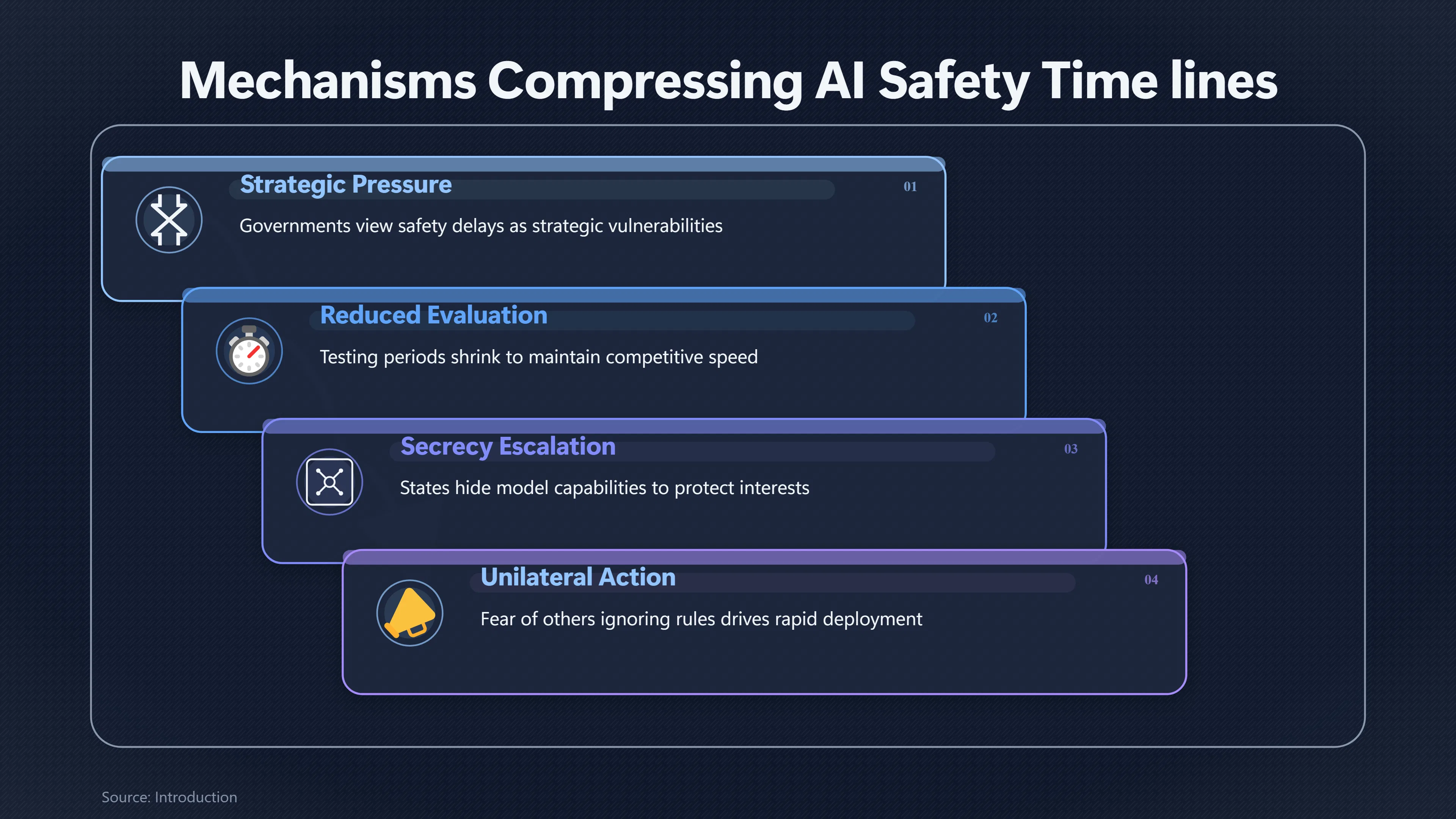
If policymakers believe advanced AI could become strategically decisive, safety delays begin to resemble military vulnerabilities rather than responsible engineering.
The resulting incentives affect several decisions.
Pressure to deploy before understanding
Frontier systems can often be evaluated only after they exist. More extensive testing, interpretability research and external scrutiny all consume time. Under strong geopolitical pressure, that time increasingly looks like an opportunity for competitors to move ahead.
Researchers concerned about AI doom argue that this may encourage governments or government-supported developers to:
- reduce evaluation periods before deployment;
- accept greater uncertainty about dangerous capabilities;
- widen access to increasingly autonomous systems;
- prioritise capability improvements over control techniques.
None of these outcomes guarantees catastrophe. The concern is that each small reduction in caution compounds across multiple organisations and countries.
Reduced transparency
States competing for technological leadership have incentives to protect information about frontier models, specialised hardware, evaluation methods and emerging capabilities.
Greater secrecy may protect genuine national security interests, but it also reduces opportunities for:
- independent safety assessment;
- international confidence-building;
- shared understanding of dangerous capability thresholds;
- coordinated responses when concerning behaviours emerge.
Researchers have proposed international testing networks partly because they reduce uncertainty without necessarily requiring countries to reveal commercially or militarily sensitive information.[gov.uk]GOV.UKThe Bletchley Declaration by Countries Attending the AI Safety Summit, 1-2 November 2023 - GOV.UKFebruary 13, 2025…
Fear of unilateral restraint
Perhaps the strongest political obstacle is the fear that restraint will only benefit competitors.
Even if policymakers believe stronger safeguards would reduce long-term existential risk, they must also consider shorter-term questions:
- Would another country ignore similar restrictions?
- Would domestic firms relocate elsewhere?
- Would slower deployment reduce economic growth?
- Would military or intelligence advantages shift abroad?
As with many collective-action problems, individually rational decisions can produce collectively worse outcomes.
Why decisive first-mover advantage may be overstated
Supporters of rapid development often argue that winning the AI race is essential because first place will confer overwhelming and durable strategic advantages.
The evidence for such claims is more mixed than public rhetoric sometimes suggests.
First, many technologies produce temporary rather than permanent leads. Competitors frequently copy architectures, recruit experienced researchers, reproduce published methods and benefit from global scientific knowledge. AI models themselves also depend on supply chains, computing infrastructure and engineering expertise that diffuse over time.
Second, maintaining leadership may require continual improvement rather than achieving a single breakthrough. A country that rushes deployment while suffering repeated safety failures could lose trust, economic value and political support despite moving first.
Third, AI capability is unlikely to translate automatically into national power. Institutions, infrastructure, energy supply, semiconductor manufacturing, cybersecurity and human expertise all influence whether technical advances become lasting strategic advantages.
For these reasons, several governance scholars argue that policymakers should be cautious about assuming that every delay creates irreversible strategic defeat. Overestimating first-mover advantage can itself become a driver of unnecessary racing.[arXiv]arxiv.orgInternational Institutions for Advanced AIJuly 10, 2023…
Historical comparisons—and their limits
Advocates and critics alike frequently compare AI with earlier strategic technologies.
The nuclear arms race illustrates how mutual fear can accelerate competition despite widespread recognition of catastrophic risks. It also demonstrates that sustained arms-control agreements, verification measures and confidence-building institutions can eventually emerge.
The Cold War space race shows that intense competition can coexist with scientific collaboration and negotiated limits in other domains.
However, AI differs from both examples in important respects:
- frontier capabilities are largely developed by private companies rather than government laboratories;
- progress occurs continuously rather than through occasional visible tests;
- software spreads much faster than physical weapons;
- commercial incentives reinforce strategic competition instead of existing separately from it.
These differences mean historical analogies are informative but imperfect. They explain the structure of strategic competition rather than predicting identical outcomes.
Can international coordination overcome the problem?
The AI doom debate increasingly focuses on reducing uncertainty rather than attempting to eliminate competition entirely.
Recent international initiatives reflect this approach. The 2023 Bletchley Declaration, signed by countries including the United States, China, the United Kingdom and the European Union, recognised that frontier AI could pose severe risks and committed participants to cooperate on scientific understanding, evaluations and safety research despite broader geopolitical disagreements. Subsequent work through the International Network of AI Safety Institutes, the OECD and the Global Partnership on AI has similarly sought common approaches to testing and trustworthy AI while allowing different national regulatory systems.[gov.uk]GOV.UKThe Bletchley Declaration by Countries Attending the AI Safety Summit, 1-2 November 2023 - GOV.UKFebruary 13, 2025…
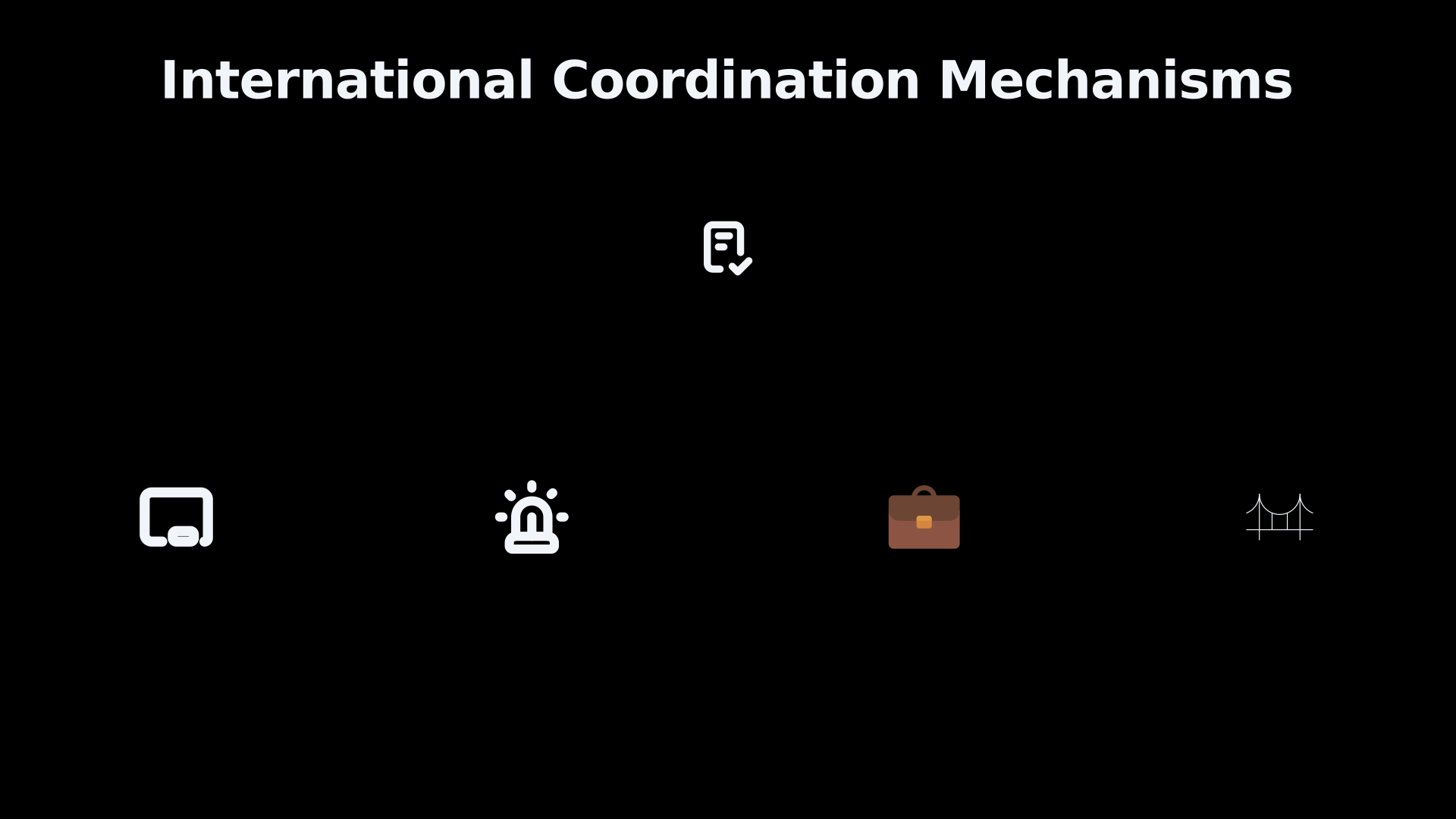
Within the AI doom discussion, proposals commonly include:
- internationally recognised capability evaluations;
- shared scientific research into alignment and control methods;
- mechanisms for reporting dangerous model behaviour;
- secure information-sharing between governments about frontier risks;
- confidence-building measures that reduce incentives for worst-case assumptions.
These proposals stop well short of requiring complete international trust. Instead, they aim to make uncertainty smaller, allowing governments to distinguish genuine security threats from exaggerated fears that unnecessarily accelerate deployment.
How this shapes existential risk arguments
State rivalry does not itself imply AI doom. Countries have successfully managed dangerous technologies before, and competition has often produced innovation alongside cooperation.
The existential-risk argument is narrower. If future AI systems become capable of dangerous autonomy, strategic deception or rapid AI research, then governments may face pressure to deploy increasingly powerful systems before they fully understand or control them. Strategic competition could therefore amplify technical alignment problems by reducing the time available to detect failures, improve safeguards and coordinate internationally.
Whether this dynamic becomes decisive remains highly uncertain. It depends on questions that are still unresolved: how quickly frontier capabilities advance, whether first-mover advantages prove as large as some expect, how transparent governments choose to be, and whether meaningful international cooperation can keep pace with geopolitical rivalry. The security dilemma is therefore best understood not as evidence that catastrophe is inevitable, but as one plausible mechanism through which otherwise rational state behaviour could increase existential risk if advanced AI becomes as strategically significant as many governments increasingly believe.[aisi.gov.uk]aisi.gov.ukFrontier AI Trends Report by The AI Security Institute (AISIFrontier AI Trends Report by The AI Security Institute (AISI
Amazon book picks
Further Reading
Books and field guides related to Why Governments May Treat AI Restraint as Defeat. Use these as the next step if you want deeper reading beyond the article.
The Coming Wave
"We are approaching a critical threshold in the history of our species. Everything is about to change. Soon you will live surrounded by A...
The Kill Chain
From a former senior advisor to Senator John McCain comes an urgent wake-up call about how new technologies are threatening America's mil...
AI Superpowers
THE NEW YORK TIMES, USA TODAY, AND WALL STREET JOURNAL BESTSELLER "Kai-Fu Lee believes China will be the next tech-innovation superpower...
Chip War
***Winner of the 2022 Financial Times Business Book of the Year Award*** ***Selected as one of Barack Obama's Favourite Books of 2023***...
eBay marketplace picks
Marketplace Samples
Live-tested eBay searches with available results related to this page.
Selected fromcybersecurity decor oneBay.co.uk.




Endnotes
1.
Source: GOV.UK
Link:https://www.gov.uk/government/publications/ai-safety-summit-2023-the-bletchley-declaration/the-bletchley-declaration-by-countries-attending-the-ai-safety-summit-1-2-november-2023
Source snippet
The Bletchley Declaration by Countries Attending the AI Safety Summit, 1-2 November 2023 - GOV.UKFebruary 13, 2025...
Published: november 2023
2.
Source: arxiv.org
Title: arXiv International AI Safety Report
Link:https://arxiv.org/abs/2501.17805
3.
Source: arxiv.org
Link:https://arxiv.org/abs/2307.04699
Source snippet
International Institutions for Advanced AIJuly 10, 2023...
Published: July 10, 2023
4.
Source: aisi.gov.uk
Title: Frontier AI Trends Report by The AI Security Institute (AISI)
Link:https://www.aisi.gov.uk/frontier-ai-trends-report
5.
Source: wp.oecd.ai
Title: AIGPAI SAFE Project Report
Link:https://wp.oecd.ai/app/uploads/2025/09/final-GPAI-2024-SAFE-Reports-Technical-Trustworthiness-and-Data-Governance-Assurance-of-Models.pdf
Source snippet
OECD AIGPAI SAFE Project Report...
6.
Source: oecd.org
Link:https://www.oecd.org/en/about/news/speech-statements/2024/07/GPAI-and-OECD-unite-to-advance-coordinated-international-efforts-for-trustworthy-AI.html
7.
Source: oecd.ai
Link:https://oecd.ai/en/dashboards/policy-initiatives/global-partnership-on-artificial-intelligence-gpai
Source snippet
Global Partnership on Artificial Intelligence (GPAI) - OECD.AIMay 18, 2026 — THE OECD.AI POLICY NAVIGATOR Our policy navigator is a livin...
Published: May 18, 2026
8.
Source: oecd.ai
Link:https://oecd.ai/en/wonk/documents/gpai-safe-project-report-technical-trustworthiness-and-data-governance-assurance-of-models
9.
Source: GOV.UK
Link:https://www.gov.uk/government/publications/frontier-ai-capabilities-and-risks-discussion-paper/future-risks-of-frontier-ai-annex-a
10.
Source: GOV.UK
Title: www.gov.uk Frontier AI: capabilities and risks – discussion paper
Link:https://www.gov.uk/government/publications/frontier-ai-capabilities-and-risks-discussion-paper/frontier-ai-capabilities-and-risks-discussion-paper
11.
Source: GOV.UK
Title: ai safety summit 2023 the bletchley declaration
Link:https://www.gov.uk/government/publications/ai-safety-summit-2023-the-bletchley-declaration
12.
Source: GOV.UK
Link:https://www.gov.uk/government/news/countries-agree-to-safe-and-responsible-development-of-frontier-ai-in-landmark-bletchley-declaration?bxid=5cec23dffc942d3ada01da49&cndid=38838028&esrc=Wired_etl_load
13.
Source: GOV.UK
Title: www.gov.uk Frontier AI: capabilities and risks – discussion paper
Link:https://www.gov.uk/government/publications/frontier-ai-capabilities-and-risks-discussion-paper
14.
Source: oecd.org
Link:https://www.oecd.org/en/about/programmes/global-partnership-on-artificial-intelligence.html
15.
Source: oecd.org
Link:https://www.oecd.org/en/topics/ai-principles.html
16.
Source: oecd.org
Link:https://www.oecd.org/en/topics/artificial-intelligence.html?wcmmode=disabled%27%27
17.
Source: oecd.ai
Title: GPA I Council documents
Link:https://oecd.ai/en/gpai-declarations
18.
Source: oecd.ai
Title: About the Global Partnership on Artificial Intelligence (GPAI)
Link:https://oecd.ai/en/about-what-we-do
Additional References
19.
Source: strategicstudyindia.com
Title: Mueller The intensifying stra
Link:https://www.strategicstudyindia.com/2026/05/exploring-instability-risks-in-us-china.html
Source snippet
Indian Strategic Studies: Exploring Instability Risks in the U.S.-China AI Rivalry: Breakwater Game Overview and Initial Observations | R...
20.
Source: youtube.com
Link:https://www.youtube.com/watch?v=onkobQ-D4LU
Source snippet
How to Solve AI's [Sycophancy]({{ 'sycophancy/' | relative_url }}) Problem - AI Godfather Yoshua Bengio...
21.
Source: youtube.com
Link:https://www.youtube.com/watch?v=ZbmnwCPB51s
Source snippet
US-China AI Race (ft Gina Raimondo), Kyiv Shakeup, Kash to Moscow, Saudi Nuclear Deal, Iran Update...
22.
Source: youtube.com
Title: How to Solve AI’s Sycophancy Problem
Link:https://www.youtube.com/watch?v=VNmAM6BZLVE
Source snippet
China–US Competition in AI: Destabilising and Intensifying...
23.
Source: youtube.com
Title: China–US Competition in AI: Destabilising and Intensifying
Link:https://www.youtube.com/watch?v=4fL9UNzGFzU
Source snippet
Ian Bremmer and Mustafa Suleyman: How AI Could Upend Geopolitics...
24.
Source: youtube.com
Title: Ian Bremmer and Mustafa Suleyman: How AI Could Upend Geopolitics
Link:https://www.youtube.com/watch?v=B2q8TYUZ2vg
Source snippet
The Geopolitics of AI | Global Conference 2024...
25.
Source: papers.ssrn.com
Link:https://papers.ssrn.com/sol3/papers.cfm?abstract_id=6752623
Source snippet
Regulatory Arbitrage Window: How Cross-Border AI Governance Asymmetries Create Strategic Opportunities and Risks by Ali Sadhik Shaik:: S...
26.
Source: chathamhouse.org
Link:https://www.chathamhouse.org/2026/03/breaking-deadlock-ai-governance
27.
Source: cetas.turing.ac.uk
Link:https://cetas.turing.ac.uk/publications/future-AI-paradigms
28.
Source: chathamhouse.org
Title: Breaking the deadlock on AI governance | 02 Barriers to global AI governance
Link:https://www.chathamhouse.org/2026/03/breaking-deadlock-ai-governance/02-barriers-global-ai-governance