Within Automated Labs
How Autonomous Are Today's Biology Labs Really?
Current systems can automate narrow optimisation tasks, but unpredictable biology still demands extensive human judgement and intervention.
On this page
- What recent self driving lab demonstrations achieved
- Where human scientists still remain essential
- Why narrow success does not prove dangerous autonomy
Page outline Jump by section
Introduction
Self-driving biology laboratories are real, but they are much less autonomous than the name suggests. Today’s most advanced systems can automate tightly defined research workflows by combining AI software with robotic equipment that performs repetitive laboratory tasks, analyses results and selects the next experiment within a predefined objective. They can dramatically speed up optimisation problems such as improving an enzyme, screening thousands of experimental conditions or refining laboratory protocols.[PubMed]pubmed.ncbi.nlm.nih.govAutonomous 'self-driving' laboratories: a review of technology and policy implications - PubMedJuly 16, 2025…

This distinction matters for debates about AI doom and catastrophic biological misuse. Some arguments assume that “AI-run laboratories” already possess broad scientific autonomy. The evidence points to something narrower. Existing demonstrations show impressive automation under carefully engineered conditions, but they do not demonstrate laboratories that independently conduct open-ended biological research, cope with unexpected failures across many domains, or replace experienced scientists. Understanding this gap is essential when assessing claims that automated laboratories could rapidly accelerate bioweapon development.
How Autonomous Are Today’s Biology Labs Really?
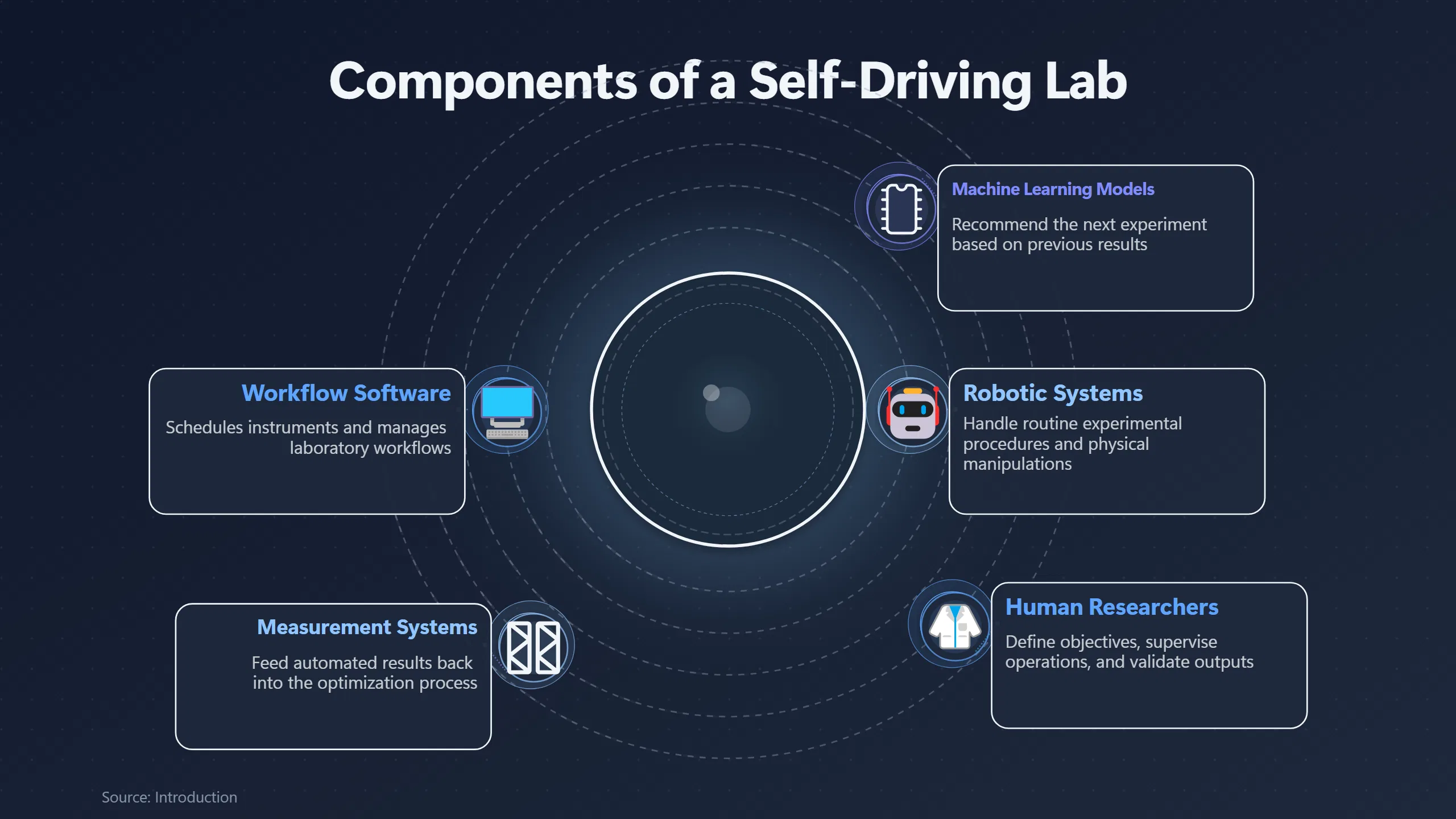
A modern self-driving laboratory combines several existing technologies rather than relying on a single breakthrough. Typically it includes:
- Robotic systems that handle routine experimental procedures.
- Software that schedules instruments and laboratory workflows.
- Machine-learning models that recommend which experiment should be performed next.
- Automated measurement systems that feed results back into the optimisation process.
- Human researchers who define the scientific objective, supervise operation, validate outputs and intervene when problems occur.[PubMed]pubmed.ncbi.nlm.nih.govAutonomous 'self-driving' laboratories: a review of technology and policy implications - PubMedJuly 16, 2025…
The important point is that autonomy is usually narrow rather than general. The AI is not independently deciding what grand scientific problem to solve. Instead, it is optimising within boundaries that humans have already specified, using equipment configured for a particular experimental workflow.
Researchers increasingly distinguish between automation and autonomy. Automation means carrying out predefined procedures without continuous human input. Autonomy implies that the system can adapt its behaviour, revise plans and make scientific decisions within its assigned task. Most current biological platforms exhibit some autonomy inside carefully constrained optimisation problems, but very little outside them.[Royal Society of Chemistry Pubs]pubs.rsc.orgRoyal Society of Chemistry PubsIntegrating autonomy into automated research platforms - Digital Discovery (RSC Publishing) DOI:10.1039/D3…
What Recent Self-Driving Lab Demonstrations Achieved
Recent demonstrations show genuine scientific progress, but they also illustrate how specialised today’s systems remain.
One widely discussed example is the SAMPLE platform from the University of Wisconsin–Madison. The system repeatedly designed protein variants, instructed robotic equipment to build and test them, analysed the results and selected improved candidates over many experimental rounds. Working continuously for months, it successfully identified enzymes with substantially improved thermal stability without researchers manually selecting each experiment.[nature.com]nature.comOpen source on nature.com.
This achievement is significant because protein engineering often requires exploring enormous numbers of possible variants. Instead of exhaustively testing every option, the AI gradually learned where promising candidates were likely to exist and focused experiments accordingly.
Other research groups have demonstrated similar closed-loop optimisation in areas including:
- protein engineering;
- metabolic engineering;
- synthetic biology workflows;[arxiv.org]arxiv.orgarXiv Perspectives for self-driving labs in synthetic biologyarXiv Perspectives for self-driving labs in synthetic biology
- chemical reaction optimisation; and
- materials discovery.
Across these fields, the main advantage is not that AI suddenly understands biology like an expert scientist. Rather, it can make the experimental search process far more efficient by choosing informative experiments instead of relying on trial and error alone.[nih.gov]pubmed.ncbi.nlm.nih.govAutonomous 'self-driving' laboratories: a review of technology and policy implications - PubMedJuly 16, 2025…
Many published successes also depend on cloud-connected laboratory infrastructure, allowing AI software to remotely schedule robotic experiments and receive data automatically. This makes experimentation more scalable but does not eliminate the need for human oversight or laboratory staff maintaining equipment.[PubMed]pubmed.ncbi.nlm.nih.govAutonomous 'self-driving' laboratories: a review of technology and policy implications - PubMedJuly 16, 2025…

Where Human Scientists Still Remain Essential
The phrase “self-driving lab” can suggest that scientists have been removed from the process. In practice, humans remain involved at nearly every important decision point.
Researchers typically:
- define the scientific question;
- choose the optimisation objective;
- prepare biological materials and protocols;
- ensure regulatory and biosafety compliance;
- troubleshoot equipment failures;
- interpret surprising or contradictory findings; and
- decide whether unexpected observations justify changing research direction.[PubMed]pubmed.ncbi.nlm.nih.govAutonomous 'self-driving' laboratories: a review of technology and policy implications - PubMedJuly 16, 2025…
Biological experiments are unusually difficult to automate because living systems behave unpredictably. Small variations in reagents, cell health, contamination, environmental conditions or measurement quality can produce misleading results that require scientific judgement rather than straightforward optimisation.
Laboratory robotics also remain technically constrained. Many procedures still involve fragile physical manipulations, manual preparation, quality control or specialised instruments that cannot simply be integrated into an automated workflow. Even highly automated laboratories frequently require technicians to reload consumables, recalibrate equipment or recover from hardware faults. Nature’s reporting on the SAMPLE system noted that researchers still had to intervene occasionally to repair hardware during months-long operation.[nature.com]nature.comOpen source on nature.com.
Perhaps most importantly, scientists continue to provide contextual understanding. AI systems may recommend the statistically best next experiment within their objective, but they generally cannot recognise when the original objective itself should be abandoned because biology is behaving in an unexpected way.
Why Narrow Success Does Not Prove Dangerous Autonomy
For discussions about catastrophic misuse, the key question is whether today’s demonstrations generalise beyond carefully controlled optimisation tasks.
The current evidence suggests several important limitations.
First, published systems usually operate in closed experimental domains. Researchers know in advance which biological system they are studying, what measurements matter and which experimental variables may change. The AI is not confronting arbitrary biological problems from scratch.[PubMed]pubmed.ncbi.nlm.nih.govAutonomous 'self-driving' laboratories: a review of technology and policy implications - PubMedJuly 16, 2025…
Second, success depends heavily on extensive engineering around the AI. Months or years of work typically go into integrating robotics, laboratory information systems, sensors and software before autonomous experimentation becomes possible.
Third, optimisation differs from scientific discovery. Improving an enzyme that already exists is a different challenge from identifying entirely new biological mechanisms or solving unfamiliar experimental problems where relevant measurements, controls and failure modes are unknown.
Finally, many demonstrations measure success by relatively narrow objectives—such as maximising enzyme stability or improving reaction yield. These are ideal settings for machine learning because there is a clear numerical target. Much of biological research instead involves ambiguous questions where success cannot easily be reduced to a single optimisation metric.[Royal Society of Chemistry Pubs]pubs.rsc.orgRoyal Society of Chemistry PubsIntegrating autonomy into automated research platforms - Digital Discovery (RSC Publishing) DOI:10.1039/D3…
For these reasons, today’s self-driving laboratories should not be interpreted as evidence that AI has achieved broad scientific agency.

What This Means for AI Doom and Bioweapon Risk
Within AI doom discussions, self-driving laboratories matter because they could reduce practical bottlenecks in scientific experimentation over time. Faster iteration may eventually make some forms of biological research easier, particularly if AI reasoning, robotics and laboratory infrastructure continue improving together.[PubMed]pubmed.ncbi.nlm.nih.govAutonomous 'self-driving' laboratories: a review of technology and policy implications - PubMedJuly 16, 2025…
However, current demonstrations provide stronger evidence for accelerated optimisation than for autonomous biological innovation. They show that AI can efficiently search well-defined experimental spaces once humans have built the platform, selected the problem and established reliable laboratory workflows.
This distinction weakens simplistic claims that today’s self-driving laboratories already enable autonomous development of sophisticated biological threats. Existing evidence does not support that conclusion. At the same time, the technology deserves continued monitoring because many of the remaining limitations—such as broader laboratory integration, more capable scientific reasoning and improved robotic reliability—are active areas of research. Whether future systems overcome those constraints remains uncertain, making current capabilities an important baseline rather than proof of either imminent catastrophe or complete safety.
Amazon book picks
Further Reading
Books and field guides related to How Autonomous Are Today's Biology Labs Really?. Use these as the next step if you want deeper reading beyond the article.
The Genesis Machine
A New Yorker Best Book of the Year The next frontier in technology is inside our own bodies. The breakthrough science of synthetic biolog...
Regenesis
A Harvard biologist and master inventor explores how new biotechnologies will enable us to bring species back from the dead, unlock vast...
The Code Breaker
"A gripping account of how the pioneering scientist Jennifer Doudna, along with her colleagues and rivals, launched a revolution that wil...
Biology Is Technology
In Biology Is Technology, author Robert Carlson offers a uniquely informed perspective on the endeavors that contribute to current progre...
eBay marketplace picks
Marketplace Samples
Live-tested eBay searches with available results related to this page.
Selected fromlaboratory robot model oneBay.co.uk.
Endnotes
1.
Source: nature.com
Link:https://www.nature.com/articles/s44286-023-00002-4
2.
Source: nature.com
Link:https://www.nature.com/articles/d41586-024-00093-w
3.
Source: nature.com
Title: Will self-driving ‘robot labs’ replace biologists?
Link:https://www.nature.com/articles/d41586-026-00453-8
Source snippet
Paper sparks debate | NatureFebruary 18, 2026 — * 18 February 2026 WILL SELF-DRIVING ‘ROBOT LABS’ REPLACE BIOLOGISTS? PAPER SPARKS DEBATE...
Published: February 18, 2026
4.
Source: nature.com
Title: Steering towards safe self-driving laboratories | Nature Reviews Chemistry
Link:https://www.nature.com/articles/s41570-025-00747-x
5.
Source: nature.com
Link:https://www.nature.com/articles/s41467-025-61209-y
6.
Source: nature.com
Link:https://www.nature.com/articles/s41467-025-59231-1
7.
Source: pubmed.ncbi.nlm.nih.gov
Link:https://pubmed.ncbi.nlm.nih.gov/40852582/
Source snippet
Autonomous 'self-driving' laboratories: a review of technology and policy implications - PubMedJuly 16, 2025...
Published: July 16, 2025
8.
Source: pubs.rsc.org
Link:https://pubs.rsc.org/en/content/articlehtml/2023/dd/d3dd00135k
Source snippet
Royal Society of Chemistry PubsIntegrating autonomy into automated research platforms - Digital Discovery (RSC Publishing) DOI:10.1039/D3...
9.
Source: pubmed.ncbi.nlm.nih.gov
Link:https://pubmed.ncbi.nlm.nih.gov/38468718/
Source snippet
Self-driving laboratories to autonomously navigate the protein fitness landscape - PubMed...
10.
Source: pubmed.ncbi.nlm.nih.gov
Link:https://pubmed.ncbi.nlm.nih.gov/42350467/
Source snippet
nih.govAutoLabs: cognitive multi-agent systems with self-correction for autonomous chemical experimentation - PubMedJune 25, 2026 — ABSTR...
Published: June 25, 2026
11.
Source: pubmed.ncbi.nlm.nih.gov
Title: Despite recent advancements in applying artificial intellige
Link:https://pubmed.ncbi.nlm.nih.gov/42156546/
Source snippet
multi-agent system for automating scientific discovery - PubMedMay 19, 2026 — ABSTRACT Scientific discovery is driven by the iterative pr...
Published: May 19, 2026
12.
Source: pubmed.ncbi.nlm.nih.gov
Link:https://pubmed.ncbi.nlm.nih.gov/41292801/
13.
Source: pubmed.ncbi.nlm.nih.gov
Link:https://pubmed.ncbi.nlm.nih.gov/40936235/
14.
Source: pmc.ncbi.nlm.nih.gov
Link:https://pmc.ncbi.nlm.nih.gov/articles/PMC12368842/
15.
Source: pubmed.ncbi.nlm.nih.gov
Link:https://pubmed.ncbi.nlm.nih.gov/38263405/
16.
Source: pmc.ncbi.nlm.nih.gov
Link:https://pmc.ncbi.nlm.nih.gov/articles/PMC10926838/
17.
Source: pmc.ncbi.nlm.nih.gov
Link:https://pmc.ncbi.nlm.nih.gov/articles/9454899/
18.
Source: pubmed.ncbi.nlm.nih.gov
Link:https://pubmed.ncbi.nlm.nih.gov/38726823/
Additional References
19.
Source: youtube.com
Title: Self-Driving Labs: How AI & Robotics Are Transforming Microbiology Forever
Link:https://www.youtube.com/watch?v=B7vPNdU5r2w
Source snippet
How Autonomous Labs Will Transform Scientific Research: Ginkgo Bioworks' Jason Kelly...
20.
Source: youtube.com
Link:https://www.youtube.com/watch?v=g45Alfg7diw
Source snippet
How AI Went From Predicting Biology to Running It...
21.
Source: youtube.com
Title: How AI Went From Predicting Biology to Running It
Link:https://www.youtube.com/watch?v=FzOD3Hgq-4k
Source snippet
How AI is accelerating scientific discovery today and what's ahead — the OpenAI Podcast Ep. 10...
22.
Source: researchgate.net
Link:https://www.researchgate.net/publication/393750833Autonomous%27self-driving%27_laboratories_a_review_of_technology_and_policy_implications
23.
Source: colab.ws
Link:https://colab.ws/articles/10.1098%2Frsos.250646
24.
Source: arxiv.org
Title: arXiv Perspectives for self-driving labs in synthetic biology
Link:https://arxiv.org/abs/2210.09085
25.
Source: youtube.com
Link:https://www.youtube.com/watch?v=0sNOaD9xT_4
26.
Source: pnnl.gov
Title: perspectives self driving labs synthetic biology
Link:https://www.pnnl.gov/publications/perspectives-self-driving-labs-synthetic-biology
27.
Source: youtube.com
Link:https://www.youtube.com/watch?v=zTxtIUdQRJM
Source snippet
Self-Driving Labs: How AI & Robotics Are Transforming Microbiology Forever...
28.
Source: pubs.acs.org
Link:https://pubs.acs.org/doi/10.1021/acs.chemrev.4c00055