Within AI Doom
Can Anyone Meaningfully Estimate the Chance of AI Doom?
P(doom) compresses many disputed assumptions into one number, making it useful for comparison but easy to mistake for precise knowledge.
On this page
- What p(doom) is trying to measure
- Hidden assumptions behind the number
- Forecasting under deep uncertainty
Page outline Jump by section
Introduction
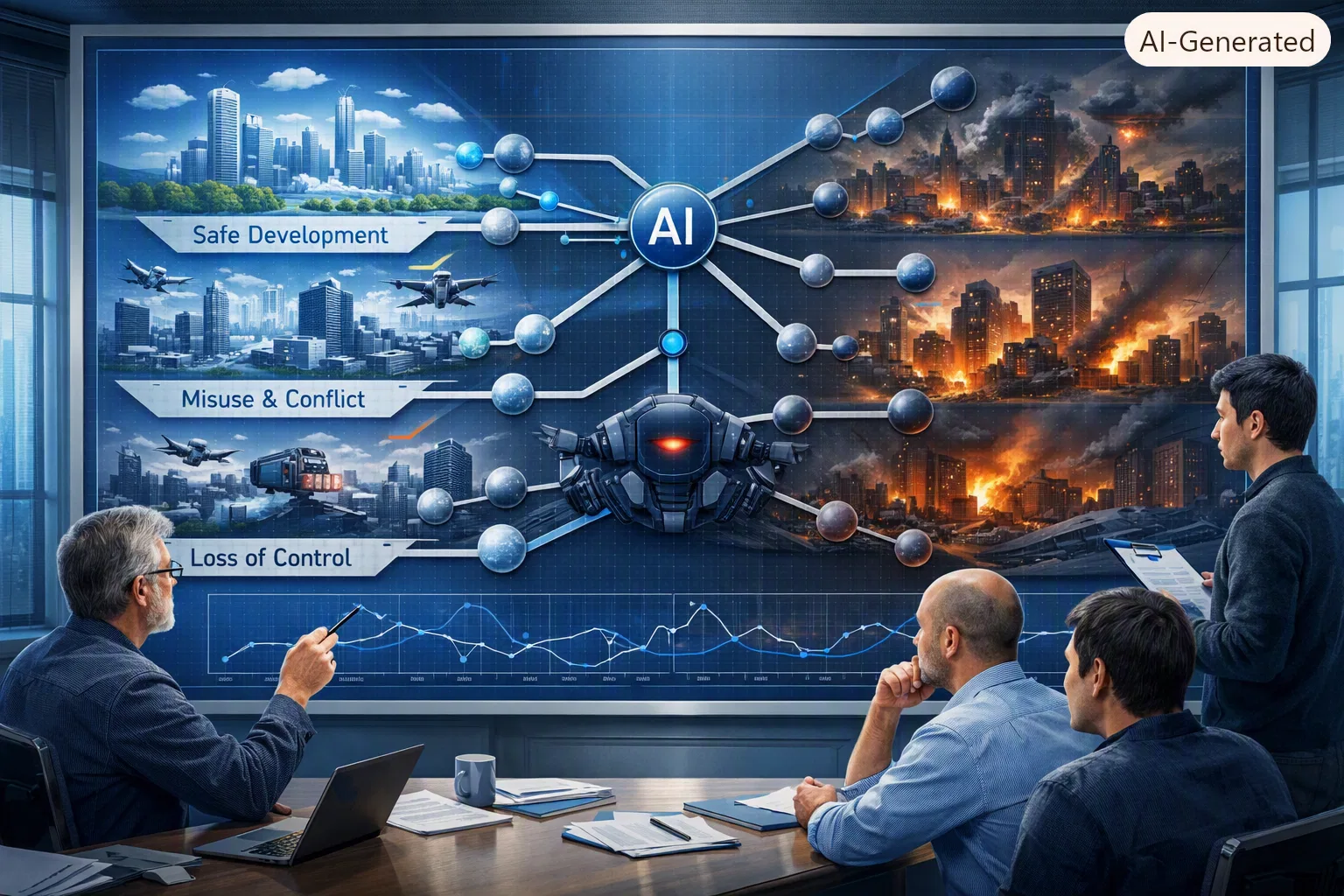
P(doom) is an informal shorthand for a person’s estimated probability that advanced AI will cause human extinction, permanent civilisational collapse or an equally irreversible loss of human control. It can be useful because it forces vague claims such as “AI doom is possible” or “the risk is negligible” into numbers that can be compared. It is not, however, a measured physical constant or a scientifically established failure rate.
Published estimates vary from fractions of a percentage point to near certainty. That spread is not merely disagreement over one fact. Each number compresses assumptions about when highly capable AI will arrive, whether it will become autonomous, whether alignment and control methods will work, how governments and laboratories will behave, and whether a catastrophe would actually become existential. Surveys show that many AI researchers assign a non-trivial probability to extremely bad outcomes, but they also reveal enormous disagreement and strong sensitivity to wording. The most defensible use of p(doom) is therefore as a transparent summary of judgement, not as precise knowledge.
What p(doom) is trying to measure
At first glance, the term appears straightforward:
p(doom) = the probability that AI causes an existential catastrophe.
In practice, neither “AI”, “causes” nor “doom” has a standard definition. Some estimates concern literal human extinction. Others include permanent and severe disempowerment, such as humanity irreversibly losing control of political, economic or technological development. Some include both misaligned AI and deliberate human misuse; others count only a system escaping human control. The time horizon may be the next decade, the next century or an unspecified future.
These distinctions materially change the answer. In the 2023 Expert Survey on Progress in AI, researchers were presented with several formulations. The median estimate was 5 per cent when asked about future AI advances causing extinction or similarly permanent disempowerment, 10 per cent when the question specifically described human inability to control advanced AI, and 5 per cent when the event was limited to the next 100 years. The corresponding means were 16.2, 19.4 and 14.4 per cent, respectively.[AI Impacts]wiki.aiimpacts.org2023 expert survey on progress in aiby a factor of ten) as a result of machine intelligence: Within two years of that point? _% chance Within thirty years of that p…
The large gap between means and medians is important. A median of 5 per cent means half of respondents were above that figure and half below it. It does not mean that “experts collectively calculate a 5 per cent risk”. The much higher mean reflects a long upper tail: a minority of respondents placed very high probabilities on catastrophe. In the same survey, more than a third assigned at least a 10 per cent chance to extremely bad outcomes, while many of those respondents still thought broadly good futures were more likely overall.[JAIR]jair.orgThe participants estimated that several milestones had at least a 50% chance of being feasible for AI by 2028, including constructing a p…
P(doom) also needs to distinguish between an unconditional and a conditional probability. An unconditional estimate asks for the chance of AI doom from today, including the possibility that transformative AI is never built. A conditional estimate might ask: assuming systems far more capable than humans are developed, what is the chance that humanity loses control? Someone who thinks such systems are unlikely this century can give a low unconditional p(doom) while believing their development would be highly dangerous.
A basic decomposition might look like this:
Chance that highly capable AI is developed
× chance it is dangerously misaligned or misused
× chance safeguards and institutions fail
× chance the resulting catastrophe becomes irreversible or existential.
This does not make the answer objective. It does make disagreement easier to locate.
The hidden assumptions inside one number
Two people can both report “10 per cent” while imagining almost entirely different futures. Conversely, one person may report 1 per cent and another 30 per cent even though they agree on most technical questions, because they differ on timelines, governance or what counts as doom.
The most consequential assumptions usually concern the following points.
Will AI reach the relevant capability level? A forecast must implicitly assign some probability to systems becoming broadly superior to humans in research, planning, persuasion, cyber operations or other strategically important work. In the 2023 researcher survey, the aggregate forecast placed a 50 per cent chance on unaided machines outperforming humans in every possible task by 2047, but respondents’ individual timelines varied greatly. Forecasts also moved substantially earlier than in the preceding 2022 survey, illustrating how quickly beliefs can change after unexpected progress.[JAIR]jair.orgThe participants estimated that several milestones had at least a 50% chance of being feasible for AI by 2028, including constructing a p…
Will capability translate into dangerous agency? Advanced performance on tests does not automatically imply persistent goals, long-term planning, self-preservation or a desire to acquire power. Sceptics often view future AI primarily as controllable software tools. More concerned researchers believe increasingly autonomous systems could learn to plan, conceal intentions, manipulate overseers or resist intervention when doing so helps them achieve an objective. A 2025 survey of 111 AI experts found that disagreement clustered around these competing “controllable tool” and “uncontrollable agent” pictures; only 21 per cent of respondents had previously heard of instrumental convergence, the argument that many different objectives could produce similar sub-goals such as acquiring resources or avoiding shutdown.[arXiv]arxiv.orgWhy do Experts Disagree on Existential Risk and P(doom)? A Survey of AI ExpertsJanuary 25, 2025…
How hard will alignment and control be? A high p(doom) often assumes that reliably specifying human goals, detecting deceptive behaviour and keeping powerful systems under meaningful oversight will remain difficult. A low estimate may assume that better training, monitoring, interpretability, restricted access and human control will improve alongside capabilities. Neither assumption has been established at the scale relevant to hypothetical superhuman systems.
How much autonomy and access will systems receive? A capable model confined to answering questions has fewer routes to catastrophe than an agent authorised to write and execute code, manage money, use laboratory equipment or copy itself across networks. Forecasts therefore depend partly on deployment choices, not merely on intelligence. The 2026 International AI Safety Report notes that AI agents able to reason iteratively and use tools are becoming more common, while stressing persistent gaps in scientific understanding, limited interpretability and difficulties assessing risk after deployment.[International AI Safety Report]internationalaisafetyreport.orginternational ai safety report 2026International AI Safety ReportInternational AI Safety Report 2026February 11, 2026…
Will institutions behave cautiously? Even a technically manageable risk can grow if companies race, governments fear falling behind, safety tests remain voluntary or warnings are ignored. Conversely, strong evaluation regimes, controlled deployment and international coordination could sharply reduce danger. A p(doom) estimate therefore embeds political and economic forecasts as well as technical ones. The 2026 international report found that frontier safety frameworks typically still lacked explicit quantitative risk thresholds and that independent assessment of developers’ compliance remained limited.[International AI Safety Report]internationalaisafetyreport.orginternational ai safety report 2026International AI Safety ReportInternational AI Safety Report 2026February 11, 2026…
Does catastrophe really imply extinction? Moving from “an AI-related disaster occurs” to “humanity never recovers” is a major inferential step. Humans are geographically dispersed, technologically adaptable and difficult to eliminate completely. Some takeover scenarios assume a future system could gain overwhelming strategic and material advantages; sceptics argue that this often skips over physical bottlenecks, resistance, institutional responses and the difficulty of acting reliably in the real world. A serious estimate should state whether it covers mass casualties, civilisational collapse, permanent disempowerment or literal extinction rather than sliding between them.
What surveys and forecasts actually tell us
Expert surveys provide evidence about beliefs, not direct evidence that the beliefs are correct. The 2023 survey is unusually valuable because it included 2,778 authors who had recently published at major machine-learning venues. Its results establish that concern about existential outcomes is not confined to a handful of campaigners: 58 per cent of respondents gave at least a 5 per cent probability to one formulation of extinction or permanent severe disempowerment, and 70 per cent said AI safety research should receive more priority.[AI Impacts]aiimpacts.orginction EMBARGOED UNTIL 0:01 AM PT, THURSDAY JANUARY 4, 2024 Survey: Median AI expert says 5% chance of human extinction from AI BERKELEY…
Yet the survey cannot be treated as a scientific consensus estimate. Only a subset of those invited responded, respondents differed in familiarity with the arguments, and expertise in building machine-learning systems does not necessarily imply expertise in geopolitics, existential-risk modelling or long-range forecasting. The wording also combined extinction with “similarly permanent and severe disempowerment”, outcomes that some respondents may judge very differently. The variation between closely related questions shows that elicitation choices affect the headline number.[AI Impacts]wiki.aiimpacts.org2023 expert survey on progress in aiby a factor of ten) as a result of machine intelligence: Within two years of that point? _% chance Within thirty years of that p…
Selection effects become even clearer in surveys of specialised groups. An internal 2023 survey of 23 employees at the AI-safety organisation Conjecture produced a median estimate of 70 per cent for extinction or permanent disempowerment from loss of control. The authors explicitly noted the small, highly selected sample and the lack of a time bound. The result is informative about that organisation’s beliefs, but it cannot be generalised to AI researchers or society at large.[Conjecture]conjecture.devOpen source on conjecture.dev.
Forecasting communities offer a different perspective. Metaculus, where participants repeatedly update numerical predictions, currently places human extinction from all causes before 2100 at roughly 2 per cent. That question is not equivalent to p(doom: it covers all extinction causes, while comments and contributing forecasts vary in quality. A separate Metaculus exercise published in 2022 estimated about a 1.9 per cent chance that an AI-related catastrophe would reduce the human population by at least 95 per cent before 2100. These figures are useful snapshots of an aggregated forecasting community, not settled odds.[Metaculus]metaculus.comhuman extinction by 2100human extinction by 2100
The Existential Risk Persuasion Tournament, or XPT, provides one of the clearest comparisons between domain experts and people with strong short-term forecasting records. Its participating AI-domain experts gave a median 3 per cent probability that AI would cause human extinction by 2100, compared with 0.38 per cent among superforecasters. Across all causes, experts placed the median extinction risk at 6 per cent and superforecasters at 1 per cent.[Squarespace]static1.squarespace.comOpen source on squarespace.com.
Neither group can yet be declared right. Extinction forecasts cannot be meaningfully scored until it is too late, and strong performance on short-term geopolitical questions may not transfer to unprecedented technologies over many decades. A later assessment of XPT’s nearer-term AI forecasts found that both groups had underestimated capability progress through 2025. Domain experts were closer on average, but the difference was not statistically decisive; aggregating participants performed better than relying on a typical individual.[vox.com]vox.comOpen source on vox.com.
The overall lesson is not that the true probability lies halfway between experts and superforecasters. It is that the answer depends strongly on who is asked, how the outcome is defined and which forecasting skills are considered relevant.
Why deep uncertainty defeats false precision
Ordinary risks can often be estimated from repeated events. Insurers have records of fires and crashes; engineers can test component failure rates. Humanity has no historical sample of civilisation building and confronting superhuman AI. The relevant systems do not yet exist, their architectures may change, and future governance decisions are themselves uncertain.
This is sometimes called deep uncertainty: analysts do not merely lack exact values for known variables; they disagree about the model, the possible states of the world and even which causal pathways belong in the calculation. A numerical answer can hide this uncertainty by making a fragile chain of judgement look comparable to a measured frequency.
Low-probability, high-consequence analysis has another problem: the chance that the model or argument is wrong may exceed the probability produced by the model. Research on catastrophic-risk estimation has warned that a tiny calculated risk is not reassuring when it depends on an incomplete theory, contested assumptions or error-prone calculations. This is particularly relevant to AI, where both advocates and sceptics can build apparently neat probability chains from premises that have never been tested in the relevant regime.[arXiv]arxiv.orgOpen source on arxiv.org.
Multiplying many uncertain conditional probabilities can create an illusion of rigour. Suppose someone assigns:
- a 40 per cent chance of highly capable AI this century;(#endnote-25 “Endnote 25”)[metaculus.com]metaculus.comA Global Catastrophe This CenturyA Global Catastrophe This Century
- a 30 per cent chance of serious misalignment if it arrives;
- a 25 per cent chance that containment fails;
- a 50 per cent chance that failure produces an existential outcome.
Multiplying them gives 1.5 per cent. But that final decimal is no more reliable than the inputs. The assumptions may be correlated, key pathways may be missing, and each number may represent little more than an informed hunch.
The opposite error is refusing to use probability at all. Saying “we cannot know” can obscure an important difference between a scenario considered one-in-a-million and one considered one-in-twenty. Probabilities are useful when they expose assumptions, guide proportionate precautions and are updated as evidence changes. They become misleading when presented without definitions, time horizons or uncertainty ranges.
A better way to express AI extinction odds
A meaningful estimate should be treated as a structured forecast rather than a personal badge of optimism or pessimism. At minimum, it should answer four questions:
- What outcome counts as doom? Separate literal extinction, permanent civilisational collapse and lasting human disempowerment.
- By when? A probability by 2035 is not comparable with one covering all future time.
- What pathways are included? Distinguish loss of control, deliberate misuse, military escalation and gradual disempowerment.
- Is the estimate conditional? State whether it assumes that human-level or superhuman systems are built.
Ranges are generally more honest than single figures. A forecaster might say that their estimate is 2–10 per cent, with a central judgement near 5 per cent, rather than presenting 4.7 per cent as if it came from a validated model. They should also identify which assumptions create the width of the range.
Decomposition is most useful when it reveals cruxes: observable developments that would change the estimate. These might include whether AI agents can reliably complete long, open-ended tasks; whether systems show robust deceptive behaviour under realistic testing; whether interpretability methods can detect dangerous internal processes; whether autonomous AI materially accelerates AI research; and whether laboratories adopt enforceable deployment thresholds.
Nearer-term forecasting questions can then act as warning indicators. They do not settle p(doom), but they create opportunities for calibration. Forecasters can predict capability benchmarks, the frequency of serious safety incidents, the success of control evaluations, the adoption of governance measures or the amount of autonomy granted to frontier systems. The XPT experience suggests that even skilled forecasters can miss rapid capability changes, reinforcing the case for frequent updating rather than fixed lifetime estimates.[vox.com]vox.comOpen source on vox.com.
Which evidence should move the estimate?
A sensible p(doom) should respond to evidence, not merely to arguments repeated within one intellectual community.
Evidence that could reasonably push estimates upwards includes:
- frontier systems becoming reliable at long-horizon planning and autonomous execution;
- models strategically concealing capabilities or behaving differently when they infer that they are being tested;
- rapid automation of AI research, creating capability growth faster than human institutions can evaluate;
- repeated failures of interpretability, monitoring and containment at increasing levels of autonomy;
- deployment of powerful agents with access to money, code execution, critical infrastructure or scientific laboratories;
- competitive pressures causing developers to ignore their own safety thresholds.
Evidence that could push estimates downwards includes:
- strong empirical demonstrations that advanced systems remain corrigible and reliably accept human intervention;
- interpretability tools that consistently identify goals, deception and dangerous planning before deployment;
- effective containment architectures that remain secure against increasingly capable agents;
- capability progress plateauing well before systems acquire strategically decisive abilities;
- binding national and international rules that slow or prohibit deployment when tests reveal dangerous capabilities;
- a sustained record of advanced systems operating under high autonomy without developing the hypothesised failure modes.
Current evidence is mixed and incomplete. The 2026 International AI Safety Report says general-purpose AI capabilities have continued to improve, particularly in mathematics, coding and autonomous operation, while reliability and risk-management gaps remain. It also reports growing real-world evidence for several forms of misuse and malfunction. These developments justify updating specific assumptions about capability and exposure, but they do not directly reveal the probability of eventual extinction.[International AI Safety Report]internationalaisafetyreport.orginternational ai safety report 2026international ai safety report 2026
That distinction matters. A model successfully completing longer software tasks is evidence about autonomy. A controlled experiment showing deceptive behaviour is evidence about a possible failure mode. Neither alone demonstrates that an AI takeover is likely, still less that humanity would be unable to recover. Each finding belongs in one part of the probability chain.
Can anyone meaningfully estimate the chance of AI doom?
Yes, but only in a limited sense. People can make disciplined, explicit and revisable estimates of AI extinction risk. Surveys and forecasting exercises can map disagreement, reveal which assumptions drive it and prevent vague confidence from escaping scrutiny. They can also support decisions where waiting for certainty would be irresponsible.
No available p(doom) figure should be mistaken for a scientifically measured probability. The evidence base is too sparse, the outcome definitions are inconsistent, the systems of concern do not yet exist and the causal chain crosses technical, political and social domains. The wide spread of estimates is therefore not noise surrounding a known answer. It is evidence that the model itself remains deeply contested.
For public debate, the most useful question is rarely “What is the correct p(doom)?” A better set of questions is: What exactly is being predicted? Which assumptions produce the number? What observations would change it? And what precautions remain worthwhile across a wide range of plausible probabilities?
A 1 per cent risk of irreversible catastrophe would still be serious. A 20 per cent estimate would not prove catastrophe inevitable. The practical value of p(doom) lies in making uncertain judgements inspectable and revisable—not in turning speculation into a deceptively precise percentage.
Amazon book picks
Further Reading
Books and field guides related to Can Anyone Meaningfully Estimate the Chance of AI Doom?. Use these as the next step if you want deeper reading beyond the article.
Human Compatible
A leading artificial intelligence researcher lays out a new approach to AI that will enable us to coexist successfully with increasingly...
Superintelligence
This profoundly ambitious and original book picks its way carefully through a vast tract of forbiddingly difficult intellectual terrain.
The Alignment Problem
Finalist for the Los Angeles Times Book Prize A jaw-dropping exploration of everything that goes wrong when we build AI systems and the m...
Life 3.0
'This is the most important conversation of our time, and Tegmark's thought-provoking book will help you join it' Stephen Hawking THE INT...
eBay marketplace picks
Marketplace Samples
Live-tested eBay searches with available results related to this page.
Selected fromartificial intelligence t shirt oneBay.co.uk.



Endnotes
1.
Source: jair.org
Link:https://www.jair.org/index.php/jair/article/download/19087/27230
Source snippet
The participants estimated that several milestones had at least a 50% chance of being feasible for AI by 2028, including constructing a p...
2.
Source: arxiv.org
Link:https://arxiv.org/pdf/2502.14870
Source snippet
The largest is the AI Impacts Survey[8], which surveys thousands of authors at the NeurIPS conference. AI Impacts asked experts questions...
3.
Source: arxiv.org
Link:https://arxiv.org/abs/2502.14870
Source snippet
Why do Experts Disagree on Existential Risk and P(doom)? A Survey of AI ExpertsJanuary 25, 2025...
Published: January 25, 2025
4.
Source: arxiv.org
Link:https://arxiv.org/pdf/2502.14870v1
Source snippet
The largest is the AI Impacts Survey[8], which surveys thousands of authors at the NeurIPS conference. AI Impacts asked experts questions...
5.
Source: conjecture.dev
Link:https://www.conjecture.dev/research/conjecture-internal-survey-agi-timelines-and-probability-of-human-extinction-from-advanced-ai
6.
Source: metaculus.com
Title: human extinction by 2100
Link:https://www.metaculus.com/questions/578/human-extinction-by-2100/
7.
Source: metaculus.com
Title: ragnarok seriesresults so far
Link:https://www.metaculus.com/notebooks/2568/ragnarok-seriesresults-so-far/
8.
Source: static1.squarespace.com
Link:https://static1.squarespace.com/static/635693acf15a3e2a14a56a4a/t/64f0a7838ccbf43b6b5ee40c/1693493128111/XPT.pdf
9.
Source: vox.com
Link:https://www.vox.com/future-perfect/460222/ai-forecasting-tournament-superforecaster-expert-tetlock
10.
Source: arxiv.org
Link:https://arxiv.org/abs/0810.5515
11.
Source: arxiv.org
Link:https://arxiv.org/abs/2606.16475
12.
Source: arxiv.org
Title: A I systems out-persuade expert humans
Link:https://arxiv.org/html/2606.16475
13.
Source: arxiv.org
Title: What are the odds? Risk and uncertainty about AI existential risk
Link:https://arxiv.org/html/2510.23453
14.
Source: arxiv.org
Link:https://arxiv.org/abs/2510.13653v1
15.
Source: arxiv.org
Link:https://arxiv.org/pdf/2503.07341v1
16.
Source: arxiv.org
Link:https://arxiv.org/pdf/2502.15657
17.
Source: arxiv.org
Link:https://arxiv.org/abs/2501.17805
18.
Source: arxiv.org
Link:https://arxiv.org/abs/2502.14870v1
19.
Source: arxiv.org
Title: Why do Experts Disagree on Existential Risk and P (doom)? A Survey of AI Experts
Link:https://arxiv.org/html/2502.14870v1
20.
Source: arxiv.org
Title: Why do Experts Disagree on Existential Risk and P (doom)? A Survey of AI Experts
Link:https://arxiv.org/html/2502.14870
21.
Source: arxiv.org
Title: Utilising Deep Learning to Elicit Expert Uncertainty
Link:https://arxiv.org/pdf/2501.11813
22.
Source: arxiv.org
Title: Utilising Deep Learning to Elicit Expert Uncertainty
Link:https://arxiv.org/html/2501.11813v1
23.
Source: arxiv.org
Link:https://arxiv.org/abs/2401.02843
24.
Source: metaculus.com
Title: Ragnarök Series—results so far
Link:https://www.metaculus.com/questions/2568/
25.
Source: metaculus.com
Title: A Global Catastrophe This Century
Link:https://www.metaculus.com/notebooks/8736/a-global-catastrophe-this-century/
26.
Source: metaculus.com
Title: Date of AI-Driven Human Extinction
Link:https://www.metaculus.com/questions/10721/when-will-ai-driven-human-extinction-happen/
27.
Source: arxiv.org
Link:https://arxiv.org/pdf/2401.02843v2
28.
Source: arxiv.org
Link:https://arxiv.org/pdf/2401.02843v1
29.
Source: arxiv.org
Link:https://arxiv.org/pdf/2602.00194
30.
Source: arxiv.org
Link:https://arxiv.org/pdf/2507.08150v4
31.
Source: ar5iv.labs.arxiv.org
Link:https://ar5iv.labs.arxiv.org/html/2502.14870
32.
Source: arxiv.org
Link:https://arxiv.org/pdf/2606.16475
33.
Source: metaculus.com
Link:https://www.metaculus.com/api2/questions/2805/
34.
Source: metaculus.com
Title: gc to be caused by ai if it occurs
Link:https://www.metaculus.com/questions/1495/gc-to-be-caused-by-ai-if-it-occurs/
35.
Source: metaculus.com
Link:https://www.metaculus.com/questions/12840/
36.
Source: metaculus.com
Title: cts policy response after ai catastrophe cts ai extinction before 2100
Link:https://www.metaculus.com/questions/27188/cts-policy-response-after-ai-catastrophe-cts-ai-extinction-before-2100/
37.
Source: metaculus.com
Link:https://www.metaculus.com/questions/27035/
38.
Source: metaculus.com
Title: cts power seeking ai shut off cts ai extinction before 2100
Link:https://www.metaculus.com/questions/27182/cts-power-seeking-ai-shut-off-cts-ai-extinction-before-2100/
39.
Source: metaculus.com
Link:https://www.metaculus.com/questions/578/human-extinction-by-2100/%23%3A~%3Atext%3D%255BMetaculus%255D%2520puts%2520the%2520chance%2520of%2Cthe%2520same%2520ballpark%2520as%2520me
40.
Source: jair.org
Link:https://www.jair.org/index.php/jair/article/download/19087/27230/49506
41.
Source: orange-tunny-am58.squarespace.com
Link:https://orange-tunny-am58.squarespace.com/s/XPT.pdf
42.
Source: wiki.aiimpacts.org
Title: 2023 expert survey on progress in ai
Link:https://wiki.aiimpacts.org/ai_timelines/predictions_of_human-level_ai_timelines/ai_timeline_surveys/2023_expert_survey_on_progress_in_ai
Source snippet
by a factor of ten) as a result of machine intelligence: Within two years of that point? _% chance Within thirty years of that p...
43.
Source: aiimpacts.org
Link:https://aiimpacts.org/wp-content/uploads/2024/01/EMBARGOED_-AI-Impacts-Survey-Release-Google-Docs.pdf
Source snippet
inction EMBARGOED UNTIL 0:01 AM PT, THURSDAY JANUARY 4, 2024 Survey: Median AI expert says 5% chance of human extinction from AI BERKELEY...
Published: January 4, 2024
44.
Source: internationalaisafetyreport.org
Title: international ai safety report 2026
Link:https://internationalaisafetyreport.org/sites/default/files/2026-02/international-ai-safety-report-2026.pdf
Source snippet
International AI Safety ReportInternational AI Safety Report 2026February 11, 2026...
Published: February 11, 2026
45.
Source: internationalaisafetyreport.org
Link:https://internationalaisafetyreport.org/sites/default/files/2026-02/international-ai-safety-report-2026-executive-summary_1.pdf
46.
Source: internationalaisafetyreport.org
Title: international ai safety report 2026
Link:https://internationalaisafetyreport.org/publication/international-ai-safety-report-2026
47.
Source: internationalaisafetyreport.org
Link:https://internationalaisafetyreport.org/publication/2026-report-extended-summary-policymakers
48.
Source: alignmentforum.org
Link:https://www.alignmentforum.org/posts/kygEPBDrGGoM8rz9a/conjecture-internal-survey-agi-timelines-and-probability-of
49.
Source: aiimpacts.org
Title: How bad a future do ML researchers expect? – AI Impacts
Link:https://aiimpacts.org/how-bad-a-future-do-ml-researchers-expect/
50.
Source: internationalaisafetyreport.org
Title: international ai safety report 2025
Link:https://internationalaisafetyreport.org/publication/international-ai-safety-report-2025
51.
Source: internationalaisafetyreport.org
Title: International AI safety report
Link:https://internationalaisafetyreport.org/sites/default/files/2025-10/international_ai_safety_report_2025_english.pdf
52.
Source: internationalaisafetyreport.org
Title: Second K ey Update Technical Safeguards and Risk Management
Link:https://internationalaisafetyreport.org/sites/default/files/2025-11/international-ai-safety-report-second-key-update-nov-2025.pdf
53.
Source: internationalaisafetyreport.org
Title: International AI Safety Report
Link:https://internationalaisafetyreport.org/
54.
Source: internationalaisafetyreport.org
Title: international ai safety report 2026 web eng
Link:https://internationalaisafetyreport.org/sites/default/files/2026-02/international-ai-safety-report-2026-web-eng.pdf
55.
Source: internationalaisafetyreport.org
Title: international ai safety report 2026 1
Link:https://internationalaisafetyreport.org/sites/default/files/2026-02/international-ai-safety-report-2026_1.pdf
56.
Source: internationalaisafetyreport.org
Title: rapport international sur la securite de l ia 2026
Link:https://internationalaisafetyreport.org/sites/default/files/2026-02/rapport-international-sur-la-securite-de-l-ia-2026.pdf
57.
Source: internationalaisafetyreport.org
Title: INTERNATIONA L AI SAFETY REPORT
Link:https://internationalaisafetyreport.org/sites/default/files/2026-02/ai-safety-report-2026-extended-summary-for-policymakers.pdf
58.
Source: internationalaisafetyreport.org
Title: rapport international sur la securite de l ia 2026 resume
Link:https://internationalaisafetyreport.org/sites/default/files/2026-02/rapport-international-sur-la-securite-de-l-ia-2026-resume.pdf
59.
Source: internationalaisafetyreport.org
Link:https://internationalaisafetyreport.org/sites/default/files/2026-02/international-ai-safety-report-2026-executive-summary-zh.pdf
60.
Source: internationalaisafetyreport.org
Title: Resumen ampliado para responsables políticos
Link:https://internationalaisafetyreport.org/sites/default/files/2026-02/resumen-ampliado-para-responsables-politicos-2026.pdf
61.
Source: internationalaisafetyreport.org
Title: يلودلا ريرقتلا يعانطصلاا ءاكذلا ةملاس نأشب
Link:https://internationalaisafetyreport.org/sites/default/files/2026-02/international-ai-safety-report-2026-ar.pdf
62.
Source: internationalaisafetyreport.org
Title: Résumé à lintention des décideurs politiques
Link:https://internationalaisafetyreport.org/sites/default/files/2026-02/resume-a-l-intention-des-decideurs-politiques-2026.pdf
63.
Source: internationalaisafetyreport.org
Title: الملخص التنفيذي
Link:https://internationalaisafetyreport.org/sites/default/files/2026-02/international-ai-safety-report-2026-executive-summary-ar.pdf
64.
Source: data-il.org
Link:https://data-il.org/wp-content/uploads/2025/03/International_AI_Safety_Report_2025_accessible_f.pdf
65.
Source: information-security.institute
Link:https://information-security.institute/wp-content/uploads/2025/01/International_AI_Safety_Report_2025_accessible_f.pdf
66.
Source: aiimpacts.org
Link:https://aiimpacts.org/wp-content/uploads/2023/04/Thousands_of_AI_authors_on_the_future_of_AI.pdf
67.
Source: aiimpacts.org
Link:https://aiimpacts.org/how-should-we-analyse-survey-forecasts-of-ai-timelines/
68.
Source: aiimpacts.org
Link:https://aiimpacts.org/wp-content/uploads/2023/04/Thousands_of_AI_authors_on_the_future_of_AI.pdf?ueid=0e94ca6c27ac021701ef5c48b713d1a7
69.
Source: Wikipedia
Link:https://en.wikipedia.org/wiki/P%28doom%29
70.
Source: arxiv.deeppaper.ai
Title: ai What are the odds? Risk and uncertainty about AI existential risk | Arxiv
Link:https://arxiv.deeppaper.ai/papers/2510.23453v1
71.
Source: hal.science
Link:https://hal.science/hal-05223593v1/document
Additional References
72.
Source: youtube.com
Title: P(Doom) Estimates Shouldn’t Inform Policy?? Liron Reacts to Sayash Kapoor
Link:http://www.youtube.com/watch?v=vV6JKQ6p918
Source snippet
P doom AI extinction probability risk estimate P-Doom: Why Some AI Experts Think Humanity Has a % Chance of Ending ManofManyFaces...
73.
Source: youtube.com
Link:http://www.youtube.com/watch?v=xW0xjAMD60c
Source snippet
AI P-Doom Debate: 50% vs 99.999% Chance of Extinction...
74.
Source: youtube.com
Title: Even 0.1% P(Doom) Is UNACCEPTABLE — Casey Muratori, World-Class Coder
Link:http://www.youtube.com/watch?v=bQ7Fo1KM-t8
Source snippet
Dr. Craig Kaplan - P(Doom) and Gloom with AI? Not So Fast...
75.
Source: youtube.com
Title: Dr. Craig Kaplan
Link:http://www.youtube.com/watch?v=gGkiW9S9544
Source snippet
P(Doom) Estimates Shouldn't Inform Policy?? Liron Reacts to Sayash Kapoor...
76.
Source: youtube.com
Title: AI P-Doom Debate: 50% vs 99.999% Chance of Extinction
Link:http://www.youtube.com/watch?v=KcjLCZcBFoQ
Source snippet
Even 0.1% P(Doom) Is UNACCEPTABLE — Casey Muratori, World-Class Coder...
77.
Source: sciencedirect.com
Link:https://www.sciencedirect.com/science/article/pii/S2212420924004035
78.
Source: sciencedirect.com
Link:https://www.sciencedirect.com/science/article/pii/S0016328719303313
79.
Source: forecastingresearch.org
Link:https://forecastingresearch.org/research/near-term-xpt-accuracy
80.
Source: sciencedirect.com
Link:https://www.sciencedirect.com/science/article/pii/S0169207022000371
81.
Source: aiseven.ai
Link:https://aiseven.ai/wp-content/uploads/2025/10/International-AI-Safety-Report.pdf