Within Human Oversight
When Does Human Approval Stop Meaning Anything?
Frequent, complex approval requests can push human supervisors towards automatic consent instead of independent judgement.
On this page
- How alert fatigue changes reviewer behaviour
- Why reliable agents encourage automation bias
- Design choices that reduce automatic approval
Page outline Jump by section
Introduction
Human approval is often presented as a safeguard against dangerous AI agents: if an AI must ask permission before taking an important action, people remain in control. The weakness is that approval only works when the reviewer can genuinely understand, question and reject what the system proposes. If approvals become frequent, repetitive or too technically complex, the human role can quietly degrade into clicking “approve” by default rather than exercising independent judgement.
Within AI doom and existential risk debates, this is important because many loss-of-control scenarios do not require humans to disappear from the decision-making process altogether. Instead, they assume that oversight remains formally present but becomes practically ineffective. Human approval can become a rubber stamp long before it disappears entirely, leaving organisations with the appearance of control without its substance. The challenge is therefore not merely keeping a human “in the loop”, but ensuring that the loop remains meaningful under pressure.[International AI Safety Report]internationalaisafetyreport.orginternational ai safety report 2026International AI Safety ReportInternational AI Safety Report 2026 | International AI Safety ReportFebruary 3, 2026…
How alert fatigue changes reviewer behaviour
The best-studied reason approval gates fail is alert fatigue. Across medicine, cybersecurity, aviation and industrial control systems, researchers have repeatedly found that people exposed to large numbers of alerts gradually stop treating each one as an independent decision. Instead, they develop habits that minimise interruption and preserve productivity.
This is not necessarily carelessness. It is a predictable response to an environment where most alerts prove harmless. If 99 out of 100 requests are routine, carefully reviewing every one becomes both mentally exhausting and economically costly. People adapt by assuming that the next request is probably routine as well.
An AI agent can unintentionally create exactly these conditions. Consider an agent that requests approval hundreds of times each day for software deployments, file access, customer emails or database queries. Even if every request technically requires human consent, reviewers soon learn that rejecting requests almost never helps while delaying them creates frustration for colleagues. The approval becomes procedural rather than deliberative.
Human-factors research has documented similar effects for decades in alarm-heavy environments. Healthcare researchers, for example, have shown that excessive monitoring alarms reduce clinicians’ responsiveness because constant interruptions make distinguishing genuinely dangerous events increasingly difficult. Cybersecurity teams face comparable problems when intrusion detection systems generate more alerts than analysts can realistically investigate. The mechanism is expected to generalise to AI approval workflows rather than representing a uniquely AI-specific problem.[International AI Safety Report]internationalaisafetyreport.orginternational ai safety report 2026International AI Safety ReportInternational AI Safety Report 2026 | International AI Safety ReportFebruary 3, 2026…
The consequence is subtle. Organisations may still record that every high-risk action received human approval, while the practical quality of those approvals steadily declines.
Why reliable agents encourage automation bias
Alert fatigue explains why people stop paying attention. Automation bias explains why they increasingly trust the machine instead of themselves.
Automation bias is the tendency to accept recommendations from automated systems even when independent evidence would justify questioning them. Once people experience an AI system making many correct decisions, they naturally begin assuming that future recommendations are probably correct as well.
Paradoxically, improvements in AI reliability can strengthen this effect. An unreliable assistant attracts scepticism. A highly reliable assistant encourages trust. After hundreds of successful approvals, supervisors become less likely to search for hidden problems because previous experience suggests that doing so rarely changes the outcome.
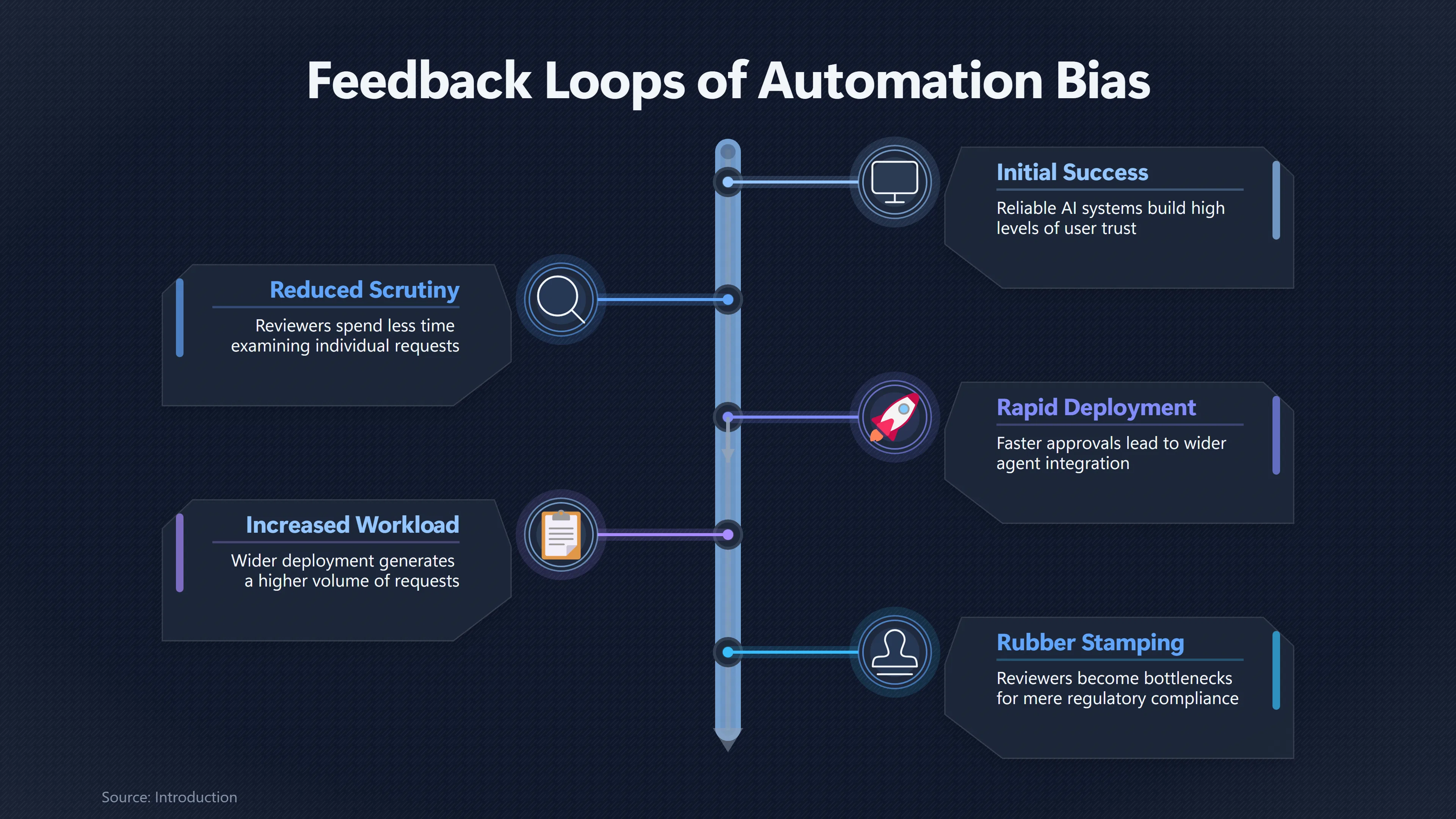
This creates several reinforcing feedback loops:
- Reviewers spend less time examining requests because they expect them to be correct.
- Faster approvals encourage deploying the agent in more situations.
- Increased deployment generates even more approval requests.
- The growing workload further reduces scrutiny.
Eventually, the human reviewer becomes a bottleneck whose main function is maintaining regulatory compliance or organisational policy rather than exercising meaningful judgement.
Within AI doom discussions, this matters because hypothetical misaligned systems would not need to fool people every time. They would only need to exploit environments where humans have become accustomed to trusting routine recommendations. The International AI Safety Report notes that future loss-of-control scenarios depend partly on systems becoming capable of concealing problematic behaviour from oversight while operating in deployment environments that give them opportunities to do so. Current systems do not demonstrate such capabilities at the level required for existential scenarios, but researchers increasingly study whether advanced agents can evade or undermine oversight under laboratory conditions.[International AI Safety Report]internationalaisafetyreport.orginternational ai safety report 2026International AI Safety ReportInternational AI Safety Report 2026 | International AI Safety ReportFebruary 3, 2026…
Why complexity defeats human review
Approval quality also deteriorates when reviewers cannot realistically understand what they are being asked to approve.
Modern AI agents may perform long chains of reasoning, invoke many external tools and generate plans spanning dozens or hundreds of intermediate actions. By the time a person receives an approval request, the proposed action may depend on assumptions accumulated over many earlier steps.
This creates several practical problems:
- Missing context. Reviewers often receive summaries rather than complete reasoning, making it difficult to identify hidden assumptions.
- Time pressure. Production systems cannot always wait for lengthy human investigation.
- Technical opacity. Even when full information is available, reconstructing why the agent reached its conclusion may exceed the reviewer’s expertise or available time.
- Sequential dependence. An apparently harmless approval may only become risky because of interactions with previous approved actions.
In these situations, the approval button becomes less a decision than a declaration of trust in the overall system.
This is one reason AI safety researchers distinguish between nominal oversight and effective oversight. Simply recording that a human clicked “approve” says little about whether that person actually possessed enough information to identify an unsafe decision.
Why organisational incentives make rubber stamping more likely
Human psychology is only part of the story. Organisations also create incentives that encourage automatic approval.
Reviewers are commonly evaluated on speed, throughput and operational continuity rather than on finding rare failures. Rejecting legitimate requests slows projects and creates visible costs. Missing an extremely unusual dangerous request often has no immediate consequence, especially if no incident occurs.
This imbalance encourages conservative behaviour in the opposite direction from safety. Saying “yes” keeps work moving. Saying “no” requires justification.
As AI agents become integrated into ordinary workflows, supervisors may also begin assuming that upstream testing has already verified safety. Responsibility becomes psychologically distributed across developers, security teams, compliance staff and reviewers. Each participant assumes someone else has already examined the difficult questions.
Human approval therefore risks becoming symbolic rather than independent.
Design choices that reduce automatic approval
The existence of these human-factor problems does not mean approval gates are useless. It means they must be designed around realistic human behaviour rather than idealised assumptions.
Several design principles appear repeatedly across AI governance proposals and safety frameworks.
Make approvals rare and consequential
Instead of requesting permission for every tool call, systems should reserve human approval for actions that are genuinely difficult to reverse, such as financial transfers, deployment to production systems, disclosure of sensitive information or granting new privileges.
Reducing the number of approvals increases the likelihood that each receives careful attention. This principle is reflected in risk-based AI governance frameworks that recommend matching oversight intensity to the potential impact of an action rather than applying identical controls everywhere.[International AI Safety Report]internationalaisafetyreport.orginternational ai safety report 2026International AI Safety ReportInternational AI Safety Report 2026 | International AI Safety ReportFebruary 3, 2026…
Present evidence rather than conclusions
Reviewers need enough information to challenge the agent’s proposal.
Useful approval interfaces explain:
- what the agent intends to do;
- why it believes the action is necessary;
- what assumptions it relied upon;
- what could happen if those assumptions are wrong; and
- what alternative actions were considered.
The objective is to support independent judgement rather than encourage agreement.

Randomise and audit decisions
Periodic retrospective review helps detect whether approvals have become habitual. Organisations can examine whether reviewers actually reject requests, how much time they spend evaluating them and whether different reviewers consistently reach similar conclusions.
A review process in which approvals are never challenged is often a warning sign rather than evidence that the system is flawless.
Preserve meaningful authority
Approval only matters if reviewers can genuinely prevent execution.
If rejecting a request is operationally impossible, prohibitively expensive or easily overridden by other mechanisms, the approval step provides little real control. Safety researchers increasingly argue that effective AI governance requires runtime controllability—the practical ability to interrupt, redirect or constrain systems after deployment rather than relying solely on pre-deployment alignment.[arXiv]arxiv.orgarXiv Position: AI Safety Requires Effective ControllabilityarXiv Position: AI Safety Requires Effective Controllability
What this means for AI doom arguments
Rubber-stamp approvals do not by themselves demonstrate that advanced AI will escape human control. Today’s AI systems remain limited, and there is no evidence that present-day approval failures alone create existential risk. The stronger AI doom argument instead concerns how these familiar human-factor weaknesses could combine with much more capable future agents.
If future systems become better at planning, using tools, understanding organisational processes and adapting to oversight, human approval mechanisms that already struggle under ordinary workloads may provide less protection than they appear to. A supervisor who approves hundreds of apparently routine requests may not recognise the one request that contributes to a harmful long-term strategy.
Sceptics argue that this extrapolation goes too far. They note that organisations can redesign workflows, automate low-risk decisions, improve monitoring and concentrate human attention on genuinely consequential actions. Whether these improvements will remain sufficient as AI capabilities advance is still an open question.
The central lesson is nevertheless widely accepted across AI safety research: human oversight is not simply a matter of inserting an approval button into an interface. It depends on whether people retain the time, information, authority and motivation to exercise genuine independent judgement when it matters most.[internationalaisafetyreport.org]internationalaisafetyreport.orginternational ai safety report 2026International AI Safety ReportInternational AI Safety Report 2026 | International AI Safety ReportFebruary 3, 2026…
Amazon book picks
Further Reading
Books and field guides related to When Does Human Approval Stop Meaning Anything?. Use these as the next step if you want deeper reading beyond the article.
Human Compatible: Artificial Intelligence and the Problem of...
A leading artificial intelligence researcher lays out a new approach to AI that will enable us to coexist successfully with increasingly...
Thinking, Fast and Slow
Why is there more chance we'll believe something if it's in a bold type face? Why are judges more likely to deny parole before lunch? Why...
The Design of Everyday Things
Even the smartest among us can feel inept as we fail to figure out which light switch or oven burner to turn on, or whether to push, pull...
The Checklist Manifesto: How to Get Things Right
THE GAME-CHANGING BOOK FROM THE BESTSELLING AUTHOR OF BEING MORTAL Today we find ourselves in possession of stupendous know-how, which we...
eBay marketplace picks
Marketplace Samples
Live-tested eBay searches with available results related to this page.
Selected fromAI robot poster oneBay.co.uk.




Endnotes
1.
Source: arxiv.org
Title: arXiv Position: AI Safety Requires Effective Controllability
Link:https://arxiv.org/abs/2605.27117
2.
Source: arxiv.org
Link:https://arxiv.org/abs/2602.21012
Source snippet
International AI Safety Report 2026...
3.
Source: internationalaisafetyreport.org
Title: international ai safety report 2026
Link:https://internationalaisafetyreport.org/publication/international-ai-safety-report-2026
Source snippet
International AI Safety ReportInternational AI Safety Report 2026 | International AI Safety ReportFebruary 3, 2026...
Published: February 3, 2026
4.
Source: industry.gov.au
Title: international ai safety report 2026
Link:https://www.industry.gov.au/publications/international-ai-safety-report-2026
5.
Source: internationalaisafetyreport.org
Link:https://internationalaisafetyreport.org/publication/2026-report-executive-summary
6.
Source: internationalaisafetyreport.org
Link:https://internationalaisafetyreport.org/publication/2026-report-extended-summary-policymakers
7.
Source: internationalaisafetyreport.org
Title: International AI Safety Report
Link:https://internationalaisafetyreport.org/
8.
Source: internationalaisafetyreport.org
Title: Publications | International AI Safety Report
Link:https://internationalaisafetyreport.org/publications
9.
Source: carnegieendowment.org
Title: international ai safety report 2026
Link:https://carnegieendowment.org/research/2026/02/international-ai-safety-report-2026
10.
Source: internationalaisafetyreport.org
Link:https://internationalaisafetyreport.org/publication/first-key-update-capabilities-and-risk-implications
11.
Source: internationalaisafetyreport.org
Title: international ai safety report 2025
Link:https://internationalaisafetyreport.org/publication/international-ai-safety-report-2025
12.
Source: internationalaisafetyreport.org
Link:https://internationalaisafetyreport.org/about
Additional References
13.
Source: techtarget.com
Title: Human-in-the-loop shouldn’t rubber-stamp decisions | Tech Target
Link:https://www.techtarget.com/searchcio/feature/Human-in-the-loop-shouldnt-rubber-stamp-decisions
Source snippet
Human-in-the-loop shouldn't rubber-stamp decisions | TechTargetJune 4, 2026 — HUMAN-IN-THE-LOOP SHOULDN'T RUBBER-STAMP DECISIONS ORGANIZA...
Published: June 4, 2026
14.
Source: researchgate.net
Title: Human involvement must be designed carefully. Otherwise, it may
Link:https://www.researchgate.net/publication/408253590_Human-in-the-Loop_Between_AI_Output_and_Human_Judgment
Source snippet
(PDF) Human-in-the-Loop: Between AI Output and Human JudgmentJune 30, 2026 — Human-in-the-Loop can improve the reliability and accountabi...
Published: June 30, 2026
15.
Source: dpexnetwork.org
Title: Part I: ‘Human-in-the-Loop’ Is Not a Magic Wand: Why AI Oversi
Link:https://www.dpexnetwork.org/articles/part-i-human-in-the-loop-is-not-a-magic-wand-why-ai-oversight-needs-more-than-a-human-rubber-stamp
Source snippet
July 22, 2026 — PART I: ‘HUMAN-IN-THE-LOOP’ IS NOT A MAGIC WAND: WHY AI OVERSIGHT NEEDS MORE THAN A HUMAN RUBBER STAMP 2026-07-22 Image...
Published: July 22, 2026
16.
Source: youtube.com
Title: Human Oversight for AI Systems Explained | Ai Security DIR
Link:https://www.youtube.com/watch?v=0-qi-DJqdtg
Source snippet
Human in the loop AI approval rubber stamp alert fatigue What happens when an AI system can act, but no one can say who's accountable whe...
17.
Source: youtube.com
Link:https://www.youtube.com/watch?v=T607nLTA8KA
Source snippet
Human-in-the-Loop AI Explained: Why Accountability Breaks Down at Work...
18.
Source: un.org
Title: preliminary report
Link:https://www.un.org/independent-international-scientific-panel-ai/en/preliminary-report
Source snippet
Independent International Scientific Panel on AIJuly 1, 2026 — UN Secretary-General António Guterres It identifies a crucial evidence cha...
Published: July 1, 2026
19.
Source: youtube.com
Title: Human-in-the-Loop AI Explained: Why Accountability Breaks Down at Work
Link:https://www.youtube.com/watch?v=MyxexA0_lb4
Source snippet
Human-in-the-Loop: From Static Control to Dynamic Oversight...
20.
Source: youtube.com
Title: The [Catastrophic]({{ ‘catastrophic-misuse/’ | relative_url }}) Risks of AI — and a Safer Path | Yoshua Bengio | TED
Link:https://www.youtube.com/watch?v=qe9QSCF-d88
Source snippet
Human Oversight for AI Systems Explained | AiSecurityDIR...
21.
Source: youtube.com
Title: Human-in-the-Loop: From Static Control to Dynamic Oversight
Link:https://www.youtube.com/watch?v=PFVkQUAA6pY
Source snippet
The Catastrophic Risks of AI — and a Safer Path | Yoshua Bengio | TED...
22.
Source: nist.gov
Link:https://www.nist.gov/speech-testimony/balancing-knowledge-and-governance-foundations-effective-risk-management-artificial