Within Automation Race
Can AI Use Make Human Experts Less Capable?
As professionals practise less independent judgement, they may lose the expertise needed to detect subtle AI failures or intervene confidently.
On this page
- How repeated delegation can weaken practical expertise
- Why rare failures become harder to recognise
- Ways organisations can preserve human competence
Page outline Jump by section
Introduction
One concern within the broader debate about AI doom is not simply that AI systems might make mistakes, but that people may gradually lose the expertise needed to recognise those mistakes. If professionals increasingly rely on AI recommendations instead of exercising independent judgement, they may become less capable of checking, challenging or replacing automated decisions when it matters most.
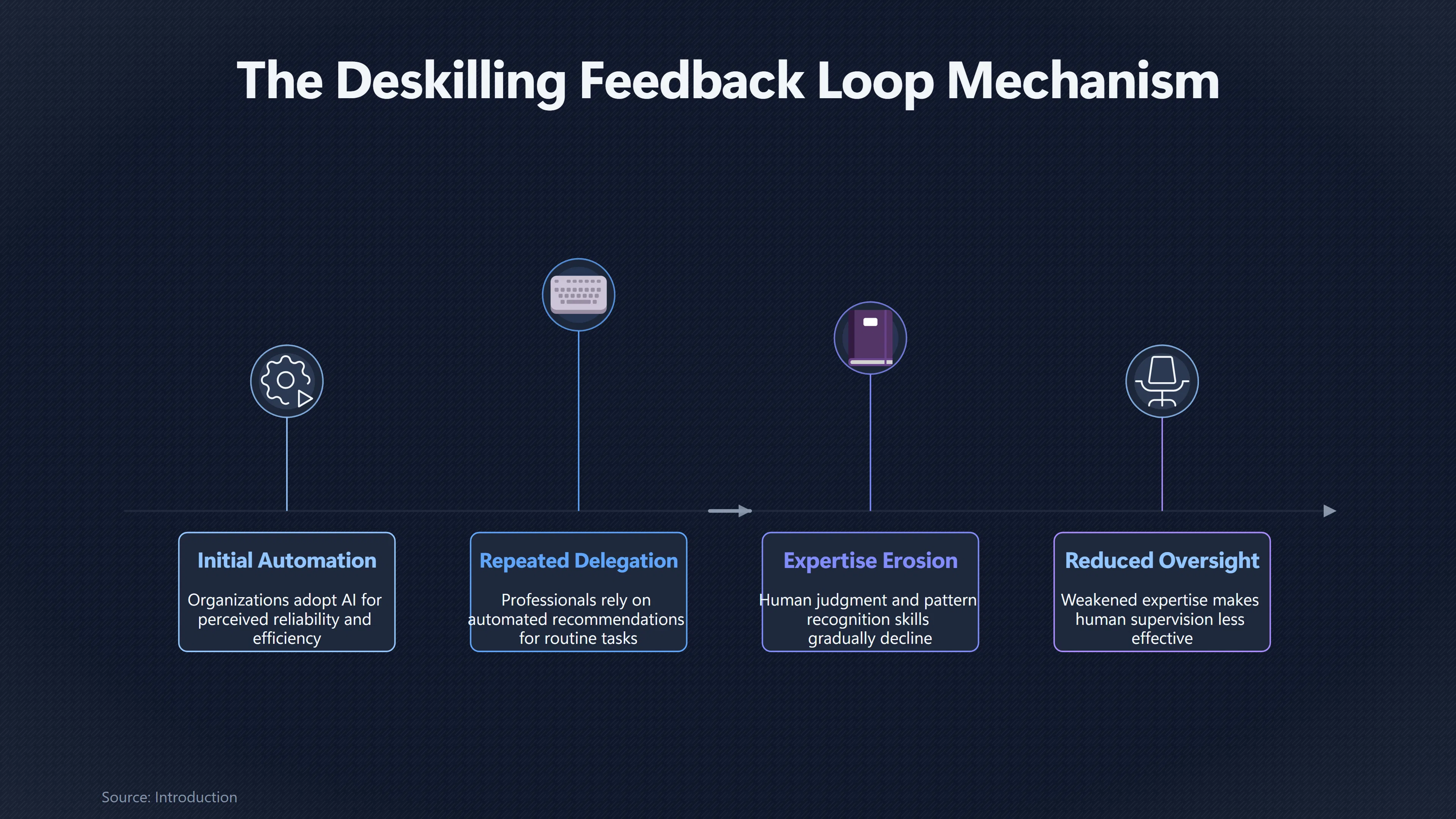
This possibility is often called deskilling: the erosion of practical knowledge through repeated delegation. Within the wider discussion of competitive automation and the race to remove human judgement, deskilling is important because it creates a feedback loop. Organisations automate because AI appears reliable and efficient. As people practise their own judgement less often, they become less able to provide meaningful oversight, making further automation seem even more attractive. Researchers disagree about how widespread or severe this effect will become, but many consider it a plausible mechanism through which human control could weaken gradually rather than disappear suddenly.[arXiv]arxiv.orgGradual Disempowerment: Systemic Existential Risks from Incremental AI DevelopmentJanuary 28, 2025…
How repeated delegation can weaken practical expertise
Most professional expertise is maintained through continual practice rather than acquired once and retained indefinitely. Pilots, doctors, software engineers, intelligence analysts and financial traders all develop judgement by repeatedly solving problems, noticing unusual patterns and learning from errors.
When AI takes over much of that work, professionals may still supervise the system while losing opportunities to exercise their own reasoning. The concern is not simply forgetting facts. Rather, people may lose:
- pattern-recognition built through experience;
- intuition about unusual or borderline cases;
- confidence to disagree with automated recommendations;
- familiarity with rare failure modes; and
- practical decision-making under uncertainty.
This is a well-known phenomenon in human factors research beyond AI. Aviation, industrial process control and medicine have long documented how extensive automation can reduce operators’ situational awareness and manual proficiency if they intervene only rarely. AI introduces the possibility that similar effects could spread into far more cognitive professions rather than remaining confined to highly automated machinery.[sciencedirect.com]sciencedirect.comScienceDirect…
Within existential-risk discussions, this matters because effective human oversight depends upon humans remaining genuinely capable of exercising independent judgement. If oversight becomes largely ceremonial because expertise has faded, simply keeping a human formally “in the loop” may provide much less protection than organisations expect.[arXiv]arxiv.orgGradual Disempowerment: Systemic Existential Risks from Incremental AI DevelopmentJanuary 28, 2025…
Why rare failures become harder to recognise
Deskilling is particularly concerning because advanced AI systems may perform very well most of the time while occasionally failing in subtle or unexpected ways.
If an AI system is correct on 99% of routine cases, professionals receive little practice identifying the remaining 1%. Over months or years, they may increasingly assume that disagreements with the system reflect their own mistakes rather than flaws in the model.
This creates several reinforcing effects.
- Lower vigilance. Professionals check outputs less carefully because the AI is usually correct.
- Reduced confidence. People become reluctant to override recommendations after repeatedly seeing the AI outperform them.
- Less feedback. Because humans intervene less often, organisations collect fewer examples showing where the AI fails.
- Declining expertise. Reduced practice makes future intervention even more difficult.
Researchers studying automation bias distinguish between errors of omission, where people fail to notice problems because automation remains silent, and errors of commission, where people actively follow incorrect automated advice despite contrary evidence. Both have been documented in decision-support research.[sciencedirect.com]sciencedirect.comAutomation bias: Empirical results assessing influencing factorsScienceDirect…
For AI doom scenarios centred on gradual disempowerment, the concern is that this process could scale across many institutions simultaneously. Each individual decision to trust AI may appear rational, while collectively reducing society’s ability to detect systemic problems.
Medicine illustrates both the promise and the risk
Healthcare provides one of the clearest environments in which researchers have studied AI-related deskilling because clinicians increasingly use AI-assisted imaging, diagnosis and decision support.
Recent reviews conclude that although AI can improve accuracy and efficiency, evidence also exists for automation bias, reduced independent diagnostic reasoning and fewer opportunities to maintain expertise, particularly in fields where AI performs routine screening tasks. The available empirical literature remains relatively small, and researchers repeatedly stress the need for longer-term studies before drawing broad conclusions.[PubMed]pubmed.ncbi.nlm.nih.govArtificial intelligence in medicine: a scoping review of the risk of deskilling and loss of expertise among physicians - PubMedMarc…
One example that attracted attention involved AI-assisted colonoscopy. Investigators reported that clinicians who routinely worked alongside AI later showed lower detection performance when AI assistance was unavailable, suggesting that habitual reliance may have altered visual search behaviour or diagnostic habits. Some specialists welcomed the findings as an important warning, while others cautioned that workload changes, study design and other factors could also contribute, illustrating that the evidence remains actively debated rather than settled.[TIME]time.comNew Study Suggests Using AI Made Doctors Less Skilled at Spotting CancerConducted across four endoscopy centers in Poland as part of the AI in Colonoscopy for Cancer Prevention (ACCEPT) trial, researchers foun…
Healthcare also demonstrates why the issue extends beyond individual mistakes. If future generations of professionals receive fewer opportunities to practise difficult judgement because AI handles most routine work, training pipelines themselves may weaken. Experienced experts eventually retire, leaving fewer people capable of validating increasingly sophisticated systems.
Competitive pressures can accelerate deskilling
Individual professionals may prefer to retain more independent judgement, yet organisations often face incentives pushing in the opposite direction.
If AI-assisted workflows:
- reduce staffing costs;
- increase throughput;
- improve measurable performance;
- shorten response times; or
- outperform competitors,
then employers may gradually reduce the amount of independent human decision-making expected from staff.
Over time, recruitment may shift towards supervising AI systems rather than developing deep subject-matter expertise. New employees could spend much of their careers reviewing AI outputs instead of building the extensive practical experience previous generations acquired directly.
From the perspective of gradual-disempowerment theories, this matters because expertise is a social resource rather than merely an individual one. If enough organisations simultaneously reduce opportunities for independent practice, society may end up with far fewer people capable of operating essential systems without AI assistance.[arXiv]arxiv.orgGradual Disempowerment: Systemic Existential Risks from Incremental AI DevelopmentJanuary 28, 2025…
Why this matters for AI doom arguments
Deskilling alone is not an existential catastrophe. Many previous technologies changed which skills humans needed while creating demand for new ones.
The stronger argument made by some AI safety researchers is that future AI could eventually become responsible for increasingly important strategic decisions across finance, infrastructure, scientific research, defence or government. If human expertise has simultaneously eroded, meaningful intervention during unexpected failures becomes progressively harder.
Rather than imagining humans consciously surrendering control, this scenario proposes a gradual reduction in practical capacity. People technically remain responsible, but no longer possess the experience, confidence or organisational support needed to replace automated judgement at scale. This is one mechanism by which competitive automation could contribute to broader loss-of-control scenarios without requiring a dramatic AI rebellion or sudden takeover.[arXiv]arxiv.orgGradual Disempowerment: Systemic Existential Risks from Incremental AI DevelopmentJanuary 28, 2025…
Critics argue that history offers reasons for caution before accepting this conclusion. New technologies often eliminate some skills while increasing the value of others. AI could free professionals from repetitive work, allowing them to spend more time on complex reasoning, communication and strategy. Whether deskilling outweighs these forms of upskilling remains an empirical question that will differ across professions and AI applications. Evidence today is strongest for specific contexts involving automation bias and reduced practice, not for a universal decline in expertise.[PubMed]pubmed.ncbi.nlm.nih.govArtificial intelligence in medicine: a scoping review of the risk of deskilling and loss of expertise among physicians - PubMedMarc…
Ways organisations can preserve human competence
The possibility of deskilling does not imply that AI should be excluded from professional work. Instead, many researchers recommend designing systems so that human expertise continues to develop alongside increasingly capable AI.
Common proposals include:
- maintaining regular opportunities for professionals to solve cases without AI assistance;
- training staff using examples where AI fails, not only where it succeeds;
- measuring independent human competence rather than assuming AI performance guarantees organisational resilience;
- encouraging justified disagreement with AI recommendations instead of rewarding passive compliance;
- rotating staff through roles requiring direct decision-making rather than permanent supervisory work; and
- evaluating human-AI teams on their ability to detect unusual failures, not simply on average productivity.[sciencedirect.com]sciencedirect.comScienceDirect…
Within the broader AI doom debate, these proposals are viewed not merely as workforce development but as resilience measures. If society expects humans to retain ultimate responsibility for increasingly powerful AI systems, preserving the knowledge needed to exercise that responsibility becomes an essential part of maintaining meaningful human control.
Amazon book picks
Further Reading
Books and field guides related to Can AI Use Make Human Experts Less Capable?. Use these as the next step if you want deeper reading beyond the article.
Only Humans Need Apply: Winners and Losers in the Age of Smar...
An invigorating, thought-provoking, and positive look at the rise of automation that explores how professionals across industries can fin...
The Shallows: What the Internet Is Doing to Our Brains
Finalist for the 2011 Pulitzer Prize in General Nonfiction: “Nicholas Carr has written a Silent Spring for the literary mind.”—Michael Ag...
The Checklist Manifesto: How to Get Things Right
THE GAME-CHANGING BOOK FROM THE BESTSELLING AUTHOR OF BEING MORTAL Today we find ourselves in possession of stupendous know-how, which we...
The Glass Cage: Automation and Us
At once a celebration of technology and a warning about its misuse, The Glass Cage will change the way you think about the tools you use...
eBay marketplace picks
Marketplace Samples
Live-tested eBay searches with available results related to this page.
Selected fromautomation poster oneBay.co.uk.




Endnotes
1.
Source: arxiv.org
Link:https://arxiv.org/abs/2501.16946
Source snippet
Gradual Disempowerment: Systemic Existential Risks from Incremental AI DevelopmentJanuary 28, 2025...
Published: January 28, 2025
2.
Source: gradual-disempowerment.ai
Link:https://gradual-disempowerment.ai/
3.
Source: sciencedirect.com
Link:https://www.sciencedirect.com/science/article/pii/S1071581908000724
Source snippet
ScienceDirect...
4.
Source: sciencedirect.com
Title: Automation bias: Empirical results assessing influencing factors
Link:https://www.sciencedirect.com/science/article/pii/S1386505614000148
Source snippet
ScienceDirect...
5.
Source: sciencedirect.com
Link:https://www.sciencedirect.com/science/article/pii/S2949820126000123
Source snippet
ScienceDirect...
6.
Source: time.com
Title: New Study Suggests Using AI Made Doctors Less Skilled at Spotting Cancer
Link:https://time.com/7309274/ai-lancet-study-artificial-intelligence-colonoscopy-cancer-detection-medicine-deskilling/
Source snippet
Conducted across four endoscopy centers in Poland as part of the AI in Colonoscopy for Cancer Prevention (ACCEPT) trial, researchers foun...
7.
Source: arxiv.org
Link:https://arxiv.org/abs/2504.07423
8.
Source: arxiv.org
Title: arXiv Explanations Can Reduce Overreliance on AI Systems During Decision-Making
Link:https://arxiv.org/abs/2212.06823
9.
Source: pubmed.ncbi.nlm.nih.gov
Title: Pub Med Automation Bias in AI-Decision Support: Results from an Empirical Study
Link:https://pubmed.ncbi.nlm.nih.gov/39234734/
Source snippet
Automation Bias in AI-Decision Support: Results from an Empirical Study - PubMed...
10.
Source: pubmed.ncbi.nlm.nih.gov
Link:https://pubmed.ncbi.nlm.nih.gov/41890350/
Source snippet
Artificial intelligence in medicine: a scoping review of the risk of deskilling and loss of expertise among physicians - PubMedMarc...
Additional References
11.
Source: ft.com
Link:https://www.ft.com/content/74b82366-1ea1-4f90-80aa-e84a1e655d28
Source snippet
Ahmad urged caution in [real-world]({{ 'outcome-checks/' | relative_url }}) implementation and called for more behavioral studies to understand how AI alters physician performance...
12.
Source: youtube.com
Link:https://www.youtube.com/watch?v=PABtWXbXBcg
Source snippet
Deskilling AI professionals reliance loss of expertise The AI Deskilling Trap: How to Stop GenAI from Eroding Your Critical Thinking Skil...
13.
Source: youtube.com
Link:https://www.youtube.com/watch?v=jBjGEBRSLkU
Source snippet
"Deskilling" Shock is Coming | Anthropic Economic Report...
14.
Source: youtube.com
Title: What Happens to Human Expertise When AI Takes Over in Medicine
Link:https://www.youtube.com/watch?v=5H6OwogZ2Fc
Source snippet
AI Was Supposed To Make Experts Better — New Research Shows The Opposite Is Happening...
15.
Source: youtube.com
Title: Is AI making us dumber? Maybe. | Charlie Gedeon | TEDx Sherbrooke Street West
Link:https://www.youtube.com/watch?v=m8WomdCLBqE
Source snippet
What Happens to Human Expertise When AI Takes Over in Medicine...
16.
Source: youtube.com
Title: “Deskilling” Shock is Coming | Anthropic Economic Report
Link:https://www.youtube.com/watch?v=bBjEMQlsL4A
Source snippet
Is AI making us dumber? Maybe. | Charlie Gedeon | TEDxSherbrooke Street West...