Within Nuclear Crises
Could AI Cyberattacks Destabilise Nuclear Deterrence?
AI-enabled cyber operations could weaken confidence in nuclear communications and create pressure to escalate before systems are lost.
On this page
- Why nuclear command networks are strategic targets
- How AI could strengthen cyber offence and defence
- Why fear of disruption can encourage early escalation
Page outline Jump by section
Introduction
Could AI-enabled cyberattacks make nuclear crises more dangerous? Potentially yes, but not because hackers are likely to seize direct control of nuclear weapons. The greater concern is that increasingly capable AI could make cyber operations faster, more scalable and more deceptive, increasing the risk that a state loses confidence in its nuclear command, control and communications (NC3) during a crisis. If leaders believe that communications, early-warning systems or retaliatory forces have already been compromised, they may feel pressure to act before those capabilities disappear. That dynamic—not the cyberattack itself—is why this topic matters within debates about AI doom and existential risk.

This risk sits within the broader question of whether AI could amplify catastrophic human mistakes. Most researchers do not argue that AI-driven cyberattacks make nuclear war inevitable. Instead, they argue that AI may strengthen existing escalation pathways by making it harder to distinguish genuine attacks from false alarms, by reducing confidence in critical systems, and by compressing the time available for careful judgement.[SIPRI]sipri.orgImpact of Military Artificial Intelligence on Nuclear Escalation Risk | SIPRIImpact of Military Artificial Intelligence on Nuclear Escalation Risk | SIPRI…
Why nuclear command networks are strategic targets
Nuclear deterrence depends on more than missiles. It also depends on confidence that national leaders can communicate with military forces, receive accurate information, authenticate orders and maintain the ability to retaliate after absorbing an attack. These functions are collectively known as nuclear command, control and communications (NC3).
An adversary does not necessarily need to destroy an entire NC3 system to create strategic instability. Merely creating uncertainty about whether communications remain trustworthy can change leaders’ calculations. During a conventional conflict, cyber operations against command networks, satellites, communications infrastructure or intelligence systems may be interpreted as preparation for a wider attempt to disable a country’s nuclear deterrent.[Carnegie Endowment]carnegieendowment.orgCarnegie EndowmentChina-U.S. Cyber-Nuclear C3 Stability | Carnegie Endowment for International PeaceApril 8, 2021…
This concern has existed for years, but AI could increase its significance because advanced systems may enable attackers to:
- discover software vulnerabilities more quickly;
- automate reconnaissance across very large networks;
- generate convincing phishing and social engineering campaigns at scale;
- coordinate multiple simultaneous cyber operations;
- adapt attacks more rapidly as defenders respond.
The key strategic problem is not simply whether attacks become technically more effective. It is whether leaders become less certain that their own systems will survive long enough to support measured decision-making.[SIPRI]sipri.orgImpact of Military Artificial Intelligence on Nuclear Escalation Risk | SIPRIImpact of Military Artificial Intelligence on Nuclear Escalation Risk | SIPRI…
How AI could strengthen both cyber offence and cyber defence
The relationship between AI and cyber security is not one-sided. The same technologies that may improve offensive operations can also improve defence.
The offensive case
Cybersecurity researchers increasingly expect AI to accelerate parts of the attack cycle by assisting with vulnerability discovery, malware adaptation, reconnaissance and automated analysis of large technical environments. Rather than inventing entirely new forms of cyberattack, AI mainly reduces the cost and speed of existing techniques while allowing attackers to conduct more operations simultaneously.[arXiv]arxiv.orgOpen source on arxiv.org.
Applied to military competition, this raises concern because NC3 systems are among the highest-value targets in any confrontation between nuclear-armed states.
The defensive case
The same AI capabilities can strengthen defenders by:
- detecting unusual network behaviour more rapidly;
- prioritising alerts from huge volumes of security data;
- identifying malware patterns that humans might miss;
- automating parts of incident response;
- improving resilience through continuous monitoring.
Some analysts therefore argue that AI may ultimately improve the security of nuclear-related networks if deployed carefully under strong human oversight. Better detection and faster recovery could reduce opportunities for successful cyber intrusion.[Chatham House]chathamhouse.orgOpen source on chathamhouse.org.
The difficulty is that neither attackers nor defenders know in advance which side will gain the larger advantage during a crisis. That uncertainty itself can influence strategic behaviour.
Why fear of disruption can encourage early escalation
One of the most important ideas in nuclear strategy is that perceptions matter almost as much as technical reality.
Imagine that one country’s leadership receives evidence suggesting its military communications have been infiltrated while unusual activity is simultaneously detected in satellite networks and missile-warning systems. Even if none of these events proves decisive on its own, leaders may begin to fear that an adversary is attempting to blind them before launching a larger attack.
Researchers sometimes describe this as a “use it before you lose it” pressure. If decision-makers believe their ability to retaliate is rapidly disappearing, waiting for additional confirmation may appear increasingly dangerous. The cyberattack does not need to eliminate the deterrent completely. It only needs to reduce confidence that the deterrent will remain available.[Carnegie Endowment]carnegieendowment.orgCarnegie EndowmentChina-U.S. Cyber-Nuclear C3 Stability | Carnegie Endowment for International PeaceApril 8, 2021…
AI could intensify this dynamic in several ways:
- automated attacks may spread faster than traditional cyber operations;
- AI-assisted deception may produce more convincing fake evidence;
- defensive systems may generate overwhelming volumes of alerts;
- commanders may struggle to distinguish genuine compromise from AI-generated noise.
The result is not automatic escalation but greater uncertainty during the period when accurate judgement matters most.
False confidence can be as dangerous as real compromise
An important misconception is that only successful cyberattacks create danger.
In reality, false beliefs may be equally destabilising.
Leaders could mistakenly conclude that communications have been compromised when they have not. Conversely, they might trust AI-assisted defensive assessments that incorrectly report systems as secure. Both errors affect decision-making because nuclear crises unfold under severe time pressure and incomplete information.
Researchers studying cyber-nuclear interactions emphasise that attribution remains difficult. States may struggle to determine:
- who conducted an intrusion;
- whether it is espionage or preparation for sabotage;
- whether malware has actually damaged critical systems;
- whether apparently independent failures share a common cause.
AI does not remove these uncertainties. In some circumstances it may increase them by producing larger volumes of ambiguous technical evidence that requires rapid interpretation.[carnegieendowment.org]carnegieendowment.orgCarnegie EndowmentChina-U.S. Cyber-Nuclear C3 Stability | Carnegie Endowment for International PeaceApril 8, 2021…
Why this matters for AI doom debates
Within discussions of AI doom and existential risk, AI-enabled cyber threats to nuclear command systems represent an indirect pathway rather than a story about AI independently deciding to launch nuclear weapons.
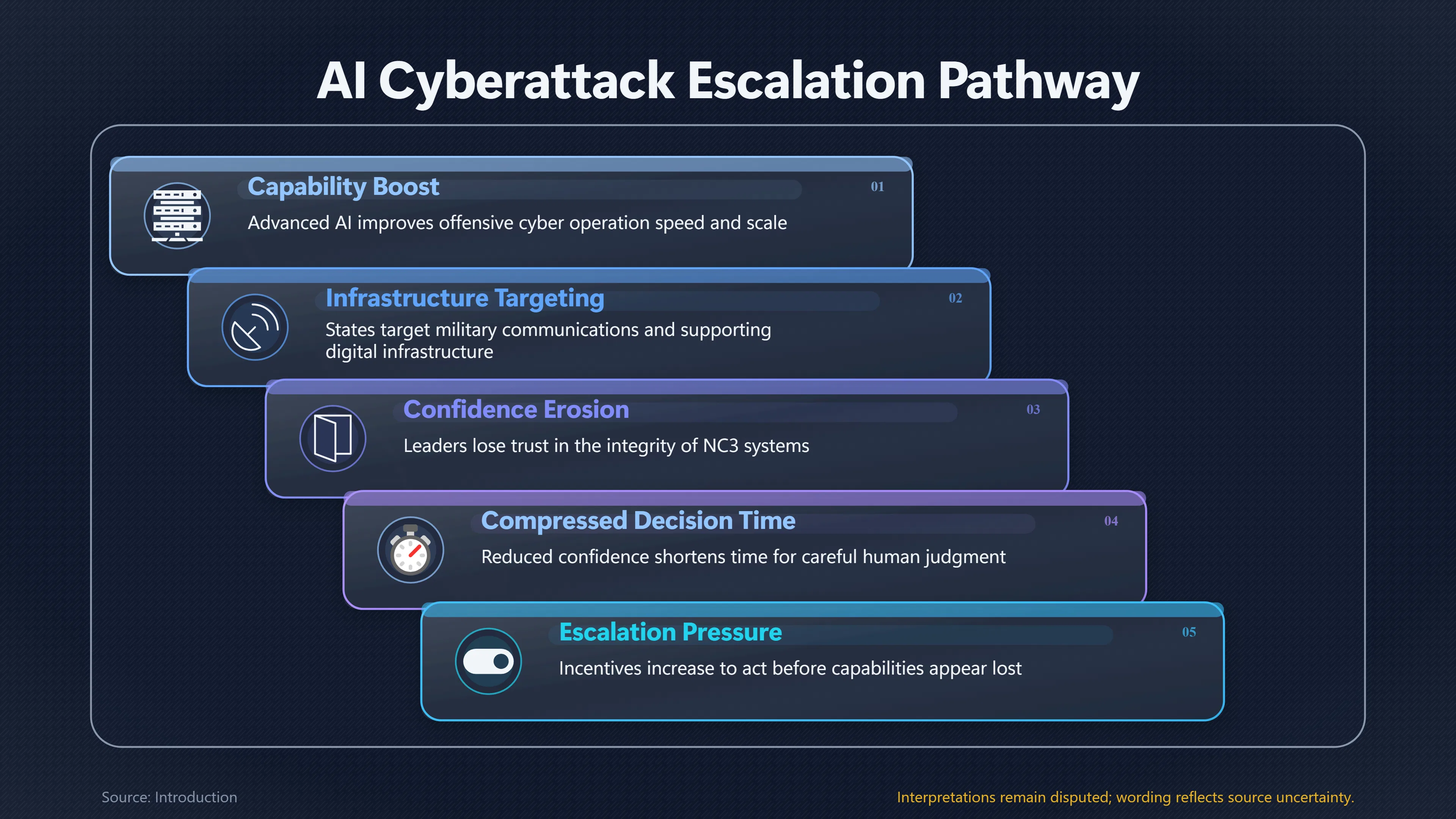
The proposed chain looks roughly like this:
- Advanced AI substantially improves cyber capabilities.
- States increasingly target military communications and supporting infrastructure.
- During a crisis, leaders lose confidence in the integrity of their NC3 systems.
- Reduced confidence shortens decision time and increases incentives to escalate before capabilities appear to disappear.
- Human decisions—not autonomous AI—produce a catastrophic outcome.
Supporters of this concern argue that AI compounds an already dangerous strategic environment by accelerating offensive cyber operations and increasing uncertainty. Critics respond that modern nuclear forces are deliberately designed with redundancy, authentication procedures and multiple communication pathways that make catastrophic failure considerably harder than simplified scenarios suggest. They also note that governments recognise the extraordinary importance of NC3 security and invest heavily in protecting it.[SIPRI]sipri.orgImpact of Military Artificial Intelligence on Nuclear Escalation Risk | SIPRIImpact of Military Artificial Intelligence on Nuclear Escalation Risk | SIPRI…
The evidence therefore does not show that AI makes nuclear cyber catastrophe inevitable. Rather, it suggests that AI could amplify one of the most sensitive parts of nuclear deterrence: confidence that leaders can still communicate, understand events accurately and retain credible second-strike capability under attack.
What researchers see as the most promising risk-reduction measures
Because the greatest danger comes from uncertainty rather than AI acting independently, many proposed safeguards focus on preserving confidence and extending decision time instead of pursuing complete technological superiority.
Common recommendations include:
- strengthening cyber resilience around NC3 and closely related conventional systems;
- maintaining meaningful human judgement over nuclear decisions, even when AI assists analysis;
- separating nuclear command functions from less secure digital systems wherever practical;
- improving transparency and confidence-building measures between nuclear-armed states regarding AI integration;
- conducting rigorous testing of AI-assisted cyber defence before deployment in high-consequence environments;
- developing communication channels that remain available even during severe cyber disruption.
Many analysts also argue that AI governance and cyber security should not be treated as separate policy areas. As AI becomes more capable, protecting the systems that underpin nuclear deterrence increasingly depends on understanding how machine learning changes both attack and defence. The central question is therefore not whether AI can “hack the nuclear button”, but whether it can erode the confidence and communication on which stable nuclear deterrence depends.[sipri.org]sipri.orgImpact of Military Artificial Intelligence on Nuclear Escalation Risk | SIPRIImpact of Military Artificial Intelligence on Nuclear Escalation Risk | SIPRI…
Amazon book picks
Further Reading
Books and field guides related to Could AI Cyberattacks Destabilise Nuclear Deterrence?. Use these as the next step if you want deeper reading beyond the article.
The Perfect Weapon
From Russia’s tampering with the US election to the WannaCry hack that temporarily crippled Britain’s NHS, cyber has become the weapon of...
Command and Control
Presents a minute-by-minute account of an H-bomb accident that nearly caused a nuclear disaster, examining other near misses and America'...
Dark Territory
“An important, disturbing, and gripping history” (Kirkus Reviews, starred review), the never-before-told story of the computer scientists...
This is how They Tell Me the World Ends
WINNER OF THE FT & McKINSEY BUSINESS BOOK OF THE YEAR AWARD 2021The instant New York Times bestsellerA Financial Times and The Times Book...
eBay marketplace picks
Marketplace Samples
Live-tested eBay searches with available results related to this page.
Selected fromcybersecurity t shirt oneBay.co.uk.


Endnotes
1.
Source: sipri.org
Title: Impact of Military Artificial Intelligence on Nuclear Escalation Risk | SIPRI
Link:https://www.sipri.org/publications/2025/sipri-insights-peace-and-security/impact-military-artificial-intelligence-nuclear-escalation-risk
Source snippet
Impact of Military Artificial Intelligence on Nuclear Escalation Risk | SIPRI...
2.
Source: sipri.org
Link:https://www.sipri.org/publications/2024/sipri-background-papers/nuclear-weapons-and-artificial-intelligence-technological-promises-and-practical-realities
Source snippet
Nuclear Weapons and Artificial Intelligence: Technological Promises and Practical Realities | SIPRI...
3.
Source: arxiv.org
Link:https://arxiv.org/abs/1802.07228
4.
Source: sipri.org
Title: AI in Chinese, Indian and US Nuclear Postures, Norms and Systems | SIPRI
Link:https://www.sipri.org/publications/2026/other-publications/ai-chinese-indian-and-us-nuclear-postures-norms-and-systems
Source snippet
AI in Chinese, Indian and US Nuclear Postures, Norms and Systems | SIPRI...
5.
Source: carnegie.org
Title: How Are Modern Technologies Affecting Nuclear Risks?
Link:https://carnegie.org/article/how-are-modern-technologies-affecting-nuclear-risks/
Source snippet
CarnegieOctober 27, 2025 — WHAT ARE THE BIGGEST KNOWLEDGE GAPS FOR NUCLEAR EXPERTS TO UNDERSTAND NEW TECHNOLOGIES AND NUCLEAR DANGERS?...
Published: October 27, 2025
6.
Source: sipri.org
Link:https://www.sipri.org/publications/2025/other-publications/pragmatic-approaches-governance-artificial-intelligence-nuclear-nexus
7.
Source: sipri.org
Link:https://www.sipri.org/publications/2020/policy-reports/artificial-intelligence-strategic-stability-and-nuclear-risk
8.
Source: sipri.org
Link:https://www.sipri.org/publications/2025/eu-non-proliferation-and-disarmament-papers/artificial-intelligence-non-proliferation-and-disarmament-compendium-state-art
9.
Source: sipri.org
Link:https://www.sipri.org/publications/2025/sipri-insights-peace-and-security/advancing-governance-nexus-artificial-intelligence-and-nuclear-weapons
10.
Source: chathamhouse.org
Link:https://www.chathamhouse.org/publications/the-world-today/2025-06/what-happens-if-ai-goes-nuclear
11.
Source: carnegieendowment.org
Link:https://carnegieendowment.org/research/2021/04/china-us-cyber-nuclear-c3-stability?lang=en
Source snippet
Carnegie EndowmentChina-U.S. Cyber-Nuclear C3 Stability | Carnegie Endowment for [International]({{ 'shared-testing/' | relative_url }}) PeaceApril 8, 2021...
Published: April 8, 2021
12.
Source: carnegieendowment.org
Link:https://carnegieendowment.org/posts/2018/12/escalation-through-entanglement-how-the-vulnerability-of-command-and-control-systems-raises-the-risks-of-an-inadvertent-nuclear-war
Source snippet
Carnegie EndowmentEscalation Through Entanglement: How the Vulnerability of Command-and-Control Systems Raises the Risks of an Inadverten...
13.
Source: chathamhouse.org
Link:https://www.chathamhouse.org/2020/12/how-deter-cyberattacks-nuclear-weapons-systems
14.
Source: carnegieendowment.org
Link:https://carnegieendowment.org/research/2021/04/china-us-cyber-nuclear-c3-stability
15.
Source: chathamhouse.org
Link:https://www.chathamhouse.org/2020/07/ensuring-cyber-resilience-natos-command-control-and-communication-systems-0/about-authors
16.
Source: carnegieendowment.org
Link:https://carnegieendowment.org/china/posts/2018/12/escalation-through-entanglement-how-the-vulnerability-of-command-and-control-systems-raises-the-risks-of-an-inadvertent-nuclear-war
17.
Source: chathamhouse.org
Title: Cyber Armageddon | Chatham House – International Affairs Think Tank
Link:https://www.chathamhouse.org/publications/the-world-today/2018-04/cyber-armageddon
Additional References
18.
Source: axios.com
Link:https://www.axios.com/newsletters/axios-future-of-cybersecurity-bdca0b60-0db6-11f1-b157-114c2c7943cd
Source snippet
Experts also fear nation-states like Russia or China exploiting AI for cyberwarfare, or non-state actors losing control of autonomous sys...
19.
Source: youtube.com
Title: Could AI Trigger a Nuclear Crisis? | Ankit Panda & Andrew Reddie
Link:https://www.youtube.com/watch?v=t95vNJgNAkA
Source snippet
The Algorithmic Trigger: AI, OODA Loops, and Nuclear Command in South Asia...
20.
Source: youtube.com
Title: Decision Time: AI and our Nuclear Arsenal
Link:https://www.youtube.com/watch?v=W3HABFroOBo
Source snippet
U.S. Defense Strategist on How AI Drone Warfare Could Spiral Out of Control...
21.
Source: armscontrol.org
Link:https://www.armscontrol.org/act/2025-09/features/artificial-intelligence-and-nuclear-command-and-control-its-even-more
22.
Source: stanleycenter.org
Link:https://stanleycenter.org/publications/cybersecurity-of-nuclear-weapons-systems-threats-vulnerabilities-and-consequences/
23.
Source: defense360.csis.org
Link:https://defense360.csis.org/bad-idea-integrating-artificial-intelligence-with-nuclear-command-control-and-communications/
24.
Source: youtube.com
Title: The Algorithmic Trigger: AI, OODA Loops, and Nuclear Command in South Asia
Link:https://www.youtube.com/watch?v=8ttqt9uNdxg
Source snippet
What If AI Controlled Nuclear Weapons?...
25.
Source: youtube.com
Title: U.S. Defense Strategist on How AI Drone Warfare Could Spiral Out of Control
Link:https://www.youtube.com/watch?v=SQowubuvk-s
Source snippet
Could AI Trigger a Nuclear Crisis?...
26.
Source: tandfonline.com
Title: Full article: The survivability of nuclear command-and-control capabilities
Link:https://www.tandfonline.com/doi/abs/10.1080/01402390.2024.2435957
27.
Source: tandfonline.com
Title: Full article: The survivability of nuclear command-and-control capabilities
Link:https://www.tandfonline.com/doi/full/10.1080/01402390.2024.2435957