Within Parallel Researchers
When More AI Researchers Create More Confusion
Large AI research teams may lose much of their advantage through duplicated work, conflicting code and overwhelming volumes of results.
On this page
- Why duplicated experiments and shared code conflicts emerge
- How planning and integration become harder at scale
- What orchestration systems must do to preserve useful output
Page outline Jump by section
Introduction
The idea of running thousands of AI researchers in parallel sounds like an obvious way to accelerate AI progress. However, simply creating more digital researchers does not guarantee proportionally faster discoveries. As research teams grow, coordination becomes a limiting factor. Different agents may unknowingly repeat the same experiment, overwrite one another’s code, optimise for inconsistent goals or produce more results than any system can realistically evaluate.
Within debates about AI doom and existential risk, this matters because predictions of extremely rapid AI progress often assume that digital researchers can be scaled almost without friction. Critics argue that coordination problems could significantly reduce those gains. Supporters respond that increasingly sophisticated orchestration systems may remove many of today’s bottlenecks. The key question is therefore not only how many AI researchers can run simultaneously, but whether their combined output remains coherent, reliable and genuinely useful.
Why duplicated experiments and code conflicts emerge
Research is naturally exploratory. Even well-managed human laboratories sometimes duplicate work because researchers pursue similar ideas independently, misunderstand existing results or race towards the same hypothesis. Scaling to thousands of AI researchers magnifies these problems.
Several forms of duplication become especially important:
- Repeated experiments. Multiple agents may unknowingly test nearly identical model architectures, datasets or hyperparameters, consuming compute without adding new information.
- Conflicting software changes. If many agents modify the same codebase simultaneously, incompatible changes become increasingly common unless carefully isolated and merged.
- Repeated literature reviews. Without shared memory, numerous agents may independently read and summarise the same papers.
- Convergent search. Agents with similar training and objectives may repeatedly generate similar ideas even when operating independently, reducing the diversity that parallel search is supposed to provide.
These inefficiencies matter because compute, engineering time and evaluation resources remain finite. If half the research workforce unknowingly repeats the work of the other half, apparent scaling greatly overstates effective scaling.
The software engineering literature has long recognised similar coordination costs in large human teams through concepts such as merge conflicts, duplicated development and communication overhead. AI researchers avoid neither problem simply because they operate digitally.
Why planning becomes harder as research scales
Adding more researchers does not merely increase output. It also increases the amount of planning required to keep everyone working on complementary rather than overlapping tasks.
For large populations of AI researchers, an orchestration system must continually answer questions such as:
- Which research directions have already been explored?
- Which failures should immediately stop similar experiments elsewhere?
- Which promising discoveries deserve additional compute?
- Which code changes are safe to merge?
- Which agents require updated information before beginning their next task?
These decisions become increasingly difficult because new experimental results arrive continuously rather than at convenient checkpoints.
Traditional management approaches become impractical. A human supervisor cannot manually coordinate thousands of experiments every hour, nor can every agent communicate directly with every other agent. Communication grows much faster than team size, creating the familiar scaling problem that affects both human organisations and distributed computing systems.
Instead, most proposed architectures rely on hierarchical or partially decentralised coordination rather than unrestricted communication among all researchers. This reduces communication costs while preserving enough shared information to prevent widespread duplication. Research into multi-agent orchestration consistently treats planning, state management and task allocation as core scalability problems rather than optional implementation details.[arXiv]arxiv.orgThe Orchestration of Multi-Agent Systems: Architectures, Protocols, and Enterprise AdoptionJanuary 20, 2026…
Why integrating thousands of results is often harder than generating them
Generating experiments is only one stage of scientific progress. Someone—or something—must also determine which results are trustworthy.
A large AI research organisation might generate tens of thousands of experimental runs every day. Most would fail, produce noisy improvements or reveal implementation errors rather than meaningful scientific advances.
The integration challenge therefore includes several distinct tasks:
- identifying genuinely novel findings
- filtering statistical noise
- detecting flawed evaluations
- merging compatible code changes
- updating shared knowledge
- deciding which ideas deserve further investigation
If these processes become bottlenecks, additional AI researchers contribute increasingly little useful progress. The system becomes overwhelmed by its own output.
This resembles information overload in large human organisations, where producing reports is often easier than extracting actionable knowledge from them.

Orchestration systems become the real productivity multiplier
Research increasingly suggests that coordination architecture may matter as much as the intelligence of individual research agents.
Rather than allowing every agent to work independently forever, orchestration systems typically divide responsibilities into layers.
A typical design includes:
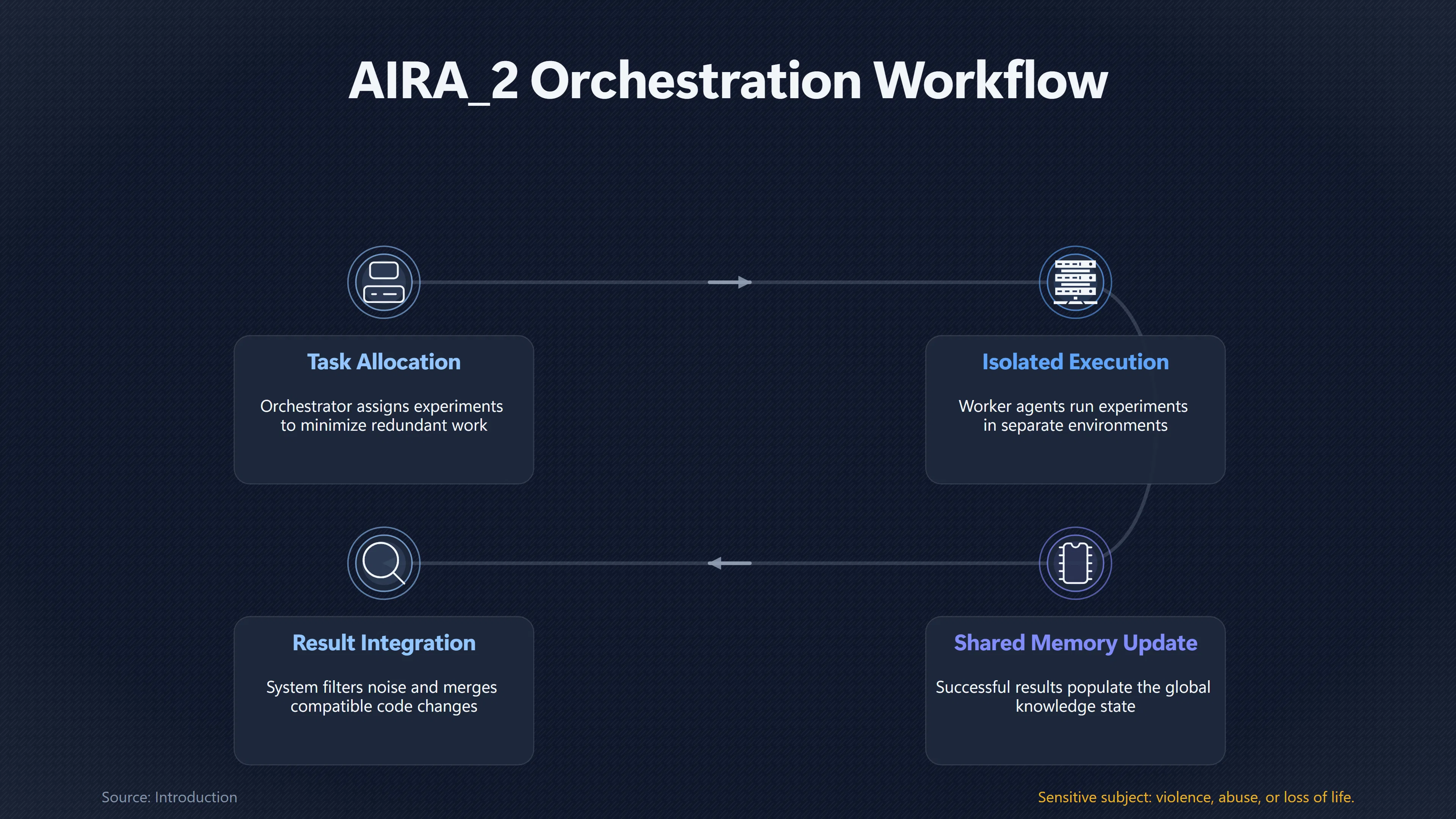
- Task allocation, assigning experiments that minimise duplication.
- Shared memory, allowing successful and unsuccessful results to be reused immediately.
- Experiment scheduling, balancing exploration of new ideas against deeper investigation of promising ones.
- Code isolation, ensuring researchers modify separate environments before changes are merged.
- Evaluation pipelines, comparing results using consistent benchmarks.
- Selection mechanisms, promoting the most successful research directions while retiring weaker ones.
Recent AI research-agent systems increasingly adopt this architecture. The AIRA₂ system, for example, separates a global orchestrator from asynchronous worker agents running isolated experiments. Instead of waiting for every experiment to finish before assigning new work, idle workers immediately begin new tasks while the orchestrator maintains a shared population of candidate solutions. This substantially increases experiment throughput while reducing coordination bottlenecks.[arXiv]arxiv.orgarXiv AIRA_2: Overcoming Bottlenecks in AI Research AgentsAIRA_2: Overcoming Bottlenecks in AI Research AgentsMarch 27, 2026…
The broader lesson is that more researchers only help if there is also a scalable mechanism for deciding what each researcher should do next.
Shared memory may matter as much as shared intelligence
One frequently overlooked requirement is organisational memory.
If every AI researcher repeatedly starts from scratch, the system wastes enormous amounts of computation rediscovering previous failures. Effective coordination therefore requires continuously updated shared records of:
- completed experiments
- unsuccessful approaches
- promising intermediate discoveries
- validated benchmarks
- known software bugs
- current project priorities
Many multi-agent research systems now include explicit shared memory or global state to reduce repeated work while allowing independent exploration. Experimental comparisons suggest that architectures with structured global memory often outperform collections of completely isolated agents, particularly on extended research tasks where accumulated knowledge becomes increasingly valuable.[arXiv]arxiv.orgarXiv An Empirical Study of Multi-Agent Collaboration for Automated ResearcharXiv An Empirical Study of Multi-Agent Collaboration for Automated Research
The challenge is balancing information sharing against excessive communication. If every minor observation is broadcast to every agent, communication itself becomes the dominant cost.

More researchers can create more confusion
One important criticism of optimistic forecasts for AI-driven research acceleration is that coordination costs may grow faster than expected.
Potential failure modes include:
- Search collapse, where many agents converge on similar ideas instead of exploring diverse possibilities.
- Evaluation bottlenecks, where reliable testing cannot keep pace with generated experiments.
- Merge failures, where independently developed improvements interact badly.
- Goal drift, where local optimisation gradually diverges from the organisation’s broader research objectives.
- Information overload, where valuable discoveries become buried among thousands of marginal results.
These problems are well known in distributed computing, software engineering and organisational management. There is little reason to assume they disappear simply because the workers are AI systems.
Some empirical work on automated research also finds trade-offs between highly parallel search and deeper collaborative reasoning. Architectures emphasising rapid independent exploration often achieve greater throughput under tight compute budgets, while more tightly coordinated teams may be better suited to complex redesigns requiring sustained theoretical consistency. This suggests there may not be a single optimal coordination strategy for every research task.[arXiv]arxiv.orgarXiv An Empirical Study of Multi-Agent Collaboration for Automated ResearcharXiv An Empirical Study of Multi-Agent Collaboration for Automated Research
Why coordination limits matter for AI doom
Within AI doom discussions, digital researchers are often presented as a mechanism through which AI capability could accelerate dramatically. Coordination limits are one of the strongest practical reasons why such acceleration may fall short of simple extrapolations.
If adding ten times as many AI researchers only doubles effective research output because planning, evaluation and integration become dominant constraints, timelines for capability advances may lengthen compared with more optimistic projections.
Conversely, if future orchestration systems successfully solve these coordination problems—rapidly assigning work, sharing knowledge, integrating code and filtering results—then scaling digital researchers could remain highly effective. In that case, the limiting factor becomes available computing resources rather than organisational complexity.
Current evidence does not resolve which outcome is more likely. Existing multi-agent research systems demonstrate that careful orchestration can substantially improve throughput compared with naïve parallelism, but they remain far smaller and less complex than the hypothetical populations of thousands or millions of AI researchers sometimes discussed in long-term AI risk scenarios.[arXiv]arxiv.orgarXiv AIRA_2: Overcoming Bottlenecks in AI Research AgentsAIRA_2: Overcoming Bottlenecks in AI Research AgentsMarch 27, 2026…
Amazon book picks
Further Reading
Books and field guides related to When More AI Researchers Create More Confusion. Use these as the next step if you want deeper reading beyond the article.
Team Topologies: Organizing Business and Technology Teams for...
Effective software teams are essential for any organization to deliver value continuously and sustainably. But how do you build the best...
eBay marketplace picks
Marketplace Samples
Live-tested eBay searches with available results related to this page.
Selected fromartificial intelligence poster oneBay.co.uk.




Endnotes
1.
Source: arxiv.org
Link:https://arxiv.org/abs/2601.13671
Source snippet
The Orchestration of Multi-Agent Systems: Architectures, Protocols, and Enterprise AdoptionJanuary 20, 2026...
Published: January 20, 2026
2.
Source: arxiv.org
Title: arXiv An Empirical Study of Multi-Agent Collaboration for Automated Research
Link:https://arxiv.org/abs/2603.29632
3.
Source: arxiv.org
Title: arXiv AIRA_2: Overcoming Bottlenecks in AI Research Agents
Link:https://arxiv.org/abs/2603.26499
Source snippet
AIRA_2: Overcoming Bottlenecks in AI Research AgentsMarch 27, 2026...
Published: March 27, 2026
4.
Source: arxiv-troller.com
Title: AIR A_2: Overcoming Bottlenecks in AI Research Age…
Link:https://arxiv-troller.com/paper/3127731/
5.
Source: doi.org
Link:https://doi.org/10.48550/arXiv.2601.02577
Additional References
6.
Source: nature.com
Link:https://www.nature.com/articles/s42256-026-01268-y
Source snippet
July 24, 2026 — Capable language models can outgrow the benefits of collaboration Download PDF Download PDF * Article * Open access *...
Published: July 24, 2026
7.
Source: mdpi.com
Link:https://www.mdpi.com/1999-5903/18/6/326
Source snippet
LLM-Based Multi-Agent Orchestration: A Survey of Frameworks, Communication Protocols, and Emerging PatternsJune 15, 2026 — Background: Op...
Published: June 15, 2026
8.
Source: clawrxiv.io
Link:https://www.clawrxiv.io/abs/2604.00656
Source snippet
Reason: Incorrect author name. Corrected version is 2604.00657. — Apr 4, 2026 AUTODEV: MULTI-AGENT SCIENTIFIC EXPERIMENT ORCHESTRATION ON...
9.
Source: paperity.org
Title: aira 2 overcoming bottlenecks in ai research agents
Link:https://paperity.org/p/374083132/aira-2-overcoming-bottlenecks-in-ai-research-agents
Source snippet
AIRA_2: Overcoming Bottlenecks in AI Research Agents (pdf) | PaperityApril 13, 2026 — AIRA_2: OVERCOMING BOTTLENECKS IN AI RESEARCH AGENT...
Published: April 13, 2026
10.
Source: alphaxiv.org
Title: * Existing AI research agents suffer from com
Link:https://www.alphaxiv.org/overview/2603.26499v2
Source snippet
AIRA_2: Overcoming Bottlenecks in AI Research Agents | alphaXivApril 13, 2026 — It achieved state-of-the-art performance on the MLE-bench...
Published: April 13, 2026
11.
Source: youtube.com
Title: AI Scientist v2: The AI That Writes Scientific Papers Accepted by Peer Review
Link:https://www.youtube.com/watch?v=mg68wk40MO8
Source snippet
"AI Scientist" Can Discover New Science! (Self-Improving AI = AGI)...
12.
Source: youtube.com
Title: “AI Scientist” Can Discover New Science! (Self-Improving AI = AGI)
Link:https://www.youtube.com/watch?v=LTM_3EUwUmE
Source snippet
AutoGen Explained | Messaging-Based Multi-Agent Coordination in AI Agents...
13.
Source: youtube.com
Title: Auto Gen Explained | Messaging-Based Multi-Agent Coordination in AI Agents
Link:https://www.youtube.com/watch?v=fMaxK0gdSfM
Source snippet
EP 3 | Scale and Orchestrate Multi-Agent Systems Effortlessly...
14.
Source: youtube.com
Title: The AI Scientist: Fully Automated Scientific Discovery
Link:https://www.youtube.com/watch?v=3y5RwwSwVpM
Source snippet
AI Scientist v2: The AI That Writes Scientific Papers Accepted by Peer Review...
15.
Source: gist.science
Link:https://gist.science/paper/2603.26499